By Steven Goddard

Break out the Speedos and Bikinis. Springtime has finally arrived in the Arctic!

Temperatures have risen about 15C, and are now averaging a balmy -15C (5F) north of latitude 80N – with sunshine 24 hours a day. Under those conditions, you can get frostbite and a tan at the same time.

http://ocean.dmi.dk/arctic/meant80n.uk.php
But despite the balmy weather, NORSEX ice area continues to run above the 1979-2006 mean – as it has for the entire month of April.

http://arctic-roos.org/observations/satellite-data/sea-ice/observation_images/ssmi1_ice_area.png

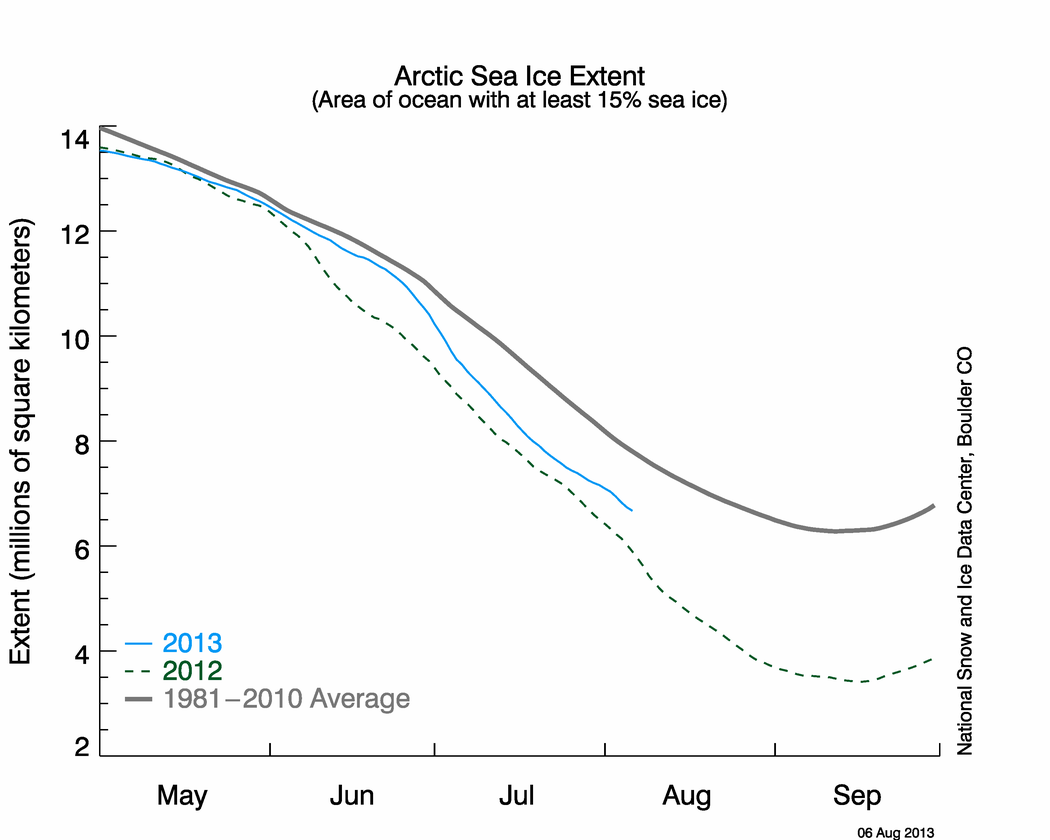
Since the melt season started, the Arctic has lost about one million km2 of sea ice. Below is a composite graph showing all of the popular (NSIDC, JAXA, NORSEX, DMI) extent measurements, superimposed on the NSIDC mean and two standard deviation region. The thin blue line is NSIDC extent from 2009. Note that all measurements have been nudging up against the mean line – for the entire month of April.


Disclaimer: All maps below are taken from NSIDC maps, and modified by the “breathtakingly ignorant” writers at WUWT.
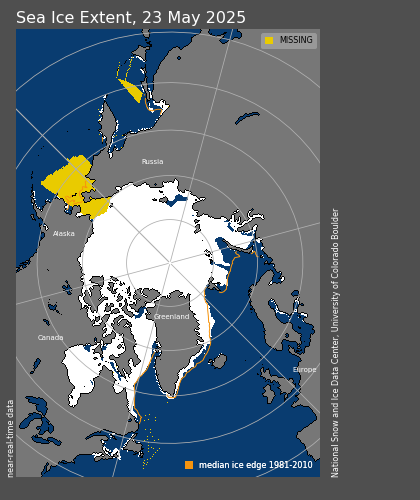
During the last three weeks ice has melted mainly at lower latitudes, as seen below in red. Areas in green have actually increased in extent, due to drift. Ice is probably still getting thicker in much of the Arctic, because temperatures remain well below freezing.

The map below shows changes over the past week.

And the map below shows changes since the same date in 2007. Green indicates ice growth.

The next map shows current areas of deficient ice (relative to the median) in red, and excess ice in green. The total amount of excess minus deficient ice is close to zero. In other words – Arctic ice extent is normal.

The Arctic Oscillation remains negative, so circulation is clockwise – as seen below in the buoy drift map. This pattern is keeping older, thicker ice from the Canadian side inside the Arctic Basin, and bodes well for another summer of increased ice thickness and extent – relative to the record melt of 2007.


http://iabp.apl.washington.edu/maps_daily_track-map.html
People counting on bad news from the Arctic to keep their agenda alive are staring at a long, (rhetorically) cold summer……. The good news is that they can keep raising the red flags about Montana glaciers, if the Arctic refuses to melt.
It has now been over 41 years since the New York Times headlined “Expert Says Arctic Ocean Will Soon Be an Open Sea.” triggering the Arctic Death Spiral. After 41 years of dangerous and increasing melt, ice area is again above normal.
My failure to understand this is surely a sign of “breathtaking ignorance.” But don’t call me Shirley.
“Leif Svalgaard”
Those extent numbers are for as low as 15% ice, or 85% water. You can easily have 15% ice coverage this time of year in some places as it is breaking up. Some might even still be coming out from rivers as their ice breaks up and washes downstream.
I like the header
http://wattsupwiththat.files.wordpress.com/2010/04/sea-ice-news-column-width.jpg?w=500&h=150
Peter Hessellund Sorensen says:
April 27, 2010 at 11:09 pm
Leif is right, there is NO ice in danish waters and temperatures are aproaching 15 degrees celcius. There has been NO ice in danish waters the last month at the least, I also noticed that satelites showed ice in danish waters in november and december, there was NO ice in danish waters in november as the temperatures here had not even dipped below freezing in noveber.
Does this have something to do with dinosaurs ? I’m thinking dinosaurs may be able to play the organ, but can they be trusted with satellites? Or, either they’re hedGing their betS, or someoNe hAsn’t got their modelS in sync.
stevengoddard says:
April 27, 2010 at 11:37 pm
Phil,
You cherry picked a six day period when the AO was positive. Nice picking.
http://www.cpc.noaa.gov/products/precip/CWlink/daily_ao_index/ao.sprd2.gif
Not really it’s been like that since the 7th.
As far as the open water goes, I suspect that you do understand the difference between a mechanical fracture (known as a “lead”) and melting?
I didn’t say it was melting, but it’s not getting thicker which is what you said.
Mark.R says: April 28, 2010 at 12:22 am
“Hi here you say that the air temp is -15c, is that in the shade or out in the sun ?.”
“Here when we get =5c and the sun is shining the forst in the sun shine still melts even tho it is -5c”
I assume =5 is Minus 5. Unless that was a submition for NASA:-)
Frost is not snow and snow is not ice.
At -15 c the snow squeeks it is so cold, have you ever been outside on a sunny day walking on squeeky snow? I’ve never noticed that is was melting or even damp, more like spakrles of unaltered crystals refeleting in the sun. But that just the snow, ice at -15 c is unlikely to be affected by sunlight low on the horizon. At -15 c even pouring rock salt on the ice has no real affect, in the full noon sun or in the shade.
-15 is cold.
@Leif Svalgaard
Take a look at http://www.seaice.dk. They are showing slight sea ice still in Denmark too. Although I do believe what can been seen as “a lot” of sea ice in Denmark from nsidc is due to less resolution i tight spots.
crosspatch: Those extent numbers are for as low as 15% ice, or 85% water. You can easily have 15% ice coverage this time of year in some places as it is breaking up. Some might even still be coming out from rivers as their ice breaks up and washes downstream.
No, there’s no way there is any trace of ice in danish waters now.
Relatively accurate, archived maps of the sea ice around Sweden are available at
http://www.smhi.se/vadret/hav-och-kust/Is-till-havs
If on the NSIDC map the white pixels around the Danish islands are supposed to indicate sea ice, then this is clearly a misidentification, probably by software algorithms that are automatically applied to the raw satellite data. One could simply exclude this difficult area (with a lot of coast lines in a small area) as never having sea ice, although, as the maps of the Swedish Meteorological and Hydrological Institute show, in the winter there were some small, globally negligible pockets of sea ice in Danish (and German) waters.
Mark.R says:
April 28, 2010 at 12:22 am
Hi here you say that the air temp is -15c, is that in the shade or out in the sun ?.The ice thats in the sun shine will be melting because the heat from the sun will be warmer than -15c as in the shade. Here when we get =5c and the sun is shining the forst in the sun shine still melts even tho it is -5c and the areas in the shade has on melting.So i would say that the green arears in the map above i would say would be areas that are shaded by hills or it has been clouder their.( sunnier summers at the poles mean more melt).
I have spent virtually all of my 60+ years of life in Minnesota and as a consequence have had the opportunity to witness more than a half century’s worth of Nature’s annual experiments in turning liquid H2O to solid and back again. Having lived through more days of 5F with bluebird skies than I care to tally, I’d say your estimates of the sun’s power to overwhelm temperature don’t match with my experience. Even at -5C the only melting that is likely to occur is in the snowplow windrows along the street that are virtually black.
Still looks pretty cold to me! I have a friend who has a friend who is apparently on a walking race to the NP. Not sure if that’s a good idea at this time of year. I will tap her for more info later – she’s just done the London Marathon at 48 so I will give her plenty of time to recover.
OT – The lovely Carol Kirkwood from the Met Office who presents the BBC tv weather from time to time, did a very interesting piece on last night’s BBC magazine prog called The One Show, all about a fascinating device designed to predict thunder storms by using leeches in glass tubes, sensing changes in atmospheric pressure. Apparently the leeches would emerge from their watery home & ascend a tube eventually rising to trigger a bell at the top. A replica of this wonderful piece of British engineering is based in Okehampton about 40 mins away from me. She let it all down though when she said that the Met Office still rely on the same basic principles for the weather forecasts today “which we all rely on”! Quote-unquote. Alas sadly she still believes the British people actually rely upon the Met Office’s forecasts! I am trying to find a clip on Youface on the interweb thingamajigy to post for general interest. BTW, Wednesday is supposed to be very hot as forecast from Monday evening! We shall see.
In re the phantom ice in Danish waters, here’s a note from the IJIS Sea Ice Extent graph page
In principle, SIC data could have errors of 10% at most, particularly for the area of thin sea ice seen around the edge of sea-ice cover and melted sea ice seen in summer. Also, SIC along coastal lines could also have errors due to sub-pixel contamination of land cover in an instantaneous field of view of AMSR-E data.
I take a swing around the UK daily papers on line each morning, mostly to see the ‘environment’ stories. The Times has ‘Wildlife disaster heralds silent summer’ and the Telegraph features ‘Rivers in England and Wales face drying out because of climate change. When one reads the latter article, one is unsurprised that the article is a desparate attempt to cast poor civic resource planning as being caused by ‘global warming’. The floods in England’s Midlands last year were largely caused by almost all local and regional authorities encouraging building on flood plains for many years; those authorities seem to have forgotton that flood plains have evolved through millennia of flooding and that covering them with concrete, asphalt and buildings might not be the smartest thing to do. When I arrived in the UK a few years ago, I was amazed at how little the authorities here seem to understand about weather – most of acquaintances here seem to think they experience really extreme weather, but I have been surprised at how mild and gentle the climate in South-East England is.
The Guardians’s enviro feature is on Rudd, the Aus PM, walking away from from his promises to bring carbon trading into law yesterday; the great majority of posters see this as a Good Thing, while less than a dozen warmists flail about attempting to defend carbon trading, giving me the distinct impression that the tide is turning in favour of healthy scepticism in the dear old ‘Grauniad’.
Sorry, Mods, forgot to add – No features about current Arctic (or Antarctic) ice.
mb says:
April 27, 2010 at 11:31 pm
kuhnkat> I only claim that at present there is no ice in the waters around Denmark. … It does make you wonder about the general accuracy of this method.
That my friend is the heart of (scientific) scepticism. There is real doubt about the methods being used to measure climate (particularly temperature – but that’s my subject), there are real doubts about the models and particularly the climate “multiplier” (aka fudge factor) and the so called affects of climatic change bear a striking resemblance to our (UK) politicians utterings on the fiscal deficit: “you can tell when they are lying …. because their lips are moving”.
As for the press describing WUWT as “polluting the bollocksphere” (joke – does that translate in US?) That’s just sour grapes from the old mainstream media whose dominance is being undermined by the far better and less partisan “bollocksphere”.
Leif Svalgaard — that map also shows “ice” in the Canadian southwest. It looks like their algorithm gets confused around busy shorelines. So Denmark will have ice south of Jutland all summer long!
It’s now possible to bet on a perpetual bone of contention: whether this year’s minimum arctic ice extent will be greater than last year’s. The rules are given here, and contain a link to the bet-page:
https://bb.intrade.com/intradeForum/posts/list/4474.page
Phil,
I liked the pictures contained in the link:
http://www.explorersweb.com/polar/news.php?id=19271
It shows the danger of camping on an ocean.
Leads can form even in the coldest weather. They occur because wind does not shift equally, over all places at the same time. When wind shifts to the east on one locale, while it still blows west at another, ice moves in opposite directions. It either parts, forming a lead, or it crunches together, forming a pressure ridge.
It would be very odd to have a pressure ridge form in the middle of your camp, in the middle of the night.
As I recall, one of the old pictures of a sub surfacing at the North Pole was taken in March, when ice is “at its thickest.”
Usually ice reforms in the open water between the two sides of the lead fairly quickly. If you look, you’ll notice the final picture in the link, at the very bottom, is of a interesting and rather lovely pattern the snow made, drifting over the fresh ice that formed on the lead.
I would like to see more studying done, concerning pressure ridges. If they stick up twenty feet, and if nine-tenths of an iceburg is under water, then a pressure ridge ought “stick down” one-hundred-eighty feet, shouldn’t it?
Having sailed on the Baltic for many years, ice never this late.
Looks sunny at the moment in Kieler Fjorde
http://www.kielmonitor.de/kameras.php?cam=laboe
Dave Springer; April 27, 2010 at 11:51 pm
No need to be alarmed about Global Cooling Dave, I can put your mind at rest. Our sceptic friend, Dr Roy Spencer (http://www.drroyspencer.com/) at the UAH has been recording global temperatures by satellite and has put up a handy web site showing figures since 1999 at various altitudes.
http://discover.itsc.uah.edu/amsutemps/execute.csh?amsutemps+002
In his monthly bulletins he usually quotes “channel 5” at 14,000 ft. Every month this year has so far been warmer than the hottest year in his record, 2005 (he does not show full data for 1998), so there is no break in the trend of ever rising temperatures. All “natural variability” of course!
http://img248.imageshack.us/img248/6189/satellitetemps2010.jpg
Just a note on the Danish ice issue. The maps are daily data, which I would take with a grain of salt. If there’s mistakes in the monthly data, then I’d let the folks at NSIDC know about it.
But..but…but….but….it’s…all…..rotten…..ice…..as my teeth chatter@-15C.
Leif Svalgaard says:
April 27, 2010 at 9:02 pm
Correct.
1. http://www.wetterzentrale.de/topkarten/fsdivka.html
http://www.wetterzentrale.de/pics/Reursnow.gif
Not correct (probably – gray areas around Baltic Sea)
1. http://iup.physik.uni-bremen.de:8084/amsr/regions.html
http://iup.physik.uni-bremen.de:8084/amsr/BalticSea_visual.png
It’d suffice to phone to any coastal town in Denmark and ask if they sea an ice. 😉
Best regards
There are strange things done in the midnight sun
By the men who moil for gold;
The Arctic trails have their secret tales
That would make your blood run cold;
The Northern Lights have seen queer sights,
But the queerest they ever did see
Was that night on the marge of Lake Lebarge
I cremated Sam McGee.
Now Sam McGee was from Tennessee, where the cotton blooms and blows.
Why he left his home in the South to roam ’round the Pole, God only knows.
He was always cold, but the land of gold seemed to hold him like a spell;
Though he’d often say in his homely way that he’d “sooner live in hell”.
On a Christmas Day we were mushing our way over the Dawson trail.
Talk of your cold! through the parka’s fold it stabbed like a driven nail.
If our eyes we’d close, then the lashes froze till sometimes we couldn’t see;
It wasn’t much fun, but the only one to whimper was Sam McGee.
And that very night, as we lay packed tight in our robes beneath the snow,
And the dogs were fed, and the stars o’erhead were dancing heel and toe,
He turned to me, and “Cap,” says he, “I’ll cash in this trip, I guess;
And if I do, I’m asking that you won’t refuse my last request.”
Well, he seemed so low that I couldn’t say no; then he says with a sort of moan:
“It’s the cursed cold, and it’s got right hold till I’m chilled clean through to the bone.
Yet ’tain’t being dead — it’s my awful dread of the icy grave that pains;
So I want you to swear that, foul or fair, you’ll cremate my last remains.”
A pal’s last need is a thing to heed, so I swore I would not fail;
And we started on at the streak of dawn; but God! he looked ghastly pale.
He crouched on the sleigh, and he raved all day of his home in Tennessee;
And before nightfall a corpse was all that was left of Sam McGee.
There wasn’t a breath in that land of death, and I hurried, horror-driven,
With a corpse half hid that I couldn’t get rid, because of a promise given;
It was lashed to the sleigh, and it seemed to say: “You may tax your brawn and brains,
But you promised true, and it’s up to you to cremate those last remains.”
Now a promise made is a debt unpaid, and the trail has its own stern code.
In the days to come, though my lips were dumb, in my heart how I cursed that load.
In the long, long night, by the lone firelight, while the huskies, round in a ring,
Howled out their woes to the homeless snows — O God! how I loathed the thing.
And every day that quiet clay seemed to heavy and heavier grow;
And on I went, though the dogs were spent and the grub was getting low;
The trail was bad, and I felt half mad, but I swore I would not give in;
And I’d often sing to the hateful thing, and it hearkened with a grin.
Till I came to the marge of Lake Lebarge, and a derelict there lay;
It was jammed in the ice, but I saw in a trice it was called the “Alice May”.
And I looked at it, and I thought a bit, and I looked at my frozen chum;
Then “Here”, said I, with a sudden cry, “is my cre-ma-tor-eum.”
Some planks I tore from the cabin floor, and I lit the boiler fire;
Some coal I found that was lying around, and I heaped the fuel higher;
The flames just soared, and the furnace roared — such a blaze you seldom see;
And I burrowed a hole in the glowing coal, and I stuffed in Sam McGee.
Then I made a hike, for I didn’t like to hear him sizzle so;
And the heavens scowled, and the huskies howled, and the wind began to blow.
It was icy cold, but the hot sweat rolled down my cheeks, and I don’t know why;
And the greasy smoke in an inky cloak went streaking down the sky.
I do not know how long in the snow I wrestled with grisly fear;
But the stars came out and they danced about ere again I ventured near;
I was sick with dread, but I bravely said: “I’ll just take a peep inside.
I guess he’s cooked, and it’s time I looked”;. . . then the door I opened wide.
And there sat Sam, looking cool and calm, in the heart of the furnace roar;
And he wore a smile you could see a mile, and he said: “Please close that door.
It’s fine in here, but I greatly fear you’ll let in the cold and storm —
Since I left Plumtree, down in Tennessee, it’s the first time I’ve been warm.”
There are strange things done in the midnight sun
By the men who moil for gold;
The Arctic trails have their secret tales
That would make your blood run cold;
The Northern Lights have seen queer sights,
But the queerest they ever did see
Was that night on the marge of Lake Lebarge
I cremated Sam McGee.
Robert Service
Has anybody told the Polar Bears about this if not why not
So far, at 10:55 hrs. cool, overcast, no sunshine at all! Mind you we should have had overnight rain on Saturday in Devon, it didn’t arrive until mid-afternoon!