By Steven Goddard

Break out the Speedos and Bikinis. Springtime has finally arrived in the Arctic!

Temperatures have risen about 15C, and are now averaging a balmy -15C (5F) north of latitude 80N – with sunshine 24 hours a day. Under those conditions, you can get frostbite and a tan at the same time.

http://ocean.dmi.dk/arctic/meant80n.uk.php
But despite the balmy weather, NORSEX ice area continues to run above the 1979-2006 mean – as it has for the entire month of April.

http://arctic-roos.org/observations/satellite-data/sea-ice/observation_images/ssmi1_ice_area.png

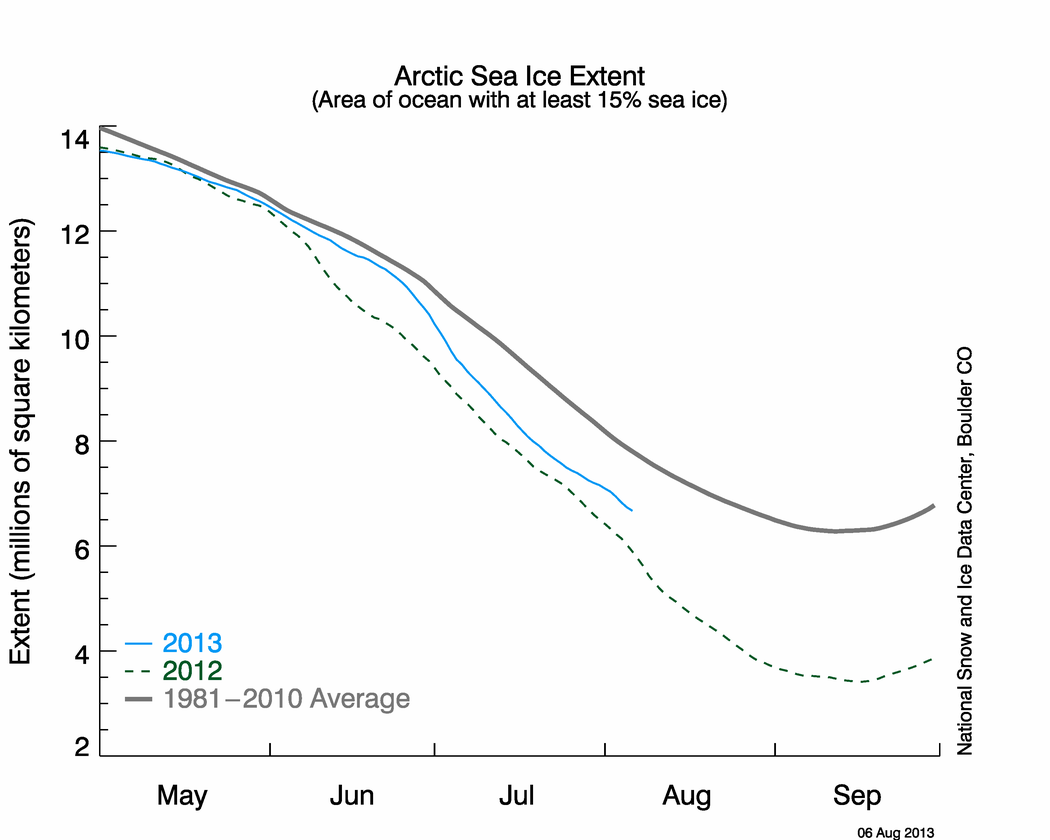
Since the melt season started, the Arctic has lost about one million km2 of sea ice. Below is a composite graph showing all of the popular (NSIDC, JAXA, NORSEX, DMI) extent measurements, superimposed on the NSIDC mean and two standard deviation region. The thin blue line is NSIDC extent from 2009. Note that all measurements have been nudging up against the mean line – for the entire month of April.


Disclaimer: All maps below are taken from NSIDC maps, and modified by the “breathtakingly ignorant” writers at WUWT.
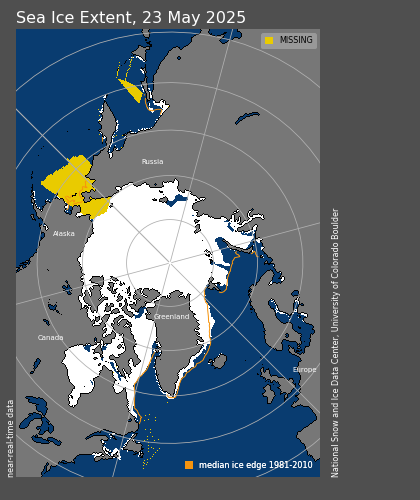
During the last three weeks ice has melted mainly at lower latitudes, as seen below in red. Areas in green have actually increased in extent, due to drift. Ice is probably still getting thicker in much of the Arctic, because temperatures remain well below freezing.

The map below shows changes over the past week.

And the map below shows changes since the same date in 2007. Green indicates ice growth.

The next map shows current areas of deficient ice (relative to the median) in red, and excess ice in green. The total amount of excess minus deficient ice is close to zero. In other words – Arctic ice extent is normal.

The Arctic Oscillation remains negative, so circulation is clockwise – as seen below in the buoy drift map. This pattern is keeping older, thicker ice from the Canadian side inside the Arctic Basin, and bodes well for another summer of increased ice thickness and extent – relative to the record melt of 2007.


http://iabp.apl.washington.edu/maps_daily_track-map.html
People counting on bad news from the Arctic to keep their agenda alive are staring at a long, (rhetorically) cold summer……. The good news is that they can keep raising the red flags about Montana glaciers, if the Arctic refuses to melt.
It has now been over 41 years since the New York Times headlined “Expert Says Arctic Ocean Will Soon Be an Open Sea.” triggering the Arctic Death Spiral. After 41 years of dangerous and increasing melt, ice area is again above normal.
My failure to understand this is surely a sign of “breathtaking ignorance.” But don’t call me Shirley.
WHOOPS, SORRY correcting formatting error above.
Concerning the Guardian photo reportedly at Longyearbyen Norway, there are a few things to note, in addition to the clouds, quoting George E Smith, April 28, 2010 at 9:58 am :
* Latitude is at 78 degrees 13
* It has been cold there this April according to this, per Google.
* The shadows suggest the photo might have been taken at around solstice (21 June) maybe last year, when sun elevation was 35.3 degrees at midday, according to this.
From the same source, the elevation would be around 22 degrees at midday in mid April.
* The lady in particular has not much of a tan, and she may become fairly numb in some parts before she does?
Stevengoddard, you wrote April 28, 2010 at 10:59 pm
By coincidence, I recently wrote this over at Bart Verheggen’s site:
Far more important I think is that solar energy is very much less up there, and even at 45 degrees latitude it is nominally 41% less per unit area at year average. So why does not Milan at 45 degrees or London at 51 degrees get really really cold with such a massive reduction of energy from the sun? Well, put simply, mostly because of heat transfer from the low latitudes from airflow and ocean currents.
It makes me smile when I hear of alarming albedo feedback forcing when perennial ice and snow melts, despite that solar energy is massively lower in those regions. Also, the albedo of water at high latitudes approaches that of old snow because of low solar zenith reflection. (check it out at sunset over water)
Oh, and also, whilst there may be some offset from scattering, not only is there a reduction of solar energy per unit area, but it has a much longer path through the atmosphere.
If we take Longyearbyen, Norway, at 78:13 degrees latitude, some relevant data for September are, according to this:
1 Sep 2010~~~ Length of day: 18h 38m~~~ Midday sun elevation: 20.1°
30 Sep 2010~~ Length of day: 10h 42m~~~ Midday sun elevation: 9.0°
stevengoddard says:
April 29, 2010 at 8:43 am
Steve, again you seem to be missing the point. It is during the summer months (i.e. June-August) that the ocean is absorbing more solar energy than it used to because there is less summer sea ice than there used to be. Thus, by the time September comes, the oceans have warmed and have to release that heat before the ice can once again reform. That is the ice albedo feedback that contributes to autumn warming (the arctic amplification). Why don’t you look at the SST anomalies for the last several years from MODIS and you will see for yourself this affect.
And Rob_FJ…of course by September there is very little solar input, that is why the ice starts to form again sometime in September.
One of the things that irritates me most about AGW climatologists is their superiority attitude because they have a degree in book learnin’. As a rancher and one time field/frozen food plant worker, a warming climate is VERY important to me, as is a cooling climate. It tells farmers whether or not to plant peas, corn, or wheat. Or to calve in the fall or spring. Or bite the big one and plant a vineyard. Why? A producing field that ends up not producing, or a cow that loses its calf to cold, is a year without income. Try eating for a year without income. A farmer needs to know the trends in detail, year to year, and decade to decade. Those that troll the seas in search of salmon must do the same. Years of plenty must be understood as being years when profit must be salted away for the lean years or decade(s).
Bottom line, anyone worth a damn in agriculture or in the fishing industry knows FAR more about weather pattern variations than any climatologist can learn spending years with their nose in books. When putting food on the table or not is the outcome, suddenly arm-chair scientists getting a peer reviewed paper in a journal doesn’t mean squat. And therein lies the problem with most uppity AGW scientists. Someone else puts food on their table, not by the sweat of their own brow, so why worry about getting it right?
Roger Knights: April 29, 2010 at 4:21 pm
Point accepted on adding appropriate caveats. With respect to claims that the ocean is warming/cooling/neither I would encourage interested readers to search for “ocean heat content”, “ocean warming” etc and read around the topic for a while. Later papers are often improvements on older papers but not always. New instrumentation is sometimes shown to be faulty and so forth. My reading indicates the ocean is heating (though not monotonically). SkepticalScience has a straightforward presentation on the topic:
Louis6439: April 29, 2010 at 11:24 am
For up to date information it is worth looking at this site which shows the satellite data and how variable sea level rise can be.
http://www.climate4you.com/SeaTemperatures.htm#Global sea level
Overall since the satellite record started sea levels are rising at around 3.5mm a year.
It seems to change in direct relationship to temperature – in other words it is acting as a global ocean thermometer. It seems blindingly obvious when you think about it. As the sea warms, it expands. It is not really possible for the sea to cool and expand. In other words if you want to see the trend in global ocean heat content, look at the sea level. Good paper here:
http://www.pnas.org/content/106/51/21527.full.pdf
Ammonite; April 29, 2010 at 5:15 pm
Very good post and one that has been bugging me recently. I think we are on a “losing wicket” here (as we say in England) because the way the average reader of this site’s mind seems to work is as follows:
1. The temperature records are false so it is probably not warming
2. Even if it is proved the earth is warming it is not very much because positive feedback is exaggerated
3. Even if it is proved that the temperatures are rising as fast as predicted, there is no proof that it is caused by CO2. It is all natural, and therefore there is nothing we can do about it.
4. Even if it is proved that temperatures are rising and that it is caused by CO2, global warming is good for man rather than bad.
In other words it appears to be possible to hold 4 very different positions on the argument simultaneously. It is very difficult to pin down anybody here on what they actually think is true.
Point 3 is hauled out to trump anybody pointing out pro AGW evidence. It is impossible to completely counter point 3 because of course there are natural variabilities in the Earth’s climate and it is very difficult to prove the change is not natural because it is almost impossible to prove a negative.
All we can do is repeat the “fingerprints” of greenhouse gas forced temperature rises that make it different to naturally forced temperature rises.
– more warming at higher than lower latitudes
– more warming during the night than during the day
– more warming in the troposphere than the stratosphere (and in the case of CO2 the stratosphere can cool while the troposphere is warming).
All these effects are currently being seen.
Individually, there are other possible causes for each of these effects, however the chances of all of them having alternative causes is pretty low, and taken together they make a pretty compelling case for greenhouse gas forced warming.
Natural forcings tend to affect all temperatures roughly equally, high and low latitudes, night and day, upper and lower atmosphere.
I have even seen an article on this web site that said that the above “fingerprints” are all good anyway – a few warm nights and a warmer Arctic can’t harm can they? And this was from a guy who vociferously argues elsewhere that AGW is not happening! Now either isn’t happening, or it is happening and it is good – you cannot honestly hold both views at the same time.
However if somebody is absolutely determined not to agree with the scientific evidence of AGW then it is very difficult to persuade them otherwise. It is a bit like trying to turn a Democrat into a Republican or vice versa. Occasionally it does happen – but it is a rare event.
I started out as a sceptic as that is my general disposition. But I have gradually over the last couple of years, after reading the science, come to the view that AGW is a real threat. Mind you I was always a “floating voter” and open minded. Many of those here have resolutely closed minds.
I still have my issues with “alarmism” (particularly in the media and politics) and the over-attribution of every natural anomaly to global warming. However I think the weight of scientific evidence that AGW is happening is compelling if you look at it as a whole and are not prepared to hold four conflicting views simultaneously.
TLM…I completely agree with what you said.
It is unfortunate that the media has spent so much time with alarmism journaling. Most scientists are actually quite conservative and they are not alarmists. They realize that there is so much about the climate system that remains poorly known or poorly modeled, so they can’t yet say with confidence what an Arctic Ocean ice free in summers will mean for the rest of the world for example. So they work hard on furthering their understanding of all the physical processes, the feedbacks that may either accelerate or stabilize the climate, etc.
Most counters I find on this site either focus on statistics w/out an understanding of the physical processes (and no scientist could publish results based on statistics such as CO2 is highly correlated to September ice extent), yet those opposed to believing human activities affect climate use statistics regularly to try to make their point. That is poor science at best.
Ammonite says:
April 29, 2010 at 5:15 pm
“Alarmists have simply decided that CO2″ could be re-phrased as “scientists in disparate fields have gathered evidence that CO2…”
Nice spin. If only it were true. Sadly, what has happened is that the scientific process has been subverted, and climate “scientists” have become little more than paid shills for CAGW/CC ideology. Once aboard the CAGW/CC gravy train, it’s all about keeping the grant money rolling in, the paychecks coming, and protecting reputations and stroking egos. The science goes out the window, and actually becomes the enemy.
The truth is that the evidence for C02-induced climate change is incredibly weak, and that for human-generated C02 so weak as to be non-existent.
Ice situation in Baltic Sea and surroundings here: http://www.smhi.se/oceanografi/istjanst/produkter/sstcolor.pdf
SMHI forecasts ice out in Gulf of Bothnia (up North) at the end of May
TLM, April 30, 2010 at 4:05 am:
“I started out as a sceptic as that is my general disposition. But I have gradually over the last couple of years, after reading the science, come to the view that AGW is a real threat.”
Your comments have never reflected honest scientific skepticism.
Skepticism is at the heart of the scientific method. If you are skeptical of anything, be skeptical of the null hypothesis: the long established theory that the climate naturally fluctuates within its long term parameters. If you can falsify that hypothesis, the door is then open to a new hypothesis, such as the [repeatedly falsified] hypothesis that human emitted CO2 causes catastrophic global warming. The current, mild global warming is simply a function of multi-decadal cycles, riding on the rise due to the planet’s emergence from the LIA.
You must falsify the null hypothesis before coming up with weak new hypotheses that cannot withstand falsification. Steven Goddard, Willis and many others have tried to educate you, to no avail. Your mind is made up: AGW is gonna get us all.
I will stick with the null hypothesis, unless it is falsified. But so far it has withstood all attacks. That is how scientific theories are arrived at: the original null hypothesis can not be falsified, and so becomes the accepted theory.
In the mean time, planet Earth herself laughs at the hubris of the CAGW contingent.
hmmm…Arctic sea-ice extent for 2010 finally caught up with the mean!
http://nsidc.org/data/seaice_index/images/daily_images/N_stddev_timeseries.png
jeff brown wrote April 29, 2010 at 8:50 pm
Jeff, your item [1] does not seem to support your item [2] to me …. Is not August still summer, and September the real start of Autumn? (in England I seem to remember)
Here is my hand drawn overlay graph showing the monthly solar elevations at MIDDAY at latitude 78:13, (Longyearbyen, Norway). This is strong evidence that solar energy is of minor significance compared with the other complex drivers.
Perhaps my, may assist concerning albedos etc, upon a re-read?
Bob_FJ says:
April 30, 2010 at 6:22 pm
Bob I don’t think you understand that the ocean is absorbing the sun’s energy ALL summer. It is not until the air temperatures become colder than the ocean temperatures in autumn that the ocean releases its heat back to the atmosphere. It’s elementary physics.
Smokey says:
April 30, 2010 at 1:26 pm
The null hypothesis is proved to be wrong with the CO2 record that for the last several million years that shows the CO2 amounts today are outside the range of natural variability. And I’m not talking about when CO2 levels were higher than today when the continents were in different places. Let’s compare CO2 levels when when the land masses are where they are today and CO2 levels are way outside the range of natural variability.
ALL: Coming back to the lead Guardian photo of “sunbathers”, the caption reads:
There are a bunch of webcams at Longyearbyen and nearby, and here are a few:
View 1 Midday
View 2 Midday
View 2; 8:00 am
The mountain on the left in the latter view looks similar to me to that in the Guardian shot These views as of yesterday were all cloudy, but presumably change daily on the webcam.
I guess it is typical of journalistic accuracy that Longyearbyen is on one of the islands of the Svalbard Archipelago in a substantial inlet, rather than a fjord.
TLM, Reur April 30, 2010 at 4:05 am:
Gee, that’s something I don’t recall seeing before. It’s usually the other way around as far as I know!
A classic example is Peter Taylor; author of the Book “Chill” about AGW science. He has a long experience as an environmental scientist working for governments and NGO’s, but is now unpopular with some ex colleagues.
I recommend you read his book which is available from Amazon. (404 pages)
He clarifies some of the dopey science such as MBH 99 and some stuff in the IPCC reports
jeff you wrote April 30, 2010 at 9:48 pm:
Sorry Jeff, but the topic is about the sea-ice area annual cycle and whatever happens in the atmosphere is secondary.
However, if you are implying that because the air gets colder in Autumn, it will be heated by the warmer ocean, (per thermo’ law 2), then if it would be significant in effect, the process would become self defeating. More essentially, the sea-ice area increases at that time, (whilst the supposed “summer-trapped-heat” is being released), and whilst also, according to the season, the air continues to get colder.
In the composite graph that I showed earlier, I’ve now highlighted some text in yellow. Jeff, please study that text, and if there is anything you disagree with, please let me know.
BTW, the dynamics of the suggested Autumn warming you mention are quite complex what with three basic heat loss processes to consider, thermohaline circulations, oceanic oscillations like the AMO, wind, and whatnot.
Oh, and notice that the monthly sun elevation at 78:13 north is plotted at midday. I’ll make a wild GUESS that summer day average is no more than 20 degrees*, which would translate to the solar constant being spread over a unit surface area about 3 times larger than normal**. In addition it has to battle through almost 3x the normal atmospheric depth. (compare the sun’s strength in your region whilst sunset approaches)
*Cosecant = 2.923; ** as in 90 degrees
Bob_FJ says:
May 1, 2010 at 3:26 pm
Bob, I think I will chime in now. As the sun comes up in the Arctic, solar energy is absorbed by the surface. Snow starts to melt off the ice, and eventually the summer melt season is fully underway resulting in substantial surface melt, and the formation of melt ponds. Areas that have melted out, either because of solar input, warm ocean temperatures, or advection because of winds expose the ocean to the solar input. The ocean absorbs more of the sun’s energy than the ice, so it warms up in the ocean mixed layer. It doesn’t mix with the deeper ocean layers. Then in autumn, when the sun starts to go down, the solar input is much reduced. Air temperatures fall below that of the ocean. So now the ocean starts to cool down. In order for it to do that, it must lose the heat it gained during summer. Where does that heat go? Observations show that heat goes back into the atmosphere in autumn. Steve Goddard posted on another blog all the trends in air temperature in the Arctic as a function of month. You can see clearly that all months and all seasons show warming trends. But the warming trends are strongest in August. Evaluation of fluxes of latent and sensible heat content reveal large transfers from the surface to the atmosphere in autumn. This sensible and latent heat transfer would mean warming of the overlying air. So while the autumn air temperatures do get colder than summer, that cooling is partially offset by the ocean releasing heat back to the atmosphere.
Ask yourself this. If you don’t believe the ocean is giving it’s heat back to the atmosphere is it refreezes, where else does it go? Do you have some observational evidence showing it goes someplace else? Because it has to go someplace right?
Wildred, You wrote in part in your May 1, 2010 at 7:22 pm
[1] Yes, but the topic is: the annual cycle of sea-ice area, which increases in Autumn, despite that there is some heat release to the atmosphere from the diminishing ocean.
[2] There is plenty of observational evidence that the complex dynamics of the ocean result in internal heat transport over vast distances and in turn-overs. To verify, I suggest you Google ‘thermohaline circulation’ for a start.
I’ve highlighted some text in yellow in the composite graph that I showed earlier. Widred, please study that text, and if there is anything you disagree with, please let me know.
Ghost of Jim Cooley
Fresh water ice at 0C has a density of about 917 kg/m3. That’s because the density of water decreases continuously from 4C to freezing. After the water freezes, teh density starts increasing again. If 1m3 of freshwater ice at 0C is floating, it will displace (Archimedes Principle) 917kg of whatever it is floating in. If that is saltwater with a density of 1.025 (1,025 kg/m3), then it will displace 917/1025 = 0.895 m3 of saltwater (whose mass is 917 kg). When it melts, the 917 kg of ice will turn into 1 m3 of water at 0C, but its mass still will be 917 kg.
There will be no increase or decrease in sea volume provided the ice was formed originally from sea water – what was taken away is given back.