From UCSB News: (h/t to David Schnare) UCSB Geologist Discovers Pattern in Earth’s Long-Term Climate Record

| Lorraine Lisiecki |
||
 |
||
 |
||
|
|
||
(Santa Barbara, Calif.) –– In an analysis of the past 1.2 million years, UC Santa Barbara geologist Lorraine Lisiecki discovered a pattern that connects the regular changes of the Earth’s orbital cycle to changes in the Earth’s climate. The finding is reported in this week’s issue of the scientific journal Nature Geoscience.
Lisiecki performed her analysis of climate by examining ocean sediment cores. These cores come from 57 locations around the world. By analyzing sediments, scientists are able to chart the Earth’s climate for millions of years in the past. Lisiecki’s contribution is the linking of the climate record to the history of the Earth’s orbit.
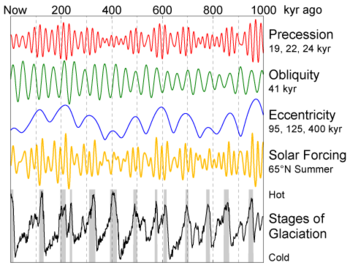
It is known that the Earth’s orbit around the sun changes shape every 100,000 years. The orbit becomes either more round or more elliptical at these intervals. The shape of the orbit is known as its “eccentricity.” A related aspect is the 41,000-year cycle in the tilt of the Earth’s axis.
Glaciation of the Earth also occurs every 100,000 years. Lisiecki found that the timing of changes in climate and eccentricity coincided. “The clear correlation between the timing of the change in orbit and the change in the Earth’s climate is strong evidence of a link between the two,” said Lisiecki. “It is unlikely that these events would not be related to one another.”
Besides finding a link between change in the shape of the orbit and the onset of glaciation, Lisiecki found a surprising correlation. She discovered that the largest glacial cycles occurred during the weakest changes in the eccentricity of Earth’s orbit –– and vice versa. She found that the stronger changes in the Earth’s orbit correlated to weaker changes in climate. “This may mean that the Earth’s climate has internal instability in addition to sensitivity to changes in the orbit,” said Lisiecki.
She concludes that the pattern of climate change over the past million years likely involves complicated interactions between different parts of the climate system, as well as three different orbital systems. The first two orbital systems are the orbit’s eccentricity, and tilt. The third is “precession,” or a change in the orientation of the rotation axis.
###
Rant on:
re: sniping about “we know that already so this is not news”
There is much to learn about the specifics related to the cycles. This researcher understands the process of narrowing the topic. Yes the cycles are known. But not all that well known. Just because it has a name that is hard to spell doesn’t mean that everything is known about it.
I had the same criticism leveled at my research. Yes many drugs are known to cause hearing loss and kidney damage so why bother with understanding the specificity of the hearing mechanism to tone bursts delivered while the patient naps? Who cares?
Ever been sick? Take naps? Be unconscious getting hearing-toxic drugs pumped into your system? Ever wonder if hearing loss is a precursor to kidney loss (read up on how these two systems are connected “in-utero”)? For me, I would want to know whether or not the sensitivity of the hearing mechanism predicts kidney damage. You can live well without your hearing. Can’t live well without your kidneys.
Ask my mom. Oh. You can’t. She died. Antibiotic drugs destroyed her hearing in her teen years then destroyed what was left of her kidneys in her 40’s. With kidney failure comes an enlarged heart. She died of an enlarged heart in her 50’s. Had they been monitoring very specific frequencies of hearing, they might have noticed hearing loss and changed her antibiotics to less kidney damaging ones.
Knowing the detailed specifics is important. Ya got my hen-feathers ruffled!
Rant off.
The results of the paper might not be news to some of us here, but hey, the corroboration of a theory has value.
George E. Smith (17:26:29) :
“”” jack mosevich (15:19:46) :
AlexB(14:22:48):
You guys are all interesting. Alex, I agree. The negative feedback is probably unwarranted. No, this isn’t new, really. But it’s nice to see reaffirmation of what we’ve already assumed was true. Further, it is new material for some people. That is a positive as far as I concerned.
It speaks volumes to the people worried about what we should do about our current condition. It seems we’ve been here before. What did we do the last time? Nothing? Probably the standard with which we should work from.
As far as solving climate problems, let’s first establish that there is a “climate problem”. Lisiecki’s findings seem to indicate that there isn’t one, or at least it is possible that there isn’t one. It may very well be that there isn’t anything to “solve”.
I’ve heard, my entire life, that we’re using so much fossil fuels, that we’ll run out shortly. If that proposition is true, then will not anthropological CO2 emissions diminish significantly anyway? I find the CAGW theory to be a self-defeating circular argument that shouldn’t be worthy of any consideration at all, except the people that worry about it are insisting that I participate in the madness……………unless, WE ALL DROWN BEFORE THE OIL RUNS OUT!!!! OMG WE’RE ALL GOING TO DIE!!!! WE’RE ALL GOING TO DIE!!!!
As a scientist of 40+ years, I have been looking at earth’s very complicated picture, and I keep seeing amazing buffer systems at work. That is why we have such low correlation coefficients with each hypothesis, since climate is so multivalent with polynomial high order equations operating. Feedback systems suppress any great pitch or yaw created by any singular event. Here are some of these buffers, but it is a great exercise to think of many others:
1) Ocean heat storage system (oscillators) – these operate to redistribute regional heat storage and thereby stabilize the whole
2) Water triple point – because of water’s tremendous heat capacities between phases, heat is sequestered or released accordingly. Because water as ice floats, it reflects irradiance. As it crystallizes, it has a high latent heat of crystallization that grabs more heat than other compounds would. When it evaporates from water phase, it cools the system, etc.
3) Tectonics – the earth’s mantle is very thin and hard. It is orders of magnitude thinner with respect to the total volume of the earth than an eggshell is to an egg, e.g. Any cooling makes the mantle contract, sliding plates together faster (producing earthquakes as a side effect). In a warming phase, the plates pull apart allowing magma to rise more easily and form volcanoes, which release aerosols which cool the earth back down. [I haven’t heard this buffer discussed before, so I present it as hypothesis here]
4) Atmosphere – CO2, O3, H2O, NOx, CH4, HCl and CxClx all have different absorptive effects which modulate acute swings in the temperature. Each of these gases, and others, are part of an exquisite buffer system.
5) Magnetic field – the earth’s field modulates the effect of cosmic ray bombardment, by switching polarity in cycles.
6) Algae and plants absorb CO2 when plentiful and proliferate, marine organisms precipitate the CO2 until the plates tuck under, and vulcanism releases the CO2 back. When CO2 is low (like today), plants grow slower and absorb less.
7) When solar or galactic events change, the system changes to interact and cope.
These are just the “tip of the iceberg”, to make a pun.
Such an amazing system has many weapons to stave off man’s puny efforts to perturb her. Almost like it was designed that way.
She’s saying the position and movement of the Earth relative to the Sun affects the climate? That is the sort of nonsense they tried to teach me at school.
Fortunately, I have now seen the light, and I know that the climate depends on how much CO2 filled foam I have on my beer.
“…she never heard of Milankovitch…” ??? Doesn’t anyone here read the provided links? This is from a link posted very early on in the discussion:
• Mid-depth Δδ13C has a different phase with respect to
Milankovitch forcing and ice volume at each orbital frequency.
• Our results are inconsistent with the SPECMAP hypothesis that
Milankovitch forcing drives the same sequence of circulation
response at each frequency.
(From the Conclusions section of the linked paper).
So blah-blah nothing new?? Yeah, this is new, and it’s interesting, and -just a wild guess- I’m betting she knows more about Milankovitch cycles via working through the math than some of those wondering if she’s ever heard of it.
Does anybody here know the year we are going to drop over that edge into another glacial period?
You want to trust R. Gates 50,000 – 130,000 years-from-now blind guess above. I’m very much like Pamela’s comment, all research efforts in real true science is welcomed, it was offered as research, I felt no agendal threat to my life or lifestyle from her paper. Who knows, Lorraine might be the one who brings us that date someday.
he found that the stronger changes in the Earth’s orbit correlated to weaker changes in climate. “This may mean that the Earth’s climate has internal instability in addition to sensitivity to changes in the orbit,” said Lisiecki.
In other words, she has no clue what it means.
Last I heard, this blog was about “puzzling things in life, nature, science, weather, climate change, technology, and recent news” (see the header).
Clearly the paper in question did not address “the next 100 years of earth climate changes”; that wasn’t the subject. The climate history of the ancient Earth is a fascinating topic in its own right. If anything, I suspect that the vast resources poured into contemporary ‘climate change’ studies have diverted precious funds from this kind of basic science.
It is astonishing to hear so erudite a scientist-engineer as George E. Smith denigrating pure science, simply because it has no immediate application to the mostly political and ideological kerfuffle over ‘global warming’.
I think Dennis Nikols (15:42:22) has it right:
Right on! And so is Pamela Gray (18:33:27), who drives the point home in a dramatic, but sad, way.
/Mr Lynn
The geological record (ice cores and fossil reefs) has always been a stumbling block for the alarmists. We’re living in “icehouse” era conditions presently, less than a few thousand years before reverting back to full-scale glaciation, and the alarmists are worried about 1-2 degrees C. Sheesh!
http://en.wikipedia.org/wiki/Geologic_temperature_record
bubbagyro (18:53:54) : ………….(great stuff)………..Such an amazing system has many weapons to stave off man’s puny efforts to perturb her. Almost like it was designed that way.
And now maybe when “Lisiecki found a surprising correlation. She discovered that the largest glacial cycles occurred during the weakest changes in the eccentricity of Earth’s orbit –– and vice versa.”, we can add that to the list of dynamics that regulate our climate, almost like it was designed. Weird.
Tectonics and aerosols, hmmm…..
Although there’s a line for “Solar Forcing” shown, I don’t see any incorporation of techtonic plate movements. There’s been significant movement over a million years, which not only change the surface albedo, but perhaps more significantly, the ocean currents.
Then there’s a complication like ice ages which cover some of the surface with white stuff, freezing a lot of water, lowering sea levels and exposing more land near the Equator. “Data” as to the location of the plates, the extent of the ice and sea levels over much of the period covered, are at best; educated guesses with large degrees of uncertainty.
We observe that there are substantial differences in the response of the climate system to perturbations between northern and southern hemispheres. The response appears to be greater than that expected out of orbital eccentricity. The distribution of land, sea and ice are “chief suspects” to help to explain why this is so.
As the author of this study, I would like to clarify a couple points.
(1) This study specifically deals with the last million years. It does not include any analysis of the warming trend of the last century, which is much faster than changes that would be produced by slow changes in Earth’s orbit over tens of thousands of years. The current changes in orbit would be expected to cause gradual cooling over the next ~90,000 years.
(2) The new results in this study are finding (a) a statistically significant correlation between climate and eccentricity specifically and (b) a negative correlation in the strength of the cycles. This suggests that the primary reason we have 100,000-yr glacial cycles is internal instability within the climate system. Eccentricity appears to affect the timing of these changes and (in some cases) weaken them.
REPLY: Ms. Lisiecki, thank you for taking the time to comment here and to add additional insights. – Anthony Watts
Why publish such speculative nonsense? 1.2 million years? How stupid are we becoming that we think we can extrapolate our knowledge to such ridiculous boundaries? We can’t even predict next weeks’s weather, nor even accuratley recall weather data from a mere thirty years ago.
If this sedimentation theory can be passed off as science then we need to leave science to childrens’ story writers, and come up with a new name for the genuine practice of experimental observation.
B. Smith (12:40:22) :
tty (12:00:43) :
And this is supposed to be NEWS? Hasn’t she ever heard of the Milankovich curve?
____________________________________________________________________
“Lisiecki’s contribution is the linking of the climate record to the history of the Earth’s orbit.”
There are assumptions and theory, but nothing beats having empirical, duplicable hard data to back up assumptions and theory.
REPLY:
I did not read all the comments but here is a very old article on the first confirmation of Milankovich cycles using seabed cores: http://corior.blogspot.com/2006/02/part-15-ice-ages-confirmed.html
” In the spring of 1971, as part of the International Decade of Ocean Exploration, a group of scientists and researchers organized a series of studies known as CLIMAP — the Climate Long Range Investigation, Mapping and Prediction project. One of their first missions was to analyze sea cores and deduce the climate changes that have taken place during the 700,000-year Brunhes Epoch.
To achieve the goal, investigators needed a core rich in forams that could be analyzed for oxygen isotopes. In December, CLIMAP scientists located such a specimen — it had been raised from the western Pacific early in the year — and after confirming that it dated back beyond the magnetic reversal that marked the start of the Brunhes Epoch, they shipped samples of the core to Nicholas Shackleton at Cambridge University.
Shackleton, an expert at analyzing the isotopic contents of marine fossils, studied the core samples and plotted two isotopic curves, one showing the ratio of light and heavy oxygen isotopes in the remains of surface-dwelling forams, and the other plotting isotopic variations in forams that lived on the sea floor. If, as Cesare Emiliani had theorized some years earlier, the proportion of oxygen isotopes in marine fossils is governed by sea temperatures, the second curve should have shown much smaller deviations than the first: No matter what the climate, the temperature of the water at the bottom of the ocean remains close to freezing. In fact, as Shackleton showed the CLIMAP team in mid-1972, the two isotopic curves were nearly identical……
In January 1973, Hays located a core in the Lamont collection that seemed to meet his requirements. Core RC11-120 had been raised from the southern Indian Ocean six years earlier by Geoffrey Dickson aboard the Robert Conrad. After counting the radiolaria and sending samples to Shackleton for isotopic analysis, Hays was gratified to find that the deposition rate was high enough for his purposes (three millimeters per century). When the data were plotted, the answer to Croll’s question was immediately apparent: climatic changes in the northern hemisphere were essentially synchronous with those of the southern hemisphere. Although this result alone was important enough to justify his efforts, Hays was disappointed to find that the core only extended back about 300,000 years, to the base of Stage 9 in Emiliani’s isotopic scheme. To provide a suitable record for spectral analysis, a core extending back at least 400,000 years would be needed.
When it became clear that the needle Hays was looking for was not to be found in the Lamont haystack, he decided to search elsewhere. In July, he went to Florida State University in Tallahassee, where an extensive collection of Antarctic cores was maintained. There, he continued the search for cores taken near the site of RC11-120. Soon he came upon several cores taken by Norman Watkins aboard the Eltanin in 1971. With the assistance of two graduate students, Hays began to open the Watkins cores. Later he would recall: “The cores were kept in cold storage, and we were all shivering in our parkas. But when core E49-18 was opened, we stopped shivering. I knew right away we had something interesting because the color-banding matched perfectly with the oscillations in Shackleton’s oxygen curve for V23-238.” Counting down, Hays found that the core extended to Stage 13 — giving it an age of 450,000 years. He had found his needle at last.”
Lisiecki is adding knowledge to the 1973 break through, and more importantly bringing this theory back in front of the mass media’s attention.
“the stronger changes in the Earth’s orbit correlated to weaker changes in climate.”
Uh oh… I guess that means the weaker orbital changes correlated to stronger climate changes? Take another look at that graph… look at the left side (the present). The earth’s orbit just had one of the weakest eccentricity spikes on record (spikes in eccentricity often precede glaciation). The gun is cocked… and I happen to have a theory as to what kind of rare event pulls the trigger. In such an event, the harshest cooling (~17 degrees Celsius globally) would occur the very year after the event, with gradual (~10 yr.) rise back to near-Maunder temperatures (3 degrees Celsius below normal) afterward. HOWEVER… Add in two low solar cycles just after the catastrophic event and you get less rise over that decade, and Arctic freezing coupled with increased cloud formation ala Svensmark would essentially prevent much temperature rise after that decade is over. My only hint as to what event I am talking about is this link.
http://www.seis.utah.edu/req2webdir/recenteqs/Maps/Yellowstone.html
THIS HAS NOTHING TO DO WITH THE MAYAN CALENDAR, SO DON’T ASK!!!
scienceofdoom (16:46:39) :
RockyRoad:
CO2 trails the inception of a glacial epoch by ~ 800 years, and 100,000 years later, CO2 also trails the inception of the thawing interglacial. How on earth does that not destroy any theory that CO2 causes AGW?
The answer is a simple one.
All other things being equal, a warmer climate leads to less CO2 being able to be stored in the oceans. Therefore, more CO2 in the atmosphere.
More at CO2 Lags Temperature in the Ice-Core Record. Doesn’t that prove the IPCC wrong?
Increases in CO2 also cause more “radiative forcing” at the earth’s surface (and throughout the troposphere).
Therefore CO2 increases can be a cause of temperature rise and a result of temperature rise.
————————————
Reply:
But your answer is wrong and illogical.
It wasn’t the rise of CO2 that caused the heating (since it trailed the heating), and it wasn’t the fall of CO2 that caused the cooling (since it trailed the cooling).
In other words, because CO2 is a Johnny-come-lately to the whole process (by 800 years, mind you, but it wouldn’t matter if it were 8 years or 800 years), it cannot be invoked as causing either the rise or fall of the temperature change. (It isn’t this phantom “tipping point” you’re looking for.)
To believe it could would require that CO2 has a memory, which it does not, or that it can project it’s influence into the future. CO2 is simply a lagging indicator of temperature, unless you’re telling us it is the product of freaky parallel universes and can somehow time travel:
http://www.foxnews.com/scitech/2010/04/05/freaky-physics-proves-parallel-universes/
Hence the complete falacy of your argument.
But I’ll allow that you did get one thing right: the influence of the TEMPERATURE on the CONCENTRATION of the gas CO2 (and NOT the other way around). You correctly pointed out that a warmer temperature regime caused more CO2 to be in the atmosphere; conversely, that a cooler temperature regime caused there to be less CO2 to be in the atmosphere. What is NOT correct is that more CO2 caused a warmer climate; converselely, that less CO2 caused a cooler climate.
You have provided the proof and logic that has destroyed your own theory.
Congratulations.
Don Easterbrook (16:49:42) :
No, it’s not as haphazard as you suggest. Sediment cores can be dated reasonably accurately — within a couple of thousand years for cores with sedimentation rates of several centimeters per Kyr. It’s not like tree rings where you count annual layers, of course, but adequate for Milankovich time scales. Besides radiometric dating, extinction points for certain microfossils are known and be cross-correlated between cores. Micro-fossil abundance frequencies, CaCO2 and other chemical properties, oxygen and carbon isotope ratios, and other variables are measured to produce downcore curves that are then cross-matched to develop chronologies for each core. Using multiple measures to constrain the estimates you eventually end up with a best approximation for age to depth. It may be “wiggle-matching,” but the analysis is based on multiple curves.
The glacial has already started about 4kyrs ago. Plot Vostok and GISP2 and average. Pretty flat average until 4kyrs ago, we’re down about 0.75°C. Very similar to the 420kyr when Eccentricity and Obliquity were in phase. It was good for humanity. If you scale GISP2 for the last 3 warming periods the next one won’t be over until 2200 AD. Though we’ll likely enjoy the next 30yrs of zero to negative trend, it should resume like gang-busters if the GISP2 record is any indication. What will it be? The Sun, the Sun/Ocean, Sun/Cosmic? Fun times…
[snip off topic]
Don Easterbrook (16:49:42) :
(2) if this was the cause of climate change, the climate in the southern hemisphere should always be the opposite of that in the northern hemisphere (just like modern seasons), ie. when you have a glaciation in one hemisphere, you should have an interglaciation in the other hemisphere,
That makes no sense, the axial tilt of the Earth at any particular time is the same at the south pole as the north pole, and the eccentricity of the Earths orbit at any time is the same for both hemispheres.
must read:
6 April: WaPo: David A. Fahrenthold: Scientists’ use of computer models to predict climate change is under attack
If policymakers don’t heed the models, “you’re throwing away information. And if you throw away information, then you know less about the future than we actually do,” said Gavin Schmidt, a climate scientist at NASA’s Goddard Institute for Space Studies.
“You can say, ‘You know what, I don’t trust the climate models, so I’m going to walk into the middle of the road with a blindfold on,’ ” Schmidt said. “But you know what, that’s not smart.” ..
“We’re never going to perfectly model reality. We would need a system as complicated as the world around us,” said Ken Fleischmann, a professor of information studies at the University of Maryland. He said scientists needed to make the uncertainties inherent in models clear: “You let people know: It’s a model. It’s not reality. We haven’t invented a crystal ball.”…
But Warren Meyer, a mechanical and aerospace engineer by training who blogs at http://www.climate-skeptic.com, said that climate models are highly flawed. He said the scientists who build them don’t know enough about solar cycles, ocean temperatures and other things that can nudge the earth’s temperature up or down. He said that because models produce results that sound impressively exact, they can give off an air of infallibility.
But, Meyer said — if the model isn’t built correctly — its results can be both precise-sounding and wrong.
“The hubris that can be associated with a model is amazing, because suddenly you take this sketchy understanding of a process, and you embody it in a model,” and it appears more trustworthy, Meyer said. “It’s almost like money laundering.” ..
If the models are as flawed as critics say, Schmidt said, “You have to ask yourself, ‘How come they work?’ ”
http://www.washingtonpost.com/wp-dyn/content/article/2010/04/05/AR2010040503722_pf.html
Gary (16:44:37) is right. The seminal paper confirming the connection between Milankovic cycles and Ice Age glaciations is:
J. D. Hays, John Imbrie, N. J. Shackleton. 1976. Variations in the Earth’s Orbit: Pacemaker of the Ice Ages. Science, New Series, Vol. 194, No. 4270, (Dec. 10, 1976), pp. 1121-1132.
btw, The European Geosciences Union (EGU) has awarded Dr. James D. Hays, professor of Earth and environmental sciences at Columbia University, the 2010 Milutin Milankovic Medal. He is the last of the three authors to be awarded that prize.
http://westinstenv.org/sosf/2010/02/18/james-d-hays-awarded-2010-milutin-milankovic-medal/
Note to Anthony: I think that achievement is worth a post.
And Dr. Easterbrook (16:49:42) is also correct. There are some major questions that remain.
Note to Don: what might be useful is if you wrote a layman’s primer on the apparent flaws, with references.
Ms. Lisiecki,
Thank you for your posting. WRT:
You and Ms. Raymo have studied the relative speed of some of these cycles, then? Without knowing the resolution of the cores you took (millennial? centurial? decadal?) it’s a bit hard for a layman to imagine: how long does it take for one of these big (say, 10C) temperature swings to take? From your graph, it appears that the upswings (warming episodes) are generally much sharper, the declines more “toothy”. What accounts for the difference – and how rapid are the rises?
Lorraine Lisiecki (19:31:31) : “As the author of this study, I would like to clarify a couple points…”
Thank you. I’m a little disturbed by the unwarranted negativism here today.