From UCSB News: (h/t to David Schnare) UCSB Geologist Discovers Pattern in Earth’s Long-Term Climate Record

| Lorraine Lisiecki |
||
 |
||
 |
||
|
|
||
(Santa Barbara, Calif.) –– In an analysis of the past 1.2 million years, UC Santa Barbara geologist Lorraine Lisiecki discovered a pattern that connects the regular changes of the Earth’s orbital cycle to changes in the Earth’s climate. The finding is reported in this week’s issue of the scientific journal Nature Geoscience.
Lisiecki performed her analysis of climate by examining ocean sediment cores. These cores come from 57 locations around the world. By analyzing sediments, scientists are able to chart the Earth’s climate for millions of years in the past. Lisiecki’s contribution is the linking of the climate record to the history of the Earth’s orbit.
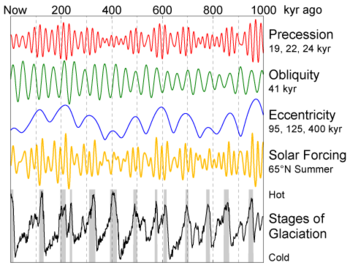
It is known that the Earth’s orbit around the sun changes shape every 100,000 years. The orbit becomes either more round or more elliptical at these intervals. The shape of the orbit is known as its “eccentricity.” A related aspect is the 41,000-year cycle in the tilt of the Earth’s axis.
Glaciation of the Earth also occurs every 100,000 years. Lisiecki found that the timing of changes in climate and eccentricity coincided. “The clear correlation between the timing of the change in orbit and the change in the Earth’s climate is strong evidence of a link between the two,” said Lisiecki. “It is unlikely that these events would not be related to one another.”
Besides finding a link between change in the shape of the orbit and the onset of glaciation, Lisiecki found a surprising correlation. She discovered that the largest glacial cycles occurred during the weakest changes in the eccentricity of Earth’s orbit –– and vice versa. She found that the stronger changes in the Earth’s orbit correlated to weaker changes in climate. “This may mean that the Earth’s climate has internal instability in addition to sensitivity to changes in the orbit,” said Lisiecki.
She concludes that the pattern of climate change over the past million years likely involves complicated interactions between different parts of the climate system, as well as three different orbital systems. The first two orbital systems are the orbit’s eccentricity, and tilt. The third is “precession,” or a change in the orientation of the rotation axis.
###
Interesting stuff…..it appears we rapidly descend into glacial periods (bad news for us), and emerge from them very slowly. I wonder why. To my knowledge, the Milankovitch Cycles don’t account for this variation. One would think, based on orbital eccentricities as the driver of continental glaciations, that the front and back slopes of each event would look the same.
Apologies to anyone who may have commented above on this observation.
Lets hear it for Professor Lisiecki for doing some good science, the way it is supposed to be done. Maybe it is about time the geologists reclaimed the stage in this debate. It should be remembered that climatology is noting more then another earth science and only a branch of geology and physical geography.
By the way, please don’t criticize lisiecki for not mentioning the Milankovich correlation in the press release. She didn’t write the press release. Someone in the UC Santa Barbara Public Affairs Office wrote the press release. This person may or may not be a science writer and may or may not understand the science involved, but he or she definitely is paid by the university rather than by the researcher. The publicist’s job is to make the university look good, so anything that can amp the rah-rah-we-are-great! up to eleven is going to be highlighted and anything that acknowledges prior work by other researchers elsewhere is going to be downplayed or omitted.
Trust me on this, folks — I’ve had to deal with pissed-off scientists at other institutions because someone wanted to make my own site look good and did some creative rewriting.
What’s new here is empirical support FOR Milankovich, and it’s world-wide data which all correlate and reveal another internal correlation. It’s one thing to measure the oribital variations of the Earth and to make predicitons about the effects of those variations on climate and glaciations. But EVERY piece of empirical evidence in the form or indisputable observation in the real world is BIG NEWS.
As I tell my students, the pure experimental sciences tell us how various things react with each other in a lab. Geology is the search to see if those things happen on their own.
Andrew W (13:34:36) :
“So while Lorraine Lisiecki’s work may strengthen the evidence linking the Milankovich cycles to the glacial-interglacial cycles, it does nothing to change the evidence supporting AGW.”
I do not agree.
Callion et al implies that CO2 is delayed by approx 800 years after temperature;
Science ;
http://www.sciencemag.org/cgi/reprint/299/5613/1728.pdf
This is real science. Don’t criticize it. Criticize the corrupt science peddled by AGW alarmists.
Reply: All science is subject to criticism. Criticism and correction is part of how science progresses. Criticism is not to be confused with name calling. ~ ctm
***************
Herein lies the Achilles heel of AGW. Also temperature and CO2 feedback weaker than previously thought.
http://www.sciencedaily.com/releases/2010/01/100127134721.htm
http://www.nature.com/nature/journal/v463/n7280/full/nature08769.html
http://news.bbc.co.uk/2/hi/science/nature/8483722.stm
AEGeneral (14:27:42) :
“I’ve never heard of it, so it passes as “news” to me.
Thanks for posting it.”
That’s great!!! For those whining because this isn’t news, AEGeneral exemplifies why it is necessary to reiterate what’s already known. Because we more often don’t, is why history repeats itself. For example, communism was more brutal than fascism and failed, glaciers osculate, gravity works on CO2, and submarines surfacing near the north pole should be repeated over and over again. Plant life thriving better in CO2 rich environment, same.
Now, I look forward to the next article about the sun being the source of earth’s heat.
Andrew W (13:34:36) :
The Milankovich cycles have been long accepted as the driver of the glacial-interglacial cycles, changes in atmospheric CO2 follow this cycle and, in the view of most climate scientists, accentuate the temperature changes that occur through these cycles.
So while Lorraine Lisiecki’s work may strengthen the evidence linking the Milankovich cycles to the glacial-interglacial cycles, it does nothing to change the evidence supporting AGW.
————————
Reply:
CO2 trails the inception of a glacial epoch by ~ 800 years, and 100,000 years later, CO2 also trails the inception of the thawing interglacial. How on earth does that not destroy any theory that CO2 causes AGW?
Or are we looking for invisible “tipping points” again? (Epiphany–since this process is obviously going back and forth, over and over, maybe I should be kind and refer to them as “teeter-totter points”, especially since they have definite predictable cyclicity to them?)
Good on her! Doing good science in the face of poor funding, by not sucking up to the AGW gravy train. All she needed was a good university that would help her find more parts of the truth.
The more studies that cover empirical evidence and more global area at the same time, expand the knowledge of what really goes on. From these tools and additional coverage data sets a better platform can be built toward the understanding of how the weather becomes the climate, globally and regionally. It will be good to see the infilling of the Ice core gaps with parallel lines of proxies, if all things stay synchronized.
Study of the shorter periods of effects on the Earth’s weather will give leads to follow other than CO2, (I hate cul de sacs in mazes). I could not find her e-mail addy to send some input for her consideration, so in hopes she reads these comments, I include this link to my research into shorter periods of Lunar weather driving cycles.
http://research.aerology.com/aerology-analog-weather-forecasting-method/
It’s refreshing to see some ‘joined up’ thinking which reinforces M cycles for our recent history. However, the ‘clincher’ would also show solar activity at that part of the M cycle! Could we use a ‘horoscope’ to determine this? 😉
Good work Lorraine!
Best regards, suricat.
I think she is arguing that glacial periods cannot be explained by changes in solar forcing alone. Strong feedbacks in ocean circulation must be brought in to the picture. The term “insolation” is used frequently in the pdf. Is she saying that the circulation is easily blocked by minor solar changes?
The Milankovitch cycles don’t change the total amount of solar insolation but the way in which it is distributed – for example, the amount of insolation at 65’N in the summer.
The explanation for how it could lead to such large changes in climate is difficult one.
One possibility is that the climate is highly sensitive to small changes (or highly sensitive under certain historical conditions that were present). Otherwise the Milankovitch cycles couldn’t have caused the ice ages.
A small commentary without much depth in Ghosts of Climates Past
-hopefully to be followed up at some stage with more on this fascinating subject.
Reading the paper, what I gathered was that in trying to confirm or refute the SPECMAP research project, she found that certain aspects of North Atlantic circulation don’t phase map with Milankovich cycles (which are indeed central to the paper). And others do.
Nothing earth shattering, just another piece of the puzzle.
First time I’ve ever seen a science paper formatted like a full page Popular Mechanix ad for a 200 mpg carburetor.
Here’s the original 1976 reference linking the Milankovich cycles to ice ages. http://www.es.ucsc.edu/~rcoe/eart206/Hays_OrbitPacemaker_Science76.pdf
It was produced by the CLIMAP project which spawned the SPECMAP project that Lorraine Lisiecki is referencing in her research poster. Among other things, these two projects improved the stratigraphic correlation and assignment of more accurate ages to points in deep-sea sediment cores. They were multi-institutional and international research projects that used sediments cores collected in the 60s and 70s from the world’s ocean before the Deep Sea Drilling Project got under way.
Ms. Lisiecki’s work is important research that supports the general and more refined Milankovitch cycles theory. It is not a new, novel, or a unique idea, but it important data gathering to support an already well established theory. We know earth is in the middle of an interglacial period that is part of the Quaternary Period ice age that we are in. Based on the cycles that Ms. Lisiecki is studying, the next best chance for a full fledged glacial period is not for at least 50,000 years, with a really good chance coming in about 130,000 years.
Wiki actually has an excellent write up on all this, with some amazingly detailed charts at:
http://en.wikipedia.org/wiki/Milankovitch_cycles
RockyRoad:
The answer is a simple one.
All other things being equal, a warmer climate leads to less CO2 being able to be stored in the oceans. Therefore, more CO2 in the atmosphere.
More at CO2 Lags Temperature in the Ice-Core Record. Doesn’t that prove the IPCC wrong?
Increases in CO2 also cause more “radiative forcing” at the earth’s surface (and throughout the troposphere).
Therefore CO2 increases can be a cause of temperature rise and a result of temperature rise.
The transition from glacial to interglacial starts about 800 years before atmospheric CO2 concentrations start to rise, the total time the transition takes is about 5000 years, so increasing CO2 can play a role in the warming for over 80% of the transition period.
This sort of thing has been taken into consideration in climate science since before the AGW debate started.
I’m afraid this is old news–the Adhemar-Croll-Milankovitch cycles have been know for a long time (the concept generally accorded to Milankovitch was actually first suggested by Adhemar and later expanded by Croll and finally quantified by Milankovitch). In the absence of any way to date deep sea cores accurately, orbital curves are fitted to ocean sediment cores by the ‘accordion method’ (you just expand and contract orbital cycles and deep see cores until they match and then claim that because they match, one must be the cause of the other!) Three major, major problems with the concept are (1) you can’t date deep sea cores accurately so you can’t claim temporal correspondence, (2) if this was the cause of climate change, the climate in the southern hemisphere should always be the opposite of that in the northern hemisphere (just like modern seasons), ie. when you have a glaciation in one hemisphere, you should have an interglaciation in the other hemisphere, and (3) the discovery in polar ice cores of very sudden, short lived changes (like the Younger Dryas) from glacial to nonglacial climates occurs so rapidly that they cannot possibly be explained by the slow methodical changes in orbital parameters.
In short, the Adhemar-Croll-Milankovitch concept falls well short of expaining glaciations and interglaciations. Sorry!
Apologies for O/T, but the SOI is starting to rock:
1-Apr-2010 1011.05 1006.55 15.21 -10.01 -12.19
2-Apr-2010 1012.24 1006.65 23.07 -8.39 -12.03
3-Apr-2010 1013.20 1007.65 22.78 -6.87 -11.83
4-Apr-2010 1013.58 1007.60 25.88 -4.83 -11.70
5-Apr-2010 1013.01 1006.85 27.18 -2.82 -11.52
6-Apr-2010 1013.40 1007.05 28.55 -1.10 -11.17
Chaco Canyon.
Moon Cycles.
Sun Cycles
Round Rocks.
People with only facts to work with.
Wow, when I suggested that you have an article that gets into this very topic on your last article’s comments I didn’t expect it to be the very next article! Good work Anthony!
More along this line would be interesting. The Rotisserie Earth Theory (it’s the sun Sol), oh, proven facts from direct observations, not just hypothesis or disconnected theory.
“”” jack mosevich (15:19:46) :
AlexB(14:22:48): I agree with you. Why the attacks here be people who probably have not even read her paper?Please people let us not become RealClimateers. “””
Well I can’t say that I have read much here that I would call attacks. Certainly a good deal of ‘ho hum’, but not really attacks. I’m sure that reports of her paper would go down well on other blogs that are currently heavily into geologocal phenomena.
But as far as earth climate, and more importantly what if anything humans ought to do either individually, or collectively about it; her paper is about as useful as some report that the eventual collision of the Andromeda Galaxy with the Milky Way, will actually occur about 60% further into the future than prevuiously thought.
Interesting; but so is the information that some bee and Ant queens only have sex during one day of their lives; which lasts them for the rest of their lives to lay all the fertile eggs they want. Wonderful; but it isn’t going to solve any climate problems which might be solvable, or might not.
R Gates, I would not expect a repeating pattern such as that shown (stages of glaciation graph) to suddenly produce a square wave. Maybe the data availible indicates 50,000 years to the next glaciation and a “real good chance” of a maximum in 130,000 years, but an eyeball of that graph suggests we will be in a glaciation in 50K yrs and might be coming out of glaciation in 130K yrs. There’s something wrong with that Wiki article.
@Steve Goddard
“If feedbacks were dominantly positive, the earth would either move towards a permanent and progressively colder ice age, or a Venus like state of incredible heat.”
Actually Steve, that is only true if the gain factor’s absolute value is greater then 1.