From UCSB News: (h/t to David Schnare) UCSB Geologist Discovers Pattern in Earth’s Long-Term Climate Record

| Lorraine Lisiecki |
||
 |
||
 |
||
|
|
||
(Santa Barbara, Calif.) –– In an analysis of the past 1.2 million years, UC Santa Barbara geologist Lorraine Lisiecki discovered a pattern that connects the regular changes of the Earth’s orbital cycle to changes in the Earth’s climate. The finding is reported in this week’s issue of the scientific journal Nature Geoscience.
Lisiecki performed her analysis of climate by examining ocean sediment cores. These cores come from 57 locations around the world. By analyzing sediments, scientists are able to chart the Earth’s climate for millions of years in the past. Lisiecki’s contribution is the linking of the climate record to the history of the Earth’s orbit.
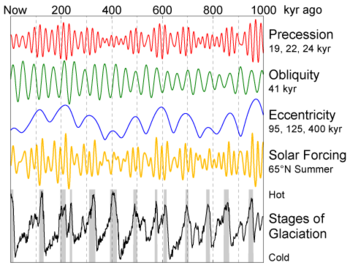
It is known that the Earth’s orbit around the sun changes shape every 100,000 years. The orbit becomes either more round or more elliptical at these intervals. The shape of the orbit is known as its “eccentricity.” A related aspect is the 41,000-year cycle in the tilt of the Earth’s axis.
Glaciation of the Earth also occurs every 100,000 years. Lisiecki found that the timing of changes in climate and eccentricity coincided. “The clear correlation between the timing of the change in orbit and the change in the Earth’s climate is strong evidence of a link between the two,” said Lisiecki. “It is unlikely that these events would not be related to one another.”
Besides finding a link between change in the shape of the orbit and the onset of glaciation, Lisiecki found a surprising correlation. She discovered that the largest glacial cycles occurred during the weakest changes in the eccentricity of Earth’s orbit –– and vice versa. She found that the stronger changes in the Earth’s orbit correlated to weaker changes in climate. “This may mean that the Earth’s climate has internal instability in addition to sensitivity to changes in the orbit,” said Lisiecki.
She concludes that the pattern of climate change over the past million years likely involves complicated interactions between different parts of the climate system, as well as three different orbital systems. The first two orbital systems are the orbit’s eccentricity, and tilt. The third is “precession,” or a change in the orientation of the rotation axis.
###
Discover more from Watts Up With That?
Subscribe to get the latest posts sent to your email.

So if I stop going north to ski and south to surf every year will this prevent the Earth tilt increase and avert catastrophic climate change?
The AGW crowd will tell you the solar forcing is too low and it was co2 that caused the ice ages and warm periods, even though it lags by a few hundred years. I actually saw a BBC documentary a while (within the last 1-2 years) that actually claimed small changes in co2 were responsible for the start and end of ice ages!!!!!
I and my geologist collegues were shocked at the poor one sided science! It was like Realclimate wrote the script for them ;0)
Although M-Cycles have been understood for some time, Cyclostratigraphy and mapping M-Cycles together in such a way that maps with a significant degree of correlation with glacial-interglacial phases is relatively novel. It would be interesting to know how she mapped the corelation and with what sediments. I know varves show a good correlation.
Unless you are waiting on a pizza order , a million years is not a long time, and the sediments are not likely to be much more than mud.
Must see if this paper is online. The links dont much get into the detail of how.
And yes, it sounds like real science. And yes, the post-modernist pseudoscientists will probably dismiss it.
How can this get by as news? This is old hat ….. Milankovitch Cycles. The key is that about every 100,000 years the NH summer solstice is at perihelion and the axis tilt is at max, 24.5 degrees in relation to the orbital plane. As conditions approach this maximum, insolation at 65N increases causing the great northern ice sheets to melt away putting Earth into an interglacial warm period. As the cycles drift away from this condition the Earth will go back into glaciation for another 100,000 years until the right combination of cycles again creates another interglacial warm period. So let’s face it, the ice is coming and there ain’t nothing we can do about it.
… and a bunch of data
is here:
http://www.ncdc.noaa.gov/paleo/indexoce.html
Keep posting, Anthony!
http://news.cnet.com/8301-13578_3-20001825-38.html?part=rss&subj=news&tag=2547-1_3-0-20
h/t Drudge
Geologists rule! Perhaps Lisiecki can help clean up the egregious mistakes of the treemometer crowd.
Check out Lisiecki’s CV at:
http://www.lorraine-lisiecki.com/lisieckiCV.pdf
A bit more here:
Links between eccentricity forcing and the 100,000-year glacial cycle Lorraine E. Lisiecki1
Abstract Variations in the eccentricity (100,000 yr), obliquity (41,000 yr) and precession (23,000 yr) of Earth’s orbit have been linked to glacial–interglacial climate cycles. It is generally thought that the 100,000-yr glacial cycles of the past 800,000 yr are a result of orbital eccentricity1, 2, 3, 4. However, the eccentricity cycle produces negligible 100-kyr power in seasonal or mean annual insolation, although it does modulate the amplitude of the precession cycle. Alternatively, it has been suggested that the recent glacial cycles are driven purely by the obliquity cycle5, 6, 7. Here I use statistical analyses of insolation and the climate of the past five million years to characterize the link between eccentricity and the 100,000-yr glacial cycles. Using cross-wavelet phase analysis, I show that the relative phase of eccentricity and glacial cycles has been stable since 1.2 Myr ago, supporting the hypothesis that 100,000-yr glacial cycles are paced8, 9, 10 by eccentricity4, 11. However, I find that the time-dependent 100,000-yr power of eccentricity has been anticorrelated with that of climate since 5 Myr ago, with strong eccentricity forcing associated with weaker power in the 100,000-yr glacial cycle. I propose that the anticorrelation arises from the strong precession forcing associated with strong eccentricity forcing, which disrupts the internal climate feedbacks that drive the 100,000-yr glacial cycle. This supports the hypothesis that internally driven climate feedbacks are the source of the 100,000-yr climate variations12.
And from her site.
http://www.lorraine-lisiecki.com/simple.html
How are glacial cycles measured?
Landscape features like Cape Cod and Half Dome in Yosemite are evidence of the large ice “sheets” over Canada and the northern U.S. The size of these ice sheets at any given time affects a certain property of the shells of tiny animals (called foraminifera) that live in the ocean. These shells get buried in the ocean, and we can find shells that grew at almost any time over the last 70 million years. The property we measure is d18O, which describes the ratio of two different types of oxygen in the shell. The lighter type of oxygen, O16, is more concentrated in the snow that gets trapped on the continents to form ice sheets. This leaves more of the heavier O18 in the ocean. The ratio of the two types of oxygen in the shells is affected by the ratio in the ocean but is also affected by the temperature of the water. This makes it very difficult to know exactly how much ice was on the continents at any one time. However, separate measurements of ocean temperature in the past can be used to improve our estimates of ice sheets size. Read more about d18O here.
Download Power Point slides illustrating how d18O measures ice volume.
As part of my research, I averaged together 57 different records of change in d18O over the last 5.3 million years. This average, known as the LR04 stack, gives us a better record of change in ice volume (and temperature) than we have ever had before because averaging together many records improves the quality of the data (reduces noise and localized changes) and because it allowed me to better constrain the time at which each glacial cycle occurred.
Yep, this looks like proper Climate Science.
I don’t think CO2 is going to help much when the next big freeze hits us!
It’s interesting how the rate of change between warm and cold climate, as shown on the ‘Stages of Glaciation’ part of the chart, seems fairly constant – I wonder why?
Actually, reading the poster link there are plenty of references to Milankovitch and others. It’s just the silly press release giving the impression she’s discovered the link between orbital changes and the climate.
There’s seems to be an ongoing problem with misleading science press releases. (*cough* NASA)
Yes, she has heard of Milankovitch and seems intent on expanding that knowledge. From her website: “I am particularly interested in the evolution of Plio-Pleistocene climate as it relates to Milankovitch forcing, 100-kyr glacial cycles, and deep-ocean circulation.”
a preprint is here:
http://www.nature.com/ngeo/journal/vaop/ncurrent/abs/ngeo828.html
I always come back to the phasing between the obliquity and eccentricity signals. When in phase, long wide interglacial (today and 420/800kys), when out of phase, shorter and double peaked (220/600kys). At least recently for the ice age.
I hate to mention it, but she got all of this off of measuring one tree in her backyard.
That, and she’s a Denialist! Funded by Exxon! And Big Tobacco! And Satan!
But in all seriousness, I’m glad there are people who are out there conducting research and pattern analysis. Gives me warm fuzzies all over.
The Milankovich cycles have been long accepted as the driver of the glacial-interglacial cycles, changes in atmospheric CO2 follow this cycle and, in the view of most climate scientists, accentuate the temperature changes that occur through these cycles.
So while Lorraine Lisiecki’s work may strengthen the evidence linking the Milankovich cycles to the glacial-interglacial cycles, it does nothing to change the evidence supporting AGW.
The earth’s orbit is 3 dimensional. She left out inclination, which has been proposed as a factor in climate change.
But yeah, it’s science, although the presentation is a bit wonky. She’s essentially using sediment data to confirm ice core data, which is what science is supposed to do – take data from different fields of study to confirm the theory.
What we don’t get from the article (you need the full research paper) is how sediment can be used as an accurate climate proxy going back 1.2 million years. The raw data would just show “change X occurs at point Y in the sediment”, and the scientist infers from there. Without the paper I would assume she’s using the microbial population approach.
Boudu (12:10:55) :
Careful tty, she knows where you live. 😉
+1 AGW Internets to you, sir.
Al Gored (12:22:21) :
This will be fun. Like the Creationists arguing that God arranged the fossils,……….
You know, damned few “Creationists” argue that belief. There is a difference between a belief in a design and a conspiracy.
So bottom line; does her new research and pattern discovery alter the predictions; excuse me; make that projections that IPCC has handed out to the world’s leaders to act on in the next few decades ?
If not; then what is her point; sure we know that the whole solar system orbital parameters all change continually, since the planetary orbital times are not commensurate with each other;
But what does that have to do with the next 100 years of earth climate changes.
Well what does she care; I’m sure she will still keep on getting research grants to study more sediments, and find new geologic variables.
Speaking of people that absolutely know things…….
http://www.foxnews.com/scitech/2010/04/06/climate-gate-michael-mann/
The Milankovitch Cycles and the Eccentricity of the Orbit do not match up with the ice age records. There is some correlation but it is not consistent and is often contradictory. And the ice ages are not actually a regular 100,000 years apart either – the length varies and so does the interglacial periods.
Gotta love geology. Understanding climate cycles has to involve more than making a computer guess what the temperature is going to be based on some fudged temperature record over the last 150 years. Lisiecki is doing the hard yards rather than pretending for her research grant money. Good on her.
One thing that scientists learn very early in their careers, is that you don’t want to be too close to any real action; as in real world action. First they will start calling you an engineer rather than a scientist, if you get too close to doing real practical things; and then they will start trying to figure out how you can make money for them.
Whereas, if you stay out in the blue sky country, when it gets to where you are facing real problems to solve; you can simply move on to the latest research subject du jour; where most of what you find will be shown to be false many years later; then you can leave behind the engineers to solve the real problems, and make some practical use of what the employer spent his money on.
What could be more useless information, than knowing that the earth’s orbit changes over time scales too long to be of any interest to humans ?
mdjackson (12:20:52) :
Uhhh… I just looked at the diagram again. Is it just me or does it look like it’s about to get real cold?
——————-
You are correct, grasshopper. But I really, really wish you weren’t.
This will be ignored by the warmists as M. Lisiecki is a geologist, totally untrained in ‘climate’ science, hence her work will be relegated in favour of more ‘robust’ research such as treemometers, GCMs, etc.
Only the likes the real ‘climate scientists’ (whatever that means) such as Jones, Mann and Co seem to have the requisite knowledge to determine how climate operates.
(/sarc off)