Forecasting The NSIDC News
By Steven Goddard and Anthony Watts
Barring an about face by nature or adjustments, it appears that for the first time since 2001, Arctic Sea ice will hit the “normal” line as defined by the National Snow and Ice Data Center (NSIDC) for this time of year.
NSIDC puts out an article about once a month called the Sea Ice News. It generally highlights any bad news they can find about the disappearance of Arctic ice. Last month’s news led with this sentence.
In February, Arctic sea ice extent continued to track below the average, and near the levels observed for February 2007.
But March brought good news for the Polar Bears, and bad news for the Catlin Expedition and any others looking for bad news. Instead of ice extent declining through March like it usually does, it continued to increase through the month and is now at the high (so far) for the year.
If it keeps this trend unabated, in a day or two it will likely cross the “normal” line.

The Danish Meteorological Institute shows Arctic ice extent at the highest level in their six year record.

The Norwegians (NORSEX) show Arctic ice area above the 30 year mean.

And the NORSEX Ice Extent is not far behind, within 1 standard deviation, and similar to NSIDC’s presentation. Note that is hit normal last year, but later.

And JAXA, using the more advanced AMSR-E sensor platform on the AQUA satellite, shows a similar uptick now intersecting the 2003 data line.

Source: IARC-JAXA
WUWT asked NSIDC scientist Dr. Walt Meir about this event to which he responded via email:
It’s a good question about the last time we’ve been above average. It was May 2001. April-May is the period when you’re starting to get into the peak of the melt season for the regions outside of the Arctic Ocean (Bering Sea, Hudson Bay) and the extent tends to have lower variability compared to other parts of the year as that thinner ice tends to go about the same time of year due to the solar heating. Even last year, we came fairly close to the average in early May.
He also mused about a cause:
Basically, it is due primarily to a lot more ice in the Bering Sea, as is evident in the images. The Bering ice is controlled largely by local winds, temperatures are not as important (though of course it still need to be at or at least near freezing to have ice an area for any length of time). We’ve seen a lot of northerly winds this winter in the Bering, particularly the last couple of weeks.
As we’ve been saying on WUWT for quite some time, wind seems to be a more powerful factor in recent sea ice declines than temperature. Recent studies agree.
See: Winds are Dominant Cause of Greenland and West Antarctic Ice Sheet Losses and also NASA Sees Arctic Ocean Circulation Do an About-Face
You can watch wind patterns in this time lapse animation, note how the ice has been pushed by winds and flowing down the east coast of Greenland:

Dr. Meier also wrote:
This has very little implication for what will happen this summer, or for the long-term trends, since the Bering Sea ice is thin and will melt completely well before the peak summer season.
There’s certainly no reason to disagree with the idea that much of the Bering Sea ice will melt this summer, it happens every year and has for millenia. But with a strong negative Arctic Oscillation this year, and a change in the wind, it is yet to be determined if Arctic Sea ice minimum for 2010 is anomalously low, and/or delayed from the usual time.
In 2009, WUWT noted it on September 15th: Arctic sea ice melt appears to have turned the corner for 2009
Dr. Mark Serreze of NSIDC offered some hopeful commentary in a press release back on October 6th 2009, but still pushes that “ice free summer” meme:
“It’s nice to see a little recovery over the past couple of years, but there’s no reason to think that we’re headed back to conditions seen in the 1970s,” said NSIDC Director Mark Serreze, also a professor in CU-Boulder’s geography department. “We still expect to see ice-free summers sometime in the next few decades.”
Remember this 2007 prediction from The Naval Postgraduate School?
Arctic summers ice-free ‘by 2013’
|
By Jonathan Amos
Science reporter, BBC News, San Francisco |

 |
 Arctic summer melting in 2007 set new records
|

 More details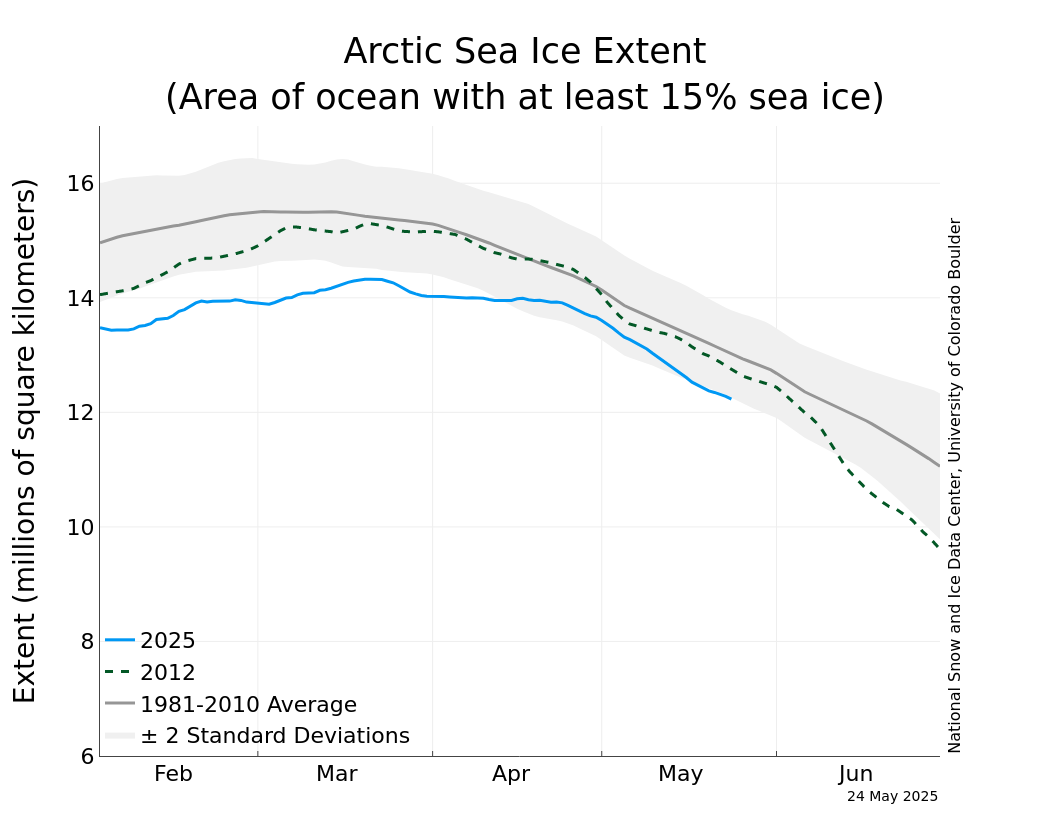

Scientists in the US have presented one of the most dramatic forecasts yet for the disappearance of Arctic sea ice.
Their latest modelling studies indicate northern polar waters could be ice-free in summers within just 5-6 years.
Professor Wieslaw Maslowski told an American Geophysical Union meeting that previous projections had underestimated the processes now driving ice loss.
Summer melting this year reduced the ice cover to 4.13 million sq km, the smallest ever extent in modern times.
Remarkably, this stunning low point was not even incorporated into the model runs of Professor Maslowski and his team, which used data sets from 1979 to 2004 to constrain their future projections.
|
 In the end, it will just melt away quite suddenly In the end, it will just melt away quite suddenly  Professor Peter Wadhams
|
“Our projection of 2013 for the removal of ice in summer is not accounting for the last two minima, in 2005 and 2007,” the researcher from the Naval Postgraduate School, Monterey, California, explained to the BBC.”So given that fact, you can argue that may be our projection of 2013 is already too conservative.”
========================================
Joe Romm wrote up a clever piece last year on this subject:
Exclusive: New NSIDC director Serreze explains the “death spiral” of Arctic ice, brushes off the “breathtaking ignorance” of blogs like WattsUpWithThat
June 5, 2009
I interviewed by email Dr. Mark Serreze, recently named director of The National Snow and Ice Data Center. Partly I wanted him to explain his “death spiral” metaphor for Arctic ice
So now that Arctic ice has returned to normal extent and area, we eagerly await the explanation from the experts about how that fits into the “death spiral” theory. Richard Feynman famously said “Science is the belief in the ignorance of the experts.”
Time will tell. 2010 is looking promising for sea ice recovery again. After all, who wouldn’t want the Arctic Sea ice to recover? WUWT is predicting a recovery again this year, which we started mentioning as a prediction last fall.
So given what we know today, what will NSIDC highlight in their April Sea Ice News?
And even more importantly, will the MSM cover it like they do the ‘terrible’ minimums?
NOTE: The poll code got messed up, duplicating an entry, press REFRESH if you see a double entry. -A
Forecasting The NSIDC News
NSIDC puts out an article about once a month called the Sea Ice News. It generally highlights any bad news they can find about the disappearance of Arctic ice. Last month’s news led with this sentence.
In February, Arctic sea ice extent continued to track below the average, and near the levels observed for February 2007.
But March brought good news for the Polar Bears, and bad news for the Catlin Expedition and any others looking for bad news. Instead of ice extent declining through March like it usually does, it continued to increase through the month and is now at the high (so far) for the year.
http://nsidc.org/data/seaice_index/images/daily_images/N_stddev_timeseries.png
The Danish Meteorological Institute shows Arctic ice extent at the highest level in their six year record.
The Norwegians (NORSEX) show Arctic ice area above the 30 year mean.
Joe Romm wrote up a clever piece last year on this subject:
Exclusive: New NSIDC director Serreze explains the “death spiral” of Arctic ice, brushes off the “breathtaking ignorance” of blogs like WattsUpWithThat
June 5, 2009
I interviewed by email Dr. Mark Serreze, recently named director of The National Snow and Ice Data Center. Partly I wanted him to explain his “death spiral” metaphor for Arctic ice
So now that Arctic ice has returned to normal extent and area, I eagerly await the explanation from the experts about how that fits into the “death spiral” theory. Richard Feynman famously said “Science is the belief in the ignorance of the experts.”
So what will NSIDC highlight in their April Sea Ice News?
-
The increase in both ice extent and quantity of multi-year ice
-
The long-term downwards linear trend line
-
The lack of 4+ year old ice
Sponsored IT training links:
Get free resources including 642-972 tutorial and 1z0-048 dumps questions for guaranteed success in JN0-532 exam.
“DirkH (13:44:07) :
“Ivan Janković (12:55:11) :
Antony,
O.T. It’s seems that Lubos has some explosive stuff about the climate […]”
Sorry Mods – stumbled over the submit button too early…
I wanted to say: Read the comments by Lubos, he’s in full swing…
Precisely – don’t let Mann, Briffa, Jones etc anywhere near the raw data.
James Chamberlain (12:47:55) :
It will be “corrected” downward within the next few years.
Everything I wanted to say… someone else has beat me to it.
I think I will open a bottle. Cheers!
Jim Cripwell said:
“There is a hypothesis that this is the norm, and total sea ice will remain constant into the indefinite future…”
___________
Really? From where does this hypothesis come? Do you have a link/source/reference?
I find it funny that AGW skeptics get all excited from a few weeks of upswing in the arctic sea ice, while all the while they’ll ignore nearly a decade of downswing…very revealing.
Plotting change in area from year to year on a daily basis shows that there is an increase in area until the beginning May followed by a sharp decline until the minimum.
Only time will tell the final minimum area.
http://img682.imageshack.us/img682/3148/deltaseaiceaveragearea.png
/harry
I tried to leave a comment over at Lubos Motl’s site but for some reason it didn’t go. Apparently you have to have an “account” with Google or somebody else.
I have no idea what that is all about.
Be afraid, be very afraid – this just in from Iceland:
http://chris.is/
The good news is that the institutions themselves, in this case NSIDC, will show a graph such as this.
The majority of media will say nothing or print what they wish. Something like:
“Arctic Sea Ice measurements indicate errors in instruments.”
R. Gates (13:50:54) :
Jim Cripwell said:
“There is a hypothesis that this is the norm, and total sea ice will remain constant into the indefinite future…”
___________
Really? From where does this hypothesis come? Do you have a link/source/reference?
I find it funny that AGW skeptics get all excited from a few weeks of upswing in the arctic sea ice, while all the while they’ll ignore nearly a decade of downswing…very revealing.
———
REPLY: Well, we find it funny when AGW proponents freak out when their cherished predictions of doom & gloom don’t pan out!!
Here’s Delingpole on the subject:
http://jamesdelingpole.com/blog/warmists-overwhelmed-by-fear-panic-and-deranged-hatred-as-their-science-collapses-858/
BTW, I’m in the field and have spent over 25 years on environmental methane mitigation projects. I’ve always bristled at the doom & gloom, polar-bears-drowning nonsense that has been pushed down our throats.
Watch the arctic sea ice extent grow! Anthony, you did predict this quite a while ago!
nice to see an articulate fact-based discussion of climate change, using information supplied by legitimate scientific sources. It makes a change from the bogus science-fueled reactionary rubbish spouted by lots of climate change sceptics.
The thing is, when blips like this deviate from the regular storyline of a chain of events the newspapers don’t like it. Journalists must work on the assumption that people are too stupid and lack the patience to follow anything but a linear, simple storyline.
Hence, now newspapers are accepting the climate change story as a legitimate source of articles, they will be reluctant to have to confuse everyone with a change of tack.
And coming back to a word I used a couple of paragraphs ago: “blip”; I do believe this is just that, a temporary anomally.
What matters in these huge world-encompassing systems is the overall grand trend – which is heading warm-wards.
It seems that as in the case of watergate’s Deep Throat, in “Climate-Gate” there is a “Deep Ice”.
R. Gates (13:50:54) :
Please explain how you can have a decade long downswing towards zero, and finish above average. Only a statistician could come up with that theory.
Could one factor be that the cold weather in the Gulf of Mexico and off of the Florida Coast has removed heat content from the gulf stream conveyor belt, thus the currents reaching the Greenland & Barents Seas are cooler than normal, (both of which have been trending up recently)? If so, the summer melt may not occur as rapidly as predicted by some. Just a thought.
http://fermi.jhuapl.edu/avhrr/avhrr/gs/averages/97mar/gs_97mar29_1328multi.gif
http://fermi.jhuapl.edu/avhrr/gs/averages/10mar/gs_10mar29_0247_mult.png
http://arctic.atmos.uiuc.edu/cryosphere/IMAGES/recent365.anom.region.6.html
http://arctic.atmos.uiuc.edu/cryosphere/IMAGES/recent365.anom.region.5.html
Can I detect an Arctic ice hockey Stick in these graphs?
Something terrible and unprecedented is happening in the Arctic! The Arctic sea ice extent is the greatest ever for this date since records have been kept. In the past, Arctic sea ice began to decrease this time of year but not this year. 14,405,781 square kilometers of ice covers the Arctic ocean and it’s still increasing.
There is 1,200,000 square kilometers more Arctic ice now than there was in 2,006. At this rate ice is increasing 300,000 square kilometers per year! Computer models show the Himalaya glaciers will be covered by an Arctic ice cap by 2,035 if we don’t do something now! Our dissolute carbon footprint conscious lifestyle is endangering polar bears. Heartbreaking pictures show these pigment challanged ursines without any open water to swim in.
Man-made global icing is endangering the planet. The only solution is “Uncap and Rebate”. Everyone should be encouraged to burn as much carbon as possible. The governments of the world should give rebates for every ton of carbon burned. We must do something before it’s to late. The science of man-made global icing is settled.
Aagh! That. . . that animation! It’s moving! It’s alive! And. . . it’s coming out!
/Mr Lynn 😀
Later the extend maximum happens, less the time for the loss ’til the expected minimum
Max Dat
14844063 03.21.03
14360313 03.10.04
14098906 03.06.05
13782344 03.08.06
13945625 03.10.07
14516875 03.09.08
14412813 03.05.09
14405781 03.30.10
Min Dat
5646875 09.09.02
6032031 09.18.03
5784688 09.11.04
5315156 09.22.05
5781719 09.14.06
4254531 09.24.07
4707813 09.09.08
5249844 09.13.09
Global swarming is just another end to the means for the progressive left. May the liberals in power have the ability to actually read your article.
Actually R Gates, arctic sea ice has been increasing since the 2007 low summer extent which as far as I can tell is a little more than “a few weeks”.
With us heading into a cool PDO phase and most models predicting a coming La Nina (or at worst neutral) it is highly likely that the 2007 low ice extent is going to be revisited any time soon.
But, hey don’t let the facts get in the way of your religion beliefs.
I thought all the ice was gone from what the AGW crowd said.I find it real funny how all thoughs that believe the load of crap ,and thats all it is ,about global always always have a reason we should’t believe the they are wrong.It never fells .The global temp can drop 3 degrees and were still told it getting warmer.We see record cold and snow and they say it getting warmer.I viewed on the global warming channel,accuweather ,where a professor has stated we are entering a period of ten years where we will be seeing global cooling and then they call the cooling a hick up in the overall warming period.Hey call it what you will I loved this past winter ,32 in of beautibul SNOW,and look foward to more of the same in winters to come .One last thought .Why do the global warming crowd always have their conference in spring a sopposed to winter?I’m prety sure Iknow the reason but. By the way were not skeptics were realist and most of the world knows the weatehr is just a cycle.
R. Gates (13:50:54) :
I find it funny that AGW skeptics get all excited from a few weeks of upswing in the arctic sea ice, while all the while they’ll ignore nearly a decade of downswing…very revealing.
I find it funny that you’ve stopped harping on the ongoing negative anomaly and your predictions that 2010 could be the warmest year on record.
And it hasn’t been a few weeks of upswing. It’s been increasing since 2007 — and has increased beyond what the “nearly a decade of downswing” wrought.
The ice is cyclical. Pretty revealing, innit?
R. Gates (13:50:54)
I find it funny that AGW skeptics get all excited from a few weeks of upswing in the arctic sea ice, while all the while they’ll ignore nearly a decade of downswing…very revealing.
Personally i find it interesting but not that exciting. Over the years I’ve viewed numerous projections of the Arctic sea ice disappearing. These public pronouncements are always couched in tones that suggest that the prospect of this occurring should fill us all with immense foreboding. Being somewhat puzzled by this, I’ve been moved to inquire on quite a number of occasions as to what is the exact nature of the catastrophe that will eventuate if this does happen. The only semi cogent response I’ve ever received, in fact the only response, suggested that the increased amount of open water would lead to increased absorption of solar insolation fueling further global warming. As you pointed out, we have in recent times experienced a rather dramatic decline in summer ice loss in the Arctic. Culminating in 2007 with a minimum that was fully 40% of the potential decline if the ice disappeared entirely. From your comments here, you seem to be someone who has his finger firmly on the pulse of CAGW science so I’m hoping you can help me locate something I haven’t been able to find on my own. Could you provide for me a link to some kind of data that suggests that this increased absorption of solar energy is actually occurring? It would be most helpful in allowing me to understand what all the excitement is about.
I think there must be some problems with the measurement or software, this looks like the reading is way too high. NASA will need to adjust the data to correct for the obviously faulty reading …
R. Gates (13:50:54) :
I find it funny that AGW skeptics get all excited from a few weeks of upswing in the arctic sea ice, while all the while they’ll ignore nearly a decade of downswing…very revealing.
Kind of like folks that get all exited about a couple of months uptick in AMSU anomalies in the middle of a strong El Nino after nearly a decade long period of flat temperatures.
Pot … Kettle …
OT – Romm is now declaring that weather is climate after all.
http://climateprogress.org/2010/03/31/northeast-hit-by-record-global-warming-type-deluge-rainfall-flooding/