Forecasting The NSIDC News
By Steven Goddard and Anthony Watts
Barring an about face by nature or adjustments, it appears that for the first time since 2001, Arctic Sea ice will hit the “normal” line as defined by the National Snow and Ice Data Center (NSIDC) for this time of year.
NSIDC puts out an article about once a month called the Sea Ice News. It generally highlights any bad news they can find about the disappearance of Arctic ice. Last month’s news led with this sentence.
In February, Arctic sea ice extent continued to track below the average, and near the levels observed for February 2007.
But March brought good news for the Polar Bears, and bad news for the Catlin Expedition and any others looking for bad news. Instead of ice extent declining through March like it usually does, it continued to increase through the month and is now at the high (so far) for the year.
If it keeps this trend unabated, in a day or two it will likely cross the “normal” line.

The Danish Meteorological Institute shows Arctic ice extent at the highest level in their six year record.

The Norwegians (NORSEX) show Arctic ice area above the 30 year mean.

And the NORSEX Ice Extent is not far behind, within 1 standard deviation, and similar to NSIDC’s presentation. Note that is hit normal last year, but later.

And JAXA, using the more advanced AMSR-E sensor platform on the AQUA satellite, shows a similar uptick now intersecting the 2003 data line.

Source: IARC-JAXA
WUWT asked NSIDC scientist Dr. Walt Meir about this event to which he responded via email:
It’s a good question about the last time we’ve been above average. It was May 2001. April-May is the period when you’re starting to get into the peak of the melt season for the regions outside of the Arctic Ocean (Bering Sea, Hudson Bay) and the extent tends to have lower variability compared to other parts of the year as that thinner ice tends to go about the same time of year due to the solar heating. Even last year, we came fairly close to the average in early May.
He also mused about a cause:
Basically, it is due primarily to a lot more ice in the Bering Sea, as is evident in the images. The Bering ice is controlled largely by local winds, temperatures are not as important (though of course it still need to be at or at least near freezing to have ice an area for any length of time). We’ve seen a lot of northerly winds this winter in the Bering, particularly the last couple of weeks.
As we’ve been saying on WUWT for quite some time, wind seems to be a more powerful factor in recent sea ice declines than temperature. Recent studies agree.
See: Winds are Dominant Cause of Greenland and West Antarctic Ice Sheet Losses and also NASA Sees Arctic Ocean Circulation Do an About-Face
You can watch wind patterns in this time lapse animation, note how the ice has been pushed by winds and flowing down the east coast of Greenland:

Dr. Meier also wrote:
This has very little implication for what will happen this summer, or for the long-term trends, since the Bering Sea ice is thin and will melt completely well before the peak summer season.
There’s certainly no reason to disagree with the idea that much of the Bering Sea ice will melt this summer, it happens every year and has for millenia. But with a strong negative Arctic Oscillation this year, and a change in the wind, it is yet to be determined if Arctic Sea ice minimum for 2010 is anomalously low, and/or delayed from the usual time.
In 2009, WUWT noted it on September 15th: Arctic sea ice melt appears to have turned the corner for 2009
Dr. Mark Serreze of NSIDC offered some hopeful commentary in a press release back on October 6th 2009, but still pushes that “ice free summer” meme:
“It’s nice to see a little recovery over the past couple of years, but there’s no reason to think that we’re headed back to conditions seen in the 1970s,” said NSIDC Director Mark Serreze, also a professor in CU-Boulder’s geography department. “We still expect to see ice-free summers sometime in the next few decades.”
Remember this 2007 prediction from The Naval Postgraduate School?
Arctic summers ice-free ‘by 2013’
|
By Jonathan Amos
Science reporter, BBC News, San Francisco |

 |
 Arctic summer melting in 2007 set new records
|

 More details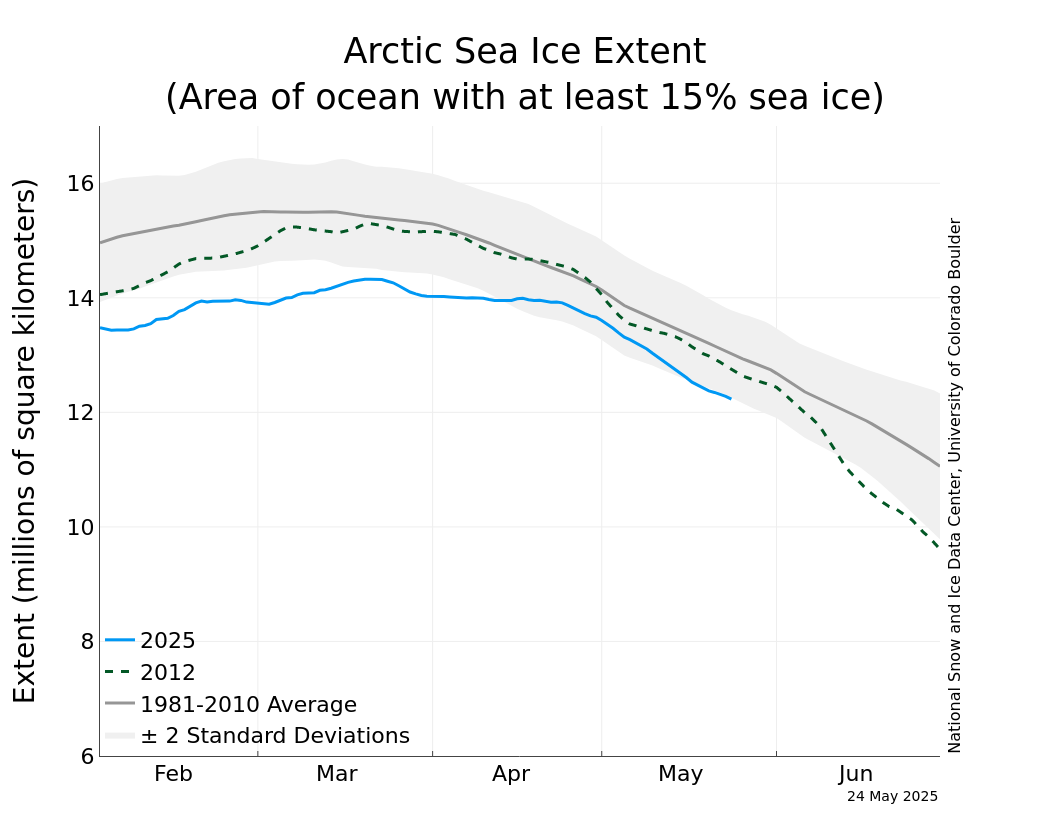

Scientists in the US have presented one of the most dramatic forecasts yet for the disappearance of Arctic sea ice.
Their latest modelling studies indicate northern polar waters could be ice-free in summers within just 5-6 years.
Professor Wieslaw Maslowski told an American Geophysical Union meeting that previous projections had underestimated the processes now driving ice loss.
Summer melting this year reduced the ice cover to 4.13 million sq km, the smallest ever extent in modern times.
Remarkably, this stunning low point was not even incorporated into the model runs of Professor Maslowski and his team, which used data sets from 1979 to 2004 to constrain their future projections.
|
 In the end, it will just melt away quite suddenly In the end, it will just melt away quite suddenly  Professor Peter Wadhams
|
“Our projection of 2013 for the removal of ice in summer is not accounting for the last two minima, in 2005 and 2007,” the researcher from the Naval Postgraduate School, Monterey, California, explained to the BBC.”So given that fact, you can argue that may be our projection of 2013 is already too conservative.”
========================================
Joe Romm wrote up a clever piece last year on this subject:
Exclusive: New NSIDC director Serreze explains the “death spiral” of Arctic ice, brushes off the “breathtaking ignorance” of blogs like WattsUpWithThat
June 5, 2009
I interviewed by email Dr. Mark Serreze, recently named director of The National Snow and Ice Data Center. Partly I wanted him to explain his “death spiral” metaphor for Arctic ice
So now that Arctic ice has returned to normal extent and area, we eagerly await the explanation from the experts about how that fits into the “death spiral” theory. Richard Feynman famously said “Science is the belief in the ignorance of the experts.”
Time will tell. 2010 is looking promising for sea ice recovery again. After all, who wouldn’t want the Arctic Sea ice to recover? WUWT is predicting a recovery again this year, which we started mentioning as a prediction last fall.
So given what we know today, what will NSIDC highlight in their April Sea Ice News?
And even more importantly, will the MSM cover it like they do the ‘terrible’ minimums?
NOTE: The poll code got messed up, duplicating an entry, press REFRESH if you see a double entry. -A
Forecasting The NSIDC News
NSIDC puts out an article about once a month called the Sea Ice News. It generally highlights any bad news they can find about the disappearance of Arctic ice. Last month’s news led with this sentence.
In February, Arctic sea ice extent continued to track below the average, and near the levels observed for February 2007.
But March brought good news for the Polar Bears, and bad news for the Catlin Expedition and any others looking for bad news. Instead of ice extent declining through March like it usually does, it continued to increase through the month and is now at the high (so far) for the year.
http://nsidc.org/data/seaice_index/images/daily_images/N_stddev_timeseries.png
The Danish Meteorological Institute shows Arctic ice extent at the highest level in their six year record.
The Norwegians (NORSEX) show Arctic ice area above the 30 year mean.
Joe Romm wrote up a clever piece last year on this subject:
Exclusive: New NSIDC director Serreze explains the “death spiral” of Arctic ice, brushes off the “breathtaking ignorance” of blogs like WattsUpWithThat
June 5, 2009
I interviewed by email Dr. Mark Serreze, recently named director of The National Snow and Ice Data Center. Partly I wanted him to explain his “death spiral” metaphor for Arctic ice
So now that Arctic ice has returned to normal extent and area, I eagerly await the explanation from the experts about how that fits into the “death spiral” theory. Richard Feynman famously said “Science is the belief in the ignorance of the experts.”
So what will NSIDC highlight in their April Sea Ice News?
-
The increase in both ice extent and quantity of multi-year ice
-
The long-term downwards linear trend line
-
The lack of 4+ year old ice
Sponsored IT training links:
Get free resources including 642-972 tutorial and 1z0-048 dumps questions for guaranteed success in JN0-532 exam.
I tell ya’, it’s that ol’ quart’r lag! 🙂
Quick, there’s not a moment to lose. Grab a toad or two, and get Phil back out of his hole. We need to ask him to clarify:
6 more weeks of winter or 6 weeks of melt this year… what exactly did you mean, Phil?
Follow up:
“Scientists believe that the colder winter and lower-than-average sea temperatures this year may have allowed the ice floe to remain frozen longer than usual, assisting the polar bear’s passage.”
http://www.countrylife.co.uk/news/article/448935/Polar-bear-washes-up-on-Scotland-s-Isle-of-Mull.html#part2
They can still swim great distances:
Polar Bear Swims 200 Miles!
http://www.guardian.co.uk/uk/2008/jun/05/animalwelfare.animalbehaviour
Polar Bear Swims 100 Km
http://www.seaworld.org/infobooks/polarbears/pbadaptations.html
If it was a UK organisation they would probably do a Met Office, along the lines of “we no longer see it as part of our remit to file reports and forecasts”
This would be immediately declared by the BBC and the rest of the MSM as a prudent measure required to release much needed money and resource into further research. The declaration would be supported by quotes from The Royal Society, Prince Charles, Phil Willis, Lord Oxburgh etc. All three of the so called “major” political parties would claim responsibility for the move.
There is also the distinct possibility that we will be told that in actual fact the sea ice has been retreating as predicted and what the satellite has picked up as an increase in the last few weeks is a major spillage of whitewash.
Dear Mr G Fawkes, we have some new technology that you maybe able to utilise in your quest.
/sarc (but not disgust) off
Anu (12:19:02) :
Last year I got really sick for a week, hardly ate at all.
I hit my “normal” college weight one day.
Ah, to be young again…
Trends are now back to normal …
Well of course, why didn’t I think of it. The ice is obviously “sick”. Is that going to replace rotten ice?
I can see the headlines now … Arctic ice comes down with horrible cold due to climate change. If we don’t act immediately this cold could spread and impact the entire NH. It’s a catastrophe.
It will be “corrected” downward within the next few years.
It cannot be emphasized too strongly that Edward Lorenz’s Chaos Theory (1964) proves linear extrapolations of phenomena in complex dynamic systems (those with three or more interacting variables) are mathematically and physically impossible. Lorenz was a meteorologist, but his “sensitive dependence on initial conditions” (the Butterfly Effect) applies equally in geophysical contexts and perspectives. Moreover, though cyclical – periodic effects may be determined in hindsight, even regular fluctuations are subject to well-defined natural effects including Punctuated Equilibrium, the Principle of Mediocrity, and local Regression-to-the-Mean.
After some 12,250 years, skewed by the 1,500-year Younger Dryas “cold shock” that ended c. BC 8800, our current Holocene Interglacial Epoch is generations overdue to end. As Sol threatens a 20-year “dead sun” Dalton if not a 70-year Maunder Minimum, we suspect that long-term “climate” may abruptly flip to ice-sheet mode. After a 500-year Medieval Warm compensated by a Little Ice Age of near-equal length, the odds of a recurrent 20th through 25th Century medieval analogue appear remote.
“Al Gory (12:37:02) :
Ice growth? But that’s unpossible! Methane! Exxon! Tipping points! Tipping points!”
Forget Exxon, it’s Koch.
Report with a beautiful photo of Joseph Romm:
http://theenergycollective.com/TheEnergyCollective/62335
I would expect a Wall Streeter type spin – its still less than analysts expected.
Ignore everything else, all the fundamentals, and all earlier predictions. Just buy, buy, buy what they’re selling!
In the meantime, the wikipedia doctors are quickly adjusting their content to fit.
Antony,
O.T. It’s seems that Lubos has some explosive stuff about the climate sensitivity on his blog http://motls.blogspot.com/2010/03/black-body-limits-climate-sensitivity.html.
It is maybe worth of re-posting here…
Anu (12:19:02) said:
So you think that the Arctic has been sick over the last few years and it will be back to normal soon? Good to hear.
I tend to think these things are cyclical …
Polar bear washes up on Scotland’s Isle of Mull
Polar Bear Swims 200 Miles!
Polar Bear Swims 100 Km.
It’s G’pa Polar Bear’s revenge! Thay’re coming! I’d run if my name were gore! Just tell G.P.B. your name isn’t Al and you’d swear to that before Congress on the Bible! (CRT :))
Returning to the thirty year mean is hardly normal. The mean is the center point of a gradual thirty year decline. Cryosphere Today Arctic area has decreased over the last few days so the recent increase in extent could be more related to ice at the margin breaking up and drifting away from the main pack. The buildup of ice around Svalbard and in the Barents Sea does indicate that the flow of warm water from the Atlantic is running well below the level during January and February. I expect the AMO index for March to be negative. The Sea of Okhotsk in the Pacific is also way above where it was last year and is close to the long term mean. Of course if the econometricians become involved, we’ll probably be told that we can’t tell if Arctic ice has declined at all.
Here’s a humorous explanation.
http://www.thedailygreen.com/environmental-news/latest/arctic-sea-ice-0330
JimP1 wrote:
“Ice is breaking-up and spreading out, not growing
What they measure is 15% ice coverage and therefore doesn’t account for ice spreading out. If you look at cryosphere today and play their movies you will see ice that is moving very fast out of the arctic. This is also confirmed by Catlin Arctic survey”
Jimbo – Had this handy from a past discussion. From this summary:
http://www.worldclimatereport.com/index.php/2008/05/16/where-are-all-the-drowning-polar-bears
Unlike demogsblog, this site’s scientific references actually substantiate what they claim to. (On another thread two years ago while debating an “AGW proponent” about a demogsblog article I discovered that two of their key cited references did NOT say what they allegedly did – the lowest form of scientific fraud if you ask me! I guess they assumed that nobody would ever check them!)
The Myth of the Drowning Polar Bears Due to The Warming is based on 4 dead bears in 2004… and…
“there were reports of drowning polar bears in 2007, and they were directly attributable to human activities. But they didn’t drown because of global warming, instead, they drowned because they had first been shot with tranquilizer darts and then slipped into the sea and were unable to be recovered.”
Not that polar bears drowning is anything new.
That bear ending up in Scotland was of course a fluke, the result of chance, but with so many polar bears now the probability of such things is higher.
I would guess/bet that that is the first one to ever get there – as the all time high polar bear numbers would predict – and there is a long historical record to check there.
While I understand the joy at seeing the AGW crowd’s predictions fail, I cannot be joyful at the thought of our world turning colder. Less northern hemisphere ice and snow is a GOOD thing, it may help put off the inevitable change back to glaciation for a while. Then again, there is that old saying about the calm before the storm ……….
SPIN, SPIN, SPIN
NSIDC – March 30, 2009
http://nsidc.org/arcticseaicenews/2009/033009.html
Re: Stephan (Mar 31 12:37),
I still expect Arctic temperatures to drop and ice to recover somewhat. I just haven’t seen much evidence that it’s happening now. I report the data as it is, not how I’d like it to be. When we start to see ice levels two or three sigma above the trend line, as opposed to that far below in 2007, you can start to crow a little louder. One month does not a trend make, or one year for that matter, neither in 2007 nor in 2010.
The poll lacked a fourth option: Arctic sea ice volume at unprecendented low number!
This winter’s Arctic refreeze would seem to have put a large dent in the notion that temperature is the largest factor in the state of Arctic ice. Since the middle of last July the AMSU sat temps have been almost resolutely at or above the 20 yr record high line. The DMI graph of temps N of Lat 80 was 3-5 degrees or more above the long term avg. from the equinox in Sept. to after the first of the year and only ventured below twice briefly since. Despite this the Arctic sea ice has rebounded as it always has and maybe more so.
The implicit fallacy in all the gloom and doom about the Arctic ice disappearing is that if it should go away some summer it will be gone for good. From conversations I’ve had with people who are products of the modern education system and not denizens of climate blogs, that indeed seems to be the impression drawn from all the hype. Unfortunately this level of ignorance is probably representative of at least 95% of the world’s population.
But even here we seem to fall into the automatic stance of “sticking up for the ice”. Let us suppose that in some future summer the Arctic sea ice did all disappear for a couple weeks in September, but that no public revelation of this fact would be allowed. What clue in the environment where you yourself live would allow you to deduce that it had occurred?
I doubt the mainstream media will even comment since they’ve bought the idea there will be no Arctic sea ice by summer 2013. NASA and GISS will no doubt twiddle with their computers to refute the fact the Arctic sea ice is still shrinking.
But, according to Surface Temperature Analysis: Maps from NASA GISS, December 2009, and Jan/Feb 2010 Arctic temperatures were well above normal. In fact, the Arctic region was the main area that pushed Jan/Feb as being some of those months’ warmest anomalies on record.
Check
http://data.giss.nasa.gov/gistemp/maps/
and go figure why the ice is increasing when it’s so ‘warm’.
“”” R. Gates (12:03:04) :
Jimmy Haigh said:
“What is the sum total of all sea ice now in both hemispheres? Must be getting pretty high I would think…”
———-
Actually Jimmy, nope. Global sea ice is currently below average for this time of year. See:
http://arctic.atmos.uiuc.edu/cryosphere/IMAGES/global.daily.ice.area.withtrend.jpg
Global sea ice is running about 400,000 sq. km under the 30 year normal. “””
Well since the first polar orbit satellite went up around 1979, giving us the first ever look at what “normal” polar sea ice is, that means we have only about a 30 year record of polar sea ice; which means we have no record of what the “30 year normal” would be since we have precisely one data point for the most recent 30 year period.
Maybe after three or four 30 year cycles are under our belt (typical climate cycle time); we might be able to say what the 30 year normal sea ice extent is.
In the mean time; it is pure speculation to say what is normal; given that we have recently passed through a 30 year (or less) cycle of warmer than average climate, followed by some 15 years or thereabout of stagnation going into a cooling trend; as witnessed by none other than Dr Phil Jones of the CRU.
So DMI has some six years of Arctic data (supposedly); so yes we have some idea what has happend since around 2003-4; and so far it seems basically nothing much has hapened, other than a big wind storm in 2007 which blew a lot of arctic ice away.
M White (12:13:23) :
Thanks for the link.
“Ivan Janković (12:55:11) :
Antony,
O.T. It’s seems that Lubos has some explosive stuff about the climate sensitivity on his blog http://motls.blogspot.com/2010/03/black-body-limits-climate-sensitivity.html.
It is maybe worth of re-posting here…