Forecasting The NSIDC News
By Steven Goddard and Anthony Watts
Barring an about face by nature or adjustments, it appears that for the first time since 2001, Arctic Sea ice will hit the “normal” line as defined by the National Snow and Ice Data Center (NSIDC) for this time of year.
NSIDC puts out an article about once a month called the Sea Ice News. It generally highlights any bad news they can find about the disappearance of Arctic ice. Last month’s news led with this sentence.
In February, Arctic sea ice extent continued to track below the average, and near the levels observed for February 2007.
But March brought good news for the Polar Bears, and bad news for the Catlin Expedition and any others looking for bad news. Instead of ice extent declining through March like it usually does, it continued to increase through the month and is now at the high (so far) for the year.
If it keeps this trend unabated, in a day or two it will likely cross the “normal” line.

The Danish Meteorological Institute shows Arctic ice extent at the highest level in their six year record.

The Norwegians (NORSEX) show Arctic ice area above the 30 year mean.

And the NORSEX Ice Extent is not far behind, within 1 standard deviation, and similar to NSIDC’s presentation. Note that is hit normal last year, but later.

And JAXA, using the more advanced AMSR-E sensor platform on the AQUA satellite, shows a similar uptick now intersecting the 2003 data line.

Source: IARC-JAXA
WUWT asked NSIDC scientist Dr. Walt Meir about this event to which he responded via email:
It’s a good question about the last time we’ve been above average. It was May 2001. April-May is the period when you’re starting to get into the peak of the melt season for the regions outside of the Arctic Ocean (Bering Sea, Hudson Bay) and the extent tends to have lower variability compared to other parts of the year as that thinner ice tends to go about the same time of year due to the solar heating. Even last year, we came fairly close to the average in early May.
He also mused about a cause:
Basically, it is due primarily to a lot more ice in the Bering Sea, as is evident in the images. The Bering ice is controlled largely by local winds, temperatures are not as important (though of course it still need to be at or at least near freezing to have ice an area for any length of time). We’ve seen a lot of northerly winds this winter in the Bering, particularly the last couple of weeks.
As we’ve been saying on WUWT for quite some time, wind seems to be a more powerful factor in recent sea ice declines than temperature. Recent studies agree.
See: Winds are Dominant Cause of Greenland and West Antarctic Ice Sheet Losses and also NASA Sees Arctic Ocean Circulation Do an About-Face
You can watch wind patterns in this time lapse animation, note how the ice has been pushed by winds and flowing down the east coast of Greenland:

Dr. Meier also wrote:
This has very little implication for what will happen this summer, or for the long-term trends, since the Bering Sea ice is thin and will melt completely well before the peak summer season.
There’s certainly no reason to disagree with the idea that much of the Bering Sea ice will melt this summer, it happens every year and has for millenia. But with a strong negative Arctic Oscillation this year, and a change in the wind, it is yet to be determined if Arctic Sea ice minimum for 2010 is anomalously low, and/or delayed from the usual time.
In 2009, WUWT noted it on September 15th: Arctic sea ice melt appears to have turned the corner for 2009
Dr. Mark Serreze of NSIDC offered some hopeful commentary in a press release back on October 6th 2009, but still pushes that “ice free summer” meme:
“It’s nice to see a little recovery over the past couple of years, but there’s no reason to think that we’re headed back to conditions seen in the 1970s,” said NSIDC Director Mark Serreze, also a professor in CU-Boulder’s geography department. “We still expect to see ice-free summers sometime in the next few decades.”
Remember this 2007 prediction from The Naval Postgraduate School?
Arctic summers ice-free ‘by 2013’
|
By Jonathan Amos
Science reporter, BBC News, San Francisco |

 |
 Arctic summer melting in 2007 set new records
|

 More details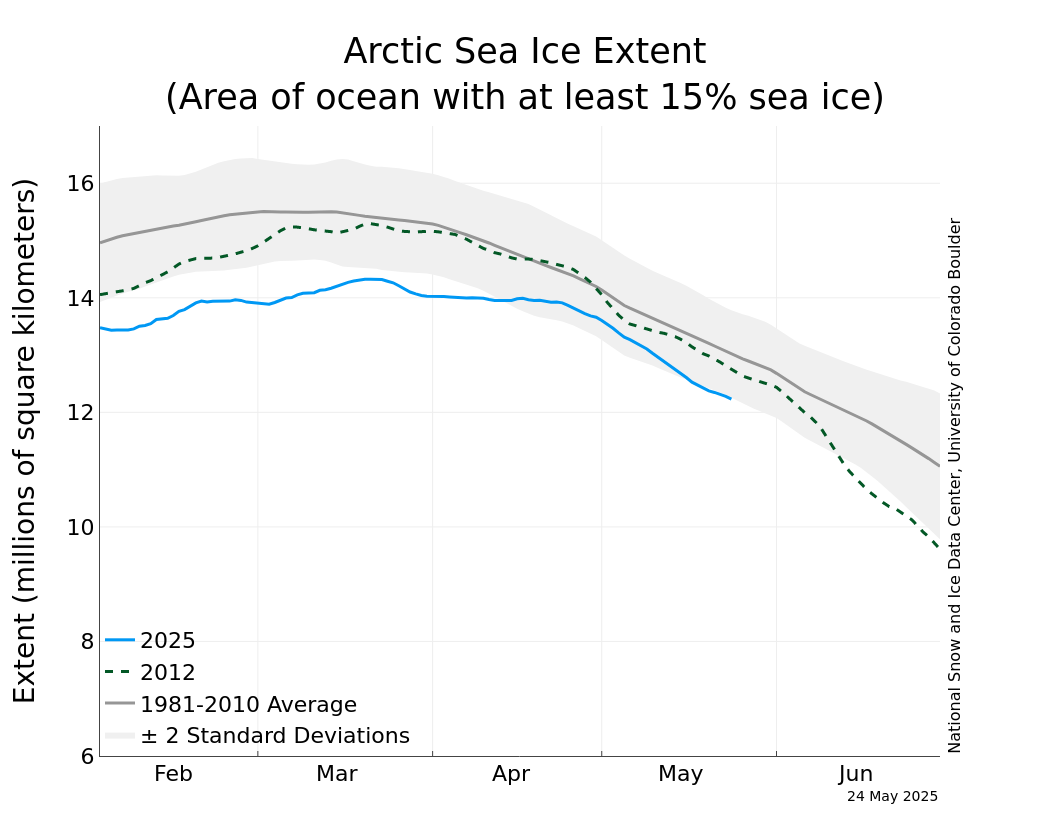

Scientists in the US have presented one of the most dramatic forecasts yet for the disappearance of Arctic sea ice.
Their latest modelling studies indicate northern polar waters could be ice-free in summers within just 5-6 years.
Professor Wieslaw Maslowski told an American Geophysical Union meeting that previous projections had underestimated the processes now driving ice loss.
Summer melting this year reduced the ice cover to 4.13 million sq km, the smallest ever extent in modern times.
Remarkably, this stunning low point was not even incorporated into the model runs of Professor Maslowski and his team, which used data sets from 1979 to 2004 to constrain their future projections.
|
 In the end, it will just melt away quite suddenly In the end, it will just melt away quite suddenly  Professor Peter Wadhams
|
“Our projection of 2013 for the removal of ice in summer is not accounting for the last two minima, in 2005 and 2007,” the researcher from the Naval Postgraduate School, Monterey, California, explained to the BBC.”So given that fact, you can argue that may be our projection of 2013 is already too conservative.”
========================================
Joe Romm wrote up a clever piece last year on this subject:
Exclusive: New NSIDC director Serreze explains the “death spiral” of Arctic ice, brushes off the “breathtaking ignorance” of blogs like WattsUpWithThat
June 5, 2009
I interviewed by email Dr. Mark Serreze, recently named director of The National Snow and Ice Data Center. Partly I wanted him to explain his “death spiral” metaphor for Arctic ice
So now that Arctic ice has returned to normal extent and area, we eagerly await the explanation from the experts about how that fits into the “death spiral” theory. Richard Feynman famously said “Science is the belief in the ignorance of the experts.”
Time will tell. 2010 is looking promising for sea ice recovery again. After all, who wouldn’t want the Arctic Sea ice to recover? WUWT is predicting a recovery again this year, which we started mentioning as a prediction last fall.
So given what we know today, what will NSIDC highlight in their April Sea Ice News?
And even more importantly, will the MSM cover it like they do the ‘terrible’ minimums?
NOTE: The poll code got messed up, duplicating an entry, press REFRESH if you see a double entry. -A
Forecasting The NSIDC News
NSIDC puts out an article about once a month called the Sea Ice News. It generally highlights any bad news they can find about the disappearance of Arctic ice. Last month’s news led with this sentence.
In February, Arctic sea ice extent continued to track below the average, and near the levels observed for February 2007.
But March brought good news for the Polar Bears, and bad news for the Catlin Expedition and any others looking for bad news. Instead of ice extent declining through March like it usually does, it continued to increase through the month and is now at the high (so far) for the year.
http://nsidc.org/data/seaice_index/images/daily_images/N_stddev_timeseries.png
The Danish Meteorological Institute shows Arctic ice extent at the highest level in their six year record.
The Norwegians (NORSEX) show Arctic ice area above the 30 year mean.
Joe Romm wrote up a clever piece last year on this subject:
Exclusive: New NSIDC director Serreze explains the “death spiral” of Arctic ice, brushes off the “breathtaking ignorance” of blogs like WattsUpWithThat
June 5, 2009
I interviewed by email Dr. Mark Serreze, recently named director of The National Snow and Ice Data Center. Partly I wanted him to explain his “death spiral” metaphor for Arctic ice
So now that Arctic ice has returned to normal extent and area, I eagerly await the explanation from the experts about how that fits into the “death spiral” theory. Richard Feynman famously said “Science is the belief in the ignorance of the experts.”
So what will NSIDC highlight in their April Sea Ice News?
-
The increase in both ice extent and quantity of multi-year ice
-
The long-term downwards linear trend line
-
The lack of 4+ year old ice
Sponsored IT training links:
Get free resources including 642-972 tutorial and 1z0-048 dumps questions for guaranteed success in JN0-532 exam.
DirkH (06:24:02) :
Shifting goalposts.
Not at all. The reason is this. When average thickness over a considerable area drops below a threshold of about two feet, it wil break up and melt very quickly over that entire area. This is what you could see happening over de summers from 2005 to 2008. It is an example of ‘catastrophe’, a physics-mathematics concept (so please make no alarm of it).
I do have to say this is the first time on this web page and I have found it to be most interesting in many ways. First the professional way the information was presented and second the bloggers where so polite and also seemed to be very knowledgeable in there own right.
I’m looking at this from a totally deferent point of view. In the world today, we find our self’s with a broke financial system (a globally broke financial system).If you were a global leader, and knew that the global financial system was going to collapse with 15 years or so, a plan would be needed to be put in place to keep the governments financial system working. In addition, this plan needs to address the economic issues of food, population and self defense. This is where it gets interesting. Looking at the EU and the US, how could you get all these governments to work as one, in light of what was to come. A New World Government thru the UN, it would work as the frame work of the new World Government. The Question is, how will it be financed?
And this is where Al Gore comes in; he and Enron come up with Cap and Trade as way of taxation on a balanced and fair basis. So how dose a global leader convince the people, we have to track Carbon Emissions? What else, but GLOBAL WARMING! This gives you two things. It is something that all countries create to some extent, and it will be a good thing for the world to get a handle on, before we change the planet for worse with our emissions. This will give the green people, the conservatives and the liberals something to rally around. The fly in the ointment has been that the climate has not been cooperating. Please don’t misunderstand me; something needs to be done about the trash, waste by-products and air pollutants of the industrialized countries. But make no mistake; the global warming charade is about the creation of a world governance and domination. Do I have a better plan NO, but way not just come cline, and tell the truth? In the case of the US it has a constitution and as for the others well it’s overwhelming to think of it all.
What will the AGW people come up with? Simple:
THEY WILL STOP THE CLOCK!
Already in the NYT ALL the Arctic ice animations stop at 2007. Ditto for most ice extent sites.
The time will be FOREVER NOVEMBER 2007!
Like the meteo guy in the movie, we’ll be from now on in Groundhog day….or rather the polar bear going for a swim year.
David Alan Evans (21:30:26) :
Anu (20:02:48) :
You’re avoiding the questions!
Did you follow up on the 1938 article?
No, but if you gave a link to the 1939 NYT article you mentioned, I would have read it.
Remember, that was 85°N in December!
The Syedoff was frozen in at that latitude on the 18th of December
It was free again in February of 1939!
The article mentions drift, although yes, very far north.
Remember that those images of sea ice “extent” are for areas that have at least 15% ice – hence, up to 85% open water.
http://nsidc.org/data/seaice_index/images/daily_images/N_bm_conc.png
What looks like “solid sea ice” could in fact be lots of ice floes, drifting, colliding, opening cracks for ships to drift in, or just drifting with the ship lodged inside.
I don’t know how far north a ship could get in February these days, but drifting north over a few years, from free water to free water as the ice floes drift, doesn’t give a good overall picture of the Arctic ice.
You still think the pre-1979 estimates are accurate?
For that chart I showed, I was mainly interested in the post-satellite era data.
http://arctic.atmos.uiuc.edu/cryosphere/IMAGES/seasonal.extent.1900-2008.jpg
Although that big dip at 1940 is interesting – are you sure the ship was freed in 1939, not 1940 ?
I ask again; when does Amunden get written out of history & transferred to folklore?
Amundsen took 3 years to traverse the “Northwest Passage”. Sitting and waiting for the ice floes to shift, and summer melts, doesn’t exactly prove that there was much less ice’ back in 1903-1906. He had the money and supplies to wait around long enough to be the “first one”.
http://en.wikipedia.org/wiki/Roald_Amundsen
Today, with the vanishing Arctic Ice, the HANSEATIC German cruise ship did the same traverse of the Northwest Passage in 19 days in 2007.
Both don’t prove what the overall ice in the Arctic was doing, but the difference is, we have the satellite data for 2007.
Amino Acids in Meteorites (07:14:22) :
I think we can all agree though, no matter how you spin the math, that the ‘North Pole ice free in 5 years’ forecast is a profound fail? When I say all I mean all, even Anu, R Gates, and barry too.
Certainly we can all see that prediction is wrong.
————
Do you mean the prediction that the Arctic summer might be ice free by 2013 ?
http://news.bbc.co.uk/2/hi/7139797.stm
I predict your prediction about the prediction is wrong. But we won’t know if I’m right till October 2013.
Frederick Michael (22:43:58) :
You are right that JAXA is reporting new figures — JAXA is legit and Roberts “bet” was not wise. However, there is a malfunction. The number at the top of the page (14,376,406 km2 for April 1) is normally the 3 day moving average. But, click on download data and you’ll see that the posted number should be higher.
??
————
I see The latest value : 14,395,000 km2 (April 1, 2010) , right now.
But it is strange that it still says April 1. Like we are getting a cached version of the page, and the main server has crashed. Maybe too many eager viewers…
Huh. My $110 billion might be in jeopardy here, although technically, I’ve already won.
“”” Billy Liar (16:28:04) :
George E. Smith (13:37:37) :
‘basically nothing much has happened, other than a big wind storm in 2007 which blew a lot of arctic ice away’
There has been a lot of talk on WUWT about the effect of wind on Arctic ice but I have not seen any reference to two other factors which might have altered the situation in 2007.
http://ocean.dmi.dk/arctic/meant80n.uk.php
Temperatures above 80N were much higher than the mean in the winter for 30-60 days in both 2005 and 2006; 18C above the mean in February 2006 for a short time. This will have affected the growth in the thickness of the ice in winter.
2007 was also apparently ‘a record breaking year for Eurasian river inflow
to the Arctic Ocean’. See:
http://iopscience.iop.org/1748-9326/4/4/045015
The ‘record breaking’ inflow of fresh water carrying heat from Siberia may also have affected the ice remaining in the summer.
Any expert care to comment? “””
Well Billy, I’m not an expert, and I’m not familiar with the details of the river flows you mentioned; but I do have some thoughts about it.
First off, I would not usually refer to Siberian Rivers as sources of warmth; but I have no numbers to compare the temperatures of Siberian river waters to ocean surface waters such as the gulf stream that flow up into the arctic regions. I don’t have a good topo map of Siberia; but the map I do have shows a good number of significant rivers, that seem to flow straight north, with not much wandering, and that suggests to me that they flow out of mountains that run East-West; or at least highlands, so they likely are cool waters (but I don’t know that).
Of course that is also fresh water, so it would be lighter than salt ocean water, and presumably float on top of saltier waters; and even moreso if it is in fact warmer than the ocean.
But if you do have a surface warmer fresh water layer, or lower salinity layer flowing into the arctic ocean it also would freeze at a higher temperature than the saltier water. Who wins, I wouldn’t even hazard a guess. If those seas were relatively stormy which we are told they were, that might cause enough turbulent mixing to change the situation. In any case; would such rivers be major water flows compared to ocean currents?
But your thoughts indicate the situation is far from simple.
Others have commented that with the more open water, there would be a lot of solar energy fed into the water, that would normally be reflected off the ice.
Steve Goddard points out that the sun angle is low at the fall ice minimum. The JAXA ice graph shows 2007 minimum was right around the Autumn equinox, so the sun would be on the equator, and the pole would be tilted in a plane at right angles to the orbital radius.
So my stick on a sandy beach geometry says you have the sun on the horizon at the poles (both of them); which puts it at 23.5 degrees above the horizon on the Arctic circle (and Antarctic circle.)
So now water has a refractive index (solar spectrum) of about 1.333; which gives a critical angle of 48.6 degrees (which doesn’t matter much here); and the Brewster Angle is 53.1 deg (Arctan(N)). So this is the angle of incidence (from the normal) for which the surface reflection is plane polarised; with the surviving plane of polarization being perpendicular to the plane of incidence (I believe that is the Electric Vector), so that angle would be 36.9 deg above the horizon, so it is well above the sun angle.
So now what do we know ? At normal incidence the reflection coefficient off water for solar spectrum (average) is 2% ((N-1)/(N+1))^2. Taking (N) as 4/3, we have ((1/3)/(7/3))^2 = 1/49; 2% as I said.
If you do the full Fresnel Polarized reflections formulae, you find that at the Brewster angle, the perpendicular polarization Reflection coefficient goes to zero; and the Parallel component Reflection coefficient, typically about doubles, at the Brewster angle. The net result of all of this is that the total reflection coefficient for both polarizations remains almost constant over incidence angle (off normal) up to the Brewster angle; but after that, both polarizations have reflection coefficients that rapidly move towards 100%.
I’m not going to try do the math in my head; because the equations are complicated Trig functions; but if you have a sun angle of 23.5 deg (arctic circle) and a Brewster angle that is 36.9 deg from the surface, then at least the perpendicular component reflectance is greatly increased.
I do know that for glass, with (N) = 1.5) the normal reflection coefficient is 4%, and the Brewster angle is 56.3 deg; which would be a 33.7 deg sun anghe. For a 23.5 deg sun angle the perpendicular reflection coefficient is already over 20%, while the parallel coefficient is still very small. So 20% of half the energy is still 10%. So that is for N = 1.5. The starting point is lower (2%) for N=1.333 but the Brewster angle is larger, so the sun angle has more effect. So I would say about 5% reflectance on the arctic circle and climbing rapidly above that towards the pole.
You are actually above 70 degrees for most of Siberia, and even higher for Canada, and Greenland, so the water surface reflectance (flat water) can become significant.
This comes up so often, I probably should calculate a table of reflectance versus sun angle for flat water.
That’s one of those things that should be in text books but isn’t. Well you can find graphs, but they are always unreadable beyond the Brewster angle.
Adrian O (09:03:24) :
“The time will be FOREVER NOVEMBER 2007!
Like the meteo guy in the movie, we’ll be from now on in Groundhog day….or rather the polar bear going for a swim year.”
Groundhog Day? That means we need to bring out Phil. to clear up this situation. So what say you Phil.? I seem to remember that one year ago you were somewhat pessimistic about the outlook for summer minimum in 2009. Since I gather you have some professional expertise on the subject matter, will you amuse us with your prediction for sea ice minimum for 2010?
Anu (09:46:48) :
“Huh. My $110 billion might be in jeopardy here, although technically, I’ve already won.”
When we see what kind of stash Anu is raking in after just one evening in front of the machine, I would expect everyone would like to get in on the action and place their bets for summer minimum 2010.
The CBC story referred to by Elizabeth (Canada) was also carried by the Toronto Globe and Mail, with a different headline: “Arctic ice makes surprising comback”. This is rather surprising given the Globe’s strong AGW views and its failure to cover other stories that do not fit in with the AGW views.
I tried to find a more complete version of Mark Serrese’s statement on the NSIDC web-site, but no luck (or no skill)
Let me get this Bet thing right: as my fear is for:
… _Zero_ Sea Ice in the middle of the Arctic Ocean, by August
[NOT because of AGW, but because the expected Weak El Nino turned into a 1.8, and is starting from a previous minimum of 9% less than 2007’s smaller 1.1 El Nino started from (leading to double or more melting)
+ False Environmentalists’ Carbon Caps’ forgiving of Diesel Soot & cutting of SO2 = more Sun is absorbed:
–50 % Something Happens ( Go Volcanos GO ! ) = I lose my shirt.
–25 % It all melts Off — The World Panics — The currents DO NOT stop — and everyone is baying for my blood.
–25 % … I collect, I’m famous for 3 months — then We all die.
I want to crawl under the covers & hug a stuffed animal.
Thanks for the thoughtful reply, phlogiston. It was interesting.
If one is describing climate as such a system, bear in mind that chaotic- nonlinear systems operate within a multi-dimensional phase space – time is one of these dimensions. So the change (for instance) in climate patterns with time is part of the emergent pattern from such an oscillatory reaction-diffusion type system.
That was (one of the) impression/s I got from the papers: change in patterns (eg, from turbulent to oscillatory) under certain conditions with time).
I’m not sure how this fits into the argument that ‘negative feedbacks can result in ice age changes’. I don’t think the papers address whole-system amplitude changes at all (the whole system getting warmer or cooler), and inference towards that conclusion is a leap beyond the domain of the discussion (of the two studies I was able to access).
People sometimes refer to Lindzens’ theories of a dominant negative feedback in the climate system. He has not explained how big climate swings (like ice age changes) can manifest if the system tends towards stability – with a low climate sensitivity to forcing. Couple that with the observation that his views are real outliers – on the extreme edge of the body of understanding – and I’m not sure why his conclusions are pre-eminent in some quarters.
I am in no position to judge or diss Lindzen, but I am intelligent enough to judge, like you, qualitative arguments within the bigger picture. A common qualitative rebuttal to AGW is that ‘the climate has changed before – it’s been much warmer and much cooler’. The first thing I note, thus, is that there seems to be a contradiction in the skeptical position. The skeptics argue on the one hand that climate is highly variable, implying a large-ish climate sensitivity – positive feedbacks are dominant. On the other hand, skeptics invoking Lindzenesque theory are supporting the idea that climate sensitivity is very small – negative feedbacks dominate. AGW theory, while retaining uncertainties, is internally consistent as a body of science. This is not so for the skeptical position, and this issue is only one of the contradictory arguments* that appear. The skeptical position seems haphazard and, generally, more concerned with negating or downplaying understanding (as in balance of evidence) than building a cogent, alternative picture.
———————————————————
* I thought I should substantiate my assertion that there are contradictory arguments within the skeptical camp, both qualitative and quantitative. This is usually done in a way that pokes fun, or belittles. I simply want to point them out and let the reader judge from their own experience whether or not my observations are sound and my conclusions fair. Some of these dichotomies appear (as separate articles) on this site. And some of these can be applied to blog arguments on the pro-AGW side.
The instrumental temperature record is unsound / The instrumental temperature record provides proof that…
The ice core record is too diffuse (Jarowoski) to discern / The ice core record clearly shows that CO2 lags temps
Human activities couldn’t possibly have a large impact on climate / Black soot is responsible for climate change at the poles – (We can address any future problems with geoengineering)
Human activities have little impact on the atmosphere / The reason the stratosphere is cooling is because of ozone depletion from CFCs (not from GHGs)
Siting issues for weather stations introduce biases in the temperature record / Adjusting raw temperature measurements is bad science
There’s not enough skepticism and appropriate uncertainty in climate science / Climate science is unequivocally a hoax
Climate trends of the last 100 years are meaningless: you need to look at much longer periods / From Instrumental records since 2002 we know that the global climate is cooling
AGW science is groupthink – its a lie / AGW scientists X and Y disagree with each other – AGW is a lie
AGW proponents are alarmists / We’ll be committing economic “suicide” if we listen to these socialistic fraudsters (this is more hypocritical than contradictory)
Dissent should be respected / You disagree with me because you’ve drunk the Kool-Aid – (typical of both sides of the debate)
Proxy data for paleoclimatology is riddled with problems (look at the divergence issue), you can’t rely on it / The proxy data definitely show a warmer MWP than today
Proof is paramount and there is none / Skeptics do not have to prove anything **
We need lots of good data, not extrapolations from little data / Anecdotal evidence of Vikings in warm climes strongly indicate something about paleoclimate
They are focusing on one region of the world, while ignoring another (Arctic/Antarctic) / the temperature record from a few locations proves the instrumental record is wrong
Climate scientists won’t respond to criticism – they’re hiding / Climate scientists are speaking out – they’re circling the wagons
The press is not to be trusted in the way it portrays climate change / Here is another news story about the fraudulent AGW theory
The message on climate change is a political construct / Here is Senator Inhofe’s list of quotes from scientists
Ex-politician Al Gore’s film is being played in classrooms: politics should not interfere in science education / The Arizona state legislature is trying to get the skeptical view taught in classrooms. Good for them.
You can’t trust scientists who huddle together under their banner / Here is a landmark article from ICECAP, a group of AGW skeptical scientists
Science on clouds is too uncertain / Clouds provide a negative feedback/are responsible for recent warming
Skeptical papers are barred from being published in the literature/ Here are 100 peer-reviewed science papers, written by scientists with the appropriate qualifications, calling AGW into question
CO2 doesn’t have much impact – it’s a tiny fraction of the atmosphere / CO2 will make things warmer, which is a good thing, and it may save us from the next ice age. Our CO2 output will increase plant growth
Consensus isn’t science, it’s the quantitative evidence that matters / Here’s a petition of anti-AGW scientists
(And relevant to the topic….)
There was a big hoo-hah over sea ice extent in 2007 – that’s only one year! / The sea ice extent of the last month means that the concern about the Arctic has “just gone down the drain” (Steve Goddard above)
———————————————-
** This is perhaps the most intellectually corrupt argument I know of. Our side need prove nothing, your side must prove everything. It is particularly egregious when ‘our side’ contains so many contradictions. Anything that doesn’t cut both ways equally is outside the bounds of reason and reasonableness. I think it comes from a confusion between deductive reasoning (‘proofs’), and inductive reasoning (‘cogency’). The former is mainly the province of law and mathematics, the latter is the largely the province of many natural science theories (eg, medical, evolution).
As I said, some of the above apply to the pro-AGW camp in the blog wars. I have seen protagonists be just as illogical and insulting as antagonists.
Pamela Gray (06:03:24)
As the saying goes, why use 10 words when 100 will do. BTW John Gribben is a very readable and lucid author, “Science: a history” another entertaining one by him (post-renaissance).
“After all, who wouldn’t want the Arctic Sea ice to recover? WUWT is predicting a recovery again this year, which we started mentioning as a prediction last fall.”
Would you please send me a copy of your model code and all relevant data?
barry (20:25:02):
No kidding, boy.
Prof Richard Lindzen is the head of MIT’s Atmospheric Sciences department, universally esteemed as a world class climatologist — not limited to, as you so disparagingly say, “in some quarters.”
And so far, Prof Lindzen has been more accurate regarding both the climate and the political shenanigans surrounding CAGW than anyone else. The fact that you so desperately attempt to denigrate someone who has forgotten more than you will ever learn about the climate says it all.
Tom W (20:32:30) :
Believe it or not, people used to do science before computers were widely available. Back then, they had to rely on their brains.
You can generate a lot of GIGO with a teraflop of compute power.
Steve Goddard (11:38:32) : “Believe it or not, people used to do science before computers were widely available. Back then, they had to rely on their brains.”
You don’t use a model? Then tell us about how you went about making your ‘brainy’ prediction. I hope you didn’t use data as that would imply someone else used the computer for you.
“You can generate a lot of GIGO with a teraflop of compute power.”
As you can with the brain. Really smart people can use both their brain and a teraflop of computer power intelligently.
Tom W (16:16:35) :
Do a search for Steven Goddard Arctic in the search box at the upper right corner. Since you haven’t read my articles, there isn’t a whole lot of point in answering your imagined criticisms of them.
Smokey (21:11:32) :
barry (20:25:02):
“People sometimes refer to Lindzens’ theories of a dominant negative feedback in the climate system. He has not explained how big climate swings (like ice age changes) can manifest if the system tends towards stability – with a low climate sensitivity to forcing. Couple that with the observation that his views are real outliers – on the extreme edge of the body of understanding – and I’m not sure why his conclusions are pre-eminent in some quarters.
I am in no position to judge or diss Lindzen…”
No kidding, boy.
Prof Richard Lindzen is the head of MIT’s Atmospheric Sciences department, universally esteemed as a world class climatologist — not limited to, as you so disparagingly say, “in some quarters.”
Actually he isn’t, Maria Zuber is the department head. The above is a fair description of the status of his Adaptive Iris theory, not many takers!
The fact that you so desperately attempt to denigrate someone who has forgotten more than you will ever learn about the climate says it all.
There are plenty here who do that, you’ve done your fair share.
Barry (20:25:02)
A transition in climate even as large as a jump from glacial to interglacial and the reverse, does not necessarily need to be a whole system amplitude shift. These large shifts like all shifts can be consistent with non-equilibrium / nonlinear pattern. One needs to start taking a step back from the minutiae and viewing the characteristice of the system as a whole, looking at what indications are given by such whole system characteristics. (Note however that one of the catogories of nonlinear oscillation studied in Matthias Bertram’s thesis was amplitude oscillation).
Non-equilibrium pattern formation (NEPF) phenomena are much more pervasive in natural systems than generally recognised. Modern research into such chaos-related phenomena began with the work of Mandelbrot and Prigogine and others several decades ago, but it has remained confined as a periperal curiosity, (except perhaps in chemical engineering) and major fields such as biology, biochemistry and climate whose systems and phenomena are probably dominated by NEPF have to date paid little more than lip-service to this paradigm for viewing natural processes.
Certain things are diagnostic of a system where NEPF is operating:
1. Complexity and a multiplicity of factors and agencies operating in potentially limiting (negative feedback) and reinforcing modes (positive feedback);
2. Being far from equilibrium: with a complex and dissipative rather than simple energy flow through the system;
3. Being “dissipative” in that there is a constant flow of energy into the system and dissipation of energy by a multiplicity of interactions by the system (“dissipation” is sometimes referred to as friction or damping);
4. Being characterised by a fractal type of complex pattern
5. Associated with fractal pattern is the “power law” or log-log pattern of the magnitude of system changes.
6. Attractors: NEPF systems are characterised by the phenomenon of attractors, or “strange attractors”. These are states that the system preferentially adopts for no clearly apparent reason. Mathematically speaking these are limited regions of the multi-dimensional phase space of the system to which the evolving system converges. There can be multiple attractors, and systems can switch periodically between attractors.
Climate meets all of these diagnostic criteria. The complexity and mix of negative and positive feedbacks is not in doubt. And as long as winds are still blowing and ocean currents still flowing, equilibrium is never close to being reached (a world at climate equilibrium would be stagnant with static atmosphere and ocean); indeed all climatic phenomena – winds, ocean currents, clouds, precipitation, represent dissipative energy flow and the seeking of equilibrium that will never be attained. Biological systems and organisms also exhibit clearly all five of these criteria – the only time an organism is at equilibrium is when it is dead.
The fractal-like power law or “log-log” pattern in the case of climate this is observed as follows. Take a simple metric like the long term reconstruction of a meaningful metric of global climate state (sea level, amount of glaciation, temperature, ocean salinity etc.) For example from the ice core reconstructions (which BTW validate eachother and I have no problem in accepting). Define a short period – say 100 years of something, and divide the record into intervals of this duration. Calculate the change in the climate parameter (oxygen or deuterium isotope ratio, etc) over each of these intervals. Then simply make a plot of the magnitude of the changes in the measured parameter from each interval to the next, with the change magnitude along the x axis and the frequency of the observed parameter change (from one interval to the next) in the y axis: and importantly, both x and y axis are plotted as log. A chaotic system displaying NEPF will exhibit a linear relationship in this log-log plot. This means that very small changes are very frequent, and the frequency of larger and faster jumps – to either warmer or cooler climate or more or less glaciation for instance – decreases in a double-logarithmic manner with increasing sharpness of change, with the big glacial-interglacial switches being very infrequent. The slope of this log-log plot is defined as the fractal dimension.
Chaos itself is not what we are talking about here; the random and turbulent system characteristics of pure chaos are not amenable to much productive analysis. The pattern-rich NEPF phanomena occur at the boundary between linear and non-linear behaviour, at the onset of chaos: mathematically this is where system bifurcations begin to occur and spread in an avalanch-like manner, such as the Hopf bifurcations described in the study by Bertram. (You can see this transition if you turn on a tap gradually: first drip-drip then a smooth linear flow. Eventually when fully open you get the turbulent chaotic tumbing of water at maximum rate. However there is a narrow transitional region between linear and turbulent, in which osscillating and comlex flow patterns can be observed.)
Despite it being abundantly clear that climate is a non-equilibrium system, a large part of climatic research, especially the radiative balance CO2 story, focuses on a limited hypothetical scenario of equilibrium. In fact much of modern physics does exactly this – it isolates the small islands of exceptional linearity and equilibrium and focusses study and research on such systems, ignoring the much larger seas of chaotic non-equilibrium characterising the natural world. It is easy to see why – science is described as the “art of the do-able”. Its only fun and rewarding to do mathematical-based physics in systems that follow orthodox mathematical laws and allow predictions to be made mathematically.
I can hear your counter-argument to this already – “yes but the global energy budget is not chaotic but very simple – solar energy in minus energy radiated out from earth. No role for chaos except in small scale internal systems within earth’s climate. CO2 back-reflection of IR means hotter earth, end of story”. I will not get sucked into the CO2 atmosphere radiation argument, except to briefly refer to many proposed mechanisms that could easily negate the CO2 greenhouse effect, such as tropical clouds and thunderstorms, absence of the required – and somewhat improbable – strong positive feedback of water vapour to CO2, the narrowness and possible saturation of the IR absorbance band of CO2 etc.
BTW the debate about “climate sensitivity” is a good case in point. Engaging in this debate pre-assumes CO2 driven warming – the only argument is about its magnitide. Again one is distilling and compressing all climate complexity into a simple linear scanario, which does not necessarily connect to the dynamically complex non-equilibium nature of the actual system. Thus I’m not that interested in the question of climate “sensitivity” which pre-supposes what is driving climate: instead we are in reality at an earlier stage, needing to understand what does and does not drive the complex and chaotic dynamics of climate.
However in terms of what people engaged in the climate debate are chiefly interested in, i.e. is global climate getting hotter or colder in some defined sense, confining such a debate to one simply of global radiative balance is, in the context of system comlexity and NEPF, an “argument ad absurdam”. It is not even necessary to argue that the earth as a whole gets much colder during an ice age. A shift to a mode of reduced energy distribution from the tropics poleward features in several models of glaciation. It is clear that a major climate shift between glacial and interglacial involves a strong positive feedback operating for a limited period. Such a temporary feedback could easily be, for instance, increased albedo and reduced radiative heat input due to spread of ice and snow (white surface area). You do not need therefore to demonstrate a major change in the “global” energy budget of the earth (solar input minus earth radiation) in order to believe in an ice age.
In the currently unfolding climate, the northern hemisphere in particular has experienced a series of cool summers and severely cold winters. AGW proponents argue that, counter-intuitively, global climate is none-the-less still warming, taking heart from sattelite measurements of warm patches in the tropical Pacific ocean for example. However this could be false comfort, since periodic cooling of high-latitude climate may be associated with a mode of decreased tropical to polar heat redistribution, in which case tropical warming is even expected alongside high latitude cooling. Indeed Kukla’s model of glacial onset involves transition to glaciation being associated with a period of overall global warming.
Going back to the previous posting, climate dynamics over long historical periods including the cycles of glaciation, show compelling analogy to a reaction-diffusion system that is driven by periodic forcing and exhibits non-equilibrium pattern formation and associated complexity. The phenomenon of alternating glacial and interglacial states during glacial epochs such as the current one, are a classic example of a chaotic-non-equilibrium system flipping between attractors. It is interesting to note in this context that during periods of glaciation (about 10 times longer than interglacials) there are sometimes very brief periods when climate warms to almost interglacial levels, then drops back to glacial – these can be as short as less than a century. It is impossible to argue that such brief phenomena could be linked to CO2 and radiative forcing, since even AGW proponents concede that in the palaeoclimate record warming precedes CO2 increase, and that CO2 somehow mysteriously displaces the initial causes of warming to become the predominant driver only a few centuries into the warming cycle.
No, such brief flips are much more consistent with attractor switching. In a NEPF context, attactors are described pictorially as valleys in a landscape of probability (with high altitude meaning improbability) – valleys represent attractors that can be linked by passes or “saddles” allowing systems to find energy routes to move from one attractor to another.
Therefore to summarize, the type of complexity and non-equilibrium pattern formation (NEPF) within which negative fedback plays a role, can explain switches between glacial and interglacial without the need to demonstrate a large “amplitude” change in global energy. What you would describe as “internal” system dynamics can produce periodically (according to a characterstic log-log frequency pattern) major and time-limited shifts in – among other things – global feedback, thus having profound impact on the total system.
So chaos and non-linear / non equilibrium dynamics can have a role in global climate, not only within fine scale local processes.
In fact it is impossible to imagine the climate system dominated by either negative or positive feedback in a strictly linear sense. In that case, if negative feedback predominated you would indeed have flat-line stasis, while if positive feedback predominated you would have run-away change to terminal heat or cold and no life. (But we do have life and we are here having this debate – a “weak anthropic” argument.) Some postings here on WUWT such as Willis Eschenbach’s articles on Bejan’s “constructal law” point to the apparently regulatory and adaptive nature of non-equilibrium dynamic systems and how these have provided us with our otherwise improbably stable, life-supporting climate over the last few billion years.
(In fact decreasing atmospheric CO2 over palaeo-history could even be a Gaia-response of the biosphere to the 25-30% increase in solar input over the last 4 billion years – however this might give new ammunition to C-AGW so I wont go there!)
Finally you indulged in some attacks on apparent contradictions in climate skeptical arguments. I wont go into the details of these as I regard this line of attack as unfair. It is obviously in the naure of the cliamte blogosphere that there will be as many arguments and points o view as there are independent thinkers who question C-AGW orthodoxy. To point to contradictions between the mllions of independent opinions gives some satisfaction no doubt but underlines the weakness of the establishment scientific process – principally its closed nature and its vulnerability, due to its closed and elitist structure, to hi-jacking by a political lobby.
To give an analogy – here is a conversation between a pair of North Korean generals, on their way to an evening of entertainment watching political prisoners being poisoned by experimental chemical weapons. They discuss the contradictions between democratic politicians in Western countries:
General 1: “You know, it is easy to discredit democracy. There is so much contradiction between politicians. For instance, take the USA. The Obama health care reform is much needed and fundamentally right / it is dictatorial and socialistic and must be opposed.”
General 2 “Or – the war in Iraq was justified to remove Saddam Hussein / the war was illegal and a huge mistake!”
General 1: “What about global warming – it is a serious threat and we must start taxing CO2 emission / the evidence is not clear and we must not damage the economy responding to hypothetical and possibly non-existent threat. Ha ha ha!”
General 2: “How about this one – employers and employees should be allowed flexibly to work as many hours as necessary / there should be a rigid 35 hour week.”
General 1: “This is a good one – we must have a nuclear deterrent / we must have nuclear disarmament”
General 2: “These guys must be tired of life or soft in the head!”
This selection of contradictory opinions could easily be continued indefinitely. But it does not point to the weaknes of democracy – it points instead to its strength.
Finally, the impact of the blogosphere and blogs such as WUWT in the climat debate, and scienctific research in general, is I feel even more profound than has been realised up to now. Looking for a historical parallel, one is drawn to the Reformation of the Catholic Church in the 16 hundreds. Note this coment is not an atack on Christianity, only a comment on the abuse of the institutionalised control of belief in the population.
Here are the essentials – at a certain time (I don’t have the dates to hand) the Roman catholic church was short of cash for a big cathedral project in Rome. So they came up with the idea of “indulgences” – essentially credits for sinning. In the population there was at this time strong belief in the afterlife, with options of heaven, hell or purgatory – a kind of time-limited hell, a place to serve time for sins committed during ones life.
However the experts in the field – the ones who published in the peer-reviewed journals of the time, the professional and only ones qualified to have opinions on such matters – revealed some new research that showed that the large population of saints of the christian church, both past and present, had done so many righteous deeds that they had accumulated an “excess of righteousness” and further, the Catholic Church had the authority to issue paper certificates representing certain units of this righteousness excess that had the effect of reducing or eliminating the time in Purgatory due to the purchasor of this certificate – the so-called “indulgence”. Sale of these indulgences was strongly marketed in a slick PR capaign that spoke of “souls leaping from Purgatory”.
The parallels with carbon credits and the IPCC are too obvious to mention. However the excessive nature of this cynical corruption and exploitation of the ignorance and gullibility of the population offended particularly Martin Luther, resulting in his research into the bible and formulation of protestant theology which emphasised individuals search for truth in their own right and without needing officiation of the formal church, and the famous 99 postings on the door of the Wittenburg cathedral (WUWT is a contemporary analogy of the Wittenburg door) . The stimlus for independent intellectual activity was given a powerful assist by the coincident development of printing technology. Now groups with non-orthodox religious beliefs were able to quickly print large numbers of books or pamphlets fuelling the spread of many new protestant groups.
Things have come full circle since then with publication of scientific research again falling under political control similar to that of pre-reformation Roman Catholic Church, with opponents of established partly lines on each subject being marginalised and subjected to viscious personal attack as heretics. But the emergence of the internet and bloging has created a new communication technology whose role is similar to that of the printing presses during the Reformation. A major strength of the blog is that a scientific debate can continue indefinetely with many communications on both sides – until they get bored and move on. By contrast the interaction between a scientific journal and submitting authors is much more terse. The decision of acceptance or rejection of a paper is very often a process of tribalistic bottom-sniffing, but with an attempted smokescreen of “scientific” argument to support it. Often there is outright corruption where valueable discoveries are concerned – it is a well-known phenomenon for a new scientific idea to be rejected by a – conveniently anonymous – reviewer, only for said reviewer to publish the idea him/herself a few months later.
The scientific communty is suffering the discomfort of the population wising up to the corruption that is fostered by its opaque and closed practices, and the political exploitation of scientific research on climate and other issues that are examples of this. The blogosphere could become an important parallel forum for scientific debate and exchange of ideas which, by contrast, is refreshingly open and transparent and thus receiving more trust and attention from the scientific polupation. Even inspite of the odd apparent contradiction (real or otherwise).
Steve Goddard (20:23:08) :
Tom W (16:16:35) :
Do a search for Steven Goddard Arctic in the search box at the upper right corner. Since you haven’t read my articles, there isn’t a whole lot of point in answering your imagined criticisms of them.
Criticism? All I did was ask you to reveal the methods underlying your claim that “WUWT is predicting a recovery this year”. All I got back was a sarcastic remark about computing.
I’m still waiting. If your ‘methods’ are secret, just say so.
Tom W (05:37:35) :
Do a search for Steven Goddard Arctic in the search box at the upper right corner. And read the articles. I am not going to reproduce them here for you.
“Do a search for Steven Goddard Arctic in the search box at the upper right corner. And read the articles. I am not going to reproduce them here for you.”
I did and found nothing worthy of beging called an ice prediction model.
Reply: It’s not really gambling if it doesn’t hurt to lose. You were offered a reduced bet from 5000 to 1000 dollars. You made feeble mumblings concerning trustworthy third parties and moved on. You cringed and ran and now wish to make “gentleman’s bets”. I have respect for Tom P. He is willing to put his money where his mouth is. You are all talk, no conviction. ~ ctm
I’ve raised my chance of winning the bet to 100%.
But I am no longer willing at all to place a bet here.
You will see the ice melt, like you are seeing a moderate El Niño taking 2010 to record warm heights.
Reply: Yawn. ~ ctm
Reply: Yawn. ~ ctm
I know. It’s getting warmer all the time, quite boring. Play on.
Reply: It is your ongoing cowardice that bores me. You have no conviction at all. You are a classic blog wannabe big boy. You were given the chance to make a bet you are “100% certain” of, one which could make you famous in the blogosphere for taking down the moderator of Watts Up With That. You were offered far better terms than your wildest speculation and yet you run scurrying like a cockroach from the light. You even called your evasion “courageous”. Go ahead make some more excuses before turning and running away from the door hitting you on the way out. ~ ctm