Forecasting The NSIDC News
By Steven Goddard and Anthony Watts
Barring an about face by nature or adjustments, it appears that for the first time since 2001, Arctic Sea ice will hit the “normal” line as defined by the National Snow and Ice Data Center (NSIDC) for this time of year.
NSIDC puts out an article about once a month called the Sea Ice News. It generally highlights any bad news they can find about the disappearance of Arctic ice. Last month’s news led with this sentence.
In February, Arctic sea ice extent continued to track below the average, and near the levels observed for February 2007.
But March brought good news for the Polar Bears, and bad news for the Catlin Expedition and any others looking for bad news. Instead of ice extent declining through March like it usually does, it continued to increase through the month and is now at the high (so far) for the year.
If it keeps this trend unabated, in a day or two it will likely cross the “normal” line.

The Danish Meteorological Institute shows Arctic ice extent at the highest level in their six year record.

The Norwegians (NORSEX) show Arctic ice area above the 30 year mean.

And the NORSEX Ice Extent is not far behind, within 1 standard deviation, and similar to NSIDC’s presentation. Note that is hit normal last year, but later.

And JAXA, using the more advanced AMSR-E sensor platform on the AQUA satellite, shows a similar uptick now intersecting the 2003 data line.

Source: IARC-JAXA
WUWT asked NSIDC scientist Dr. Walt Meir about this event to which he responded via email:
It’s a good question about the last time we’ve been above average. It was May 2001. April-May is the period when you’re starting to get into the peak of the melt season for the regions outside of the Arctic Ocean (Bering Sea, Hudson Bay) and the extent tends to have lower variability compared to other parts of the year as that thinner ice tends to go about the same time of year due to the solar heating. Even last year, we came fairly close to the average in early May.
He also mused about a cause:
Basically, it is due primarily to a lot more ice in the Bering Sea, as is evident in the images. The Bering ice is controlled largely by local winds, temperatures are not as important (though of course it still need to be at or at least near freezing to have ice an area for any length of time). We’ve seen a lot of northerly winds this winter in the Bering, particularly the last couple of weeks.
As we’ve been saying on WUWT for quite some time, wind seems to be a more powerful factor in recent sea ice declines than temperature. Recent studies agree.
See: Winds are Dominant Cause of Greenland and West Antarctic Ice Sheet Losses and also NASA Sees Arctic Ocean Circulation Do an About-Face
You can watch wind patterns in this time lapse animation, note how the ice has been pushed by winds and flowing down the east coast of Greenland:

Dr. Meier also wrote:
This has very little implication for what will happen this summer, or for the long-term trends, since the Bering Sea ice is thin and will melt completely well before the peak summer season.
There’s certainly no reason to disagree with the idea that much of the Bering Sea ice will melt this summer, it happens every year and has for millenia. But with a strong negative Arctic Oscillation this year, and a change in the wind, it is yet to be determined if Arctic Sea ice minimum for 2010 is anomalously low, and/or delayed from the usual time.
In 2009, WUWT noted it on September 15th: Arctic sea ice melt appears to have turned the corner for 2009
Dr. Mark Serreze of NSIDC offered some hopeful commentary in a press release back on October 6th 2009, but still pushes that “ice free summer” meme:
“It’s nice to see a little recovery over the past couple of years, but there’s no reason to think that we’re headed back to conditions seen in the 1970s,” said NSIDC Director Mark Serreze, also a professor in CU-Boulder’s geography department. “We still expect to see ice-free summers sometime in the next few decades.”
Remember this 2007 prediction from The Naval Postgraduate School?
Arctic summers ice-free ‘by 2013’
|
By Jonathan Amos
Science reporter, BBC News, San Francisco |

 |
 Arctic summer melting in 2007 set new records
|

 More details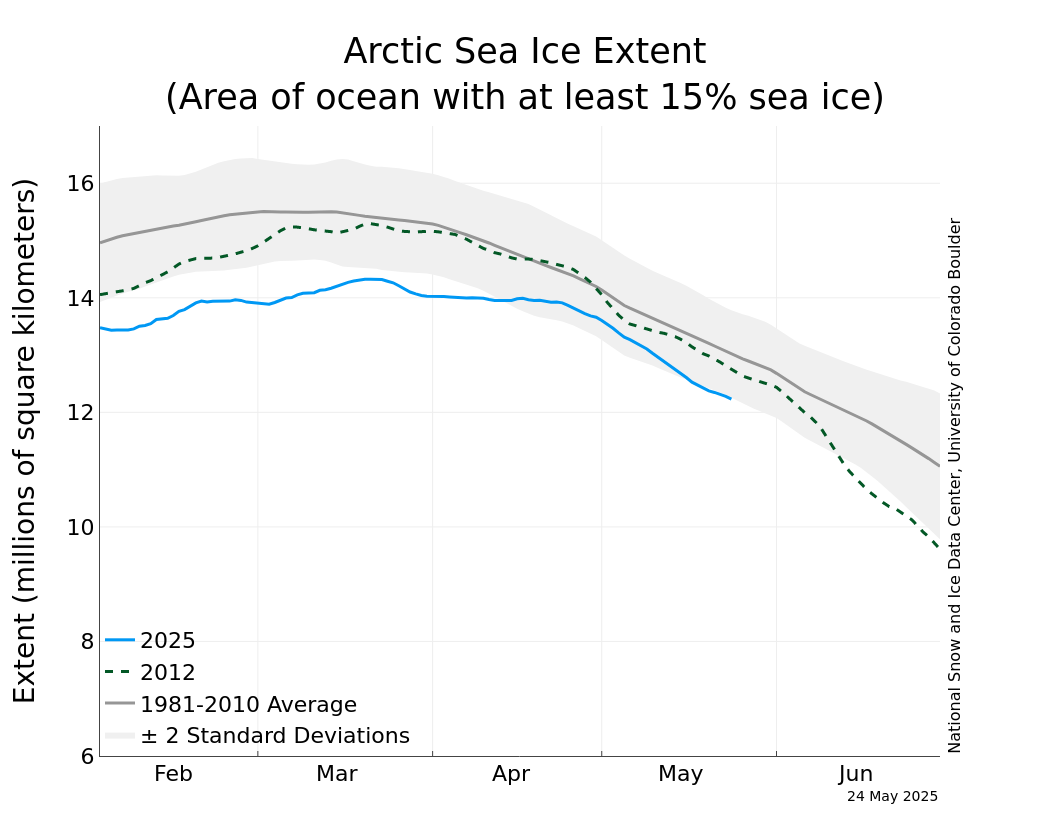

Scientists in the US have presented one of the most dramatic forecasts yet for the disappearance of Arctic sea ice.
Their latest modelling studies indicate northern polar waters could be ice-free in summers within just 5-6 years.
Professor Wieslaw Maslowski told an American Geophysical Union meeting that previous projections had underestimated the processes now driving ice loss.
Summer melting this year reduced the ice cover to 4.13 million sq km, the smallest ever extent in modern times.
Remarkably, this stunning low point was not even incorporated into the model runs of Professor Maslowski and his team, which used data sets from 1979 to 2004 to constrain their future projections.
|
 In the end, it will just melt away quite suddenly In the end, it will just melt away quite suddenly  Professor Peter Wadhams
|
“Our projection of 2013 for the removal of ice in summer is not accounting for the last two minima, in 2005 and 2007,” the researcher from the Naval Postgraduate School, Monterey, California, explained to the BBC.”So given that fact, you can argue that may be our projection of 2013 is already too conservative.”
========================================
Joe Romm wrote up a clever piece last year on this subject:
Exclusive: New NSIDC director Serreze explains the “death spiral” of Arctic ice, brushes off the “breathtaking ignorance” of blogs like WattsUpWithThat
June 5, 2009
I interviewed by email Dr. Mark Serreze, recently named director of The National Snow and Ice Data Center. Partly I wanted him to explain his “death spiral” metaphor for Arctic ice
So now that Arctic ice has returned to normal extent and area, we eagerly await the explanation from the experts about how that fits into the “death spiral” theory. Richard Feynman famously said “Science is the belief in the ignorance of the experts.”
Time will tell. 2010 is looking promising for sea ice recovery again. After all, who wouldn’t want the Arctic Sea ice to recover? WUWT is predicting a recovery again this year, which we started mentioning as a prediction last fall.
So given what we know today, what will NSIDC highlight in their April Sea Ice News?
And even more importantly, will the MSM cover it like they do the ‘terrible’ minimums?
NOTE: The poll code got messed up, duplicating an entry, press REFRESH if you see a double entry. -A
Forecasting The NSIDC News
NSIDC puts out an article about once a month called the Sea Ice News. It generally highlights any bad news they can find about the disappearance of Arctic ice. Last month’s news led with this sentence.
In February, Arctic sea ice extent continued to track below the average, and near the levels observed for February 2007.
But March brought good news for the Polar Bears, and bad news for the Catlin Expedition and any others looking for bad news. Instead of ice extent declining through March like it usually does, it continued to increase through the month and is now at the high (so far) for the year.
http://nsidc.org/data/seaice_index/images/daily_images/N_stddev_timeseries.png
The Danish Meteorological Institute shows Arctic ice extent at the highest level in their six year record.
The Norwegians (NORSEX) show Arctic ice area above the 30 year mean.
Joe Romm wrote up a clever piece last year on this subject:
Exclusive: New NSIDC director Serreze explains the “death spiral” of Arctic ice, brushes off the “breathtaking ignorance” of blogs like WattsUpWithThat
June 5, 2009
I interviewed by email Dr. Mark Serreze, recently named director of The National Snow and Ice Data Center. Partly I wanted him to explain his “death spiral” metaphor for Arctic ice
So now that Arctic ice has returned to normal extent and area, I eagerly await the explanation from the experts about how that fits into the “death spiral” theory. Richard Feynman famously said “Science is the belief in the ignorance of the experts.”
So what will NSIDC highlight in their April Sea Ice News?
-
The increase in both ice extent and quantity of multi-year ice
-
The long-term downwards linear trend line
-
The lack of 4+ year old ice
Sponsored IT training links:
Get free resources including 642-972 tutorial and 1z0-048 dumps questions for guaranteed success in JN0-532 exam.
Lori (21:19:02) :
Is this just normal normal or unexpectedly normal?
(PS I’m not good with graphs).
It’s within the normal ballpark.
Why it is being talked about here is because global warming predictions say Arctic ice should be in decline and this shouldn’t be happening. The ice totals are heading the opposite way predicted.
Anu (20:14:26) :
http://www.ijis.iarc.uaf.edu/en/home/seaice_extent.htm
Data of Sea Ice Extent
The latest value : 14,376,406 km2 (April 1, 2010)
No sudden mass melt off, no “malfunction”, no March 30th numbers.
Science marches on, reporting the data honestly as they always do.
You are right that JAXA is reporting new figures — JAXA is legit and Roberts “bet” was not wise. However, there is a malfunction. The number at the top of the page (14,376,406 km2 for April 1) is normally the 3 day moving average. But, click on download data and you’ll see that the posted number should be higher.
??
Steve Goddard (05:14:21) :
If you look at a graph of Arctic ice, you will see that the Arctic Ocean is saturated with high albedo ice through the sunny months of May-July, and the ice minimum occurs during September when the sun is setting for the winter. There is little or no absorption of solar energy in the water at that time. So loss of heat dominates. i.e. a negative feedback.
It would seem to me that this conclusion doesn’t follow. If negative feedbacks dominate as the melt season finishes, there shouldn’t be much of a delay to melt following the solstice – negative feedbacks should bring the phase change in sooner. If positive feedbacks from the summer warmth dominates (ocean albedo absorbing more heat), the warmth may be extended and ice continues melting.
Ice albedo is about 0.6. Ocean albedo is 0.06 (0 is black, 1 is white). As open water increases during melt season, the oceans absorb and store more heat.
From all I’ve read, the extended melt from solstice is a result of well-known seasonal lag in temperature shifts. This is evident from daily temp profiles, where the hottest part of the day is usually an hour or two after midday, when the sun is at its zenith.
http://www.uwsp.edu/geO/faculty/ritter/geog101/textbook/temperature/temperature_radiation_heat_p_2.html
http://www.weatherzone.com.au/help/article.jsp?id=42
http://www.absoluteastronomy.com/topics/Season
barry (23:30:23) :
If positive feedbacks dominated, Earth would either be like Pluto or Venus.
barry (23:30:23) :
Ice albedo is about 0.6. Ocean albedo is 0.06 (0 is black, 1 is white). As open water increases during melt season, the oceans absorb and store more heat.
Melt ice is also a good source of N and Fe which increases the lush of the spring bloom and extends into mid summer.this is an important factor in the cold water species eg Phaeocystis antarctica and Phaeocystis pouchetii (arctic) where both light and fe are limiting qualities.
This has concomitant properties in it increase sea albedo ,cloud formation and increased biomass draws down co2.
Bio optical properties in the ocean where nutrients are limited (they decrease at distance from land) produce the clearest waters on the planet.eg Morel et al, 2007
Optical properties of the clearest waters
Abstract
Optical measurements within both the visible and near ultraviolet (UV) parts of the spectrum (305–750 nm) were recently made in hyperoligotrophic waters in the South Pacific gyre (near Easter Island). The diffuse attenuation coefficients for downward irradiance, Kd(l), and the irradiance reflectances, R(l), as derived from
hyperspectral (downward and upward) irradiance measurements, exhibit very uncommon values that reflect the exceptional clarity of this huge water body. The Kd(l) values observed in the UV domain are even below the absorption coefficients found in current literature for pure water. The R(l) values (beneath the surface) exhibit a maximum as high as 13% around 390 nm. From these apparent optical properties, the absorption and backscattering coefficients can be inferred by inversion and compared to those of (optically) pure seawater. The total absorption coefficient (atot) exhibits a flat minimum (, 0.007 m21) around 410–420 nm, about twice that of pure water. At 310 nm, atot may be as low as 0.045 m21, i.e., half the value generally accepted for pure water. The particulate absorption is low compared to those of yellow substance and water and represents only ,15% of atot
in the 305–420-nm domain. The backscattering coefficient is totally dominated by that of water molecules in the UV domain. Because direct laboratory determinations of pure water absorption in the UV domain are still scarce and contradictory, we determine a tentative upper bound limit for this elusive coefficient as it results from in situ measurements.
This article is motivated by recent (2004) observations in the exceptionally clear, blueviolet waters of the anticyclonic South Pacific gyre,
This is observable in the ocean colour section of seawifs the “purple patches” are the areas of greatest absorbtion.
R. Gates (17:21:43) :
“Prediction vs Prediction
Alright, I like this…Steve Goddard et. al. are predicting that the 2010 arctic summer sea ice minimum will recover, continuing the 2008-2009 trend upward, meaning that 2010 minimum will be greater than 2008 or 2009, and I’m predicting that the summer arctic sea ice will be less this year than in 2009, (meaning the 2008-2009 trend will be broken). My only qualification is if one of those pesky big volcanoes in Iceland or elsewhere blows up, creating a similar or larger eruption to Mt. Pinatubo 1991.
I continue to hold to my prediction despite this little “bump” upward in March, and I base this on what will become rapid melting in June, July & August from the Atlantic side of the arctic.
I’ll be here to watch these predictions with interest…”
Wow, this is getting interesting now. Can I butt in here and offer my prediction of a minimum of 6 Mkm2, based on IARC-JAXA Sea Ice Extent in September? This means continued recovery from 2007. I base this on the reduced (back to normal) inflow of warm Atlantic water as reported in the paper I linked to above. My qualification also will be volcanoes on Iceland, and/or under the Arctic Ocean.
DeWitt Payne (18:28:21) :
“Speaking of a linear trend, Monte Carlo analysis using an AR(2) model or an AR(15) model with coefficients calculated from the Cryosphere Today data gave similar estimates for the slope: -0.04964555 Mm2/year with a standard error of 0.004429909. That means the slope is significantly different from zero. Of course, it also means that Arctic ice isn’t going to be disappearing any time soon.”
Thank you, DeWitt. Although I assume your slope estimate is: -0.04964555 Mkm2/year (i.e. Mkm2, not Mm2). It does still mean that Artcitc ice isn’t going to disappear any time soon.
Even if we extrapolate this trend into the distant future (which is questionable indeed), it obviously is going to take more than 100 years before the Arctic is “ice free” even on 1 single day in September. I guess we can already say that El Gore et. al totally lost it with their nonsensical predictions of an “ice free” Arctic by 2013.
Or maybe they simply made a misprint/misquote, and that the year should be 2130? Or maybe they have consulted Dr Mann to do their stats for them, so that the real figures have been mirror reversed, and should read 3102? Who knows, in Climate Science, anything goes.
JAN (02:21:24) :
Sorry, that should be: Al Gore et. al.
barry (16:46:22)
“Phlogiston, the math is way over my head. Do you actually understand it yourself?
Are you implying that log-log function dynamics provide a better explanation for ice age changes than Milankovitch cycles? If Milankovitch works, what is the need to invoke highly theoretical in-system transitions.”
I dont understand the math either (as a mere biologist by training), I try to get my head around the qualitative characteristics of these systems. (I tried to convey the impression that I understood it but clearly failed!)
Concerning the Milankovitch cycles, an important class of the chaotic dynamic systems that have been studied is oscillatory systems. These are systems that are subject to periodic forcing of a regular nature, but within which complex patterns arise or emerge by the chaotic-nonlinear processes. So climate could be considered as such a system in that it is subject to periodic forcing – by the Milankovitch ortibal, precessional etc oscillations, and also solar cycles, maybe also (depending who you believe) gravitational effects of the big planets Jupiter and Saturn – aligning every 60 years.
Thus log-log type nonlinear fluctuations are not necessarily an alternative to the results of forcing. Periodically forced systems can display new, emergent periodicities in a chaotic-nonlinear response to the regular forcing stimulus. For a nice visual example of this, have a look at the video (link below) from Texas University of a vibrated container of corn-starch – it is vibrated with a regular frequency but the emergent patterns – especially the “fingers” near the end – do not have a simple relationship to the frequency of the vibration. (This video has been posted an number of times here on WUWT):
“As far as I could make out, the transitions discussed are not about amplitude changes of the whole system, but “much richer dynamics” within it.”
This is an important question – are the complex dynamics of the whole system of contained within subsystems.
A reference that I found very helpful on this subject was the PhD thesis of Matthias Bertram. It was previously on his personal web site but not anymore – however I have posted it using google-docs:
http://docs.google.com/fileview?id=0B9p_cojT-pflY2Y2MmZmMWQtOWQ0Mi00MzJkLTkyYmQtMWQ5Y2ExOTQ3ZDdm&hl=nl
This thesis includes a thorough mathematical background to the emergent pattern formation within “reaction-diffusion” systems. It is a useful document generally on non-linear pattern formation.
One classic and well-studied oscillatory reaction-diffusion system is the Belousov-Zhabotinsky reaction, which occurs under periodic forcing of light flashes. Here is Bertram’s description of it:
“The BZ reaction consists of the oxidation of malonic acid by bromate, catalyzed by metal ions in acidic aqueous solution. The reaction is known to exhibit oscillatory behavior for a wide range of control parameters when maintained in a nonequilibrium state [8, 19]. The experiments described in Ref. [40] have used a light-sensitive ruthenium-catalyzed version of the BZ reaction, where forcing can be externally applied as spatially uniform, time-periodic light pulses. The reaction proceeds in a thin porous membrane (0.4 mm thick, 22 mm in diameter) sandwiched between two continuously refreshed reservoirs of reagents. Quasi-two dimensional patterns in the spatial distribution of the ruthenium catalyst Ru(II) are imaged by measuring the light transmission through the membrane.”
My conjecture is that the earth’s climate, i.e. the system of ocean and air currents, clouds, precipitation, ice formation, mixing and temperature dynamics, that take place on the earths surface, can be likened by analogy as a reaction-diffusion system. Energy input at the equator is redistributed globally in complex patterns involving a mixture of feedbacks and interactions. It also occurs under a number of periodic forcings – earth’s rotation, day-night cycle,lunar and solar cycles, Milankotitch cycles etc..
One of the criteria for a reaction-diffusion system is an “excitable medium” in which reactions have a self-propagating nature. In chapter 3.1 on periodic forcings, the variety of complex patterns that can be obtained in the BZ reaction is illustrated (e.g. p. 26). If one is describing climate as such a system, bear in mind that chaotic- nonlinear systems operate within a multi-dimensional phase space – time is one of these dimensions. So the change (for instance) in climate patterns with time is part of the emergent pattern from such an oscillatory reaction-diffusion type system.
I came across this body of theory while trying to research an abnormal type of bone deformity in a rare genetic disease, and look at the type of perturbation of bone remodelling (resorption-formation cycle) that could account for it. I found such reaction-diffusion systems a very compelling analogy. Another system described in Bertram’s thesis is the platinum-catalysed oxidation of CO – what happens in the catalytic converter in your car exhaust. This system is very informative on the effects of negative and positive feedbacks in a chaotic-nonlinear system that I referred to earlier.
More generally, a very helpful and interesting treatment of nonlinear pattern formation in natural phenomena – written non-mathematically – is the book “Deep Simplicity” by John Gribben, Random House, NY, which I would recommend.
JAN (02:41:28) :
JAN (02:21:24) :
“El Gore” is perfect! You should have left it as is. Now you can’t claim credit for inventing such a brilliant term.
dbleader61 (12:48:10) :
@richard M (12:37:48):
“This is in spite of the fact that “average” is still higher than it should be. We have 30 years of data (1979-2009), why not use it all? We all know that this would drop the “average” and that’s not good for the warmers.”
There is an explanation – it may even be somewhere in the archives of WUWT but as I recall the 2000 – 2010 data is to be inputed soon – but as 1989 – 2010 20 year running average.
I believe the “official” explanation is that the final year must end with “00”. In my opinion that is more like an excuse than an explanation. So, it looks like we will have at least 9 more months before any changes are made.
Reminds me of a Far Side cartoon: two cavemen are standing by a glacier. One says, “Say, Thag. Wall of ice closer today?”
phlogiston, nice post. Put into high definition what I was trying to say with instinct. Your book reference “Deep Simplicity” will be added to my wish list at Amazon. If I ever get married again, I will be registered there. Much more interesting than dishes.
Richard M (04:49:23) :
There is an explanation – it may even be somewhere in the archives of WUWT but as I recall the 2000 – 2010 data is to be inputed soon – but as 1989 – 2010 20 year running average.
I believe the “official” explanation is that the final year must end with “00″. In my opinion that is more like an excuse than an explanation. So, it looks like we will have at least 9 more months before any changes are made.
NSIDC’s explanation notes that they don’t want the average to be a moving target — so they use an old average.
Anu, I would compare SST in the main Arctic currents, surface wind patterns, and AO conditions with summer melt, as well as with clear versus cloudy days, before I would make a statement as to why the ice is this or that. I think it is a combination of these factors, not dependent on any one of them.
DeWitt, I think sea ice distribution and melt patterns ARE oscillatory. However, I will concede that my thinking is based on a mind experiment and daily observations of localized ice buildup and melt. I take into account Arctic influencing oscillatory currents (contained, as well as incoming and outgoing), Arctic edge topography, GPS address, axial tilt, and chaotic/oscillatory (short and long term) weather pattern variations (air pressure systems and surface winds) to make an educated guess that there are both short and long term oscillations to localized sea ice distribution and melt patterns. With the right conditions (a chaotic but also oscillatory event), the bowl will fill with ice and not flush so readily, though the air temps remain fairly stable.
JAN (02:21:24) :
Thank you, DeWitt. Although I assume your slope estimate is: -0.04964555 Mkm2/year (i.e. Mkm2, not Mm2).
No DeWitt is correct, the correct unit is Mm^2, the prefix is part of the unit and so is squared also. You should never mix prefixes.
Smokey (05:24:44) :
You said you were 90% sure you would win the bet. You talk the talk, but you don’t walk the walk. You chickened out. No doubt Charles would have taken any wager, even $100. Or $1.00.
No doubt maybe, but it was not for me to suggest that, as I have explained in that thread, in a truly heroic way I have to add.
Of course I’d accept a wager for say fifty bucks or a crate of beer (Westmalle Tripel for me).
Your excuses farther down the thread show that you don’t really believe what you’re saying.
Really? Please look at this:
http://www.weerwoord.be/uploads/10420102121.jpg
You are looking at, once again, a uniquely bad ice situation there.
Reply: It’s not really gambling if it doesn’t hurt to lose. You were offered a reduced bet from 5000 to 1000 dollars. You made feeble mumblings concerning trustworthy third parties and moved on. You cringed and ran and now wish to make “gentleman’s bets”. I have respect for Tom P. He is willing to put his money where his mouth is. You are all talk, no conviction. ~ ctm
By the way, wonderful thread. Very thoughtful posts from all.
Jan said:
“Can I butt in here and offer my prediction of a minimum of 6 Mkm2, based on IARC-JAXA Sea Ice Extent in September? This means continued recovery from 2007. I base this on the reduced (back to normal) inflow of warm Atlantic water as reported in the paper I linked to above. My qualification also will be volcanoes on Iceland, and/or under the Arctic Ocean.”
__________
The more the merrier! I think maybe Anthony should start a WUWT minimum 2010 arctic summer sea ice extent contest…the closest guess in sq. km. Maybe use this as the standard (IJIS):
http://www.ijis.iarc.uaf.edu/en/home/seaice_extent.htm
The contest should close no later than June 1, as that is when the real melt season will start to kick it high gear. What do you think Anthony? What could the prize be? Just for fun, or $5 a guess?
barry (23:30:23) :
During the summer, when the sun is up high in the sky in the Arctic, there is very little open water and albedos are very high. The ice minimum occurs in September when the sun is very low above the horizon, so very little solar energy is being absorbed by the water.
I think we can all agree though, no matter how you spin the math, that the ‘North Pole ice free in 5 years’ forecast is a profound fail? When I say all I mean all, even Anu, R Gates, and barry too.
Certainly we can all see that prediction is wrong.
Listening to the lastest blog, they’re experiencing bad weather and waiting for a re-supplies drop, if it doesn’t drop they may have to wait upto 10 days for the next drop.
After 3 weeks one of the scientists Glenn Cooper is already leaving the expedition. His work is done.
http://www.catlinarcticsurvey.com/AudioGallery.aspx
A decade of first rate Arctic climate hysteria has just gone down the drain.
http://nsidc.org/data/seaice_index/images/daily_images/N_timeseries.png
Pamela Gray (06:15:55) :
SST, AO, Arctic currents, data: they don’t want to hear that. They want this:
DISASTERS ARE COMING TO THE EARTH FROM MANMADE CO2! TAX EVERYONE TO STOP IT!
Say things along those lines then they’ll go back under the bridge and take a good nap.