Forecasting The NSIDC News
By Steven Goddard and Anthony Watts
Barring an about face by nature or adjustments, it appears that for the first time since 2001, Arctic Sea ice will hit the “normal” line as defined by the National Snow and Ice Data Center (NSIDC) for this time of year.
NSIDC puts out an article about once a month called the Sea Ice News. It generally highlights any bad news they can find about the disappearance of Arctic ice. Last month’s news led with this sentence.
In February, Arctic sea ice extent continued to track below the average, and near the levels observed for February 2007.
But March brought good news for the Polar Bears, and bad news for the Catlin Expedition and any others looking for bad news. Instead of ice extent declining through March like it usually does, it continued to increase through the month and is now at the high (so far) for the year.
If it keeps this trend unabated, in a day or two it will likely cross the “normal” line.

The Danish Meteorological Institute shows Arctic ice extent at the highest level in their six year record.

The Norwegians (NORSEX) show Arctic ice area above the 30 year mean.

And the NORSEX Ice Extent is not far behind, within 1 standard deviation, and similar to NSIDC’s presentation. Note that is hit normal last year, but later.

And JAXA, using the more advanced AMSR-E sensor platform on the AQUA satellite, shows a similar uptick now intersecting the 2003 data line.

Source: IARC-JAXA
WUWT asked NSIDC scientist Dr. Walt Meir about this event to which he responded via email:
It’s a good question about the last time we’ve been above average. It was May 2001. April-May is the period when you’re starting to get into the peak of the melt season for the regions outside of the Arctic Ocean (Bering Sea, Hudson Bay) and the extent tends to have lower variability compared to other parts of the year as that thinner ice tends to go about the same time of year due to the solar heating. Even last year, we came fairly close to the average in early May.
He also mused about a cause:
Basically, it is due primarily to a lot more ice in the Bering Sea, as is evident in the images. The Bering ice is controlled largely by local winds, temperatures are not as important (though of course it still need to be at or at least near freezing to have ice an area for any length of time). We’ve seen a lot of northerly winds this winter in the Bering, particularly the last couple of weeks.
As we’ve been saying on WUWT for quite some time, wind seems to be a more powerful factor in recent sea ice declines than temperature. Recent studies agree.
See: Winds are Dominant Cause of Greenland and West Antarctic Ice Sheet Losses and also NASA Sees Arctic Ocean Circulation Do an About-Face
You can watch wind patterns in this time lapse animation, note how the ice has been pushed by winds and flowing down the east coast of Greenland:

Dr. Meier also wrote:
This has very little implication for what will happen this summer, or for the long-term trends, since the Bering Sea ice is thin and will melt completely well before the peak summer season.
There’s certainly no reason to disagree with the idea that much of the Bering Sea ice will melt this summer, it happens every year and has for millenia. But with a strong negative Arctic Oscillation this year, and a change in the wind, it is yet to be determined if Arctic Sea ice minimum for 2010 is anomalously low, and/or delayed from the usual time.
In 2009, WUWT noted it on September 15th: Arctic sea ice melt appears to have turned the corner for 2009
Dr. Mark Serreze of NSIDC offered some hopeful commentary in a press release back on October 6th 2009, but still pushes that “ice free summer” meme:
“It’s nice to see a little recovery over the past couple of years, but there’s no reason to think that we’re headed back to conditions seen in the 1970s,” said NSIDC Director Mark Serreze, also a professor in CU-Boulder’s geography department. “We still expect to see ice-free summers sometime in the next few decades.”
Remember this 2007 prediction from The Naval Postgraduate School?
Arctic summers ice-free ‘by 2013’
|
By Jonathan Amos
Science reporter, BBC News, San Francisco |

 |
 Arctic summer melting in 2007 set new records
|

 More details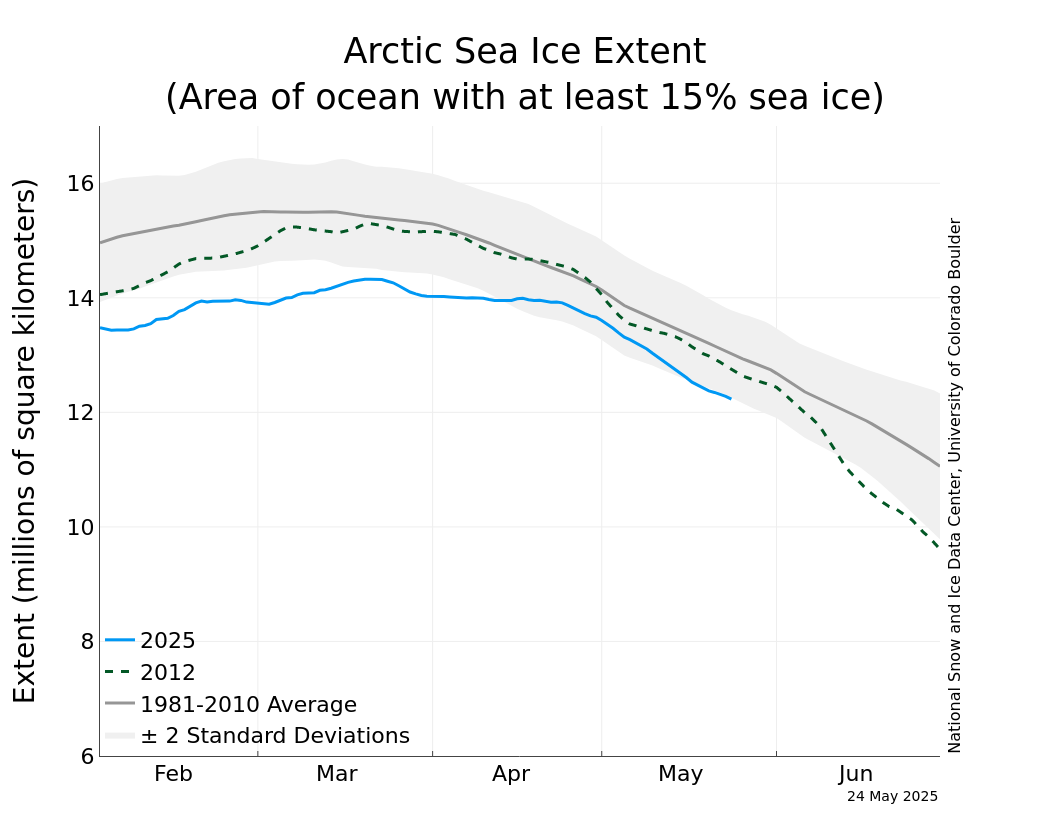

Scientists in the US have presented one of the most dramatic forecasts yet for the disappearance of Arctic sea ice.
Their latest modelling studies indicate northern polar waters could be ice-free in summers within just 5-6 years.
Professor Wieslaw Maslowski told an American Geophysical Union meeting that previous projections had underestimated the processes now driving ice loss.
Summer melting this year reduced the ice cover to 4.13 million sq km, the smallest ever extent in modern times.
Remarkably, this stunning low point was not even incorporated into the model runs of Professor Maslowski and his team, which used data sets from 1979 to 2004 to constrain their future projections.
|
 In the end, it will just melt away quite suddenly In the end, it will just melt away quite suddenly  Professor Peter Wadhams
|
“Our projection of 2013 for the removal of ice in summer is not accounting for the last two minima, in 2005 and 2007,” the researcher from the Naval Postgraduate School, Monterey, California, explained to the BBC.”So given that fact, you can argue that may be our projection of 2013 is already too conservative.”
========================================
Joe Romm wrote up a clever piece last year on this subject:
Exclusive: New NSIDC director Serreze explains the “death spiral” of Arctic ice, brushes off the “breathtaking ignorance” of blogs like WattsUpWithThat
June 5, 2009
I interviewed by email Dr. Mark Serreze, recently named director of The National Snow and Ice Data Center. Partly I wanted him to explain his “death spiral” metaphor for Arctic ice
So now that Arctic ice has returned to normal extent and area, we eagerly await the explanation from the experts about how that fits into the “death spiral” theory. Richard Feynman famously said “Science is the belief in the ignorance of the experts.”
Time will tell. 2010 is looking promising for sea ice recovery again. After all, who wouldn’t want the Arctic Sea ice to recover? WUWT is predicting a recovery again this year, which we started mentioning as a prediction last fall.
So given what we know today, what will NSIDC highlight in their April Sea Ice News?
And even more importantly, will the MSM cover it like they do the ‘terrible’ minimums?
NOTE: The poll code got messed up, duplicating an entry, press REFRESH if you see a double entry. -A
Forecasting The NSIDC News
NSIDC puts out an article about once a month called the Sea Ice News. It generally highlights any bad news they can find about the disappearance of Arctic ice. Last month’s news led with this sentence.
In February, Arctic sea ice extent continued to track below the average, and near the levels observed for February 2007.
But March brought good news for the Polar Bears, and bad news for the Catlin Expedition and any others looking for bad news. Instead of ice extent declining through March like it usually does, it continued to increase through the month and is now at the high (so far) for the year.
http://nsidc.org/data/seaice_index/images/daily_images/N_stddev_timeseries.png
The Danish Meteorological Institute shows Arctic ice extent at the highest level in their six year record.
The Norwegians (NORSEX) show Arctic ice area above the 30 year mean.
Joe Romm wrote up a clever piece last year on this subject:
Exclusive: New NSIDC director Serreze explains the “death spiral” of Arctic ice, brushes off the “breathtaking ignorance” of blogs like WattsUpWithThat
June 5, 2009
I interviewed by email Dr. Mark Serreze, recently named director of The National Snow and Ice Data Center. Partly I wanted him to explain his “death spiral” metaphor for Arctic ice
So now that Arctic ice has returned to normal extent and area, I eagerly await the explanation from the experts about how that fits into the “death spiral” theory. Richard Feynman famously said “Science is the belief in the ignorance of the experts.”
So what will NSIDC highlight in their April Sea Ice News?
-
The increase in both ice extent and quantity of multi-year ice
-
The long-term downwards linear trend line
-
The lack of 4+ year old ice
Sponsored IT training links:
Get free resources including 642-972 tutorial and 1z0-048 dumps questions for guaranteed success in JN0-532 exam.
[snip]
[Please provide a valid email address.]
Re: JAN (Apr 1 12:26),
I did. Using the daily anomaly data for the Northern Hemisphere from Cryosphere today starting in January, 1979, the ADF and PP test reject the presence of a unit root at the 99% confidence level (p value less than 0.01). The KPSS tests rejects stationarity also at the 99% confidence level. The autocorrelogram decays. The first three coefficients in the partial autocorrelogram alternate in sign and are highly significant. That implies an AR(3) model. I’m doing a Monte Carlo on the slope now. With a time series of 11,400 points, it may take a while.
Prediction vs Prediction
Alright, I like this…Steve Goddard et. al. are predicting that the 2010 arctic summer sea ice minimum will recover, continuing the 2008-2009 trend upward, meaning that 2010 minimum will be greater than 2008 or 2009, and I’m predicting that the summer arctic sea ice will be less this year than in 2009, (meaning the 2008-2009 trend will be broken). My only qualification is if one of those pesky big volcanoes in Iceland or elsewhere blows up, creating a similar or larger eruption to Mt. Pinatubo 1991.
I continue to hold to my prediction despite this little “bump” upward in March, and I base this on what will become rapid melting in June, July & August from the Atlantic side of the arctic.
I’ll be here to watch these predictions with interest…
Linear trends in chaotic oscillating climate systems cannot ever be useful in defining such systems. They either delay the detection of oscillations (which is why they are never used for climate systems such as ENSO measures), or falsely lead to erroneous cause and effect theories tied to a statistical maneuver instead of reality.
To wit, the straight trend line is not data. Nor is it observations. It is a completely artificial construct that has no place in falsifying or corroborating hypotheses.
Steinar Midtskogen (11:32:11) :
“So if it was sound science in 2007 to predict an ice free summer in 2013, we can equally scientifically declare that, at the current rate, the last patch of open water in the northern hemisphere will be completely gone during summer by 2300.”
Yeah, it’s like Glaciergate. The prediction was really for an Ice free Arctic summer by 2310. Not 2013. It’s Arcticgate. 🙂
Anthony.
I voted “The lack of 4+ year old ice” because everything else is too close to call. Sol is comming back on stream and it’s insolation spectrum spread will have greater ocean and ice penetration. Though young ice doesn’t have the soot deposition to warm from the top down, there is still the issue of a warmer ocean causing a bottom up melt and who knows when a ‘hunt’ in the N Polar planar turbine will cause winds to change? I think you’re brave to make a forecast. 🙂
Best regards, suricat.
Phil. (08:43:38)
In fairness?
Everything that has happened in the last 10 years has been within normal variability. So how can one be fair to him? To tell him he is wrong? Yes. Tell him that. That is fairness.
jose (10:01:34) :
Who’s talking about deserts?
Ya, gee, who’s talking deserts?
It’s amazing, jose, how you can miss the point with such ease of effort.
Frank (10:18:39) :
Arctic sea ice will reach normal when coverage is above the mean about half of the time and usually within two standard deviations of the mean. Don’t join the CAGWers by exaggerating the importance of trivial changes. Do give them hell for unreasonable predictions based on 2007.
It’s not just 2007 Arctic ice that makes them give unreasonable predictions. You’ll find that in all of ‘global warming’. You can just close your eyes and throw a dart and you’ll hit some other unreasonable prediction to give em hell for.
And if you want to get sense overload from unreasonable predictions watch Al Gore’s movie.
Re: Pamela Gray (Apr 1 17:27),
That would be good if we knew that Arctic ice extent was a chaotic oscillating climate system. It obviously is on the 100,000 year time scale, but that doesn’t really tell us much. So why not calculate a linear trend and look to see if the data are deviating significantly from the trend?
Speaking of a linear trend, Monte Carlo analysis using an AR(2) model or an AR(15) model with coefficients calculated from the Cryosphere Today data gave similar estimates for the slope: -0.04964555 Mm2/year with a standard error of 0.004429909. That means the slope is significantly different from zero. Of course, it also means that Arctic ice isn’t going to be disappearing any time soon.
JAN (13:56:35) :
Richard Sharpe (13:23:56) :
Sorry Richard, my bad.
No JAN, you’re good!
Since SSMI has taken down their graph of Arctic ice, I guess it’s fortunate that someone saved it: click
Don’t get me wrong-I like good news as much as the next guy. But what are the chances that this return is a result of equipment malfunction….erroneous.
Is there any other source (for comparative) data?
Seems to me that this is just too good to be true.
Do a search on “submarine north pole” (use the image or photo option) look at the thickness of the ice, if they show ice. Look at the lack of ice in MANY pictures. Look at the date, many were March, April, STILL Winter.
And I will bet you believed those photos of the US submarines at the North Pole surrounded by ice years ago in newspapers. WRONG, for many of them there was no ice at the North Pole so they went to where there was some ice to take the pictures. It is hard to float a barber pole in water or make a flag stand up, so they look for ice and do it there. And that was 50-60 years ago! And today you can’t get through the “north west passage” every summer as they have predicted without an icebreaker.
barbee butts (18:36:21) :
The data you are looking at is not from one source.
Go up to the post and reread it.
It is real. It is right. There is not a malfunction. This is what is really happening to North Pole ice.
Maybe Al Gore and the media have made you afraid to trust anything other than them. But please, don’t let yourself become a clone. Don’t be assimilated into their ‘borg’. Resistance is not futile.
Just look at the data for yourself. 🙂
Trust the data in not just North Pole ice but in all areas of global warming. If you do this, in time, you’ll begin to understand why some are not only ‘skeptical’, but have become indignant over ‘global warming’, and why some others are calling it the greatest scientific scam ever.
barbee butts (18:36:21) :
Seems to me that this is just too good to be true.
ClimateGate felt like that to me the first few hours.
IF the Ice were to totally melt off:
this “Encyclopedia of Earth” site graphs month by month, how the Pole gets more sun than the Equator
— for 3 months, that is:
http://www.eoearth.org/article/Earth-Sun_relationships_and_insolation
PS: even in Winter, winds & currents sometimes pile up 2 Ice floes on each other, producing some open water, called a: “lead” (which in winter can ice-over Very rapidly). The Pole is over a comparatively rapid current.
PSS There are online articles which give Sub-recorded thicknesses for thousands of locations & times, allowing an Arctic-wide average to be calculated (if I recall right, peak was 5.2 meters thick including snowpack) but a 7-year delay is imposed lest the subs’ data-points allow their favorite spots to be found out — they are Military after all — & data not running past 2002 … is not much good to this discussion.
David Alan Evans (16:50:45) :
Anu.
You seem to think the Summer extent is important & not the Winter extent
——————
Interesting 1938 NYT article, thanks.
I think the summer extent is much more important than the winter extent, but I think the two are probably slightly correlated for a given year. I think the big difference in albedo between sea ice and open water contributes to the unpredictability of summer ice area – a month of cloudless days melts much more ice than a month of cloudy days. Even if the Arctic sea-level air is warming at something like 0.4° C/decade, that averages out to 0.04° C/yr, which will be overwhelmed by winds and clouds and ocean currents that year. But I would bet on the trends:
http://nsidc.org/images/arcticseaicenews/20091005_Figure3.png
Look at spring 2009, very close to the 1979-2000 average at the end of April:
http://nsidc.org/images/arcticseaicenews/20090504_Figure2.png
Then look at what happened that summer:
http://nsidc.org/images/arcticseaicenews/20091005_Figure2.png
About 3 std dev below the 1979-2000 average.
It’s always the summer that shows the largest deviations from the average.
So, where will this wind up in the summer ?
http://nsidc.org/data/seaice_index/images/daily_images/N_stddev_timeseries.png
Who knows, but we won’t have to wait long to find out.
I certainly wouldn’t bet on it being “average” (1979-2000).
Anu (17:10:19) :
Robert Wykoff (12:20:30) :
I will bet eleventy billion dollars that JAXA has some “malfunction”, and does not report anything for the next week. You will see the March 30th numbers until April 7th. (unless there is a sudden mass melt off)
I’ll take that bet.
Eleventy billion.
I’ll give you 30 days to transfer the money.
—————————————-
http://www.ijis.iarc.uaf.edu/en/home/seaice_extent.htm
Data of Sea Ice Extent
The latest value : 14,376,406 km2 (April 1, 2010)
No sudden mass melt off, no “malfunction”, no March 30th numbers.
Science marches on, reporting the data honestly as they always do.
Fork it over: $110 billion
I’ve already spent about a third of it, so you better not welsh…
Here’s what our CBC news is saying about it, “Northern sea ice growth a fluke: researcher.”
http://www.cbc.ca/canada/north/story/2010/04/01/north-sea-ice-arctic.html#socialcomments
Steve Goddard (13:58:48) :
Anu (13:35:10) :
I made my predictions a long time ago.
——————-
Care to make a little wager ?
I’ve recently won some money…
Elizabeth (Canada) (20:16:50) :
Here’s what our CBC news is saying about it, “Northern sea ice growth a fluke: researcher.”
http://www.cbc.ca/canada/north/story/2010/04/01/north-sea-ice-arctic.html#socialcomments
————————
Notice how the headline says: Northern sea ice ?
All this thin ice growth in the Bering Sea is not even “the Arctic” :
http://en.wikipedia.org/wiki/Arctic_Circle
the parallel of latitude that runs 66º 33′ 43″ (or 66.5619°) north of the Equator.
Also, the sea ice in the Sea of Okhotsk (west of the Bering Sea, west of the Kamchatka Peninsula) is not in the “Arctic”:
Iceland is south of the Arctic Circle:
http://www.stormchaser.ca/News/News_2008/Iceland_Map.jpg
which shows that the ice covered Hudson Bay in Canada is also not in the Arctic.
Now look at the “Northern sea ice”:
http://nsidc.org/data/seaice_index/images/daily_images/N_bm_conc.png
Keep this in mind when scientists try to weasel out of predictions with their “facts” and “definitions” and “explanations”.
Or when making bets.
Is this just normal normal or unexpectedly normal?
(PS I’m not good with graphs).
Anu (20:02:48) :
You’re avoiding the questions!
Did you follow up on the 1938 article?
Remember, that was 85°N in December!
The Syedoff was frozen in at that latitude on the 18th of December
It was free again in February of 1939!
You still think the pre-1979 estimates are accurate?
I ask again; when does Amunden get written out of history & transferred to folklore?
DaveE
It’s always Marcia, Marcia (18:18:23) :
“It’s amazing, jose, how you can miss the point with such ease of effort.”
It’s amazing, IAMM, how you can fail basic reading comprehension or jump into a discussion without reading the background:
Steve Goddard (09:22:06) :
“jose (08:40:35) :
The heat capacity of the oceans is vastly greater than the air. Air temperatures in the desert can rise 70 degrees in a matter of hours.”