Forecasting The NSIDC News
By Steven Goddard and Anthony Watts
Barring an about face by nature or adjustments, it appears that for the first time since 2001, Arctic Sea ice will hit the “normal” line as defined by the National Snow and Ice Data Center (NSIDC) for this time of year.
NSIDC puts out an article about once a month called the Sea Ice News. It generally highlights any bad news they can find about the disappearance of Arctic ice. Last month’s news led with this sentence.
In February, Arctic sea ice extent continued to track below the average, and near the levels observed for February 2007.
But March brought good news for the Polar Bears, and bad news for the Catlin Expedition and any others looking for bad news. Instead of ice extent declining through March like it usually does, it continued to increase through the month and is now at the high (so far) for the year.
If it keeps this trend unabated, in a day or two it will likely cross the “normal” line.

The Danish Meteorological Institute shows Arctic ice extent at the highest level in their six year record.

The Norwegians (NORSEX) show Arctic ice area above the 30 year mean.

And the NORSEX Ice Extent is not far behind, within 1 standard deviation, and similar to NSIDC’s presentation. Note that is hit normal last year, but later.

And JAXA, using the more advanced AMSR-E sensor platform on the AQUA satellite, shows a similar uptick now intersecting the 2003 data line.

Source: IARC-JAXA
WUWT asked NSIDC scientist Dr. Walt Meir about this event to which he responded via email:
It’s a good question about the last time we’ve been above average. It was May 2001. April-May is the period when you’re starting to get into the peak of the melt season for the regions outside of the Arctic Ocean (Bering Sea, Hudson Bay) and the extent tends to have lower variability compared to other parts of the year as that thinner ice tends to go about the same time of year due to the solar heating. Even last year, we came fairly close to the average in early May.
He also mused about a cause:
Basically, it is due primarily to a lot more ice in the Bering Sea, as is evident in the images. The Bering ice is controlled largely by local winds, temperatures are not as important (though of course it still need to be at or at least near freezing to have ice an area for any length of time). We’ve seen a lot of northerly winds this winter in the Bering, particularly the last couple of weeks.
As we’ve been saying on WUWT for quite some time, wind seems to be a more powerful factor in recent sea ice declines than temperature. Recent studies agree.
See: Winds are Dominant Cause of Greenland and West Antarctic Ice Sheet Losses and also NASA Sees Arctic Ocean Circulation Do an About-Face
You can watch wind patterns in this time lapse animation, note how the ice has been pushed by winds and flowing down the east coast of Greenland:

Dr. Meier also wrote:
This has very little implication for what will happen this summer, or for the long-term trends, since the Bering Sea ice is thin and will melt completely well before the peak summer season.
There’s certainly no reason to disagree with the idea that much of the Bering Sea ice will melt this summer, it happens every year and has for millenia. But with a strong negative Arctic Oscillation this year, and a change in the wind, it is yet to be determined if Arctic Sea ice minimum for 2010 is anomalously low, and/or delayed from the usual time.
In 2009, WUWT noted it on September 15th: Arctic sea ice melt appears to have turned the corner for 2009
Dr. Mark Serreze of NSIDC offered some hopeful commentary in a press release back on October 6th 2009, but still pushes that “ice free summer” meme:
“It’s nice to see a little recovery over the past couple of years, but there’s no reason to think that we’re headed back to conditions seen in the 1970s,” said NSIDC Director Mark Serreze, also a professor in CU-Boulder’s geography department. “We still expect to see ice-free summers sometime in the next few decades.”
Remember this 2007 prediction from The Naval Postgraduate School?
Arctic summers ice-free ‘by 2013’
|
By Jonathan Amos
Science reporter, BBC News, San Francisco |

 |
 Arctic summer melting in 2007 set new records
|

 More details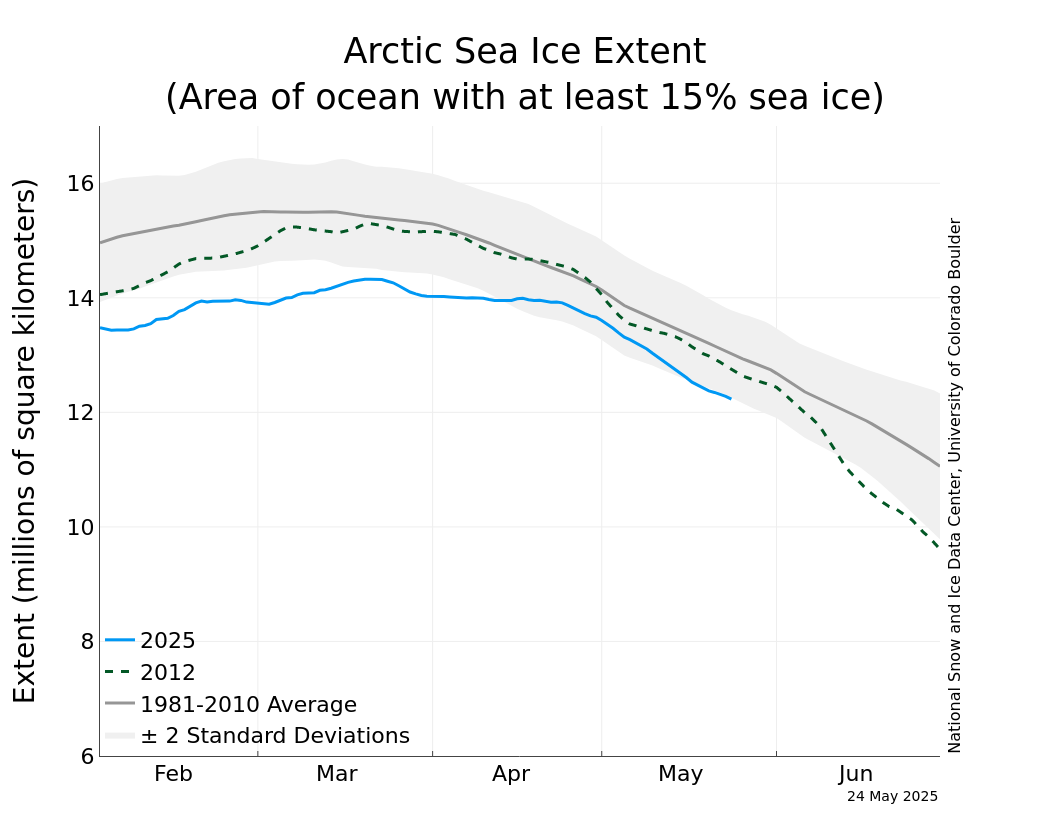

Scientists in the US have presented one of the most dramatic forecasts yet for the disappearance of Arctic sea ice.
Their latest modelling studies indicate northern polar waters could be ice-free in summers within just 5-6 years.
Professor Wieslaw Maslowski told an American Geophysical Union meeting that previous projections had underestimated the processes now driving ice loss.
Summer melting this year reduced the ice cover to 4.13 million sq km, the smallest ever extent in modern times.
Remarkably, this stunning low point was not even incorporated into the model runs of Professor Maslowski and his team, which used data sets from 1979 to 2004 to constrain their future projections.
|
 In the end, it will just melt away quite suddenly In the end, it will just melt away quite suddenly  Professor Peter Wadhams
|
“Our projection of 2013 for the removal of ice in summer is not accounting for the last two minima, in 2005 and 2007,” the researcher from the Naval Postgraduate School, Monterey, California, explained to the BBC.”So given that fact, you can argue that may be our projection of 2013 is already too conservative.”
========================================
Joe Romm wrote up a clever piece last year on this subject:
Exclusive: New NSIDC director Serreze explains the “death spiral” of Arctic ice, brushes off the “breathtaking ignorance” of blogs like WattsUpWithThat
June 5, 2009
I interviewed by email Dr. Mark Serreze, recently named director of The National Snow and Ice Data Center. Partly I wanted him to explain his “death spiral” metaphor for Arctic ice
So now that Arctic ice has returned to normal extent and area, we eagerly await the explanation from the experts about how that fits into the “death spiral” theory. Richard Feynman famously said “Science is the belief in the ignorance of the experts.”
Time will tell. 2010 is looking promising for sea ice recovery again. After all, who wouldn’t want the Arctic Sea ice to recover? WUWT is predicting a recovery again this year, which we started mentioning as a prediction last fall.
So given what we know today, what will NSIDC highlight in their April Sea Ice News?
And even more importantly, will the MSM cover it like they do the ‘terrible’ minimums?
NOTE: The poll code got messed up, duplicating an entry, press REFRESH if you see a double entry. -A
Forecasting The NSIDC News
NSIDC puts out an article about once a month called the Sea Ice News. It generally highlights any bad news they can find about the disappearance of Arctic ice. Last month’s news led with this sentence.
In February, Arctic sea ice extent continued to track below the average, and near the levels observed for February 2007.
But March brought good news for the Polar Bears, and bad news for the Catlin Expedition and any others looking for bad news. Instead of ice extent declining through March like it usually does, it continued to increase through the month and is now at the high (so far) for the year.
http://nsidc.org/data/seaice_index/images/daily_images/N_stddev_timeseries.png
The Danish Meteorological Institute shows Arctic ice extent at the highest level in their six year record.
The Norwegians (NORSEX) show Arctic ice area above the 30 year mean.
Joe Romm wrote up a clever piece last year on this subject:
Exclusive: New NSIDC director Serreze explains the “death spiral” of Arctic ice, brushes off the “breathtaking ignorance” of blogs like WattsUpWithThat
June 5, 2009
I interviewed by email Dr. Mark Serreze, recently named director of The National Snow and Ice Data Center. Partly I wanted him to explain his “death spiral” metaphor for Arctic ice
So now that Arctic ice has returned to normal extent and area, I eagerly await the explanation from the experts about how that fits into the “death spiral” theory. Richard Feynman famously said “Science is the belief in the ignorance of the experts.”
So what will NSIDC highlight in their April Sea Ice News?
-
The increase in both ice extent and quantity of multi-year ice
-
The long-term downwards linear trend line
-
The lack of 4+ year old ice
Sponsored IT training links:
Get free resources including 642-972 tutorial and 1z0-048 dumps questions for guaranteed success in JN0-532 exam.
jose (10:01:34) :
Arctic ice melt has little to do with air temperatures. It is melted by sunshine, wind and water.
Note that summer temperatures north of 80N show almost no year over year variation.
http://ocean.dmi.dk/arctic/meant80n.uk.php
I’ll post it again: it’s not unusual just like 2007 wasn’t:
See Chapter XIII (page 444): seasonal and longterm fluctuations of ice.
http://www.archive.org/stream/arcticice00zubo#page/n0/mode/2up
There are more interesting (old) books on climate on http://www.archive.org.
Arctic sea ice will reach normal when coverage is above the mean about half of the time and usually within two standard deviations of the mean. Don’t join the CAGWers by exaggerating the importance of trivial changes. Do give them hell for unreasonable predictions based on 2007.
ocksblog (14:08:57) :
“…What matters in these huge world-encompassing systems is the overall grand trend – which is heading warm-wards….”
Reply:
The geologic record shows “the overall grand trend” is COLD and ICE with “minor” 1,500-year warm blips. These graphs puts the current political idiocy into perspective: http://www.greenworldtrust.org.uk/Science/Images/ice-HS/noaa_gisp2_icecore_anim_adj.gif
The interesting part of this discussion is not that the ice amount is “trending” back to “normal” but that the curve has shifted so the peak is coming later this year. However as the referenced graphs show this is NOT anything unusual but it is still lots of fun to tweak the CAGW believers noses.
I consider the CAGW believers equivalent to a three year old trying to stop the 3:27 PM commuter train – It ain’t gonna happen, the next ice age will arrive on schedule and mankind will have very little influence unless we get off this politicized science kick and do some real research.
jose
I think the struggle you are having comes from your statement.
“The historical trend towards decreasing summer sea ice extents will release huge amounts of energy to the Arctic atmosphere”
This is a very strange statement. Melting does not release heat. Melting is a hugely endothermic process. Something melting will NEVER do so by warming the surroundings.
“”” jose (10:01:34) :
Steve:
Who’s talking about deserts? The historical trend towards decreasing summer sea ice extents will release huge amounts of energy to the Arctic atmosphere. As the heat leaves the ocean, it warms the air. Warmer air = less sea ice. This is a positive feedback. Please try and tell me again how its negative. “””
Well so far Jose, the summer sea ice hasn’t all gone away completely.
In any case, 9/10 or is it 10/11 of the sea ice is underwater, so clearly if it melts, that heat (80 cal/gm latent heat plus about 1 cal/gm per deg C below freezing) is going to come out of the sea water, which is above the sea water freezing temperature. That is going to cool an astronomical amount of sea water (which will thereby lower the sea level).
Once the ice is melted so the air is in contact with the sea water, which is certainly warmer than the ice was, then one certainly would expect the air to warm up (at the surface).
But that is good, because now you will get convection that transports that heat to the upper troposphere, where it can be eventually radiated to space.
The cooling of the earth in the arctic would be greatly enhanced by an increase in the air temperatures. Right now, the polar regions are not very effective in cooling the earth; for that we have to go to the tropical deserts under the middday sun, with +60 deg c ground temperatures radiating at more than ten times what the Antarctic polar nights are doing.
Perhaps the increasing ice reflects the view that scientists will get caught if they “cook the books” again. Thus, now they actually have to report the accurate data?
If you listen to the March 30 BBC interview with Professor Lovelock (founder of the Gaia Theory), he said “It’s all over. We’re doomed,…We can’t do anything about climate change…Might as well enjoy the ride…” and he admitted the numbers were distorted with climate change research as well as with the CFC/ozone debate.
Jeff in Ctown (Canada) said:
“R. Gates (07:14:52) :
What are you talking about? There is no long downward trend. There is in fact a short (3 year) upward trend.”
——–
Jeff, if you can’t see the 10+ year downward trend in this chart:
http://arctic.atmos.uiuc.edu/cryosphere/IMAGES/seaice.anomaly.arctic.png
Then we inhabit different universes. Good day, sir!
Thanks wondering aloud, but thats not the problem. I understand that melting is an endothermic process (i.e. it requires heat). Conversely, freezing is an exothermic process (i.e. it releases heat). But what Steve is saying makes no sense. If the oceans are open, for longer periods of time in the summer, then the enormous thermal inertia of the oceans (as pointed out by Steve above) will release heat to the Arctic. If they’re capped with sea ice, that heat stays in the oceans, and is released elsewhere.
Your feedback is still wrong Steve.
jose (11:42:36) :
The rate of heat transfer is proportional to delta T. If you have warm water near cold air, heat moves rapidly out of the oceans and eventually gets radiated out into space – which ultimately has a net cooling effect on the planet. That is a negative feedback. Positive feedback would be a process that adds heat to the oceans.
The Arctic ice cap actually reduces heat flow out of the oceans, by providing a layer of insulation from the very cold air above.
Billy Liar (16:28:04) :
George E. Smith (13:37:37) :
There was a record volume of warm water flowing into the Norwegian Sea in 2005 and 2006. The water temperature reached a record high in 2007, since then it has cooled down to normal. This probably also contributes to the explanation of the anomalous sea ice loss in 2007/2008.
http://www.imr.no/filarkiv/havets_ressurser_og_miljo_2009/tilstand_okosystem_NH2_sammendrag.pdf/nb-no
“The Atlantic water in the Norwegian Sea has been
extraordinarily warm and salt since 2002 with
record-high temperature in 2007. Since then a cooling
is observed, and in 2008 the temperature sunk to
normal. After the record-high volume transport of
Atlantic water into the Norwegian Sea during 2005–
2006, the temperature fell, and has been normal the
last two years.”
Institute of Marine Research, Bergen, Norway (2009) “Status of the Norwegian Sea Ecosystem” (Summary), (English version, p. 3)
R. Gates (11:18:03) :
“Jeff, if you can’t see the 10+ year downward trend in this chart:
http://arctic.atmos.uiuc.edu/cryosphere/IMAGES/seaice.anomaly.arctic.png
Then we inhabit different universes. Good day, sir!”
Did you test that time series for the presence of unit roots in order to establish the validity of doing a trend regression? In the presence of a unit root, you may find that there is no statistical significant “trend” at all in that time series.
@Ben Klijn D (15:55:26) :
“Why doesn’t the average go from 1979 to 2009, why stop at 2000 why not add 9 more years of data?? for an average don’t you have to add every year…averages go up and down… that’s why they are averages”
AND
@richard M (12:37:48):
“This is in spite of the fact that “average” is still higher than it should be. We have 30 years of data (1979-2009), why not use it all? We all know that this would drop the “average” and that’s not good for the warmers.”
There is an explanation – it may even be somewhere in the archives of WUWT but as I recall the 2000 – 2010 data is to be inputed soon – but as 1989 – 2010 20 year running average.
I think that this will magnify the recovery as Richard suggests. I have asked for comment from WUWT contributors (dbleader61 (11:03:53) ) but haven’t seen any yet.
Jose:
Are you implying that close to freezing water heats up the well-below-freezing atmosphere enough to melt the ice in turn, overcoming the latent heat in the process?
Never heard of the 2nd law of thermodynamics then?
JAN (12:26:57) said:
Climate Science has no need for techniques that might prove their fund-seeking messages incorrect. Surely you know that?
Thermodynamics: (1) Melting of ice absorbs heat into the H2O, thus removing heat from the air. (2) Freezing of water releases heat from the H2O, thus releasing heat into the air. The daily Svalbard news http://icepeople.net says it was quite warm for much of this winter. Was this because of heavy ice freezing? Just holding this open as a possibility.
Steve Goddard (23:00:26) :
Anu (22:25:14) :
You asked “So, how is the Arctic sea ice area doing ?”
It is nearly one standard deviation above the mean – i.e. close to unusually high.
http://arctic-roos.org/observations/satellite-data/sea-ice/observation_images/ssmi1_ice_area.png
———————–
Yes, the Arctic sea ice area is rather high this week, that’s good.
But the most important fact of Arctic ice is the summer minimum area (or minimum extent, to a lesser degree). I’ve seen various predictions, but 6 months is not too long to wait for actual numbers. We’ll see soon enough if the 2008, 2009 growth (in these minimums) continues.
An Inquirer (23:22:06) :
Sorry, Anu, I am willing to accept current information from Cryosphere as useful data. However, anyone who uses that 1900-2008 chart loses credibility in my eyes. That chart contains arbitrary and capricious decisions on pre-satellite data — producing levels that are contrary to recorded observations. Its documentation even warns about its reliability.
———————
I was replying to:
pat (18:51:03) :
The loss of sea ice in 2007 was indeed precipitous. But the recovery in 2008 was equally steep.
Most people here realize the data on NH sea ice extent was not as accurate pre-satellite era. The relevant time frame, 2007 to 2008, however, is accurate on the chart I cited. Instead of complaining, why don’t you find and cite a better chart, if you have a point to make.
How about this one ?
http://nsidc.org/images/arcticseaicenews/20091005_Figure3.png
Sorry, Anu, I am willing to accept current information from Cryosphere as useful data.
Charts from 2009 are not “current” enough for you ?
Richard Sharpe (13:23:56) :
Sorry Richard, my bad.
Anu (13:35:10) :
I made my predictions a long time ago.
http://wattsupwiththat.com/2010/02/09/prediction-arctic-ice-will-continue-to-recover-this-summer/
http://wattsupwiththat.com/2009/04/15/why-third-year-arctic-ice-will-increase-next-year/
Obviously, it’s negative warming. After all, the sign of the trend doesn’t matter, we can |abs| that out.
What matters is CHANGE! Your change, everybody’s change into climate research!
After all, Change is bad… so hand over those Ben Franklins, in case you decide to break them.
Anu (13:35:10) : Yes, the Arctic sea ice area is rather high this week, that’s good. But the most important fact of Arctic ice is the summer minimum area (or minimum extent, to a lesser degree). I’ve seen various predictions, but 6 months is not too long to wait for actual numbers. We’ll see soon enough if the 2008, 2009 growth (in these minimums) continues.
New 300m long crack at Icelandic volcano:
http://scienceblogs.com/eruptions/2010/03/second_fissure_opens_in_the_ic.php#comments
It is not entirely unlikely that also Katla may erupt – and the summer minimum area may reach another maximum…
🙂
Log-log fluctuation dynamics means frequent small changes, less frequent big changes, occasional really big changes – all generated spontaneously by the system’s internal dynamics, not necessarily needing a change in external forcing. Thus, in this context, jumping to an ice age state is completely consistent with the role of negative feedbacks (and with an appropriate mixture of negative and positive fedback).
Phlogiston, the math is way over my head. Do you actually understand it yourself?
Are you implying that log-log function dynamics provide a better explanation for ice age changes than Milankovitch cycles? If Milankovitch works, what is the need to invoke highly theoretical in-system transitions.
As far as I could make out, the transitions discussed are not about amplitude changes of the whole system, but “much richer dynamics” within it.
First paper concluding section:
Second paper concluding section:
I was able to find full versions of those two papers online.
http://arxiv.org/PS_cache/nlin/pdf/0305/0305059v3.pdf
http://math.bu.edu/people/horacio/papers/rotstein_etal_PRE_Jan26-06.pdf
The abstract of the third:
This again seems to be discussing changes between turbulence and periodicity – shifts in the internal dynamics of the system. I was unable to access the full version, so I don’t know if there are implications for whole-system shift. Nor am I confident re that on the former two.
I don’t understand the math. Best I can do is try to understand the general concepts, and that’s hard enough. If you think there’s little point trying to coach me through it, I would hardly blame you.
Anu.
You seem to think the Summer extent is important & not the Winter extent
http://wattsupwiththat.com/2008/12/12/today-in-climate-history-dec-12th-1938-getting-warmer/
I suggest you check the NYT about Valentines day 1939 too. That’s about the time the Syedoff was freed from the ice.
When are you going to write Amundsen out of history & transfer him to the folklore category?
DaveE.
Forgot to say. Syedoff was frozen in at 85°N on Dec 18th 1938.
DaveE.