by Roy W. Spencer, Ph. D.

INTRODUCTION
My last few posts have described a new method for quantifying the average Urban Heat Island (UHI) warming effect as a function of population density, using thousands of pairs of temperature measuring stations within 150 km of each other. The results supported previous work which had shown that UHI warming increases logarithmically with population, with the greatest rate of warming occurring at the lowest population densities as population density increases.
But how does this help us determine whether global warming trends have been spuriously inflated by such effects remaining in the leading surface temperature datasets, like those produced by Phil Jones (CRU) and Jim Hansen (NASA/GISS)?
While my quantifying the UHI effect is an interesting exercise, the existence of such an effect spatially (with distance between stations) does not necessarily prove that there has been a spurious warming in the thermometer measurements at those stations over time. The reason why it doesn’t is that, to the extent that the population density of each thermometer site does not change over time, then various levels of UHI contamination at different thermometer sites would probably have little influence on long-term temperature trends. Urbanized locations would indeed be warmer on average, but “global warming” would affect them in about the same way as the more rural locations.
This hypothetical situation seems unlikely, though, since population does indeed increase over time. If we had sufficient truly-rural stations to rely on, we could just throw all the other UHI-contaminated data away. Unfortunately, there are very few long-term records from thermometers that have not experienced some sort of change in their exposure…usually the addition of manmade structures and surfaces that lead to spurious warming.
Thus, we are forced to use data from sites with at least some level of UHI contamination. So the question becomes, how does one adjust for such effects?
As the provider of the officially-blessed GHCN temperature dataset that both Hansen and Jones depend upon, NOAA has chosen a rather painstaking approach where the long-term temperature records from individual thermometer sites have undergone homogeneity “corrections” to their data, mainly based upon (presumably spurious) abrupt temperature changes over time. The coming and going of some stations over the years further complicates the construction of temperature records back 100 years or more.
All of these problems (among others) have led to a hodgepodge of complex adjustments.
A SIMPLER TECHNIQUE TO LOOK FOR SPURIOUS WARMING
I like simplicity of analysis — whenever possible, anyway. Complexity in data analysis should only be added when it is required to elucidate something that is not obvious from a simpler analysis. And it turns out that a simple analysis of publicly available raw (not adjusted) temperature data from NOAA/NESDIS NOAA/NCDC, combined with high-resolution population density data for those temperature monitoring sites, shows clear evidence of UHI warming contaminating the GHCN data for the United States.
I will restrict the analysis to 1973 and later since (1) this is the primary period of warming allegedly due to anthropogenic greenhouse gas emissions; (2) the period having the largest number of monitoring sites has been since 1973; and (3) a relatively short 37-year record maximizes the number of continuously operating stations, avoiding the need to handle transitions as older stations stop operating and newer ones are added.
Similar to my previous posts, for each U.S. station I average together four temperature measurements per day (00, 06, 12, and 18 UTC) to get a daily average temperature (GHCN uses daily max/min data). There must be at least 20 days of such data for a monthly average to be computed. I then include only those stations having at least 90% complete monthly data from 1973 through 2009. Annual cycles in temperature and anomalies are computed from each station separately.
I then compute multi-station average anomalies in 5×5 deg. latitude/longitude boxes, and then compare the temperature trends for the represented regions to those in the CRUTem3 (Phil Jones’) dataset for the same regions. But to determine whether the CRUTem3 dataset has any spurious trends, I further divide my averages into 4 population density classes: 0 to 25; 25 to 100; 100 to 400; and greater than 400 persons per sq. km. The population density data is at a nominal 1 km resolution, available for 1990 and 2000…I use the 2000 data.
All of these restrictions then result in thirteen 24 to 26 5-deg grid boxes over the U.S. having all population classes represented over the 37-year period of record. In comparison, the entire U.S. covers about 31 40 grid boxes in the CRUTem3 dataset. While the following results are therefore for a regional subset (at least 60%) of the U.S., we will see that the CRUTem3 temperature variations for the entire U.S. do not change substantially when all 31 40 grids are included in the CRUTem3 averaging.
EVIDENCE OF A LARGE SPURIOUS WARMING TREND IN THE U.S. GHCN DATA
The following chart shows yearly area-averaged temperature anomalies from 1973 through 2009 for the 13 24 to 26 5-deg. grid squares over the U.S. having all four population classes represented (as well as a CRUTem3 average temperature measurement). All anomalies have been recomputed relative to the 30-year period, 1973-2002.
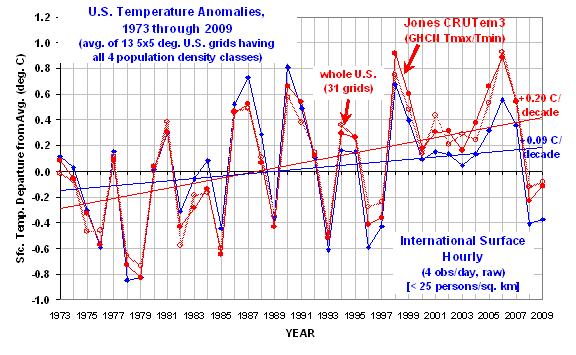
The heavy red line is from the CRUTem3 dataset, and so might be considered one of the “official” estimates. The heavy blue curve is the lowest population class. (The other 3 population classes clutter the figure too much to show, but we will soon see those results in a more useful form.)
Significantly, the warming trend in the lowest population class is only 47% of the CRUTem3 trend, a factor of two difference.
Also interesting is that in the CRUTem3 data, 1998 and 2006 would be the two warmest years during this period of record. But in the lowest population class data, the two warmest years are 1987 and 1990. When the CRUTem3 data for the whole U.S. are analyzed (the lighter red line) the two warmest years are swapped, 2006 is 1st and then 1998 2nd.
From looking at the warmest years in the CRUTem3 data, one gets the impression that each new high-temperature year supersedes the previous one in intensity. But the low-population stations show just the opposite: the intensity of the warmest years is actually decreasing over time.
To get a better idea of how the calculated warming trend depends upon population density for all 4 classes, the following graph shows – just like the spatial UHI effect on temperatures I have previously reported on – that the warming trend goes down nonlinearly as population density of the stations decrease. In fact, extrapolation of these results to zero population density might produce little warming at all!
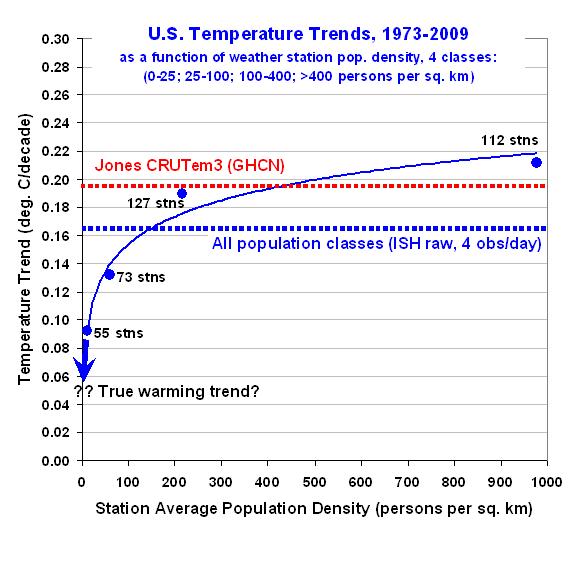
This is a very significant result. It suggests the possibility that there has been essentially no warming in the U.S. since the 1970s.
Also, note that the highest population class actually exhibits slightly more warming than that seen in the CRUTem3 dataset. This provides additional confidence that the effects demonstrated here are real.
Finally, the next graph shows the difference between the lowest population density class results seen in the first graph above. This provides a better idea of which years contribute to the large difference in warming trends.
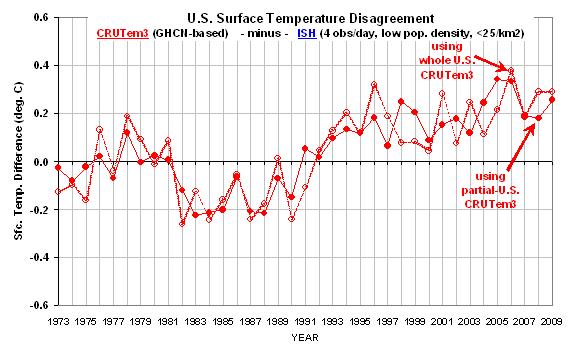
Taken together, I believe these results provide powerful and direct evidence that the GHCN data still has a substantial spurious warming component, at least for the period (since 1973) and region (U.S.) addressed here.
There is a clear need for new, independent analyses of the global temperature data…the raw data, that is. As I have mentioned before, we need independent groups doing new and independent global temperature analyses — not international committees of Nobel laureates passing down opinions on tablets of stone.
But, as always, the analysis presented above is meant more for stimulating thought and discussion, and does not equal a peer-reviewed paper. Caveat emptor.
” NickB. (08:42:12) :
paulo arruda (07:56:49)
If it’s the same VS that was commenting here: http://wattsupwiththat.com/2010/02/14/new-paper-on/
…he’s a very sharp one indeed.”
You don’t wanna mess…
…with the VS.
Poor Tamino. But he had it coming.
16
03
2010
Wren (09:52:04) :
The world’s population trend shows a sharp upswing starting before the upswing in average global temperature in the 20th Century. Obviously no density calculation is necessary here since the globe’s surface area doesn’t change much.
As can be seen in the linked graph, the world population trend turns upward around mid-century.
http://en.wikipedia.org/wiki/File:World-Population-1800-2100.png
As I recall, average global temperature starts rising sharply after the 1970’s. So if increases in population density drive increases in temperature, why is there a lag?
REPLY: It’s called growing up. Infrastructure impacts don’t begin at birth, but rise into adulthood. -A
=======
That’s a good point. However, if you look at the referenced graph on world population, you will see the trend accelerates to a slightly higher rate of growth beginning around 1920 and then to a sharply higher rate of growth beginning around 1950. Those born in the 1920’s would be middle-age by 1980 and those born in the 1950’s would be well into adulthood.
Of course Spensor is talking about the U.S. rather than the world. I haven’t looked at the U.S. population trend and population density trend.
Chris (08:39:52) :
What is the average population density of the US? Based on the graph that shows CRU temp versus pop. density, I would guess 400.
From memory (!?), I make Continental US ave pop density ~ 300M/8M km = 37.5
Yes, the Good O’l USA is almost empty!
I am wondering though, if the UHI is so widespread, at what point is it no longer just an effect that causes skewing of the data, but part of the environment? What I’m getting at is, all the extra heat that urban areas generate (and certainly this does skew the data as urbanization continues), but that extra heat in those urban area is still extra heat added to the total heat balance of the planet. Taken to an extreme, if somehow the entire planet were a giant concrete parking lot, you’d have a giant “heat island”, or would you simply have a different climate? These urban heat islands are, on some level, part of the environment, growing rapidly, and averaged over the whole globe. will add to warming.
Wren (09:52:04) :
As I recall, average global temperature starts rising sharply after the 1970’s. So if increases in population density drive increases in temperature, why is there a lag?
Hey, nice post!
I think there are a number of corollaries for UHI (some which are corollaries for CO2, strangely enough) that should imply that the per capita UHI effect should also change around that time. Take, for example, number of cars on the road. For the life of me I cannot find a good source of historical information on the number of cars globally, but I would propose that starting after WWII this is at best a linear growth rate if not mildly exponential. There is also a point in time somewhere (probably related to economic/GDP growth) where a given country starts moving towards cement or asphalt roads vs. dirt/gravel for an “average” road. Air travel, as has been mentioned here before, really started to take off in the 60’s. Air conditioning and centralized HVAC adoption has had exponential adoption starting in the 60’s I think. Cement/masonry building construction in areas where it was wood prior definitely another post World War II trend.
Were it not for the political/economic consequences of attribution of causation, the chicken-egg relationship here would almost be humorous. Cement production, for example, is a significant driver of CO2, but it’s also a significant driver of UHI. How much of its temperature impact is really one vs. the other?
Nice work, Dr. Spencer.
If the middle graph is plotted with a 1/log[Station Average Population Density] on the x-axis, won’t that give a nice straight line which will intersect at the y-axis at the actual decadal temperature trend?
Built into your study are some assumptions that may not track. You assume that any temperature affected by an urban heat island is not an accurate reading. Of course, that’s not demonstrated anywhere. Were you to ask me about a research design, I’d suggest that you give serious thought to why actual heating in cities should not be counted as actual heating. If the city thermometers are not weighted to count more than rural and suburban measurements, the skew is nonexistent — it’s accurate readings of temperatures.
There is an assumption that urban heat islands are not the result of global warming in any fashion. Again, no research to back that up.
Airports and wild lands: In your discussions of airports, there is an assumption that, since there is concrete at the airports, they must be massive concentrations affected by their own heat islands. Not only is there little if any research to vindicate that view, any careful study of our largest urban airports would suggest a contrary case. The wildlands on the grounds of O’Hare in Chicago, for example, host flocks of ducks and a problematic herd of deer. Most of the airport is uncovered by either concrete or MacAdam — it’s grassland and forest. In an air pollution study, it would be considered a sink of pollutants, and I’ll wager it’s a sink for heat, too.
Same with DFW, Austin and Denver, three of our newest and largest airports. For those airports on whose committees I have sat, or where I’ve had a chance to work with the grounds professionally, most of them would be considered far more rural than urban — Kansas City International, Wichita, St. Louis, Chicago, Toronto and Montreal, for example. Louisville and Lexington, Kentucky, probably are much cooler than their cities, but the cities themselves may not get much heat island effect due to their small size. Or consider the three airports around Washington, D.C. (Reagan) National is on the Potomac River, bordered by parklands and forested residential areas mostly. Dulles International was a country destination when it opened, and remains a largely rural enclave in a barely suburban setting. Baltimore-Washington International is largely wooded and wild, 20 miles at least from any significant urban concrete.
Airports want to have buffers between their runways and people, for safety. Better designed airports, like Denver and DFW, have enormous stretches of grassland, and sometimes forest, between the ends of runways and any buildings. Larger buffers are preferred for noise control — at St. Louis, entire neighborhoods were purchased to get people out from under the noise profile. While airports are generally engines for development of a city, that development need not include massive concrete paving and tall buildings, especially at the airport.
Were there airport heat islands for our 100 largest urban airports — or any 100 airports with weather reporting stations — that would be offset greatly by the 500 or so smaller airports, some of which still have dirt and grass landing strips. (Authorities count more than 19,000 airports in the U.S., of which 382 are “primary” airports, with more than 10,000 passengers a year; 3,364 airports are open to the public, and those would be the most likely candidates to have weather stations.)
How many principal weather reporting stations are at airports, and which of those would you argue to be heat islands?
Charles Higley (09:45:32) re using only rural data – that’s where I was going with my questions about forest fire observation posts. I think the usual problem even with rural stations, is changes to the local station environment essentially causing a mini UHI effect ala Anthony’s station survey project. FF lookouts may have some of this too, but I don’t know to what extent, if any, they have been surveyed.
kwik (10:54:37) : Yes, I had seen that great father and son science project and find it pretty convincing if there wasn’t selection bias. I’m trying to think of places where temperature data is collected that are wilderness, i.e., essentially zero population, rather than merely rural, thus the FF lookout idea.
A C Osborn (11:08:21) Yes, I think most lookouts do record temperature data because it’s related to fire danger, but don’t know how consistent it is.
Anyhow this is getting off topic from Dr. Spencer’s post. Just wondering if anyone has taken a serious look at Forest Service lookout sites.
Dr Spencer
In your first article on this topic you showed a very similar graph
to the one showing the temperature trends in the US from 1973 to 2009 by population densities but the first graph was showing the impact of UHI by population density.
In that article you stated
“Significantly, this means that monitoring long-term warming at more rural stations could have greater spurious warming than monitoring in the cities.”
In this article you say
“Also, note that the highest population class actually exhibits slightly more warming than that seen in the CRUTem3 dataset. This provides additional confidence that the effects demonstrated here are real.”
Is there a contradiction here or am I misunderstanding you.
” Jim Steele (11:08:43) :
This also suggests that maybe the lack of recent warming evidenced in the tree ring data may have been more accurate than skeptics argued. The tree ring scientist have claimed that only in recent years has the tree ring data diverged from “actual temperatures”. So maybe it was in fact the “measured” data that falsely created the hockey stick.”
Very good! You have explained the
http://en.wikipedia.org/wiki/Divergence_problem
and actually saved the day for Dendroclimatology ! (i mean real Dendro, not that Bristlecone stuff).
Look at the graph on wikipedia, it fits pretty good with the UHI explanation. And for a laugh, read the convoluted explanations on the page.
NickB. (08:42:12), paulo arruda (07:56:49), thanks for “introducing” me to VS. NickB, I followed your link to WUWT and that led me to a fascinating discussion at Bart Verheggen’s (pro-AGW) blog. While I as Non-statistician (with a capital N) found it hard to follow, VS has done what none of my statistics-for-science-majors professors managed to do: make statistics sound almost…cool. 🙂
It also made me take a second look at the Beenstock and Reingewertz paper discussed here on WUWT Feb. 14. Interesting stuff.
I have a question that I think needs to be asked regarding weighting and infilling:
If a station in the US gets a bogus boost due to a poorly considered UHI adjustment, and then that station is used to infill another station 500Km away that is heavily weighted do to scarcity of stations in that grid space, isn’t the bogus UHI adjustment then transferred to that other station that received the infill data… and therefore also subjected to that sites crazy weighting?
Walter Schneider (09:08:06) :
“Population density of the USA, according to area and population figures provided in the CIA World Factbook, is about 31.3 people per km^2.”
To me that seems kind of low and may reflect all of the US, not the continental US—Alaska is the likely reason because it’s half the size and has just over 1 person/sq m.
To go along with my previous question, let me ask it a different way:
What is the possibility that poor US UHI adjustments “broke quarantine” and ran amok through the global record in regions with heavy infilling (Australia and South America as examples)?
Obviously Australia is too far to get an infill from the US directly, but could it have gotten it second or third hand from other infill sites?
Furthermore, could this UHI “disease” have also effected non-Infilled sites through “adjustments” of records that no longer correlated well to the “diseased” station records?
Dr Spencer
A very convincing analysis. Congratulations.
I know it would loose statistical significance but I would love to see the same analysis done for each of the 4 daily temperatures and for each of the seasons. This is not to prove a point but more to get some understanding of the nature of the UHI. Is it more in the day or the night? Is it more in the winter or the summer?
“The results supported previous work which had shown that UHI warming increases logarithmically with population, with the greatest rate of warming occurring at the lowest population densities as population density increases.”
Carefull. The warmists can come back and claim that that relationship is because more people means more FF consumption, and more CO2, and not UHI.
Another fascinating post on the subject that shows we should just move to measuring ocean heat if we ever want to figure anything out – The Real Measure of Global Warming
Jim Steele wrote;
“This also suggests that maybe the lack of recent warming evidenced in the tree ring data may have been more accurate than skeptics argued. The tree ring scientist have claimed that only in recent years has the tree ring data diverged from “actual temperatures”. So maybe it was in fact the “measured” data that falsely created the hockey stick.”
I’m not a fan of tree ring proxies, but you may be on to something here.
A laugh once in a while is a good medicine: What if all this UHI is because the increase of weight among the US population?; fat people irradiate more infrared light. Fast food and high calories intake has at least doubled in the last years: Just look how much “AL” grew fat, surely he is a big, big IR source 🙂
Well Dr Roy, you and Prof Christy, may be the first people in the field of climate science to actually find something that really does follow a logarithmic/exponential relationship.
I’m looking forward to see what happens when you get this to a peer review panel and journal. Keep us posted on how that goes.
Meanwhile Dr Roy, I hope you will forgive me for reposting an updated version of my ersatz essay from a coupla years ago, on Cocktail Party Physics. It’s down here on WUWT somewhere.
Yeah, you and Prof Christy are still in the story; but I promise I did make you both look good.
George
Well now that daylight savings time has started, which increases the value of TSI, the Arctic Ice Rot has set in, and the coverage, is starting to drop according to JAXA.
So here we go again on the roller coaster.
MinB (10:02:46) :
I have had difficulty getting reliable info on determination of daily average temperature.
Obviously, average of 4 x 6 hour readings is better than av of max-min.
For my work, I assume 1.1 x (max +min)/2, because I need to be conservative.
Can anyone point me in a better direction.
Thanks
Jack
I am bewildered by the absence of temperature data going back to 1910 being released in great works such as this by Dr.R. Spencer..
Australia was a country with a very low population back in1910, but a high quality Met. Bureau service going back beyond then to federation. If you research the relative stability of the temperature range over 100 years,
I suggest you look at http://www.bom.gov.au ..
Their newly upgraded climate page has charts for temperature variations going back to 1910.. I think you may be especially interested in the chart of the relatively minor maximum temperature variation over the past century in various areas.
The data sites chosen by the Bureau have “very little or no urban warming”, and the urban sites are not used in products such as monitoring long term trends in temperature. The Bureau also do not employ or use NASA_GISS standards for their temperature data.
R. Gates (12:26:11),
Your question has been asked here before. IIRC, less than 1% of the Earth’s surface is taken up by urban cities. Kind of hard for the heat in such a small areas to have much impact on a global temperature unless it was substantial.
——————-
As for this exercise, I would classify this as a “sanity check” for temperature products like GISTemp. If the owners of the temperature products wanted to understand whether their adjustments seemed reasonable, then this type of analysis should be helpful.
Maybe this study gives hope for central heating a Mars colony: Apparently a low population density will go a long way towards heating things up… 🙂 🙂