Via Eurekalert – New study debunks myths about Amazon rain forests – They may be more tolerant of droughts than previously thought
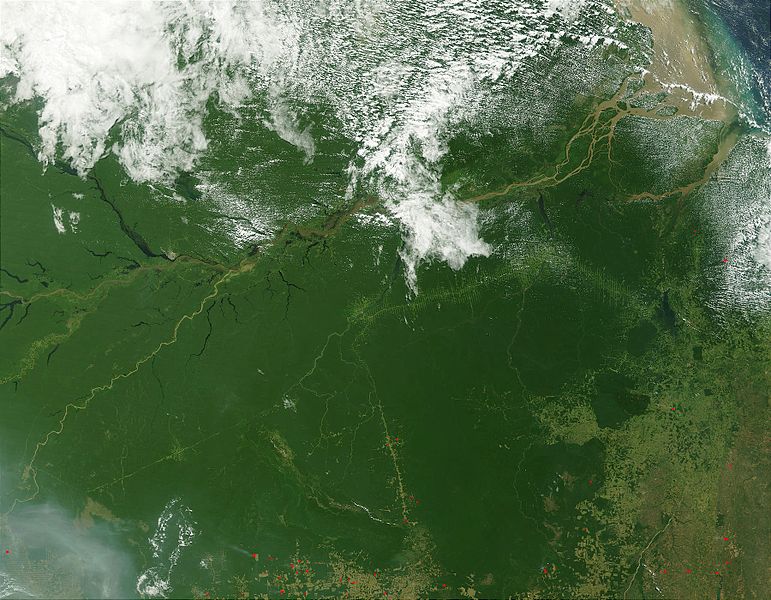
(Boston) — A new NASA-funded study has concluded that Amazon rain forests were remarkably unaffected in the face of once-in-a-century drought in 2005, neither dying nor thriving, contrary to a previously published report and claims by the Intergovernmental Panel on Climate Change.
“We found no big differences in the greenness level of these forests between drought and non-drought years, which suggests that these forests may be more tolerant of droughts than we previously thought,” said Arindam Samanta, the study’s lead author from Boston University.
The comprehensive study published in the current issue of the scientific journal Geophysical Research Letters used the latest version of the NASA MODIS satellite data to measure the greenness of these vast pristine forests over the past decade.
A study published in the journal Science in 2007 claimed that these forests actually thrive from drought because of more sunshine under cloud-less skies typical of drought conditions. The new study found that those results were flawed and not reproducible.
“This new study brings some clarity to our muddled understanding of how these forests, with their rich source of biodiversity, would fare in the future in the face of twin pressures from logging and changing climate,” said Boston University Prof. Ranga Myneni, senior author of the new study.
The IPCC is under scrutiny for various data inaccuracies, including its claim – based on a flawed World Wildlife Fund study — that up to 40% of the Amazonian forests could react drastically and be replaced by savannas from even a slight reduction in rainfall.
“Our results certainly do not indicate such extreme sensitivity to reductions in rainfall,” said Sangram Ganguly, an author on the new study, from the Bay Area Environmental Research Institute affiliated with NASA Ames Research Center in California.
“The way that the WWF report calculated this 40% was totally wrong, while [the new] calculations are by far more reliable and correct,” said Dr. Jose Marengo, a Brazilian National Institute for Space Research climate scientist and member of the IPCC.
Founded in 1839, Boston University is an internationally recognized private research university with more than 30,000 students participating in undergraduate, graduate, and professional programs. BU consists of 17 colleges and schools along with a number of multi-disciplinary centers and institutes which are central to the school’s research and teaching mission.
Geophysical Research Letters article citation: Samanta, A., S. Ganguly, H. Hashimoto, S. Devadiga, E. Vermote, Y. Knyazikhin, R. R. Nemani, and R. B. Myneni (2010), Amazon forests did not green‐up during the 2005 drought, Geophys. Res. Lett., 37, L05401, doi:10.1029/2009GL042154.
ABSTRACT: Amazon forests did not green-up during the 2005 drought
Paper available here (PDF)
The sensitivity of Amazon rainforests to dry-season droughts is still poorly understood, with reports of enhanced tree mortality and forest fires on one hand, and excessive forest greening on the other. Here, we report that the previous results of large-scale greening of the Amazon, obtained from an earlier version of satellite-derived vegetation greenness data – Collection 4 (C4) Enhanced Vegetation Index (EVI), are irreproducible, with both this earlier version as well as the improved, current version (C5), owing to inclusion of atmosphere-corrupted data in those results. We find no evidence of large-scale greening of intact Amazon forests during the 2005 drought – approximately 11%–12% of these drought-stricken forests display greening, while, 28%–29% show browning or no-change, and for the rest, the data are not of sufficient quality to characterize any changes. These changes are also not unique – approximately similar changes are observed in non-drought years as well. Changes in surface solar irradiance are contrary to the speculation in the previously published report of enhanced sunlight availability during the 2005 drought. There was no co-relation between drought severity and greenness changes, which is contrary to the idea of drought-induced greening. Thus, we conclude that Amazon forests did not green-up during the 2005 drought.
h/t to Dr. Leif Svalgaard
Sponsored IT training links:
Join pass4sure for absolute JN0-342 exam solution and get guaranteed success using F50-531 dumps and 642-359 study guide.
Anu (11:54:46) :
‘Tenuc (00:24:09) :
However, as climate is defined, in our reference frame, as long-term changes to weather these events, energetic though they are, have no measurable effect of climate and provide no indication of change.’
———–
“Sorry, no.
If what used to be a “once-in-a-century drought” starts happening every 10 years in a place like the American Southwest, then by definition, the climate for that region has changed.”
If you mean by that, natural climate, then at local level I would agree with you that change has indeed happened. Unfortunately, because we only have a poor understanding of how Earth’s climate operates, it is not usually possible to attribute cause to the observed effect.
However, regional climate change is a different topic to global climate change. Rainfall in a specific region varies seasonally, with some areas vulnerable to long periods of flooding or drought. These local effects tend to average out when global climate is considered,
Roger Knights (07:04:19) :
Wren (21:16:18) :
Roger Knights (11:21:37) :
Wren (00:16:08) :
The study was titled …..
Amazon forests did not green‐up during the 2005 drought
But the report on the study was titled …..
Another WWF assisted IPCC claim debunked: Amazon more drought resistant than claimed
Why ?
Because this is a partisan (or committed or engaged or risen-consciousness) site and the IPCC is one of its punching bags. So what?
====
So why does it say it’s a science site?
It doesn’t — others do. (I.e., the awards.) This site claims to provide “commentary” and (in the About section) states that it is a forum for discussion of weather related issues. The curator states there that he is a skeptic. If this site listed itself in its own blogroll, it would be under the heading “Skeptical Views.”
Given its stance, there’s nothing improper about providing interpretive headlines. (Any more than it’s improper for ClimateProgress, etc. to do the same.) It’s not as though it’s pretending to be a strictly neutral, nothing-but-the-facts science-news provider — where explicit interpretation of the news would be a no-no. It provides interpretive commentary on various science-related issues. On CAGW, its stance is contrarian.
========
You are right. It doesn’t say it’s a science site. It says it’s a “science news site,” which I misread as “science site.”
It takes more than “Skeptical Views” to be a skeptic. A skeptic is even-handed. “Contrarian” seems more accurate
Wren (01:09:31) :
You are right. It doesn’t say it’s a science site. It says it’s a “science news site,” which I misread as “science site.”
It takes more than “Skeptical Views” to be a skeptic. A skeptic is even-handed. “Contrarian” seems more accurate.
It’s a *commentary* site. In order to comment, the commenter must first read the article on which said commentary is sought.
Mr. Watts posts items he deems worthy of comment — or just of general interest — re the subtitle: “Commentary on puzzling things in life, nature, science, weather, climate change, technology, and recent news…” and even you have to admit that the *comments* are handled in an even-handed manner. *All* viewpoints are expressed, with the caveat that you play nice (hit the message and not the messenger) and don’t take excessive advantage of the moderators’ usual benevolent nature.
Unlike, say, RC, where commenters have been banned merely for pointing out a logical inconsistency in one of Mr. Schmidt’s pontifications.
WUWT is hardly “contrarian” — the majority of the commenters *will* wave the b.s. flag when they see it, and can back up the flagwaving with facts, rather than talking points.
Awesome newspeak:
WUWT: Amazon more drought resistant than claimed
SCIENTISTS: Thus, we conclude that Amazon forests did not green‐up during the 2005 drought.
I agree — we’re not mere doubters, we’re critics. I’ve suggested earlier that we call ourselves “climate contrarians,” and I’ve seen a few uses of that term in the press. RC is using the term “dissident,” which would work. Similar D-words that would also be accurate (and that I’ve suggested here) are “dissenter” and “deviationist” (my favorite). But it looks as though we’re stuck with “skeptic.”
I don’t think that “contrarian” implies mindless partisanship or shallowness. Googling define contrarian brings up definitions like “one who takes an opposing view.”
Bill Tuttle (03:31:55) :
Wren (01:09:31) :
You are right. It doesn’t say it’s a science site. It says it’s a “science news site,” which I misread as “science site.”
It takes more than “Skeptical Views” to be a skeptic. A skeptic is even-handed. “Contrarian” seems more accurate.
It’s a *commentary* site. In order to comment, the commenter must first read the article on which said commentary is sought.
Mr. Watts posts items he deems worthy of comment — or just of general interest — re the subtitle: “Commentary on puzzling things in life, nature, science, weather, climate change, technology, and recent news…” and even you have to admit that the *comments* are handled in an even-handed manner. *All* viewpoints are expressed, with the caveat that you play nice (hit the message and not the messenger) and don’t take excessive advantage of the moderators’ usual benevolent nature.
Unlike, say, RC, where commenters have been banned merely for pointing out a logical inconsistency in one of Mr. Schmidt’s pontifications.
WUWT is hardly “contrarian” — the majority of the commenters *will* wave the b.s. flag when they see it, and can back up the flagwaving with facts, rather than talking points.
=========
Based on my brief experience with WUWT, I would agree that comments are handled in an even-handed manner. I don’t know about RC’s record.
But WUWT says it’s a “science news site,” and the news in this instance was a study shows “Amazon forests did not green‐up during the 2005 drough,” rather than a study shows “Another WWF assisted IPCC claim debunked: Amazon more drought resistant than claimed.”
Previously you said “On CAGW, its stance is contrarian.” Now you say it is hardly “contrarian.”
That seems contradictory, but perhaps it wouldn’t if you explained what you mean.
Wren (09:04:55) :
ginckgo (03:45:17) :
From El Reg, March 12 2010, emphasis added:
As confirmed by a second source, the WUWT post title accurately reflects the contents of the study and the views of the study’s authors.
So, what is your point?
Wren (09:04:55) :
Bill Tuttle (03:31:55) :
Previously you said “On CAGW, its stance is contrarian.” Now you say it is hardly “contrarian.”
That seems contradictory, but perhaps it wouldn’t if you explained what you mean.
It probably seems contradictory because I have never *said* “On CAGW, its stance is contrarian.” I use the word “contrarian” in it’s broadest meaning == to describe someone who takes an opposite stance merely for the sake of taking an opposite stance, and I usually use it in a humorous manner.
The first time I’ve ever used “contrarian” on WUWT was at (03:31:55), when I stated that I don’t consider it a “contrarian” site because the commenters *do* produce reasoned contra-CAGW arguments.
ginckgo (03:45:17) :
Awesome newspeak:
WUWT: Amazon more drought resistant than claimed
SCIENTISTS: Thus, we conclude that Amazon forests did not green‐up during the 2005 drought.
From El Reg, March 12 2010, emphasis added:
IPCC Rainforest eco-tastrophe claim confirmed as bunk
Official UN website still shows it as fact, though
More bad news today for the International Panel on Climate Change (IPCC), as another of its extravangant ecopocalypse predictions, sourced from green campaigners, has been confirmed as bunk by scientists.
The UN body came under attack earlier this year for suggesting that 40 per cent of the Amazonian rainforests – dubbed the “lungs of the planet” by some for their ability to turn CO2 into oxygen, and also seen as vital on biodiversity grounds – might disappear imminently. This disaster would be triggered, according to the IPCC’s assessment, by a relatively slight drop in rainfall of the sort to be expected in a warming world.
Unfortunately it now appears that just such conditions have already occurred, and in fact the Amazonian jungles were unaffected.
(…)
NASA-funded scientists analysing the past decades of satellite imagery of the Amazon basin say that in fact the rainforests are remarkably resilient to droughts. Even during the hundred-year-peak dry season of 2005 the jungles were basically unaffected.
(…)
“We found no big differences in the greenness level of these forests between drought and non-drought years,” says Arindam Samanta of Boston university, lead author of the new study based on NASA’s MODIS sat data.
“Our results certainly do not indicate such extreme sensitivity to reductions in rainfall,” adds Sangram Ganguly of the NASA-affiliated Bay Area Environmental Research Institute, another study author.
(…)
As confirmed by a second source, the WUWT post title accurately reflects the contents of the study and the views of the study’s authors.
So, what is your point?
=====
The same point I made at the beginning.
The study was titled …..
Amazon forests did not green‐up during the 2005 drought
But the report on the study was titled …..
Another WWF assisted IPCC claim debunked: Amazon more drought resistant than claimed
Why did the title of the report say the study debunked an IPCC claim that wasn’t mentioned in the study?
From the report I do not know the context of the quoted comments by Sangram Ganguly and Dr. Jose Marengo, so I am skeptical.
@ur momisugly Wren (22:28:09) :
Why are you wasting valuable electrons by reposting my entire post minus only your earlier comment? Do you want to wear out the scroll wheel on my mouse?
(…)
Why did the title of the report say the study debunked an IPCC claim that wasn’t mentioned in the study?
(…)
Simple, that is a presentation the readership will respond to. Both WUWT and The Register are mass media, free and open for anyone to read, and mass media supplies eye-catching headlines to encourage reading the articles. The study does debunk the IPCC claim whether it explicitly says so or not, an IPCC claim being debunked would be of great interest to their readerships, thus both sources used that in their headlines.
Both sites, while they are accessible to all, also cater to those somewhat technically-minded. EurekAlert! caters to those who want to know about scientific papers and will likely read them, and tailors their headlines accordingly, thus they had the blander-sounding but still interest-piquing “New study debunks myths about Amazon rain forests.” Yet right in the first paragraph, which shows up with the headline, they too made quick mention of the IPCC connection.
So that is three different sources right there that found the IPCC connection highly relevant and worthy of being quickly pointed out.
(…)
From the report I do not know the context of the quoted comments by Sangram Ganguly and Dr. Jose Marengo, so I am skeptical.
The El Reg quotes are as found in the EurekAlert! piece reproduced above, which looks like a press release. Click the link, EurekAlert! included the contact info, you can ask that directly. But if they followed standard procedure, the researchers were questioned and their answers were then quoted, and the PR people (with possible input from legal counsel) checked that the release was truthful and honestly represented the paper and the authors, to avoid possibly expensive litigation over claims of misrepresentation if nothing else.
Of course, your “larger question” is why is it said this debunks the IPCC claim when the paper itself will not state such. That’s the assorted politics at play. The work was funded by NASA, which is supporting AGW claims. Likely the funding request said nothing about doing the work to debunk any IPCC claims. The paper’s title then reflects what the funding request was about, checking on the reported Amazon greening during drought conditions. That the paper does debunk the IPCC claim is something that “just happened.”
Amazon drought least of their worries!
http://eureferendum.blogspot.com/2010/03/amazon-drought-least-of-their-worries.html
Ok, so this report says there is little net change in the forest from one dry year. Surely the effect of year on year drought, or even just more frequent drought that may occur due to climate change, would have a cumulative effect on the trees. Once the water starts to become a limiting facotr to plant growth, the increased greening from reduced cloud cover (and CO2 increases) may be countered.
I don’t think this study debunks anything. Show me a long term experiment and I might be persuaded.
@ur momisugly R. Smith (16:08:16) :
You waited five days to chime in with a pro-IPCC “last word”? Were you confined to a hospital? Did you get stuck with jury duty and were denied internet access?
Doesn’t matter. This paper says they are more tolerant of drought than previously stated, as in as stated by the IPCC. It counters a 2007 paper that said the previous drought actually greened-up the Amazon, which runs counter to the IPCC claim. Thus that’s two papers against the claim, neither agreeing with it.
Why yes, if there were continuous drought conditions for long enough that the water table significantly dropped and the trees had insignificant water to maintain even their current levels of foliage, it would affect the trees. Congratulations, you have stated that if the trees are starved of water for years on end then they will suffer. However the IPCC claimed a far greater sensitivity to drought than what has been found, thus they are still debunked.
What sort of long-term experiment do you want? Do you want to see if an originally-healthy tree will suffer when subjected to years on end of insufficient water? That seems pretty much a given. Although for truly trustworthy results, you’d better start with a rainforest very similar to the Amazon, with the same trees, soil, interconnected ecosystems, etc. Due to certain exhibited properties of the Amazon rainforest, such as the ability to generate weather, it would have to be a considerable fraction of the size of the real one, say at least one-tenth of the area. Once set up, then you’d have to carefully and accurately limit how much water it received, by keeping unwanted rainfall from occurring, for example.
Well, best of luck with the mini-Amazon experiment. Let us know when the funding comes through and where it’ll be set up. Should yield results worthy of a Nobel Prize!
@kadaka
Your correct about the impracticability of a long term, large scale experiment. This means that we should be cautious about short term observational studies and accept their uncertainties. Conclutions should be made from more than one line of evidence, especially when the evidence is based on short term observations.
Maybe there is evidence that the IPCC report is not entirely correct in terms of the sensitivity of the rainforest, I’ll accept that and I’m sure the next IPCC report will take this into account.
However the main point I was making is that the IPCC suggest that rainforest will suffer, their sensitivity really just affects the rate at which they will suffer. The end result of ecosytem change will still come about.
P.s You were also correct about the hospital visit! Don’t worry I didn’t injure my head…
I can’t understand why that article was published in the first place.
Read this instead.
http://www.whrc.org/assets/scientists_amazon_response.pdf