Via Eurekalert – New study debunks myths about Amazon rain forests – They may be more tolerant of droughts than previously thought
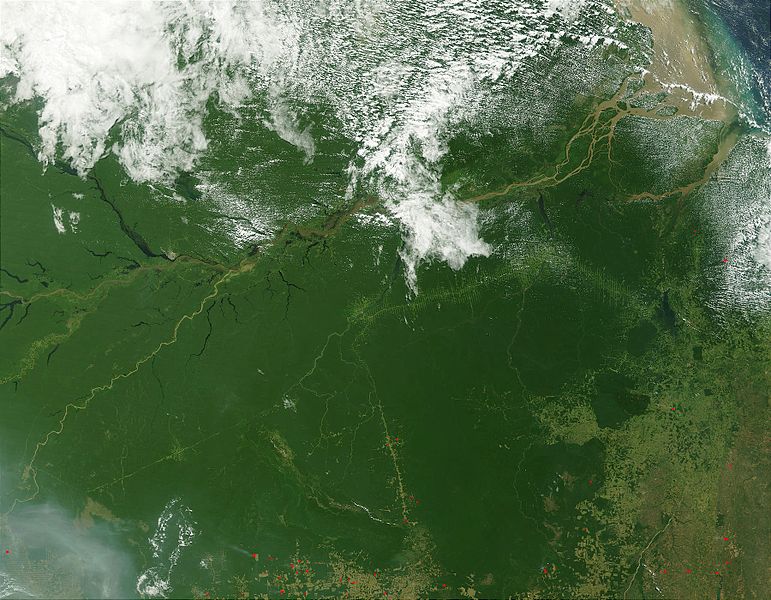
(Boston) — A new NASA-funded study has concluded that Amazon rain forests were remarkably unaffected in the face of once-in-a-century drought in 2005, neither dying nor thriving, contrary to a previously published report and claims by the Intergovernmental Panel on Climate Change.
“We found no big differences in the greenness level of these forests between drought and non-drought years, which suggests that these forests may be more tolerant of droughts than we previously thought,” said Arindam Samanta, the study’s lead author from Boston University.
The comprehensive study published in the current issue of the scientific journal Geophysical Research Letters used the latest version of the NASA MODIS satellite data to measure the greenness of these vast pristine forests over the past decade.
A study published in the journal Science in 2007 claimed that these forests actually thrive from drought because of more sunshine under cloud-less skies typical of drought conditions. The new study found that those results were flawed and not reproducible.
“This new study brings some clarity to our muddled understanding of how these forests, with their rich source of biodiversity, would fare in the future in the face of twin pressures from logging and changing climate,” said Boston University Prof. Ranga Myneni, senior author of the new study.
The IPCC is under scrutiny for various data inaccuracies, including its claim – based on a flawed World Wildlife Fund study — that up to 40% of the Amazonian forests could react drastically and be replaced by savannas from even a slight reduction in rainfall.
“Our results certainly do not indicate such extreme sensitivity to reductions in rainfall,” said Sangram Ganguly, an author on the new study, from the Bay Area Environmental Research Institute affiliated with NASA Ames Research Center in California.
“The way that the WWF report calculated this 40% was totally wrong, while [the new] calculations are by far more reliable and correct,” said Dr. Jose Marengo, a Brazilian National Institute for Space Research climate scientist and member of the IPCC.
Founded in 1839, Boston University is an internationally recognized private research university with more than 30,000 students participating in undergraduate, graduate, and professional programs. BU consists of 17 colleges and schools along with a number of multi-disciplinary centers and institutes which are central to the school’s research and teaching mission.
Geophysical Research Letters article citation: Samanta, A., S. Ganguly, H. Hashimoto, S. Devadiga, E. Vermote, Y. Knyazikhin, R. R. Nemani, and R. B. Myneni (2010), Amazon forests did not green‐up during the 2005 drought, Geophys. Res. Lett., 37, L05401, doi:10.1029/2009GL042154.
ABSTRACT: Amazon forests did not green-up during the 2005 drought
Paper available here (PDF)
The sensitivity of Amazon rainforests to dry-season droughts is still poorly understood, with reports of enhanced tree mortality and forest fires on one hand, and excessive forest greening on the other. Here, we report that the previous results of large-scale greening of the Amazon, obtained from an earlier version of satellite-derived vegetation greenness data – Collection 4 (C4) Enhanced Vegetation Index (EVI), are irreproducible, with both this earlier version as well as the improved, current version (C5), owing to inclusion of atmosphere-corrupted data in those results. We find no evidence of large-scale greening of intact Amazon forests during the 2005 drought – approximately 11%–12% of these drought-stricken forests display greening, while, 28%–29% show browning or no-change, and for the rest, the data are not of sufficient quality to characterize any changes. These changes are also not unique – approximately similar changes are observed in non-drought years as well. Changes in surface solar irradiance are contrary to the speculation in the previously published report of enhanced sunlight availability during the 2005 drought. There was no co-relation between drought severity and greenness changes, which is contrary to the idea of drought-induced greening. Thus, we conclude that Amazon forests did not green-up during the 2005 drought.
h/t to Dr. Leif Svalgaard
Sponsored IT training links:
Join pass4sure for absolute JN0-342 exam solution and get guaranteed success using F50-531 dumps and 642-359 study guide.
I think there is (yet another) real issue. How can the World WildLies Fund (and Fiends if the Earth and Greenpiss and the rest) be held to account for the damage they are doing to the global economy, for the people being thrown into fuel poverty, for the people in the third world who are being denied hope of a better tomorrow, for the school kids fed lies and terrified with their shroudwaving antics?
At least in theory you can vote politicians out. (Difficult in the UK where all the major parties vie with each other to be more stupid than the others. See:-
http://eureferendum.blogspot.com/2010/03/germany-warning.html
How do you get rid of these pernicious advocacy groups (who in the EU are being paid big money from taxpayers?)
There must be a day of reckoning.
I saw a slide show about 30 years ago of a crew trying to grow soybeans in the rain forest. The task of clearing was monunental. Then after clearing and planting the soybean crop the trees came back from the roots. I still remember laughing at the site of small combines dodging 2month old 20 foot tall trees. Plus they had to have men cleaning the field of brush so the smaller brush wouldn’t damage the equipment. After all this they found the yield to low and abndoned the ground to allow the forest to return. Here nature won.
“The way that the WWF report calculated this 40% was totally wrong, while [the new] calculations are by far more reliable and correct”
The paper discussed here does not address this issue. It is mainly focused on the curious results of Saleska et al. (2007) which reported greening during the drought. This result was unexpected, and its not too surprising that further work has corrected it. Such are the ways of science.
This paper also fails to find significantly enhanced browning during the 2005 drought. Should that reassure us that the forest is more drought tolerant than previously thought? Work by Nepstad is useful here. His group created an artificial drought in Amazonian forest by preventing much of the rainfall from reaching the forest floor with a series of gutters. After several years of artificial drought, there is a large drop in leaf area index, and an increase in mortality, especially amongst the canopy trees. But after the first year year of drought, there is little evidence of water stress (fig 2) – there is still sufficient water within reach of the roots.
This would suggest that one year droughts are unlikely to cause severe change by themselves, except perhaps in areas where the soil retains little water, or if fire risk increases. Nepstad’s work suggests that multiyear droughts will strongly affect the forest. This new paper by Samanta et al does not change this conclusion.
Who is to say these tropical rainforests will last for ever. As I understand it from the likes of Prof Philip Stott (sceptic), they are only between 12,000-15,000 years old, which would tie in pretty well with an ice-age/inter-glacial driven growth spurt of vegetation as the whole planet warmed up! Or is my reasoning so wrong? However, from the paleo-geological record, it appears that CO2 levels remained pretty much consistent throughout that time frame. So are the RFs much older, or was there another mechanism, such as oceanic absorbtion balancing these events out with CO2? Or are the RFs not so competent at sequestering CO2 & releasing it as we think, & that perhaps oceanic absorbtion is far more critical?
If we had time to adapt because of nature it would be one thing but we don’t. We are cutting down the amazon rain forest which causes dought condition. The Maya civilation
collapsed because of all the forest they cut down. WE in the 70’s had 3 billion people and today we have almost 7 billion people. WE are not like Easter Island and have another island to go to when we destroy the planet. WE have areas in the Pacific and Alantic oceans that is twice the size of the continental US that is full of tons of floating plastics which is killing marine life, birds and plankton and 70% of our oxygen comes from plankton. When we kill the plankton we kill ourselves. WE have used pesticides for decades which are causing people and animals to be sterile, causing many diseases like cancer. WE have bees disappearing at an extreme rate and if we lose the bees who pollinate our plants we don’t have any food. WE are losing large population of bats who eat their body weigh in mosquitos daily and if we lose the bats WE increase malaria world wide (WE ARE A GLOBAL WORLD). WE are losing a 150 species daily to extinction and we have no idea the impact that will have the the ecosystem. It is time WE step up to the table and be good stewarts to this little planet WE live on before it is too late. I really don’t want to hear 20 years from now why didn’t someone do something to save us. Many of us tried.
Hey owl. Can you name 5 of the those species that went extinct in 2009?
Anu 22:20:15
I think it means “so far this century” 🙂
Excellent piece of work which leaves more egg on the already bespattered face of the IPCC. Sad when political quasi-socialist dogma blinds people to science, and the cargo cult science of Climatology is allowed to thrive.
I’m not surprised that the Amazon rainforest has been shown to be a robust system, It was born 10m years ago and despite the vagaries of drought, ice-ages, 130m increases in sea levels, e.t.c., it is still thriving today. It is not the delicate beast the CAGW alarmists would have you believe, it is a vibrant, ever-changing, adaptable ecosystem and it will still be here long after the passing of mankind.
Anu,
Your story about the iceberg set to hit Australia is a good one. The article states that the iceberg is 1,700km off the coast of SYDNEY. Then it says that the iceberg is off the coast of Western Australia. LOL. Sydney is on the opposite side of the country! That would be like saying that an iceberg spotted off the coast of California was approaching New York.
As for the “once-in-a-century” events, perhaps you have some explanation of what caused these same types of events over 100 years ago, when carbon dioxide levels were lower than they are today.
BTW, did the iceberg crash into Sydney and damage the opera house? I must have missed that report on the news.
@Anu
Sorry i’m confused what are you trying to show? Is it links to articles of irrelevance? because i can do that.
Real scientist do real science
http://news.bbc.co.uk/1/hi/sci/tech/8562998.stm
Re savethesharks,
“… I think these organizations like the WWF and Greenpeace and others, were started with good intentions.”
That’s the problem. “I think” is not a substitute for “I have evidence for”.
You must be a lot younger than I am. We know a lot about Greenpeace in particular by the early 80s and what we saw was not so nice. I knew one good guy from the WWF though.
Increased atmospheric CO2 concentration improved the health of plants considerably, and enables them to tolerate drier conditions. Quite apart from the fact that historical levels of CO2 have been barely above suffocation levels for C3 photosynthesizers (such as trees), so that plants are stressed and inefficient in their use of resources (including water), the increase in CO2 enables plants to close up their stomata somewhat, thus reducing the loss of the plant’s water from the leaves through transpiration that had been drawn through the roots. I have done some posts on this:
http://buythetruth.wordpress.com/2009/06/02/world-food-supplies-and-carbon-emissions/
http://buythetruth.wordpress.com/2009/06/13/photosynthesis-and-co2-enrichment/
http://buythetruth.wordpress.com/2009/08/15/co2-enrichment-and-plant-nutrition/
http://buythetruth.wordpress.com/2009/07/11/growth-of-crops-weeds-co2-and-lies/
Anu, it’s because only recently have we been able to actually hear these things. Think about it… 20 years ago a weather event in Australia was never heard about in North America.
Only in the last two decades has the world been obsessed with weather and climate, and the media dutifully reports what they think people want to hear. Flood, fire, tornado, hurricane, snow, heat, it’s all news now.
despite the obvious faults of the IPCC, the primary interest should be, if the WWF frauded donors and the public via tax benefits by producing this and many other manipulated papers.
Are there any IPCC claims that are not exaggerated? Any that are not made with the intention of having us believe that climate change is a catastrophe?
The IPCC exaggerations should be givien the widest publicity. Because in the end, it will take overwhelming public resistance to change the direction of our own politicians and stop the nonsense. We need at least 90% of the public mobilised against AGW. Sadly, we are still a long way from that yet:
http://www.herkinderkin.com/2010/03/public-opinion-about-global-warming/
Mike D. (23:16:30) :
“…..The modern myth of an untouched land subject to vagaries of Ma Nature belie the real truth — that human beings have been caretakers and key vegetation manipulators of Amazonia for millennia, during far greater swings in climate than we are experiencing today. Amazonia is not a fragile ecological web. It is human homeland of great antiquity and resilient to disturbance.”
About 20 years ago I was at a talk where the eco-nuts were trying to restrict the use of a local state park by closing the park to any use except restricted hiking on a vastly reduced number of trails. The state biologist spiked their guns when he stated horse traffic actually reduced erosion by roughing up the trails with hoof marks, thereby slowing water drainage and allowing it to soak in. He also stated clearings, that is trails allowed MORE bio diversity since the margin areas between cleared and forested areas supported many more species as well as providing more cover for small animals.
Anyone who has ever tried to go from a grassy field or cropland into a nearby woods has run into this and probably wishes they were armed with gloves and a machete.
owl (01:36:38) :
“WE are losing large population of bats who eat their body weigh in mosquitos daily and if we lose the bats WE increase malaria world wide”
That’s what DDT is for.
http://online.wsj.com/article/SB124303288779048569.html
People like you are dangerously uninformed.
owl (01:36:38) :
These are fair concerns. So why the hell has the focus been on CO2 then? You mentioned Easter Island and it is not difficult to imagine that they thought what they were doing at the time was the right thing to do, but obviously it wasn’t. I don’t think their culture allowed them to see the predicament they were in. I think the fact many people have made CO2 the one big single issue facing humankind not dissimilar and perhaps it is the default way we deal with crisis, perceived or real. The focus on CO2 could be a dreadful distraction.
re Hughb of Sydney,
I know that this is slightly OT, but thanks for the reference to the CSIRO diagram illustrating CH4-CO2-T-time relationships as determined from the Vostok ice core data. BUT there appears to be a problem in the time series as represented in the CSIRO diagram – it appears to indicate that individual CO2 concentration maxima COINCIDE with T maxima over the time span illustrated. However, in the real data, CO2 concentrations reach maxima approximately 400- 800 years after T’s reach their maxima; and the CO2 maxima persist for 1000 years or more after T’s reach their minima during the ensuing glaciation. In this sense the CSIRO diagram is potentially misleading in that it shows that the T and CO2 maxima coincide in time- I would hope that this was not intended – and it may well be an artefact of the presentation.
The data on CO2, CH4, delta T, and time relations in the real ice core data are compelling refutations of the implied direct or indirect major forcing role that “anthropogenic” CO2 increase plays in elevating global mean surface temperatures- based as they are on light stable isotope ratios, cosmogenic isotope ratios, included dust, and gas compositions – ice cores, together with the very interesting recent studies of zoning in pelecypod shells, represent robust windows on past climate. And these data indicate that CO2 concentration spikes FOLLOW mean surface temperature maxima. Note that ~ 1000 year time lag in the drop in CO2 concentrations after T decrease is a characteristic feature of the ice core data
As I have noted before, a summary of the ice core data is presented, together with primary data sources at :
http://www.ferdinand-engelbeen.be/klimaat/climate.html
These data are well worth a study for those of you who query the robustness of ice core data! Ferdinand Engelbeen also presents reasoned refutations of the criticisms of the robustness of the data.
@ur momisugly owl
You got some good points there. There are a lot more immediate concerns for humanity than increasing CO2 and a couple of degrees of warming over the next century; general pollution, better land-use practices, etc. Just because someone doesn’t believe in AGW doesn’t mean they don’t care about the planet we live on. Cap and trade schemes and trading carbon credits aren’t going to solve any of the issues you raise.
Richard Telford (01:17:13) :”Nepstad’s work suggests that multiyear droughts will strongly affect the forest.”
To have multiyear drought in parts of Amazonia, there had to be several El Nino’s followed. Impossible.
mcfarmer (01:12:12) :
“I saw a slide show about 30 years ago of a crew trying to grow soybeans in the rain forest…”
Thanks for that.
Anyone who farms will tell you of this type of never ending battle. That is why pesticides, herbicides, herbicide resistant GMOs and all the rest were invented and make Monsanto, DuPont and Dow the big bucks. The city folk need to spend a bit of time on an organic farm trying to keep mother nature from gobbling up the crop and from reclaiming the land. Turn your back for a minute and she wins! They might also develop some appreciation for where their next dinner comes from instead of making the farmers life harder by throwing up more and more road blocks in the way of new regulations.
Once the big corporations win and get their regulations passed, the regs will drive the independent farmers off the land. Then the city folk are going to find out corporations are not going to put up with farming for slave wages. CAGW is a way to control and profit from ordinary peoples use of energy. The World Trade Organizations Agreement on Agriculture and its implementation here in the USA through Food Safety scares, is a way to control and profit from the production of food. The USA produces 25% of the world food supply. The EU, Canada, Australia and most recently NZ have already caved into many of the WTO demands.
“instead of making roughly $50 a head, the ranch lost as much as $135 on every head of cattle sold..” http://www.redorbit.com/news/science/1489401/cattle_industry_experiencing_hard_times/
“Financial reports show 20 straight months of cattle being sold at a loss in 2008.” http://www.avma.org/onlnews/javma/apr09/090415a.asp
“In summary, we have record low grain inventories globally as we move into a new crop year. We have demand growing strongly. Which means that going forward even small crop failures are going to drive grain prices to record levels. As an investor, we continue to find these long term trends..very attractive.” Food shortfalls predicted: 2008 http://www.financialsense.com/fsu/editorials/dancy/2008/0104.html
In the USA “…The current food animal production system is highly concentrated and exhibits conditions that suggest monopsony, in which there are very few buyers for a large number of suppliers. Under monopsonistic conditions, fewer goods are sold, prices are higher in output markets and lower for sellers of inputs, and wealth is transferred from the party without market power to the party with market power….
The grower does not own the animals and frequently does not grow the crops to feed them. The integrator (company) controls all phases of production… Today, the swine and poultry industries are the most vertically integrated, with a small number of companies overseeing most of the chicken meat and egg production in the United States….
The economic disparity between industrial farms and those that retain locally owned and controlled farms may be due in part, to the degree in which money stays in the community. Locally owned and controlled farms tend to buy their supplies and services locally, thus supporting a variety of local businesses. This phenomenon is known as the economic “multiplier” effect, estimated at approximately seven dollars per dollar earned by the locally owned farm…
Quality of life in rural communities has also declined, partly because of the entrenched poverty and lack of economic opportunity, but also because the linkages that once bound locally owned farms with the community have dissolved in many places and the social fabric of many communities has begun to fray. These changes are evident in negative attitudes about trust, neighborliness, community division, networks of acquaintanceship, democratic values, and community involvement, as well as increased crime and teen pregnancy rates, civil suits, and stress.” And this is just talking of the USA!
http://www.pewtrusts.org/uploadedFiles/wwwpewtrustsorg/Reports/Industrial_Agriculture/PCIFAP_FINAL.pdf
owl (01:36:38) :
“[…] WE are losing a 150 species daily to extinction and we have no idea the impact that will have the the ecosystem. […]”
What is your source for the 150 number? Is 150 typical, higher tahn in the past, or lower than in the past? Is there a cause assigned to the 150 number?
Inquiring minds want to know.
CO2 is a concern and has caused many of the problems I talked about. We are not like a gnat when they finish a banana they can find another to eat. WE are using all the natural resources on this planet to extremes. Bottom line I doubt if we will survive to the end of the century. If every spider on this planet died tomorrow we would all be dead in 8 days.
List of extinct species in 2009
New Zealand Owlet-nightjar
Great Elephantbird
Mauritius Blue Pigeon
Rodrigues Pigeon
Matinique Amazon
Guadeloupe Amazon
Kusaie Island Starling
Ratas Island lizard
Santo Stefano lizard
Here are some links:
http://www.pbs.org/wgbh/nova/extremeice/program.html
http://www.telegraph.co.uk/science/science-news/7298781/AAAS-Coral-reefs-could-disappear-by-the-end-of-the-century.html
http://www.blog.thesietch.org/2010/03/04/the-methane-bomb-is-about-to-explode/
http://www.blog.thesietch.org/2010/03/04/the-methane-bomb-is-about-to-explode/
I recently had a WWF donation request sent to me in the mail. I thought about sending it back empty saying I only support organizations who care about the earth and people. I don’t support radical, lying, deceptive organizations who push an idea that is devoid of facts.
As I suspected, the green trees are way smarter and far more adaptable to changing conditions than the greenpeeps.