By Steven Goddard
Last month we discussed how NASA continues to spread worries about the Antarctic warming and melting.
A January 12, 2010 Earth Observatory article warns that Antarctica
“has been losing more than a hundred cubic kilometers (24 cubic miles) of ice each year since 2002” and that “if all of this ice melted, it would raise global sea level by about 60 meter (197 feet).“
[Note that is continental ice, not sea ice, – Anthony]

NASA’s 1982-2007 map showing Antarctica warming

But NSIDC seems to be thinking differently in their March 3, 2010 newsletter. They say Antarctica is cooling and sea ice is increasing (makes sense – ice is associated with cold.)
Sea ice extent in the Antarctic has been unusually high in recent years, both in summer and winter. Overall, the Antarctic is showing small positive trends in total extent. For example, the trend in February extent is now +3.1% per decade. However, the Amundsen and Bellingshausen Seas show a strong negative trend in extent. These overall positive trends may seem counterintuitive in light of what is happening in the Arctic. Our Frequently Asked Questions section briefly explains the general differences between the two polar environments. A recent report (Turner, et. al., 2009) suggests that the ozone hole has resulted in changes in atmospheric circulation leading to cooling and increasing sea ice extents over much of the Antarctic region.
The NSIDC graph below shows the upwards trend in Antarctic Sea Ice. Some recent years have shown anomalies as high as +30%.

http://nsidc.org/data/seaice_index/images/s_plot_hires.png
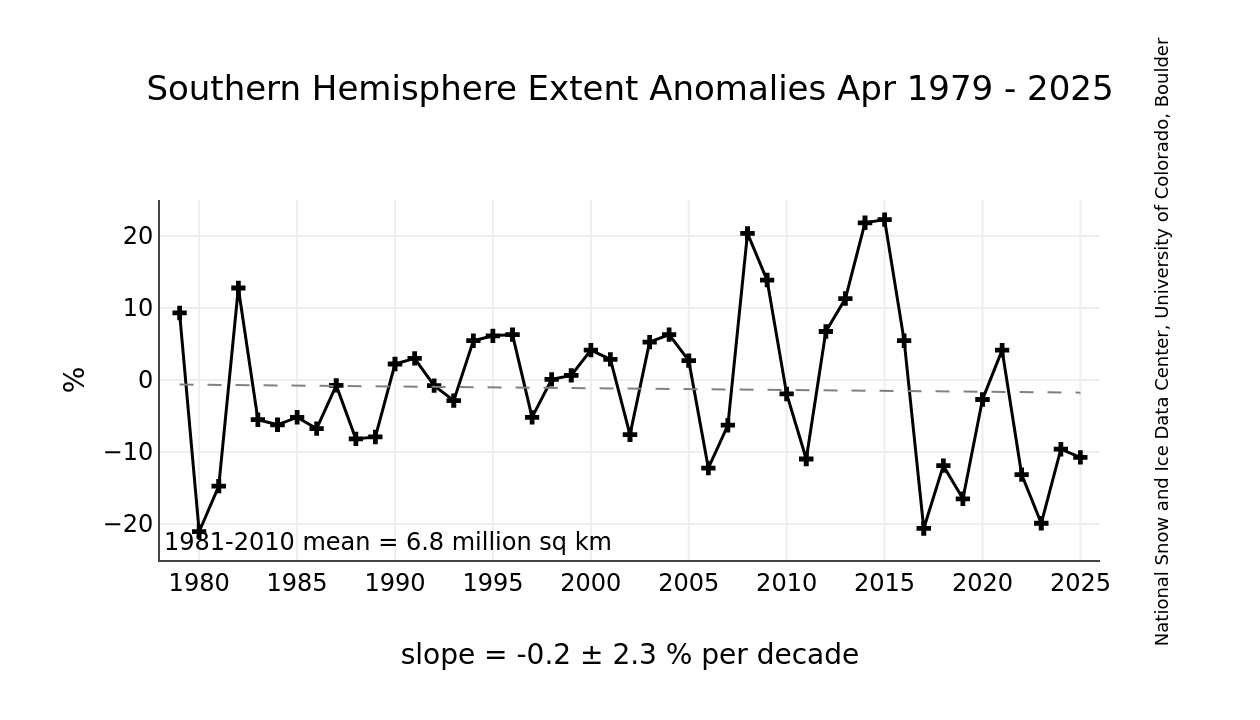
UAH satellite data also shows Antarctica cooling, as seen in their map below. (This map is dated November, 2006 – if anyone knows where to get a more recent version, please let me know.)


UAH 25 Year Temperature Trends
Perhaps NASA should have stuck with their original 2004 map below, showing Antarctica’s interior cooling?

NASA’s 1982-2004 map showing Antarctica cooling

While there’s no dispute that there’s some sea ice loss in the Antarctic peninsula, all signs seem to point in the opposite direction of what some what have you believe about Antarctica as a continent.
Sponsored IT training links:
We offer self paced 312-50 training with up to date 642-611 dumps and 70-450 practice test to provide guaranteed success in first dive.
Anu (14:59:00) :
You’re just suffering from BDS (Bush Derangement Syndrome). The supercomputers require support from a base load pwer supply. The wind farms are not a base load power supply. You can’t have the NCAR supercomputers blowing hot and cold every time the wind farms are idled by winds that don’t blow. Colorado’s power distribution system is already inadequate for their present and future needs without the additional elecrtical load of NCAR’s supercomputer project. Only the fossil fuel plants are capable of supplying the needs of NCAR’s supercomputer project day and night, in summers and winters, and regardless of whether the wind blows.
Anu (14:59:00) :
Yah hear all the time about how cheap wind is… but it just dosnt compute in my head… the biggest wind turbines are 7mw(and that is approaching the material limits.. may be able to pull off 10mw, but no greater on vertical turbines), the bigger hydro turbines are 700mw. So one hundred to one if youre assuming the same stresses and wear and tear as far as maintenance goes… but wind WOULD have far greater vibrational issues, just the thought o the stress’s on those big turbine blades and bearings makes me shudder.
There is the technology available to do away with fossil fuels… but its not wind. Fast Breeder liquid fluoride reactors are the way o the future. You need the energy to make chemical conversion(hydrogen) feasible to have any impact on fossil fuel reliance.
D. Patterson (18:31:58),
That’s exactly right. Wyoming has reliable power; Colorado doesn’t. Fossil fuel power is the most efficient, greenest power available.
I was also surprised at Anu’s BDS, but I guess I shouldn’t be. That’s what passes for science with a lot of the alarmist crowd, who are in reality mad that GWB kicked the AGW can down the road for eight years, when the easy way out would be to make a deal with the devil. Bush was human and had his failings [too profligate with tax money], but he was infinitely preferable to his two unworthy opponents, the kept Mr Heinz-Kerry, and you-know-who.
For Anu to express BDS here at the “Best Science” site deserves special recognition. Thanks.
D. Patterson (18:31:58) :
Anu (14:59:00) :
You’re just suffering from BDS (Bush Derangement Syndrome). The supercomputers require support from a base load pwer supply. The wind farms are not a base load power supply. You can’t have the NCAR supercomputers blowing hot and cold every time the wind farms are idled by winds that don’t blow. Colorado’s power distribution system is already inadequate for their present and future needs without the additional elecrtical load of NCAR’s supercomputer project. Only the fossil fuel plants are capable of supplying the needs of NCAR’s supercomputer project day and night, in summers and winters, and regardless of whether the wind blows.
———-
You might want to reread my comment, and see that I was talking about Cheney, not Bush. Welcome to American Politics – ever hear of the Lyndon B. Johnson Space Center, in Houston, Texas ?
Also, ever hear of peaking power plants ? Wind and solar replace part of the load, not the baseload.
Wind power provided 19.7 percent of electricity production and 24.1% of capacity in Denmark in 2007, a significantly higher proportion than in any other country. Denmark was a pioneer in developing commercial wind
power during the 1970s, and today almost half of the wind turbines around the world are produced by Danish manufacturers such as Vestas.
http://en.wikipedia.org/wiki/Wind_power_in_Denmark
Do you think Denmark is more technologically advanced than the U.S. ?
How about solar power – do you think the Air Force doesn’t understand how to replace fossil fuel power when the sun shines, and how to draw upon it when it doesn’t ?
http://www.wired.com/dangerroom/2009/05/obama-shines-light-on-air-forces-super-solar-array/
30 million kilowatt-hours of solar energy per year at Nellis Air Force Base just displaces fossil fuel generated power – yes, electrical grids can do that now.
Arguing that this stuff is just not technically feasible is the wrong approach.
Mike Ewing (18:41:29) :
Yes, it’s a high-tech industry. Precision engineering. Computer aided design. Advanced materials.
Wind is cheap if the siting is easy to build on (as I mentioned, the northern Great Plains), land rather than ocean construction, good steady winds year round (better utilization of the turbines), economies of scale (very large turbines), and close to power load (existing power lines).
Yes, they have 7.5 MW turbines, but those are for offshore applications (The turbines have a diameter of 492 feet. The idea is to manufacture at a port facility, and get them directly onto ships, then install them)
http://www.metaefficient.com/renewable-power/the-queen-buys-the-worlds-largest-wind-turbine-75-megawatts.html
Britain is planning to install 33 GW of offshore capacity by 2020.
These huge turbines are being manufactured by an American company:
http://www.triplepundit.com/pages/a-mighty-big-wi.php
I think Vestas is a globally respected company precisely because of their long history of quality engineering.
Fast Breeder liquid fluoride reactors might be good, but windpower is growing exponentially, doubling worldwide between 2005 and 2008. I hear the insurance rates for fission reactors is pretty high, and private companies don’t want to deal with it – the government subsidy for insurance is substantial. Windpower is just straightforward, quality engineering.
Leif Svalgaard (18:20:57) :
I was asking you to do it. You are an engineer, right?
There is more than one way to crack a coconut (…to skin a cat, would be calling for cruelty).
Fare thee well, but be back soon, who can tell…
Leif Svalgaard (10:39:06) :
Thank you for the links, it is good reading.
Maybe someone said this:
(100 Cubic KM/ 14,000,000 KM^2)*(1000 Meters/KM)*100 CM/M = .71 cm per year.
AMAZING! Just how the HELL does one make civil engineering measurements this accurate?
SORRY, because of the nature of the terrain, IMPOSSIBLE WITH SATTELLITES also.
THE FIRST PROCLAMATION BY NASA WAS MADE OF METHANE GENERATING MATERIAL. Can we trust anything else?
Max
Anu (14:59:00) :
The main reason the supercomputer is in Wyoming is because it uses huge amounts of electricity, which is much cheaper up there. They save millions of dollars.
Although it may suit your purpose to pretend that I and others who dispute you are for some reason incapable of reading and understanding what you actually wrote, the fact remains you directly linked the Bush Administration and its Vice President to the policy decision regarding the supercomputer project and its “coal power” or fossil fueled power supply.
You are quite obviously trying to use innuendo and invoke a knee jerk BDS response from the public by implying there just had to be something about the choice of Wyoming and coal fired power generation plants for support of the supercomputer project which necessarily entailed political corruption, a reckless disregard for the environmen,t and dismissal of the capabilities of wind power on the part of VP Cheney and the Bush Administration. Your remarks make no attempt whatsoever to honestly and fairly acknowledge the multitude of reasons why the Wyoming region is uniquely advantageous versus nearly any other location in the United States to support a project of this kind.
Wind power is generally used as an intermediate load power supply, because it is generally unsuitable to displace base load facilities or peak load facilities. The National Reneweable Energy Laboratory (NREL) has studied and experimented with the optimal methods of integrating the wind power facilities into the utilities dispatch schedules. Wind power facilities were found to complicate the dispatch of the more expensive peak load facilities. Although wind power facilities are less expensive with respect to marginal capital and minimal O&M (Operation and Maintenance) costs, their use in the power distribution network results in overall higher costs for the grid because the more expensive intermediate load and peak load facilities must still be deployed, maintained, and operated at even higher costs per unit of power generated when wind power is unable to displace their power loads. The NREL found the load balancing issues presented by the integration of wind power facilities into a utility’s network canceled the other economi benefits and made such wind power facilities unable to achieve an economic breakeven point on its own merits, meaning without the 30% governement interventions and taxpayer subsidies.
So, it appears you don’t have a clue as to what you are talking about.
Your comments are deceptive, because they omit any mention of the facts about Denmark’s inability to actually make use of 45% to 57% of the power, because of its highly intermittant nature. If you had been honest about it, you would have also reported how the wind power facilities in Denmark provided as little as 5% of Denmark’s annual requirements for electrical power and averages less than about 9.8% in most recent years. You also fail to mention that Denmark’s taxpayers have had to very heavily subsidize the wind power industry, because it’s earnings versus costs made it unable to breakeven much less earn a profit.
No, having served at Nellis AFB, what I think is that you have demonstrated yourself to be a dingbat who needs to teach your own grandmother how to to chew tobacco. You certainly don’t understand the very information you are citing. First, the PV (Photo-Voltaic) system began operation as a 14MW facility in a first phase 15MW project. The 30MW capacity is only a future plan. Secondly, the solar PV system is designed to provide an off-grid military mission survivability capability, rather than an economic alternative to fossil fuels and nuclear plants. Although the PV system discontinues about 33% of the prior electric utility bills, the capital and O&M costs for the lifetime of the project are greater than the avoided electric utility costs. In other words, the U.S. Governement spent a ton of money to procure a power system which could support mission critical warfighting capability when the grid is unavailable. It is certainly not in any way a model for how to deliver economically affordable power to the national power grid.
D. Patterson (12:15:51) :
So, you’re saying you’ve never heard of the Johnson Space Center ?
You refuse to acknowledge where Cheney earned his two degrees – the University of Wyoming ? You refuse to acknowledge where he retired to ?
Technical types are often politically clueless – no shame there, DP.
Are you saying 8 MW is a unique requirement that can only be supplied by siting it with the University of Wyoming ?
http://www.redorbit.com/news/technology/1374175/server_farms_becoming_a_cash_crop_in_the_midwest/
Oh look – server farms and data centers in Oklahoma and Iowa – I wonder why those states didn’t want a high tech research center…
Ever hear of URL’s DP ?
Try backing up your claims that Denmark is unable to actually make use of 45% to 57% of their windpower, for starters.
No, having served at Nellis AFB, what I think is that you have demonstrated yourself to be a dingbat who needs to teach your own grandmother how to to chew tobacco.
You were drunk when you wrote that, right ?
You certainly don’t understand the very information you are citing. First, the PV (Photo-Voltaic) system began operation as a 14MW facility in a first phase 15MW project. The 30MW capacity is only a future plan.
I said it produced 30 million kilowatt-hours of solar energy per year. 30 MW is power, not energy. Kilowatt-hour is a measure of energy.
Did you serve food at Nellis AFB ?
the capital and O&M costs for the lifetime of the project are greater than the avoided electric utility costs. In other words, the U.S. Governement spent a ton of money to procure a power system which could support mission critical warfighting capability when the grid is unavailable.
Nice try, DP.
Again, try using citations on the Web.
Something like this:
http://news.cnet.com/8301-11128_3-9829328-54.html
The deal is financed by MMA Renewables, which includes equity investments from Citi and Allstate and debt provided by John Hancock Financial Services.
It is a purchase power agreement, or PPA, where Nellis will purchase electricity that the panels generate at fixed rates. The panels themselves are owned by the financiers.
Or this:
http://www.nellis.af.mil/shared/media/document/AFD-090501-098.pdf
Saves AF over $1M a year
Developer: Designs, finances, builds and operates the PV array
Lessons Learned:
A REPP (Renewable Energy Purchase Process) like the Nellis model can be used at other DoD installations to purchase the use of on-site renewable energy
Seriously, learn to research on the Internet.
Don’t just make stuff up.
Reply: I’m not censoring this to avoid appearing partisan, but this bickering ends now. If it appears partisan later is is simply a coincidence because of multiple moderators. It’s 50/50 that each one of you will feel oppressed. ~ ctm
Anu (22:32:26)
Wrote:
“Try backing up your claims that Denmark is unable to actually make use of 45% to 57% of their windpower, for starters”
Read here:
http://www.cepos.dk/fileadmin/user_upload/Arkiv/PDF/Wind_energy_-_the_case_of_Denmark.pdf
Maybe you’ll change your point of view.
Ice is increasing in the Arctic, Antarctic and Greenland. Get used to it.
Massimo PORZIO (07:04:46) :
Anu (22:32:26)
Wrote:
“Try backing up your claims that Denmark is unable to actually make use of 45% to 57% of their windpower, for starters”
Read here:
http://www.cepos.dk/fileadmin/user_upload/Arkiv/PDF/Wind_energy_-_the_case_of_Denmark.pdf
Maybe you’ll change your point of view.
———-
Thanks for the link, interesting.
I had read “unable to make use of” as “wasted”, shunted to ground, like nuclear power plants excess power at night, hence my disbelief.
Selling windpower to Germany, the Netherlands, Norway or Sweden is not exactly “unable to make use of” – I like the word “exported” better, as used in your link.
Yes it’s true, the more interconnected intermittent power sources are, the better. Wind is not constant, but over large areas, it is blowing somewhere. Denmark is a rather small country of 5.5 million people.
I would call Saudi Arabia a large oil exporter, not someone “unable to make use of” their oil:
http://www.eia.doe.gov/cabs/Saudi_Arabia/OilExports.html
Anu (09:21:10) :
Selling windpower to Germany, the Netherlands, Norway or Sweden is not exactly “unable to make use of” – I like the word “exported” better, as used in your link.
You are all splitting hairs. Denmark is indeed ‘unable to make use of’ because of intermittent over-production and thus exports in times of surplus. The fundamental reason for not being able to make use of is that with coal fired plants you cannot quickly adjust to large fluctuations [in wind power] as you can with hydroelectric power. The set-up between Denmark and neighbors is a perfect example of good engineering.
Leif Svalgaard (10:08:32) :
Wrote:
“You are all splitting hairs. Denmark is indeed ‘unable to make use of’ because of intermittent over-production and thus exports in times of surplus. The fundamental reason for not being able to make use of is that with coal fired plants you cannot quickly adjust to large fluctuations [in wind power] as you can with hydroelectric power. The set-up between Denmark and neighbors is a perfect example of good engineering”
That’s exactly what the report said. Danish pay the world highest cost for their electric energy because they “must” sell “overproduced” energy at very low prices, and buy the “missed” one during the low windy days at very high costs.
Anu (09:21:10)
Wrote:
“Yes it’s true, the more interconnected intermittent power sources are, the better. Wind is not constant, but over large areas, it is blowing somewhere.”
The more complex is the grid, the more frequent are the failures. It’s just statistics. The Danish power grid is a good example of engineering, but I’m not so sure that it is a good example of efficiency too.
Massimo PORZIO (10:28:12) :
Danish pay the world highest cost for their electric energy because they “must” sell “overproduced” energy at very low prices, and buy the “missed” one during the low windy days at very high costs.
Not really true. They don’t ‘have’ to ‘sell’ their extra energy. They could give it away. Getting something for it is better than nothing. As I read the report, they get it back at the same price as they sell it [subject to availability]. Perhaps I missed the ‘very high cost’ bit. Could you show me where?
Look at the Danish Energy Association report:
http://www.danishenergyassociation.com/Statistics.aspx
Under Documents, download the PDF file “Statistical Survey 2008”.
Figure 17 – Denmark has lower electricity prices than Germany, Poland, Italy, and is tied with Spain.
Table 8: Exchange of Electricity with Nordic countries (Finland, Norway, Sweden, other)
10,478 GWh exported to, 11,428 GWh imported from.
Is it your contention that Denmark consistently buys high and sells low ?
Figure 21: Denmark has more than tripled exports of energy technology and equipment from 1998.
As for those “frequent grid failures”:
The Danish electricity consumers experience a high level of security of supply. The consumers were disconnected for 22 minutes on average in 2008. In 2007 the figure was 27 minutes. Compared to international figures the
security of supply in Denmark is the highest registered in EU. – Page 45
Reply: I’m not censoring this to avoid appearing partisan, but this bickering ends now. If it appears partisan later is is simply a coincidence because of multiple moderators. It’s 50/50 that each one of you will feel oppressed. ~ ctm
———-
Fair enough.
Leif Svalgaard (10:45:55)
wrote:
“They don’t ‘have’ to ’sell’ their extra energy. They could give it away. ”
Yes, of course. Here in Italy we say that way to imply that it is the “minor damage”. I put “must” between the quotes just to evidence that I was writing something not really “to do” but “better to do”. Excuse me, but my English is not so good 🙂
Anyways what you wrote about is exactly what I mean.
you wrote also:
“As I read the report, they get it back at the same price as they sell it [subject to availability]. Perhaps I missed the ‘very high cost’ bit. Could you show me where?”
Maybe I misunderstood the writing on page 22 and followings. As far I understand the exported energy price includes the subsidies paid by the Danish to support the wind power production, so Danish people exports these subsidies (their paid taxes) when exports energy to the “energy storage countries”.
Anu (16:31:49) :
Wrote:
“Figure 17 – Denmark has lower electricity prices than Germany, Poland, Italy, and is tied with Spain”
Yes it’s the energy for manufacturing industries, which is not taxed to maintain the competitivity as explained in the link I sent you before. Please note how (in your reported document, figure 18) only 29% of the total consumption is represented by the manufacturing industries. In the same figure you can also see how Denmark is not so industrialized as the other nordic countries.
Except for the manufacturing industries, all the other users must pay the taxes due to the wind power subsidies, as per the graphic at page 18 of the link I sent you in a former message. There you can see how they are the high-payers in EU because of the taxes needed to make the wind power sustainable.
you wrote:
“The Danish electricity consumers experience a high level of security of supply. The consumers were disconnected for 22 minutes on average in 2008. In 2007 the figure was 27 minutes.”
Yes, of course. But that doesn’t means they have less failure, it does mean that their system is highly reactive. It means that the great engineered system grid works very well, but at which cost?
Have a nice day
Can someone more knowledgable than myself help me understand how comparing the older Antarctic image from 2004 (showing cooling) and the more recent image from 2007 (showing warming) suggests the conclusion that the Antarctic is not warming?
I’m not an AGW proponent and I’m not being snarky, I arrived here looking for documentation to support the idea of Antarctic cooling, but from what I am seeing it appears to the opposite.
Can someone explain in fairly simple terms what I am missing? TIA.