by Steven Goddard and Anthony Watts
In late 2009, Anthony forecast that Arctic sea ice would continue to recover in 2010. Last month Steve Goddard did an analysis explaining why that was likely to happen and yesterday NSIDC confirmed the analysis.
The pattern of winds associated with a strongly negative AO tends to reduce export of ice out of the Arctic through the Fram Strait. This helps keep more of the older, thicker ice within the Arctic. While little old ice remains, sequestering what is left may help keep the September extent from dropping as low as it did in the last few years.
The wording of NSIDC press releases usually highlight the negative (this one being no exception) but the message is clear. This summer is likely to continue the trend since 2007 of increasing summer minimums.
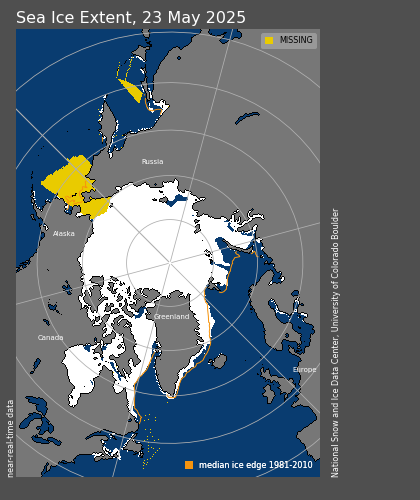
So how is Arctic sea ice looking at this point, near the winter maximum? NSIDC shows ice extent within 1 million km2 of normal and increasing.

http://nsidc.org/data/seaice_index/images/daily_images/N_timeseries.png
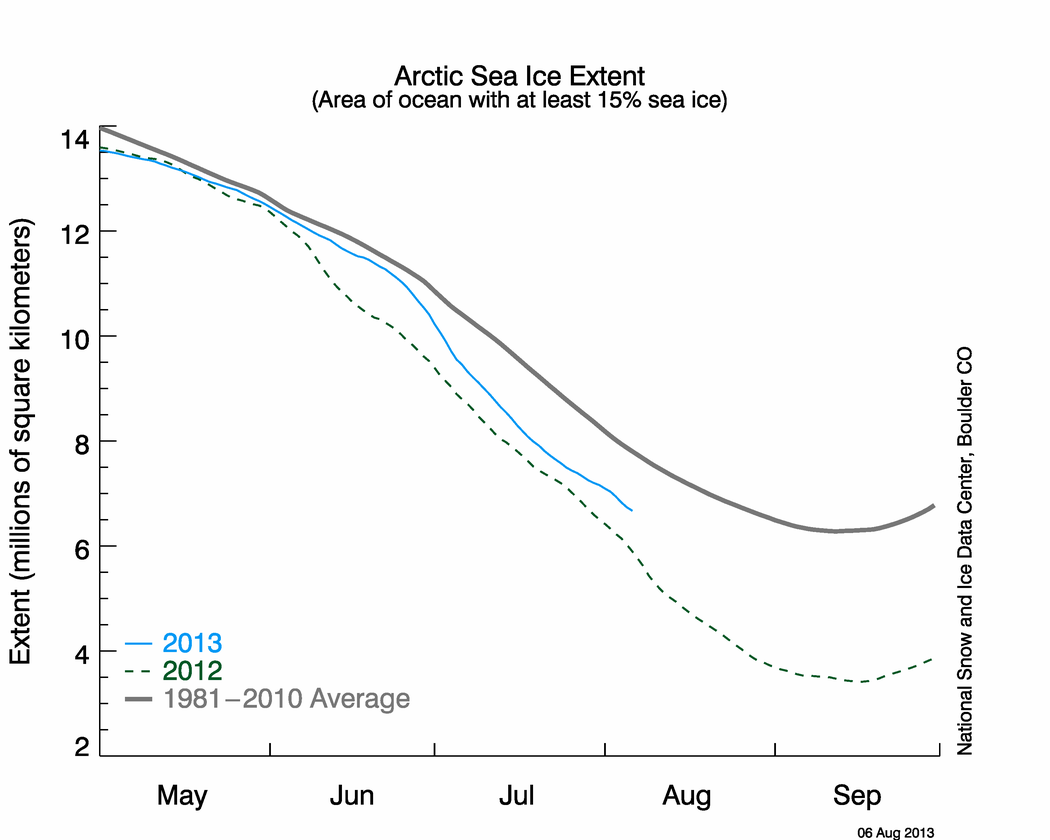
The Baltic and Bering Sea have slightly above normal ice. Eastern Canada and The Sea of Okhotsk have slightly below normal ice.

http://nsidc.org/data/seaice_index/images/daily_images/N_daily_extent.png
DMI shows sea ice extent at nearly the highest in their six year record.

Sea ice extent for the past 5 years (in million km2) for the northern hemisphere, as a function of date.
http://ocean.dmi.dk/arctic/icecover.uk.php
NORSEX shows ice area just outside one standard deviation (i.e. almost normal.)

http://arctic-roos.org/observations/satellite-data/sea-ice/observation_images/ssmi1_ice_area.png

There’s also some interesting comparisons to be made at Cryosphere Today. When you compare the current images in recent days with the same period in years past, you notice how “solid” the ice has become. For example compare March 3rd 2010 to March 3rd 2008, when we saw the first year of recovery:

Note that there’s no “fuzziness” in the signal return that creates this image on the right. A fuzzy return would indicate less than solid ice, such as we see on the left. The CT image from March 3rd is “deep purple” through and through. The edges of the ice are very sharp also, particularly near Greenland and also in the Bering sea. These two visual cues imply a solid, and perhaps thicker ice pack, rather than one that has been described by Dr. Barber as “rotten ice”.
I wish I could compare to March 3 2009, but the CT images were offline last spring then while both they and NSIDC dealt with issues of SSMI sensor dropout that was originally brought to their attention by WUWT, but was deemed “not worth blogging about“.
According to JAXA, 2003 was a good year for Arctic sea ice. Note the blue line.

So how does that year on March 3rd compare to our current year using CT’s imagery?

Compared to the best year for Arctic sea ice in the past decade, March 3rd this year looks quite solid. The setup for 2010 having more ice looks good.
You can do your own side by side comparisons here with CT’s interactive Arctic sea ice comparator.
The Arctic continues to recover, and one of the last CAGW talking points continues to look weaker and weaker. It wasn’t very long ago when experts were forecasting the demise of Arctic ice somewhere between 2008 and 2013. And it is not the first time that experts have done this – they were claiming the same nonsense in 1969, right before the ice age scare.

Note the column at the right. Even back then, skeptics got the short shrift on headlines because as we know: “all is well, don’t panic” doesn’t sell newspapers.
UPDATE: And then there’s this:
AROUND 50 ships, including large ferries reportedly carrying thousands, were stuck in the ice in the Baltic Sea today and many were not likely to be freed for hours, Swedish maritime authorities said.
R. Gates: What is happening to Arctic sea ice is exactly what AGW models say should be, albeit a bit faster than expected so far…
But it’s also exactly as expected if you think that the Arctic temperatures are subject to multidecadal natural variations (see e.g. http://wattsupwiththat.com/2009/10/08/new-paper-barents-sea-temperature-correlated-to-the-amo-as-much-as-4°c/), so there is no convincing “anthropogenic footprint” so far.
Let’s see in 2 or 3 years who is right…
Regarding the ships stuck outside Nortälje / Kapellskär. We have had a storm that has piled up the ice real good. The ice breakers in the area are to weak to cope. That is why Sjöfartsverket is sending down YMER to assist. Finland is also lending SISU. Our best ice breaker ODEN is in Antarctica on an expedition. The Swedish Sjöfartsverket did not expect a heavy ice year. ;-). We would have needed ODEN now.
/Sven
cal: I would suggest that the period of 1976 to 2006 would make a much better norm given that the PDO/AMO seems to work on this sort of timescale.
That’s exactly what NANSEN uses. And according to them, ice area today is almost within +/-1 STD again..
Regarding the 50 vessels in the Baltic, our best Icebreaker here in Sweden is not available and why not, beacuse it is in the Antarctic on a research project!!! and of course to the researchers that make sence, global warming will stop the ice in the Baltic… not.
savethesharks (22:14:56) :
“Ummm….nobody is saying its just the wind. DUH!!
Actually you are wrong, I’ve seen more than one comment saying that ice reduction in the Arctic, either in general or for exceptionally low years like 2007, was wind caused and not melt. I’ve seen this in posts here and at ClimateAudit. Wind as a factor gets massively overplayed and melting caused by high temps underplayed.
Andy
Your graphs seem to show that in the last few years yearly minimum (september) and maximum (march) data for sea ice coverage varied much more than june and december data ; is this always the case
R. Gates (21:34:45) :
Richard M (20:10:55) said:
“Would you mind providing the evidence that says the Arctic has NEVER been warmer than the last 20 years?”
When did I make this assertion? I don’t think I ever did, in fact I KNOW I never did, or would have because it is false.
Go back and read your post. You stated the last 20 years was a record. I don’t know about you but most people considered records to be the highest EVER. That means NEVER is the correct description of non-record years.
I suspect you are gradually starting to see that alarmists have set the stage for the complete demise of CAGW. It may turn out that arctic sea ice is not a good proxy for temperature. We’ve seen winds reduce the level significantly, and, if the winds this past year lead to another big increase then temperature (at least small changes) may turn out to be insignificant.
Note that this does not mean AGW is incorrect, it simply demonstrates our overall lack of understanding of climate. Many are skeptics because of this lack of understanding, not that they view AGW as an impossibility. Skeptics want us to FIRST, understand the science. Then we can proceed to take appropriate measures to deal with any anomalies.
Paul Daniel Ash (17:07:23) :
“Well, that’s a fairly dramatic move of the goalposts.”
Pure projection. It is the alarmist contingent that constantly moves the goal posts. The original hypothesis stated that a rise in human produced CO2 would lead to runaway global warming and climate catastrophe. Clearly this has not happened.
So It is still up to the climate alarmists to show that runaway global warming due to increased CO2 even exists, because that is the hypothesis the entire global warming scare is based on.
However, there is no empirical, measurable evidence validating the CO2=CAGW hypothesis. None. When we look at the climate without the one-tenth degree fluctuations due to natural variability, here is what we see: click
It is quite obvious that the climate remains well within its natural historical parameters. There is no runaway global warming, only natural cycles. Because of the complete lack of empirical evidence to support the climate scare, the CO2=CAGW hypothesis is reduced to a speculative conjecture.
That means your conclusion is baseless:
“Cause: the greenhouse gases – primarily CO2 – are causing the heating.”
Nonsense.
It doesn’t seem likely that either of the last two caused the changes in the temperature record, but Urban Heat island effects might well have.
that’s an interesting hypothesis. Has it been tested?
CRS, Dr.P.H. (09:55:21) :
…
Meanwhile, I notice that Mr. Sun is still struggling to awaken from a rather deep minimum. The brief sunspot activity observed over the past few months has decreased rather dramatically. I’m expecting the sun to slip back into a very quiet minimum, we’ll see.
————————————–
“decreased rather dramatically” ???
Are you aware of the National Geophysical Data Center (NGDC) ftp server giving daily sunspot numbers and monthly averages ?
ftp://ftp.ngdc.noaa.gov/STP/SOLAR_DATA/SUNSPOT_NUMBERS/2009
ftp://ftp.ngdc.noaa.gov/STP/SOLAR_DATA/SUNSPOT_NUMBERS/2010
Month Monthly-average-#sunspots
Nov/2009 4.2
Dec/2009 10.6
Jan/2010 13.1
Feb/2010 18.6
Compare this to the start of the last sunspot cycle:
ftp://ftp.ngdc.noaa.gov/STP/SOLAR_DATA/SUNSPOT_NUMBERS/1996
ftp://ftp.ngdc.noaa.gov/STP/SOLAR_DATA/SUNSPOT_NUMBERS/1997
If I were you, I wouldn’t waste too much money betting on the sun “slipping back” into a very quiet minimum
Paul Daniel Ash,
According to Keven Trenberth, climate scientists have no idea how to properly balance the energy budget of the earth. Since that is the case, I am very curious as to how you came up with your exact figure on the energy “imbalance”, since the climate scientists themselves admit that their models cannot possibly account for every variable in climate, and they do not even know what all of the interractions between variables actually are.
For example, ALL of the models assume postitive water vapor feedback, but several recent studies have shown that water vapor feedback is probably negative, and possibly strongly negative.
Anu,
Yes, by the normal cyclical trend of sunspot cycles, the sun slipping back into a minimum is pretty unlikely. The maximum of this cycle is projected to be one of the lowest in recent history, but given the historical record on solar cycles, it would be highly unusual for the sun to go back to a prolonged period with few to no spots. It COULD happen, and we will keep watching to see what does happen.
On the one hand, I would like to see more solar activity, I don’t personally like a bunch of cold, wet weather.
On the other hand, I would LOVE to see a prolonged solar minimum where we end up with lots of cold, ice, snow, rain, etc. That way we could tell all of these “climate scientists”, “see, we told you that it was the sun, stupid!”
Smokey (05:44:00) :
The original hypothesis stated that a rise in human produced CO2 would lead to runaway global warming and climate catastrophe. Clearly this has not happened.
The hypothesis is that greenhouse gases, would produce warming. There has been warming commensurate with that which would be expected from the additional GHGs in the atmosphere. Other posited causes have not been borne out by research.
The hypothesis also says that if current trends continue that there may be serious effects in the future. Obviously, there is no empirical evidence for this or any other projection of future events, like the heat death of the universe, Africa crashing into Eurasia or the cancellation of American Idol. No hypothesis can be validated or invalidated on the basis of predictions about the future that have not taken place in the present. This is self-evident.
However, there is no empirical, measurable evidence validating the CO2=CAGW hypothesis. None.
What would represent “empirical, measurable evidence” to you? This is a very serious question. Since temperature increases do not come with a label saying “I am ninety percent due to natural variation and ten percent due to radiative forcing!” then you have to look at the possible causes and rule them in or out.
If not proposing a description of how the greenhouse effect works and showing how it accounts for the observed warming so far, then what would be “empirical” and “measurable” in your estimation?
PeterB in Indainapolis (06:09:25) :
Climate scientists are well aware of the importance of the sun on climate:
http://data.giss.nasa.gov/gistemp/2008/Fig4.gif
But it is fluctuations *around* this high level of influence that will cause *changes* in the climate:
“However, let’s assume that the solar irradiance does not recover. In that case, the negative forcing, relative to the mean solar irradiance is equivalent to seven years of CO2 increase at current growth rates. So do not look for a new “Little Ice Age” in any case. Assuming that the solar irradiance begins to recover this year, as expected, there is still some effect on the likelihood of a near-term global temperature record due to the unusually prolonged solar minimum. Because of the large thermal inertia of the ocean, the surface temperature response to the 10-12 year solar cycle lags the irradiance variation by 1-2 years. Thus, relative to the mean, i.e, the hypothetical case in which the sun had a constant average irradiance, actual solar irradiance will continue to provide a negative anomaly for the next 2-3 years.”
http://data.giss.nasa.gov/gistemp/2008/
Solar forcing of the global temperature is cyclical – as are the forcings of the various cycles of ocean water sloshing about in 3 dimensions (ENSO, PDO, etc).
But the CO2 forcing is inexorable, and in one direction.
Thank you Steve Goddard, I looked at your http://wattsupwiththat.com/2009/01/10/polar-sea-ice-changes-are-having-a-net-cooling-effect-on-the-climate/and it is exactly what I was speculating about.
Richard M (05:15:26) :
Many are skeptics because of this lack of understanding, not that they view AGW as an impossibility.
Skeptics like me do NOT view AGW as an ‘imposibility’; I understand it for what it actually is, a THEORY foisted by people who have provided zero evidence over the last ~30 years that it has any measurable significance. Thank God the earth stopped warming enough over the last 15 years to give honest scientists at least a purchase to undermine a 79 billion dollar government funded hoax based on faulty modeling, corrupted data and politically motivated obstruction of the peer review process. If there had never been any government/UN interest to stack the deck with all that money to exploit climate science for a political agenda, the silly notion of AGW would have died a long time ago.
Anu (06:40:02):
“…CO2 forcing is inexorable, and in one direction.”
Just because that’s your personal belief system means nothing. There is no proof that CO2 is not, in fact, a negative forcing.
Paul Daniel Ash (06:34:47):
“There has been warming commensurate with that which would be expected from the additional GHGs in the atmosphere.”
The correlation between warming and CO2 is much weaker than other correlations: click
The fact is that the presumed forcing from CO2 is so insignificant that it can not be empirically measured, so it is “measured” in computer models. When you can show me that X increase in CO2 causes Y increase in temperature, wake me.
Until you or anyone else can show that particular cause and effect in the real world, your CAGW conjecture is rank speculation. As CO2 rises, the planet laughs at your hubris: click
Ref – Paul Daniel Ash (17:07:23) :
Smokey (13:56:00) :
“Just to say that you’re not convinced, though, simply won’t do.”
______________________________
Beg to differ. For most of the folks on this planet, that is more than sufficient and will do.
Ref – geo (20:37:29) :
@Steve Goddard (16:59:21) :
“The older I get, the more I recognize the importance of recognizing and respecting context.”
_________________________
Agree! Isn’t it the most fascinating aspect of blog comments? Almost every comment assumes so much, leaving so much unsaid, while begging the question: “Don’t you agree?”
Ref – savethesharks (21:01:40) :
Paul Daniel Ash: “I’m just learning this stuff, and I’d rather not be stuck with a wrong headed notion.”
“..if that’s the case then perhaps you would do well to keep your mouth shut more (and keyboard silent) and listen more to the experts on here,…”
_____________________
Plato’s 1st Rule – “Comments Personal Counterproductive Are”
Daniel,
Good questions. The Arctic is always very cold in the winter and freezes up, so there is little variation in extent through most of the year. In recent years, the amount of older and thicker ice has been reduced so there has been a tendency for summer minimums to melt back closer to the pole. That situation appears to have improved somewhat this winter, which is the point of the article.
PeterB in Indainapolis (06:03:54) :
According to Keven Trenberth, climate scientists have no idea how to properly balance the energy budget of the earth.
My guess is that this statement is based on something Trenberth said in one of the CRU emails. I have to guess, and Google, because you provide no source for your claim. It would be really helpful if you would do so.
The email, as I read it in context, refers to a paper Trenberth wrote about the inadequacies in the various observation systems of air, land and sea temperature. This is addressed openly, not “hidden” as reports about the emails tend to indicate.
Scientists responding to the controversy about this statement have referred to von Schuckmann et. al. saying that it gives support to the notion that there is warming occurring in the deep ocean. I’d be interested if someone with better understanding than I could point to any errors or inconsistencies in the paper.
Espen said:
“Let’s see in 2 or 3 years who is right…”
Unfortunately, even if we see new modern era temperature records, and new summer arctic sea ice minimums, increasing severe weather events, and even the shrinkage of southern sea ice, tI think those who are skeptical of AGW will never concede anything. But certainly, AGW as a theory makes specific predictions, and if these predictions do unfold then perhaps the reasonable “middle” ground of people will listen less to the extremes at either end and chart a reasonable course of action (if any action is possible).
Looks like Arctic ice extent may break the all-time DMI record tomorrow.
http://ocean.dmi.dk/arctic/icecover.uk.php
DMI uses 30% concentration compared to NSIDC at 15%, so this demonstrates Anthony’s point that concentration is high this year.
I’m really quite struck by the sharp upward movement this late in the season of the arctic ice pack extent coinciding with the easing of the AO from sharply negative back towards neutral the last week. I’m starting to come around to Steve’s thinking on minimum this year.
http://nsidc.org/data/seaice_index/images/daily_images/N_stddev_timeseries.png
http://www.cpc.noaa.gov/products/precip/CWlink/daily_ao_index/ao_index.html
TonyB (12:02:22) :
I haven’t had time to scan down and see if any others replied to your comment. I was very interested in the stuff about the Ipiutak culture. It seems to need more research, but to have a town of that size on the shores of the Arctic, (roughly ten times as large as any Eskimo community,) really does suggest the MWP was warmer on that coast, and not merely in Greenland and Europe. Also the demise of that culture fits in very nicely with the demise of the Greenland Vikings. I wonder where they went, just as I wonder about the Vikings.
It is a pity these people get so little funding. Likely learning how warm it was on the Arctic coast during the MWP is frowned upon by some Warmists. It makes it hard to be alarmed, if warming would only mean a return to conditions we have seen before. For example: If the seas didn’t bubble up huge amounts of methane back then, it would be hard to freak out it may happen tomorrow.
I personally feel it would be a good thing if we experienced another optimum like the MWP. The only bad thing would be certain Warmists would use a kindly climate to create human misery, with bullying politics.
Smokey (07:04:29) :
Anu (06:40:02):
“…CO2 forcing is inexorable, and in one direction.”
Just because that’s your personal belief system means nothing. There is no proof that CO2 is not, in fact, a negative forcing.
——————
Thank you.
Seldom do “skeptics” reveal their profound ignorance of the topic at hand in such a concise fashion.
Your subsequent posts will be ignored.
R Gates,
Read the NSIDC newsletter linked in the article. They make it quite clear that Antarctic ice is increasing and Antarctica is cooling.