by Steven Goddard and Anthony Watts
In late 2009, Anthony forecast that Arctic sea ice would continue to recover in 2010. Last month Steve Goddard did an analysis explaining why that was likely to happen and yesterday NSIDC confirmed the analysis.
The pattern of winds associated with a strongly negative AO tends to reduce export of ice out of the Arctic through the Fram Strait. This helps keep more of the older, thicker ice within the Arctic. While little old ice remains, sequestering what is left may help keep the September extent from dropping as low as it did in the last few years.
The wording of NSIDC press releases usually highlight the negative (this one being no exception) but the message is clear. This summer is likely to continue the trend since 2007 of increasing summer minimums.
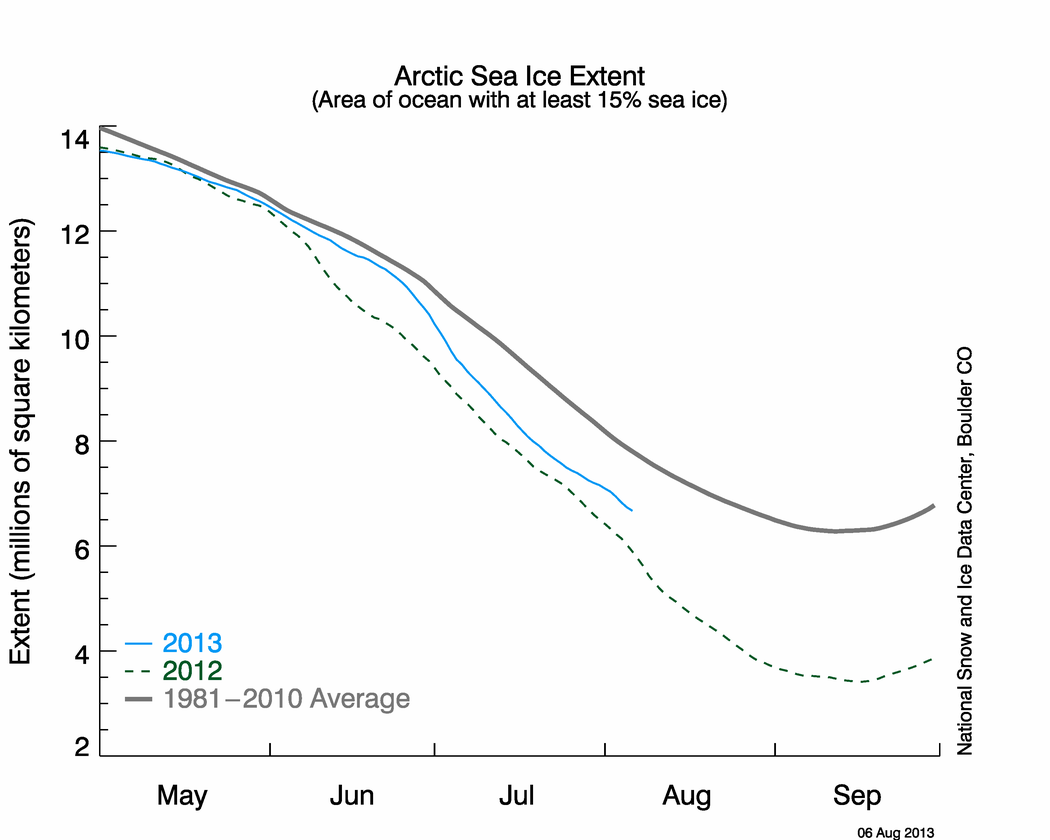
So how is Arctic sea ice looking at this point, near the winter maximum? NSIDC shows ice extent within 1 million km2 of normal and increasing.

http://nsidc.org/data/seaice_index/images/daily_images/N_timeseries.png
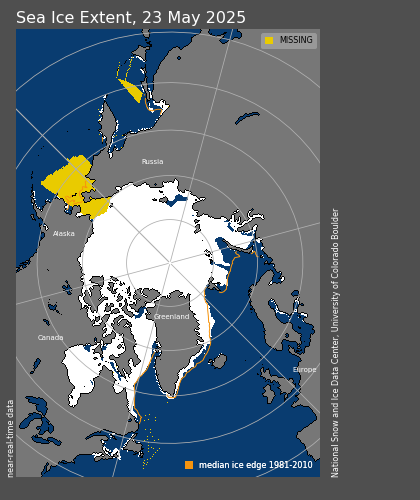
The Baltic and Bering Sea have slightly above normal ice. Eastern Canada and The Sea of Okhotsk have slightly below normal ice.

http://nsidc.org/data/seaice_index/images/daily_images/N_daily_extent.png
DMI shows sea ice extent at nearly the highest in their six year record.

Sea ice extent for the past 5 years (in million km2) for the northern hemisphere, as a function of date.
http://ocean.dmi.dk/arctic/icecover.uk.php
NORSEX shows ice area just outside one standard deviation (i.e. almost normal.)

http://arctic-roos.org/observations/satellite-data/sea-ice/observation_images/ssmi1_ice_area.png

There’s also some interesting comparisons to be made at Cryosphere Today. When you compare the current images in recent days with the same period in years past, you notice how “solid” the ice has become. For example compare March 3rd 2010 to March 3rd 2008, when we saw the first year of recovery:

Note that there’s no “fuzziness” in the signal return that creates this image on the right. A fuzzy return would indicate less than solid ice, such as we see on the left. The CT image from March 3rd is “deep purple” through and through. The edges of the ice are very sharp also, particularly near Greenland and also in the Bering sea. These two visual cues imply a solid, and perhaps thicker ice pack, rather than one that has been described by Dr. Barber as “rotten ice”.
I wish I could compare to March 3 2009, but the CT images were offline last spring then while both they and NSIDC dealt with issues of SSMI sensor dropout that was originally brought to their attention by WUWT, but was deemed “not worth blogging about“.
According to JAXA, 2003 was a good year for Arctic sea ice. Note the blue line.

So how does that year on March 3rd compare to our current year using CT’s imagery?

Compared to the best year for Arctic sea ice in the past decade, March 3rd this year looks quite solid. The setup for 2010 having more ice looks good.
You can do your own side by side comparisons here with CT’s interactive Arctic sea ice comparator.
The Arctic continues to recover, and one of the last CAGW talking points continues to look weaker and weaker. It wasn’t very long ago when experts were forecasting the demise of Arctic ice somewhere between 2008 and 2013. And it is not the first time that experts have done this – they were claiming the same nonsense in 1969, right before the ice age scare.

Note the column at the right. Even back then, skeptics got the short shrift on headlines because as we know: “all is well, don’t panic” doesn’t sell newspapers.
UPDATE: And then there’s this:
AROUND 50 ships, including large ferries reportedly carrying thousands, were stuck in the ice in the Baltic Sea today and many were not likely to be freed for hours, Swedish maritime authorities said.
Paul Daniel Ash,
Obviously you have been cherry-picking which comments to read. Several of the commentors have pointed out that in 1922, 1951, 1958, and 1969, there were predictions of the arctic being free of ice “within a few years”.
Even if we go with your “a hundred years”, it has been nearly 100 years since the 1922 prediction of an ice-free arctic, and there are still over 14 MILLION square kilometers of ice up there. Do you seriously think that the polar ice is going to shrink by > 1 million square kilometers per year over the next 12 years to make that 1922 prediction come true? I am pretty sure that in the recorded history of man there has never been a single year (much less 10 in a row) in which arctic ice extent declined by > 1 million square kilometers.
Steven and Anthony: Add this to the forecast ledger, mine of 2007- 2008 (Note that the earliest emails are at the bottom:
Dear Ms Leitzell
Its me again. I read the news release for Oct 2nd. I’m sorry but the
conclusions appear determined to ignore the alternative possibility
supported by the evidence of the past year that we may be witnessing a
rebound (even if we may not believe it will be long lived). Two factors
suggest that we will have greater ice extent next year:
1) The first year ice that survived will become 2nd year ice for the 2009
melt season.
2) Recall my observation about the steepness of the re-freeze curve in 2007
and the terribly cold winter and cool summer that followed. I note that
already the refreeze curve appears to be even steeper at this early stage.
If this is a harbinger of another cold winter (and it is only 6 degrees C
here in Ottawa this morning), then we will indeed have a significant
rebound. Thermodynamics insists that if the ocean water was cooler in 2008
summer and a cold winter follows then we will likely see not just a “mere”
10% rebound (which I still insist is significant following a summer of warm
ocean) but an exponential growth in ice extent survival.
I accordingly forecast a 15 to 20% rebound in survival ice for 2009 and
challenge NSIDC to reply that this is not possible. If it is possible, then
the unequivocal conclusions of the Oct 2 News Release should have been much tempered. If it happens, I would be pleased to be cited as having made the prediction. Keep an eye on the refreeze curve – it might be a valuable additional factor to put into the equation.
Sincerely,
Gary Pearse, P.Eng
Ottawa
—– Original Message —–
From:
To:
Sent: Friday, September 19, 2008 11:59 AM
Subject: {nsidc-170961} Re: Second lowest extent indicating continued
decline
> Dear Mr. Pearse,
> Thanks for your comments, and I hope my responses were helpful. Please let us know if you have any more questions.
> Regards,
> Katherine Leitzell
> equapolar@bellnet.ca wrote:
>> Dear Ms Leitzell
>> Thank you for your patience in responding to my curmudgeonly diatribes. I am not a “denier” (science chose a very unbecoming word in denier- it has a medieval religious inquistition-like tone) , but rather a searcher of loose threads. I trust science still finds adversary views useful in sharpening its tools.
>> Sincerely,
>> Gary Pearse,
>> Ottawa, Canada
>> —– Original Message —–
>> From:
>> To:
>> Sent: Thursday, September 18, 2008 2:37 PM
>> Subject: {nsidc-170961} Re: Second lowest extent indicating continued
>> decline
Dear Mr. Pearse,
Thank you for your input regarding Arctic Sea Ice News & Analysis. I
will pass your comments on to the authors.
Regarding your comment on previous eras when the Arctic may have been
ice-free, NSIDC scientists have addressed this briefly in a Frequently Asked Questions page on Arctic sea ice. I’ve pasted their answer at the
bottom of this email.
Also, since you are a scientist, you may find the peer-reviewed
literature on the topic of sea ice decline to be helpful. Below are several
citations of articles by NSIDC scientists on the topic. Obviously, discussion of
the 2008 melt season is preliminary. NSIDC will release a more detailed
press announcement in the beginning of October, and I expect that you will
see more peer-reviewed research on the topic in the months to follow.
Articles:
Stroeve, J., M. M. Holland, W. Meier, T. Scambos, and M. Serreze. 2007.
Arctic sea ice decline: Faster than forecast. Geophysical Research
Letters 34, L09501, doi:10.1029/2007GL029703.
Serreze, M. C., M. M. Holland, and J. Stroeve. 2007. Perspectives on
the Arctic’s shrinking sea-ice cover. Science 315(5818): 1533-1536,
doi:10.1126/science.1139426. (review article)
Serreze, M. C., A. P. Barrett, A. G. Slater, M. Steele, J. Zhang, and
K.
E. Trenberth. 2007. The large-scale energy budget of the Arctic.
Journal of Geophysical Research 112, D11122, doi: 10.1029/2006JD008230
From the FAQ (http://nsidc.org/arcticseaicenews/faq.html:
Has the Arctic Ocean always had ice in summer?
We know for sure that at least in the distant past, the Arctic was
ice-free. Fossils from the age of the dinosaurs, 65 million years ago,
indicate a temperate climate with ferns and other lush vegetation.
Based on the paleoclimate record from ice and ocean cores, the last
warm period in the Arctic was about 8,000 years ago, during the so-called
Holocene Thermal Maximum. However, NSIDC scientists are not aware of
direct evidence that the Arctic was free of sea ice in summer during
that time.
The last time that the ocean was likely free of summertime ice was
125,000 years ago, during the height of the last major interglacial period,
known as the Eemian. Sea level was also 4 to 6 meters (13 to 20 feet) higher
than it is today because the Greenland and Antarctic Ice Sheets had
partly melted. Because of the burning of fossil fuels, global averaged temperatures today are getting close to the maximum warmth seen during
the Eemian. Carbon dioxide levels now are far above tech highest levels
during the Eemian, indicating there is still warming to come.
According to analyses at NASA, 2007 was the second-warmest year
globally
in the instrumental record; the Arctic was especially warm.
Regards,
Katherine Leitzell
equapolar@bellnet.ca wrote:
Dear Ms Leitzell,
Thank you for your quick reply and I stand corrected on NSIDC’s not
noticing the steep refreeze curve of fall 2007. I guess the crux of my
long-winded email was that NSIDC was in fact drawing a strong negative conclusion from the fact that there was “only” 10% rebound (you should have been at least neutral in your conclusions). I think given the warmer ocean of the previous year, the 10% increase is rather remarkable and a similar refreeze this winter would result in an even greater increase in sea ice extent (thermodynamics would demand it). I am a scientist myself –
geological and a mathematician. 15,000 years ago, 50 million cubic kilometres of ice melted off the polar – temperate regions in a relatively short time (when we numbered perhaps a million or so people). There were also several other ice advances and even an era when the Mediterranean went dry. This gets elliptically referred to but by and large is glossed over. I think one of the problems with todays climate science is its conclusions are based on too short a time frame. I also think with the cooler ocean this summer, that if the refreeze is steep, NSIDC will likely take this more into account than previously regardless of the long term data.
Sincerely,
Gary Pearse,
Ottawa, Canada
—– Original Message —–
From:
To:
Sent: Wednesday, September 17, 2008 5:59 PM
Subject: {nsidc-170961} Re: Second lowest extent indicating continued
decline
Dear Mr. Pearse,
Thank you for your comments regarding Arctic Sea Ice News &
Analysis. The content is intended to offer a scientific analysis of current
conditions in the Arctic compared to last year (the record low), and the long
term 20 year) average. In response to your specific questions:
Yes, we noted the strong recovery of sea ice extent during winter 2007,
in a posting dated April 7, 2008. Please see http://nsidc.org/arcticseaicenews/2008/040708.html. However, we do
note in that post that much of the ice was rather thin, first-year ice. This may
have contributed to the faster melt over the summer.
You also note that a 10% recovery seems significant. However, this year’s
minimum is still 33% below the 1979-2000 average. NSIDC scientists, the
authors of this site, focus on the long-term trend rather than year-to-year variations. Comparing longer trends and averages is more appropriate because natural variability, or natural shifts in the climate system, cause changes from one day or month to the next. Scientists remove the influence of this noise in a data record by gathering many points of data over a longer time period to understand the statistical significance of trends. This is true not just in studying sea ice, but also in many areas of scientific study.Please let me know if you have any other specific questions.Regards,
Katherine Leitzell
NSIDC Communications
equapolar@bellnet.ca wrote:
Greetings,
I wish to dispute your conclusion regarding the second lowest
extent in 2008. I have a post on the “Sea Ice Outlook Report” with some ideas
on forecasting (Harper Pearse) see also Gary Pearse – I lost my password and
had to register with a new name and email. I mentioned my
observation in mid 2007 that the southern hemisphere winter in 2007 was cold with rare snowfall in Johannesburg, cold temperatures in Argentina, Australia etc. I predicted a very cold arctic winter from this and we got the
coldest winter in many years in most of the Northern Hem. (500 deaths from freezing in Afghanistan, China’s cold New years holiday, Tehran’s heavy snow, etc). The arctic refroze with a vengeance – your own melt-refreeze curve showed the steepest refreeze (see your 2007 rising ice extent
in the fall) perhaps in decades – you noted the steep decline for
August 2008 but did you remark on what must have been the steepest refreeze curve in fall 2007? It is agreed that this one year ice was vulnerable to rapid remelt, and we did get this particularly in August 2008. The 2008 ice was vulnerable also because we were starting with a warmer ocean after the summer of 2007. Despite this, we ended up with 300,000-400,000sqkm of ice added to the 2007 extent which will become 2-year ice by next summer. Observation is important but a little thermodynamics can take you a
lotfarther. I suspect that the ocean is cooler now than at the same time last year. If the refreeze curve is also a steep one like last
year – say greater than the long term average, then there is a fair to high probability that we will add further to the ice extent. Let us say for argument we were to have as cold a winter as last year – then I would predict we would add more to the extent than in 2008, say 500,000sqkm or more. I believe your half empty vs half full bias toward an iceless arctic is showing in your interpretation of this years results. If other of nature’s systems are instructive at all, even a scientist committed to global warming would lean toward some recovery from an extreme condition in the following year or two.
“Despite overall cooler summer temperatures, the 2008 minimum extent is only 390,000 square kilometres…more than the record-setting 2007 miniumum.” This season does not in anyway reinforce the long-term downward trend. A 10% rebound is very significant and is the result of the overall cooler temperatures.
Sincerely,
Gary Pearse,
When do they start these graphs?
In the 1940’s – 1970’s, we definately had some cooling going on.
If you start measuring Arctic ice in the 70’s, is there anyone that would not expect it to go down?
Thank God the “trend” of the 70’s didn’t continue either.
real scientists would not extrapolate a trend from three decades of measurement
No, and nobody does. The data since 1979 is better, but scientists have made what efforts they can to compile information from previous years based on shipping records and other proxy data. No, I’m sure it’s not perfect. Do you have a better method?
Again folks: I am referring to the link Anthony provided. Nothing else. Why do you believe the part that you think validates your preconceptions and not the rest?
That is a question. Why?
And just when it is thought that European ice floes were a thing of the past, nature plays it’s cruel tricks. Ships have been stuck in pack ice in the Baltic, a rare and unusual situation at the very least.
http://news.bbc.co.uk/1/hi/world/europe/8550687.stm
STOCKHOLM (AFP) – Around 50 ships, including large ferries carrying thousands, were stuck in the ice in the Baltic Sea Thursday and many were not likely to be freed for hours, Swedish maritime authorities said.
Isn`t it great…
http://news.yahoo.com/s/afp/20100304/ts_afp/swedenfinlandshippingweatherstorm
You completely misrepresent the NSIDC analysis. Here are a few bits you’ve missed.
“In February, Arctic sea ice extent continued to track below the average, and near the levels observed for February 2007. Ice extent was unusually low in the Atlantic sector of the Arctic, and above normal in the Bering Sea. Meanwhile, Antarctic sea ice reached its summer minimum, near the average for 1979 to 2000.”
….
“Ice extent remained more than two standard deviations below the 1979 to 2000 average throughout the month.”
….
“The average ice extent for February 2010 was the fourth lowest February extent since the beginning of the modern satellite record. It was 220,000 square kilometers (85,000 square miles) higher than the record low for February, observed in 2005. The linear rate of decline for February is now 2.9% per decade.”
….
“While little old ice remains, sequestering what is left may help keep the September extent from dropping as low as it did in the last few years. Much will depend on the weather patterns that set up this spring and summer.”
….
And here is ‘fuzziness’ for 2010: http://arctic.atmos.uiuc.edu/cryosphere/NEWIMAGES/arctic.seaice.color.000.png
You compare two different images one showing snowpack, the other without, in order to create a graphical slight of hand.
….
At the very least, the article above represents an unscientific claim based on cherry-picked data. And at the worst your claim of validation by the NSIDC is a blatant falsehood. If anything, we’ve seen a leveling off at or near record lows. Furthermore, claiming such a leveling off validates your unscientifically based forecast of arctic ice recovery is a gross misrepresentation of sea ice data.
REPLY:
“You compare two different images one showing snowpack, the other without, in order to create a graphical slight of hand.”
On that point your are factually wrong, and wrongheaded in your perception. The comparison of those two images is provided expressly by the Cryosphere today web site, managed by the University of Illinois Polar Research Group. They advertise this comparison link on the main page of the Cryosphere today web site.
You apparently didn’t follow that very same link provided in the story. Here it is again for your educational benefit:
“You can do your own side by side comparisons here with CT’s interactive Arctic sea ice comparator.”
And in case you can’t see the “here” link, here is the compare URL explicitly:
http://igloo.atmos.uiuc.edu/cgi-bin/test/print.sh?fm=03&fd=03&fy=2003&sm=03&sd=03&sy=2010
If there is any “graphical slight of hand” as you assert, then it lies with the University of Illinois and their Cryosphere Today web site, not with our exact reproduction of it here.
Had you investigated further, you’d find that Cryopshere Today only started adding snow cover in the last two years. Note that the 2008 image has snow cover but the 2003 image does not. Users of the comparison tool at Cryosphere today are not given the option of choosing it or not.
The comparison tool presents images with the following caveat right below the side by side images:
“Historic snow cover data not displayed on these images. Sea ice concentrations less than 30% are not displayed in these images. Snow cover data is displayed only for most recent dates.”
It might behoove you to read first, and ask questions later. It also might behoove you to not use the d-word to label people.
I’ll leave the other points you raise for Steve and other commenters. – Anthony
The AO is getting less negative every day for the last 7. It did occur to me to wonder if the recent sharp uptick and the change in the AO were related –less “packing” pressure, so extent is increasing?
I’m not surprised that you avoided responding to TonyB’s post @12:02:22. It deconstructs everything you want to believe.
I’ve had half a dozen posts to reply to, and am working my way through Tony’s set of ten links.
Anyway, I’m not “believing” anything, I’m just looking at what the science (which Anthony used as the basis of this post) says.
If the same thing happened in the recent past, then what is happening now is normal, natural, and has nothing to do with CO2.
That does not follow in all cases. If something happened once due to natural variation then if it every happens again it has to be as a result of natural variation, for ever and ever, world without end amen? That’s weird logic.
Oh whatever shall the warmists cry chicken little about if the sea ice doesn’t melt as forecast? It will be time to sweep their former alarmist statements under the rug, thrust their hands in their pockets, and slowly walk away whistling while hoping nobody notices…
BBC reporting vessels stuck fast in Baltic ice – worst ice in 15 years.
http://news.bbc.co.uk/1/hi/world/europe/8550687.stm
Edda,
Summer minimums increased by 33% from 2007 to 2009.
http://ocean.dmi.dk/arctic/plots/icecover/icecover_2010.png
We have been forecasting summer sea ice at WUWT for two years and have done pretty well. At least as good as NSIDC – in 2008 Mark Serreze bet on an “ice free north pole.” Check back in September and let us know how we did.
BTW – I don’t get paid to write, but if you know where I can get some of that “oil money” please let me know!
Icebound
weather by seablogger
More than 50 ships have become tapped in Baltic Sea Ice, including large ferries with thousands of passengers. I suspect some shift of wind moved large masses of ice from the upper Baltic southwestward into busy transit lanes between Scandinavia and the rest of continental Europe. Meanwhile South Florida is shivering in an unheard-of March cold wave. Just weather, not climate, we keep telling ourselves. But this has been South Florida’s coldest winter since the Seventies — when PDO was last in negative phase.
http://www.breitbart.com/article.php?id=TX-PAR-HOJ05&show_article=1
Gotta love NSIDC’s parsing of words. What they are really trying to say is that one must not use the word “recovering” except in a historical backwards-looking fashion. By their theory, you must not say the pack is recovering until the pack has *completely* recovered. Until that has been achieved, there is just no knowing if it is “recovering” or not.
Well, I sort of understand their point, but real people live in the moment and like to discuss these issues using current data to speculate on future trends, and how is one to have that kind of discussion if one gets ones knuckles rapped for using understandable words like “recovering” to do it? Perhaps the arctic pack will have a relapse over the next few years and crash back thru the 2007 low –who knows? But until it does, “recovering” is a perfectly appropriate word to use in a loose sense to describe what we’ve seen the last two years (and, perhaps, this year as well –tho I’m not convinced on that score yet).
Surely NSIDC cannot be claiming a unique and exclusive right to speculate forward (which they do all the time) based on their view? People who disagree with them get to speculate forward too, don’t they? And use words like “recovering” to do it with?
Paul Daniel Ash (13:38:05),
It is up to you to show that what is occurring now is due to human emitted CO2, because that is the hypothesis the entire global warming scare is based on.
Keep Occam’s Razor in mind when you try to gin up your explanation of why this isn’t ordinary climate variability, no more and no less.
The great thing about making short term predictions like this is that you are proven right or wrong in a reasonable time frame. The experts who predicted 2008 and 2013 end dates for the Arctic aren’t looking too good right now, but at least they made a verifiable prediction.
Seems more honest than people who forecast the demise of ski areas 60 years from now.
nsidc: “Arctic sea ice reflects sunlight, keeping the polar regions cool and moderating global climate.”
And the amount of sunlight touching the Arctic in the wintertime is….? (These people just have no shame do they?)
On top of that, IMO, the absorption of sunlight at the poles even at solstice can’t be very influential to climate anyway because, given the extra slant distance that light must travel through the atmosphere to reach the poles, most of the IR has already been absorbed by the time it reaches the surface.
@PeterB in Indainapolis (12:23:53) :
Yes, it is unfortunate that the satellite records coincide with only half –and the warmer half– of the 60 year cold/warm cycles that are pretty obvious in the records. I think there is very little reason to doubt that if we’d had satellite coverage of the arctic in 1945 that the “normal” we’d be using for arctic extent would be significantly lower than what we have today using 1979 as the starting point.
As I said, that part is unfortunate. However, what is really. . .uhhh. . . something beyond unfortunate. . . is that NSIDC, who must know that is true –even if unquantifiable– acts like they are unaware of it and that their current baseline is somehow a holy grail of comparison.
Anthony, I think the most important part of your observations is the ice density. Since extent goes out to the point where 15% of the sea surface is ice cover, one would expect a large extent of relatively dispersed ice when the winds are blowing the ice well out. With tighter wind circulation patterns we now have much more compacted ice reaching out to the same extent as the prior dispersed ice. I suspect that there is a great deal larger ice volume in the area of extent. If so we should expect much less melt back this summer.
Paul Daniel Ash
Why don’t you go back to the Wikipedia page you linked to and see who the author is? Yes its william Connelley himself.
Now go and check the actual real references given to you by a number of people here including myself-these include the Hudson Bay Co, The Board of Trade, Newfoundland records amongst very many others.
Sea ice has huge variations which can be traced back for 3000 years. The low points in the 1920’s are particularly well documented-there is even newsreel as well as newspaper reports.
Why don’t you actually read the material people have bothered to find for you instead of persisting in quoting figures from a very short 30 year satellite record then point us towards a William Conelley article?
tonyb
R. De Haan – While this winter in Florida is not colder than the worst of the ’70s the duration of cold weather is greater, especially here in Sarasota, central west Florida. The last 62 days have averaged about 10 degrees F colder than the norm, with many days 20 degrees colder. The funny thing is that the weather forecasters seem to have a conspiracy to not discourage the snowbirds. The daily highs have been consistently 6 to 10 degrees below the forecast made as little as 7 hours before the high. Lows have faired better at about 3 to 6 degrees below forecast. One wonders if the forecasts are based on Hansen thermometers.
Slightly OT and weather not climate, but I’ve been watching http://ocean.dmi.dk/satellite/index.php for the last few weeks, wondering when ships would begin to get stuck. The BBC have just reported:
“Baltic Sea ice traps passenger and cargo ships”
A number of ships, including ferries with more than 1,000 passengers on board, have become stuck in ice in the Baltic Sea, officials say. The ferries are stranded in the waters between Stockholm and the Aland Islands, while cargo boats are stuck in the Bay of Bothnia…
http://news.bbc.co.uk/1/hi/world/europe/8550687.stm for full text.
Given the IPCC has exaggerated just about everything, if not everything they have reported about climate change, it is now clear as crystal their doomsday predictions of a catastrophic global warming are false. So when are they going to admit this? If they don’t when are they are going to be shut down? Seriously. They should be hauled to the courts for fraud and the aim should be to put them behind bars but I know this probably won’t happen for several reasons.
geo (14:11:02) : :
“”Yes, it is unfortunate that the satellite records coincide with only half –and the warmer half– of the 60 year cold/warm cycles that are pretty obvious in the records. I think there is very little reason to doubt that if we’d had satellite coverage of the arctic in 1945 that the “normal” we’d be using for arctic extent would be significantly lower than what we have today using 1979 as the starting point.””
Thank you geo.
That is a fact, and a fact that too many people on both sides keep ignoring.
RE: Paul Daniel Ash (12:41:05) :
—————————–
I like the way that you point to the commentary from an obviously biased site which is promoting Man Made Global Warming, they actually say so on the right hand side.
This “obviously biased site” is the source for Anthony’s post. Again, why do you only accept research that bolsters your preconceptions and discard everything else?
The CAGW predictions were Continued Reduction leading to No Ice at the Pole in a few Years.
It is proved WRONG.
First: what predictions? Name them.
——————————
Well, here is one by a “world expert” from the University of Manitoba who spent time and over 30 million dollars on the ship.
**Arctic warming has become so dramatic that the North Pole may melt this summer (2008), report scientists studying the effects of climate change in the field. “We’re actually projecting this year that the North Pole may be free of ice for the first time [in history],” David Barber, of the University of Manitoba, told National Geographic News aboard the C.C.G.S. Amundsen, a Canadian research icebreaker. – National Geographic News, June 20, 2008**
Of course each year he pushes back the date.
If you looked at both sides you would find a lot more of these.
You stated:
**the data show that it is not recovering. To recover would mean returning to within its previous, long-term range. Arctic sea ice in September 2008 remained 34 percent below the average extent from 1979 to 2000, and in September 2009, it was 24 percent below the long term average. In addition, sea ice remains much thinner than in the past, and so is more vulnerable to further decline. The data suggest that the ice reached a record low volume in 2008, and has thinned even more in 2009.**
Who said it has thinned more in 2009? The 50 ships in the Baltic Ice?