by Steven Goddard and Anthony Watts
In late 2009, Anthony forecast that Arctic sea ice would continue to recover in 2010. Last month Steve Goddard did an analysis explaining why that was likely to happen and yesterday NSIDC confirmed the analysis.
The pattern of winds associated with a strongly negative AO tends to reduce export of ice out of the Arctic through the Fram Strait. This helps keep more of the older, thicker ice within the Arctic. While little old ice remains, sequestering what is left may help keep the September extent from dropping as low as it did in the last few years.
The wording of NSIDC press releases usually highlight the negative (this one being no exception) but the message is clear. This summer is likely to continue the trend since 2007 of increasing summer minimums.
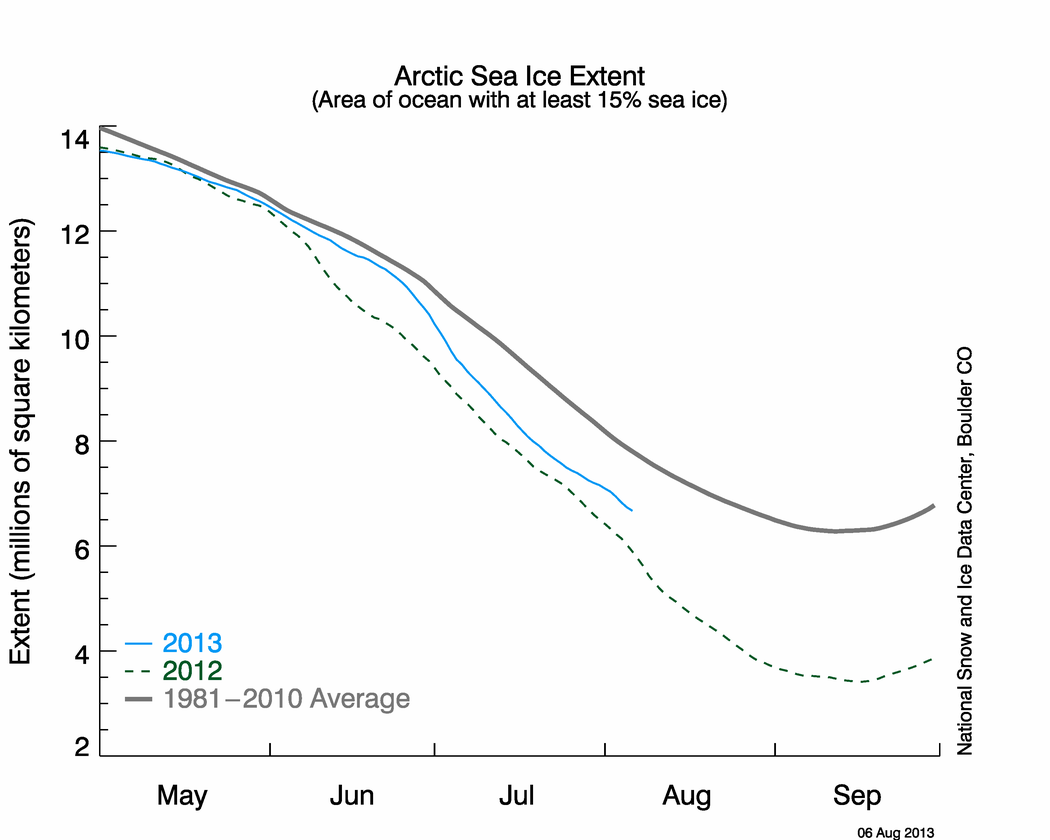
So how is Arctic sea ice looking at this point, near the winter maximum? NSIDC shows ice extent within 1 million km2 of normal and increasing.

http://nsidc.org/data/seaice_index/images/daily_images/N_timeseries.png
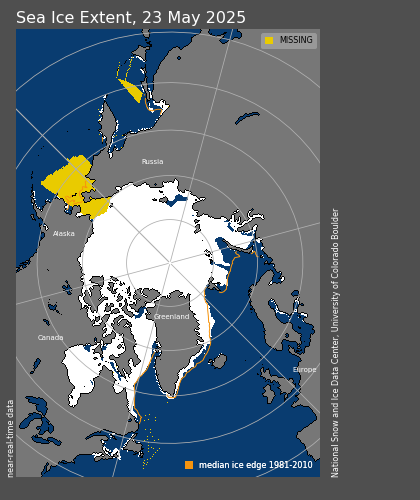
The Baltic and Bering Sea have slightly above normal ice. Eastern Canada and The Sea of Okhotsk have slightly below normal ice.

http://nsidc.org/data/seaice_index/images/daily_images/N_daily_extent.png
DMI shows sea ice extent at nearly the highest in their six year record.

Sea ice extent for the past 5 years (in million km2) for the northern hemisphere, as a function of date.
http://ocean.dmi.dk/arctic/icecover.uk.php
NORSEX shows ice area just outside one standard deviation (i.e. almost normal.)

http://arctic-roos.org/observations/satellite-data/sea-ice/observation_images/ssmi1_ice_area.png

There’s also some interesting comparisons to be made at Cryosphere Today. When you compare the current images in recent days with the same period in years past, you notice how “solid” the ice has become. For example compare March 3rd 2010 to March 3rd 2008, when we saw the first year of recovery:

Note that there’s no “fuzziness” in the signal return that creates this image on the right. A fuzzy return would indicate less than solid ice, such as we see on the left. The CT image from March 3rd is “deep purple” through and through. The edges of the ice are very sharp also, particularly near Greenland and also in the Bering sea. These two visual cues imply a solid, and perhaps thicker ice pack, rather than one that has been described by Dr. Barber as “rotten ice”.
I wish I could compare to March 3 2009, but the CT images were offline last spring then while both they and NSIDC dealt with issues of SSMI sensor dropout that was originally brought to their attention by WUWT, but was deemed “not worth blogging about“.
According to JAXA, 2003 was a good year for Arctic sea ice. Note the blue line.

So how does that year on March 3rd compare to our current year using CT’s imagery?

Compared to the best year for Arctic sea ice in the past decade, March 3rd this year looks quite solid. The setup for 2010 having more ice looks good.
You can do your own side by side comparisons here with CT’s interactive Arctic sea ice comparator.
The Arctic continues to recover, and one of the last CAGW talking points continues to look weaker and weaker. It wasn’t very long ago when experts were forecasting the demise of Arctic ice somewhere between 2008 and 2013. And it is not the first time that experts have done this – they were claiming the same nonsense in 1969, right before the ice age scare.

Note the column at the right. Even back then, skeptics got the short shrift on headlines because as we know: “all is well, don’t panic” doesn’t sell newspapers.
UPDATE: And then there’s this:
AROUND 50 ships, including large ferries reportedly carrying thousands, were stuck in the ice in the Baltic Sea today and many were not likely to be freed for hours, Swedish maritime authorities said.
CET green line tells a story! http://hadobs.metoffice.com/hadcet/graphs/HadCET_graph_ylybars_uptodate.gif
Wren,
Assuming that the current trend is linear (which there isn’t any rational reason to do) – at 2.9% per decade it would take more than 300 years to reach ice free. More likely the Arctic goes through warmer and colder cycles.
http://data.giss.nasa.gov/cgi-bin/gistemp/gistemp_station.py?id=431042500000&data_set=1&num_neighbors=1
Catlin have disabled the ‘Contact Us’ links. I wonder why?
Paul Daniel Ash,
Your arguments are so ho-hum that they defy reply; however I will reply ANYWAY.
1979 was the end of a very cold period from about 1950-1979. The 1960’s and 1970s were ESPECIALLY cold. It didn’t really start warming up until the early 1980s. As you may recall (if you were even alive back then), there was a pretty big ice-age scare going on in the media in the late 1970s.
Typical warming or cooling cycles last around 30 years. We warmed from 1979-2006 or so, and now have begun cooling again. As a result, you can well expect sea ice extent to continue to “recover”. The art of the cherry-pick is your side claiming that 1979 was “normal” just because that is when satellite data started being collected; when, in fact, 1979 was pretty darn cold.
Geologically speaking, an ice-free arctic ocean is thought to be not terribly unusual. The fact that we are this far into an inter-glacial period and that there still IS ice in the arctic could well mean that the next glacial period is going to be more severe and colder than the last. Hopefully we will not know whether THAT prediction is true during your lifetime or mine.
Also, there is no evidence whatsoever that the “thinning” which you claim is in any way unusual. Did you happen to actually READ the 1969 New York Times article embedded in the piece??? The science in that article was better written and better thought out than a lot of science going on about the same subject matter today. If you skipped the 1969 article, I would suggest you go back, hit the “click to enlarge” button, and actually read it.
The question is, who is going to tell Prince Charles? On the one hand he is counting down the last of the five years to an ice free arctic, whilst on the other (together with the toes on his left foot) he is counting down the months in which to save the planet. The other foot is required for the countdown to succession, and one is running out of digits.
What’s a chap to do?
Pual Daniel Ash:
“the data show that it is not recovering. To recover would mean returning to within its previous, long-term range.”
“First, a true recovery would continue over a longer time period than two years.”
It is important to point out that the “recovery”, so far it’s 3 years is in an upward trend. Also, the “normal” range is based on only a short 1979-onward record. The north passages have been open for 72 of the last 122 years, open for most of WWII, open for quite a while in the early 1900s. Much less ice is not all that uncommon and to be judgmental about it is making problems where there probably are not any.
As we are not warming, to think that the ice would continue to decrease makes no sense at all. To insist on ice decreases when the records show that the Arctic Rim has NOT been warming as claimed is to border on, say, an unwillingness to accept the most likely probability of the natural situation.
Paul Daniel Ash – real scientists would not extrapolate a trend from three decades of measurement – they would look to the possibility of cycles – long term, such as when the Vikings settled in Greenland 1000 years ago, and during the Little Ice Age in the 1600s, and the rate of recovery from then, plus the shorter term Pacific Decadal Oscillation (30 years) and North Atlantic Oscillation/Atlantic Multidecadal Oscillation as well as the 70 year Arctic Oscillation – when you combine all of these and look at their phases of teleconnection – THEN you are a real Arctic scientist – like Professor Polyakov at Fairbanks University – who warns about sampling error when you do not take account of low frequency cycles – pointing then to the many station records in 1940. The cycles affect ocean warm water incursion from the Atlantic – melting the ice from below, and clouds from the Pacific, melting it from above – winds do the rest. Summer air temperatures beyond 80N have not varied by much. There is no direct evidence of CO2 driving the ice-loss.
R. Gates,
The way that “long-term trend” is defined by you is merely an infinitesimal blip on the geological time-scale.
It has been theorized that in some warm inter-glacials, the arctic was completely ice free. This would mean that our current inter-glacial is actually cooler than previous inter-glacials (and there does indeed seem to be some evidence of that).
There is also some evidence that in some of the past glacial periods, the globe may have been essentially a snow-ball with almost no ice-free land or sea area whatsoever.
Which do you think would be more disasterous for life on earth? No ice in the arctic, or the entire planet covered in snow and ice?
Most of us know the rather obvious answer to that question without putting too much thought into it.
“if the trend continues”
Coming from the same people that have not been able to predict a “trend” yet.
What are they measuring up there anyway?
At one time we were told all the ice would be gone by now.
pbailey (10:31:02) :
Slightly OT but Catlin is at it again!
http://www.catlinarcticsurvey.com/
REPLY: I note they have no “live” biotelemetry this time. – A
Ah yes, the CAGW/CC fall back position of “ocean acidification”. When mother nature isn’t going along with the CAGW/CC program, there’s always the “ocean acidification” ruse. Never fails.
“Study the potential impact” – not what is happening, but what could maybe possibly happen, if you just plug the numbers into this model just right.
Ya gotta love Post Normal science.
“Polar explorer Pen Hadow, who is Director of the mission, said it will begin in early March and take scientists to an Ice Base only 750 miles from the North Geographic Pole to study the potential impact of rising levels of acidity in some of the coldest water on the planet.
Some scientists believe that, based on current projections, the pH of the world’s oceans could reach levels by 2050 not seen on Earth for 20 million years with potentially serious consequences for all marine life.”
I like the way that you point to the commentary from an obviously biased site which is promoting Man Made Global Warming, they actually say so on the right hand side.
This “obviously biased site” is the source for Anthony’s post. Again, why do you only accept research that bolsters your preconceptions and discard everything else?
The CAGW predictions were Continued Reduction leading to No Ice at the Pole in a few Years.
It is proved WRONG.
First: what predictions? Name them.
Second: What is “a few?” Ten years? twenty? fifty? a hundred?
Third: what is your standard of “proof?” If you believe two years of recovery after thirty years of decline means that sea ice will return to its historical averages, what support do you have for that belief?
Again, again, and again: can someone explain to me how this is not just cherry-picking research that you think supports your conclusions?
Has anyone looked into how good the correlation is between sea ice minima and earlier sea ice coverage? Since all of the recent curves are displaced downward a similar way from the long term average, it seems that next summer’s minimum can be partly be forecast from the current maximum and possibly the minimum of previous years. However, it is also clear that the unusual nature of 2007 didn’t become obvious until summer.
Looking at the map, instead of a graph, is the presence or absence of sea ice off the coast of Newfoundland, in parts of the Baltic, near the Aleutians, or near Kamchatka really going to have anything to do with how much ice will remain in the Arctic Ocean six months from now? This will happen only if this tells us how thick the ice will be in the Arctic – something that probably depends more on the previous minimum than on the previous maximum. So I’d expect next summer’s minimum to depend far more on last summer’s minimum than on the current maximum.
kwik (10:35:10) :
And this happens while Al Gore is in Noway spreading the AGW Carbon Cult Gospel !! LOL !!
——-
Was/Is Gore really in Norway yesterday/today?
———–
Gore is in Norway today.
So am I.
It is a travesty we cannot account for increasing arctic ice extent.
Increase of summer minimum third year in a row will be beyond doubt a sign of irreversible climate change.
Several drops in rising ice extent in recent past was probably compacting of the ice, temporary decreasing its extent but thickening it.
I find it truly alarming and astounding how few of the average population understands the scientific method or what science even actually is. To even see anyone claim that 30 years constitutes any sort of discernable “trend” beyond the normal “noise of the earth” is simply laughable. The only trend that matters is for 100,000 years or so, the earth is so cold that many of us would not be able to inhabit the areas which we currently inhabit, and then for about 10,000-15,000 years it gets nice enough that plants and animals can survive and thrive in most places on the earth.
I, for one, am thankful that we are in one of the 10,000-15,000 year periods as opposed to being in one of the 100,000 year remarkably inhospitable to life periods.
Perhaps those of us with any real understanding of science should simply start making the fantastic claim that the global warming “true believers” (that would be the opposite of “denier”, yes?) actually seem to want the earth to pass whatever tipping point is required to send us into a new ice-age.
All one really has to do is look at how humans of the past have characterized certain periods. For example:
“Medieval Climate Optimum” it was HOT. Most people think that it was probably hotter than 1998-2006 for a significant period of time!!!! (and yet the world didn’t end). In fact, not only did the world NOT end, the period was called an OPTIMUM (please look up the word optimum if you are not familliar with it).
“Maunder Minimum” It was COLD. Darned unpleasant. The other big problem with cold and darned unpleasant is this naturally led to food shortages and rampant disease. Definitely a MINIMUM.
Warmth leads to abundant food, healthy plants, healthy animals, and expanded area that is habitable. Cold leads to food shortages, increased disease, and less area which is habitable without significant engineering. Hence why the warm times are called “optima” and the cold times are called “minima”.
/rant off
So that people can’t ask them what pH they were expecting before they tell us that it’s more acidic than they expected maybe ??
I wonder why these rigorous scientists aren’t adding to the robustness of their data by going back and measuring Arctic sea ice thickness this year ??
“Paul Daniel Ash (12:41:05) :
[…]
Again, again, and again: can someone explain to me how this is not just cherry-picking research that you think supports your conclusions?”
Ah the AGW people, always weaseling out of their failed projections (they don’t make predictions. Predictions can be validated.). It’s always “we didn’t say that.” Can’t you for once stand by your word? No i don’t mean you personally, it’s a plural “you”, but i know the answer: Research is ongoing, that’s the nature of science… The ever changing, never falsifiable hypothesis, the million headed hydra of mock science…
Which reminds me of Reptilicus.
Spoiler: It attacks Copenhagen.
Passenger ferries trapped by ice. WUWT? Worst Baltic ice in 15 years..
http://news.bbc.co.uk/1/hi/world/europe/8550687.stm
cheers David
The Catlin link is interesting. They correctly point out that cold water absorbs more CO2 and can become more acidic, but don’t mention that warmer water due to global warming should cause less CO2 to be absorbed.
[snip]
[You may try again, without the ‘denier’ name-calling. ~dbs, mod.]
Frank,
Good questions. There is very little correlation between winter sea ice extent and summer extent. In the JAXA graph, 2006 was the lowest in winter and one of the highest in summer.
Also, winter ice levels off Eastern Canada or in The Sea of Okhotsk have little or no bearing on the summer minimum.
Correct me if I am wrong, but the pH of the ocean is GREATER THAN 7, correct?
If the pH of the ocean is > 7, then the ocean isn’t acidic at all, it is basic (or alkalyne if you prefer). Therefore, there technically is no rising acidity, only falling alkalynity. We cannot say anything about “rising acidity” until the pH of the ocean falls below 7.
Paul Daniel Ash (12:41:05),
I’m not surprised that you avoided responding to TonyB’s post @12:02:22. It deconstructs everything you want to believe. I suggest reading the links to learn why this is nothing but natural climate variability. If the same thing happened in the recent past, then what is happening now is normal, natural, and has nothing to do with CO2.
When you’ve finished with TonyB’s links, here’s one from the late, great John Daly: click Read it and get educated.
“The ghost of Big Jim Cooley (12:16:28) :
Catlin have disabled the ‘Contact Us’ links. I wonder why?”
Battery of satellite phone empty?
PeterB in Indainapolis (12:23:53) :
Your arguments are so ho-hum that they defy reply
They’re not my arguments, but thank you for rousing yourself to reply (is it late in this strange land of “Indainapolis?”)
As I’ve noted before, the source of those statements was the same source Anthony used to write this post. Are they only wrong when they disagree with your preconceptions? if so, why?
Typical warming or cooling cycles last around 30 years.
An interesting assertion. Your source?
The art of the cherry-pick is your side claiming that 1979 was “normal” just because that is when satellite data started being collected
Who claims that? According to the information available from the pre-satellite era, ice extent was greater before 1979.
Geologically speaking, an ice-free arctic ocean is thought to be not terribly unusual.
O RLY? What’s your source for that? Overpeck et. al. said that there was no evidence for an ice-free Arctic in the past 800 millennia, even during periods when it was warmer than it is now. Is that incorrect? Please explain your evidence.
1979 was pretty darn cold.
Source? Not even Anthony thinks 1979 was especially cold.
The science in that article was better written and better thought out than a lot of science going on about the same subject matter today.
I’m not sure how one “writes” science, but I’m sure you’ll enlighten me. I generally look first to people who are actually doing science to try and understand natural phenomena and trends. You may have a better way. More power to ya.