From Spaceweather.com with apologies to Linus and Charles Schulz

The Solar and Heliospheric Observatory (SOHO) is tracking an enormous magnetic filament on the sun. It stretches more than one million kilometers from end to end, which makes it an easy target for backyard solar telescopes. For the seventh day in a row, an enormous magnetic filament is hanging suspended above the surface of the sun’s southern hemisphere. The Solar and Heliospheric Observatory (SOHO) has a great view. How long can it last? Solar filaments are unpredictable. If this one collapses and hits the stellar surface, the impact could produce a powerful Hyder flare.
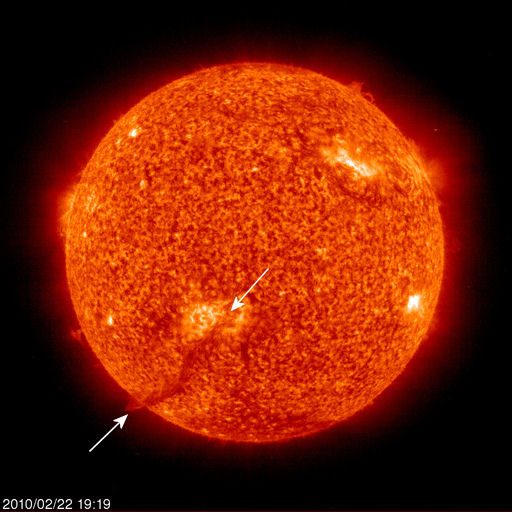


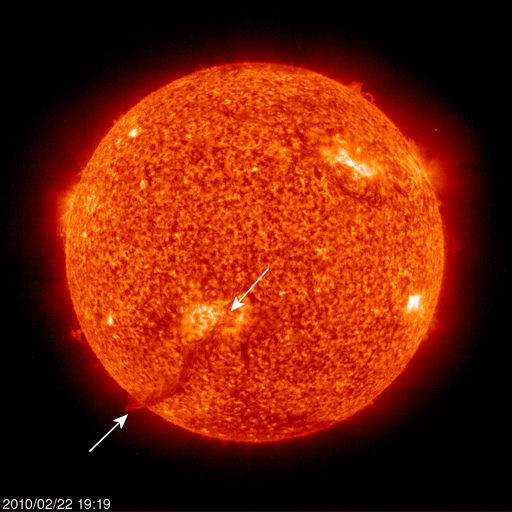
The most recent SOHO image is here
Hyder Flares: from Australian IPS 1. What is a Hyder flare?
Flares are intense brightenings that occur in the solar chromosphere. Flares are generally observed from Earth using narrow band filters, typically with a bandwidth of less than 0.1 nm, and often centred on the Hydrogen-Alpha wavelength of 656.3 nm. (Flares also have counterparts, that is, sudden outbursts, in the radio and X-ray spectrum).
Most flares occur around active regions associated with sunspot groups. However, occasionally a flare (sudden brightening) is observed well away from an active region or sunspot group. These flares are invariably associated with the sudden disappearance of a large (thick, long, ‘bushy’) dark solar filament, and are termed Hyder flares.
2. Why are Hyder flares so named?
Max Waldmeier wrote a paper in 1938 which described the phenomenon of suddenly disappearing filaments (disparition brusque), and mentioned that these can be associated with flare-like brightenings, but it was left to Charles Hyder to postulate the first comprehensive mechanism for the such flares.
Following on work from his doctoral thesis with the University of Colorado in Boulder (1964), Hyder published two papers in the second volume of the journal Solar Physics (1967) in which the mechanism by which Hyder flares might occur was discussed in detail. Hyder was then on the staff of the (US) Air Force Cambridge Research Laboratories at the Sacramento Peak Observatory in New Mexico.
It was these papers in Solar Physics by which Hyder’s name became associated with the flares in question, even though he was by no means the first to observe them.
3. What are the characteristics of Hyder flares?
As previously mentioned, the name Hyder flare is given to a flare that occurs away from an active region or sunspot group and that is associated with the sudden disappearance of a dark filament. The appearance of these flares can range from a string of bright knots on one or both sides of the filament (or rather, the position previously occupied by the filament, sometimes called the filament channel), to a single or double ribbon flare. The ribbons are parallel to the filament channel. If only one ribbon is present, it will lie to one side of the channel, whereas if two parallel ribbons occur, one ribbon will lie on one side of the filament channel, and the other ribbon will lie on the opposite side.
One interesting characteristic of Hyder flares is that they usually develop or rise to maximum brightness much more slowly than do the more common flares associated with active regions. The larger Hyder flares may take 30 to 60 minutes to rise to a peak intensity, and then they may last for several hours. Although they may attain a large area, they usually have a relatively low intensity. Thus, classifications for a large Hyder flare may read 2F, 2N or possibly even 3F. This contrasts to an active region flare in which 3F is very rare. An active region flare that attains sufficient area to put it into the importance class 3, will invariably have either a Normal or more usually a Brilliant brightness classification.
X-ray flares and radio (microwave) bursts associated with the optical Hyder flare, are also generally long lived phenomenon and are classified as the gradual rise and fall type of event (in contrast to the impulsive and complex events associated with large active region flares).
Generally Hyder flares are not associated with energetic particle emission or geomagnetic storms (implying that they may not be associated with a coronal mass ejection). However, this is not always the case, as a large halo CME observed by the LASCO solar coronagraph on board the SOHO spacecraft was most definitely associated with a Hyder flare (2N/M1) observed on 12 September 2000. This same complex also appeared to have produced energetic protons at geosynchronous orbit with energies in excess of 100 MeV, and in substantial numbers at energies of 10 MeV. It is believed that the sudden storm commencement observed at 0450UT 15 September, and the subsequent minor geomagnetic storm was produced by this particular CME.
4. What produces Hyder flares?
Hyder’s explanation of the flare type now named after him depended on the observational evidence that (1) often the flare was a parallel ribbon flare with one ribbon each side of the filament channel, and (2) that geomagnetic storms were not associated with these flares. This led to the speculation that the filamentary material was not ejected far into the corona, but in fact fell back to the chromosphere producing the flare.
Stable or quiescent filaments are believed to lie in and along a magnetic trough. It is thought that the sudden disappearance of such a filament is due to a reconfiguration of the field. In essence, the magnetic trough becomes a magnetic ridge (the bottom of the trough elevating in a period of tens of minutes to become the peak of the ridge). In this process, the filamentary material (cooler gas) is thought to be accelerated into the corona. Hyder’s explanation is that, in the case of the Hyder flare, some or even most of the filament material, instead of suffering acceleration and ejection, falls down the sides of the magnetic ridge and interacts with the lower chromospheric material producing the flare. If the infall process is symmetrical, then the double parallel ribbon flare will result, if asymmetrical, then only one ribbon results. If the infall is sporadic, or the material insufficient, then only bright knots of flare are produced. Hyder did calculations to show that the kinetic energy of the infalling material should be sufficient to provide the required flare energy release observed.
Of late, the Hyder mechanism has come into question. Some people (notably Zirin) have questioned whether infall occurs, stating that the magnetic reconfiguration must always produce ejection. The respective roles of flares and CME’s in solar active processes has also been hotly debated, and this has implications for the exact mechanism of Hyder flares. We certainly have enough observational evidence to show that Hyder flares can be associated with both CME’s and energetic particle production. For the moment, the question of Hyder flare production mechanism appears unresolved, and will probably be sidelined until the more significant (and undoubtedly related) issue of CME – flare production mechanism is sorted out.
The bottom line is that at this stage in solar physics we do not really know what produces a flare nor what produces a CME. There are competing theories, but all tend to have deficiencies with respect to matching the observational evidence. We certainly believe that they all depend on the reconfiguration of magnetic fields as their primary energy source, but in the final analysis, we really only believe this because we can conceive of no other solar energy source of sufficient magnitude.

Fascinating. If the material “hangs” there & has apparently lost its outward momentum, why doesn’t gravity quickly pull it back down? Is the magnetic field keeping it suspended?
” scienceofdoom (03:30:08) :
[…]
Is it true that physicists have ignored convection (and conduction which hardly rates) and latent heat removal (which the article ignores)? ”
You know yourself that Gerlich and Tscheuschner (Physicists) have this worked out really well and you do know that Gerlich and Tscheuschner dispute the greenhouse effect. And you do know that the climatologists are *not* physicists. Eat your own words here, scienceofdoom.
Leif, loved the article you linked to. Easy to read and understand. I appreciated the mention of models not adequately accounting for cloud influences. However, my question is that when empirical evidence based models and mathematical calculations of the various influences on temperature trends didn’t match up to the temperature data set and recent global climate models, I wonder if the authors spent any time talking amongst themselves as to whether or not the CRU temperature data set might have some errors in it (since their analysis of influences, both natural and anthropogenic) seems to cover only about 76% of the entire temperature rise). And I wonder if they are talking about that now. The remaining portion of the trend, and 24% is a large chunk, is either a cloud mystery (which is, in my opinion, not showing a great deal of correlation so far based on my review of the literature) or an error in the temperature data set from which the trend is calculated.
If only kinetic energy is involved then, up there in the sun was Hannity throwing his football that produced such a phenomenon!
From two thousand years ago, from the gnostics and the agnostics, two antagonist parties formed: The ones who affirmed that knowledge of the truth, of the fundamental law/laws, was accesible to man and those ones who deny that, who conditioned science, knowledge, to an official Church, to a political bureaucracy as the intermediary between man and knowledge, only accesible through them.
This situation has continued up to the present, with an official and, of course, settled “dogma” (aka “science”) which virulently rejects knowledge as impossible, universal laws as inescrutable, and teach us reality it is rather an inextricable chaos.
That it is and it has always been a lie. There is no and there has not ever been any opposition in nature, any dicotomy. to say it plainly: There is nothing beyond, below, above or under the electromagnetic spectrum, which, of course, it probably extends a little beyond our instruments can now detect.
Then, life, also it is not a phenomenon to be neither separated nor remain unexplained in the one and only field that exists.
Philosophers, like Pitagoras, studied and described reality in quite simple terms and without any ulterior sofistications invented by the official churchs, with instruments as simple as his monochord.
Pamela,
Are you counting UHI as a temperature error?
DirkH,
Are those the guys that tried to disprove the greenhouse effect using the second law of thermodynamics? If it is, this was allegedly “debunked” – I don’t have the details but I believe it was linked towards the bottom of the comments on Willis’ Iron Greenhouse article. I’m not sure their paper has ever been formally discussed here. I’d be curious to read more on it.
In other words, did fillnet code strings and poorly applied adjustment code strings add an artificial 24% to the temperature rise? The person(s) who can investigate that would be eligible for a Nobel Prize me thinks.
Oliver K. Manuel (04:46:32) :
JonesII (05:10:49) :
Jim Steele (20:46:52) :
James F. Evans (22:56:37) :
The usual suspects rear their heads. I guess as a community we can tolerate and smile at the nuts in our midst as they provide much needed entertainment.
beng (06:18:42) :
Fascinating. If the material “hangs” there & has apparently lost its outward momentum, why doesn’t gravity quickly pull it back down? Is the magnetic field keeping it suspended?
The material is actually falling back on the sun all the time, but is replenished at the same time looking as if it is permanently there. The magnetic field holds the material temporarily during the passage in and out of the filament. If the magnetic structure is disturbed, the filament may erupt and a CME results.
Pamela Gray (06:30:53) :
an error in the temperature data set from which the trend is calculated.
I don’t think the temperatures are all that bad [Climategate not withstanding]. If we flatten it out, the solar influence becomes even smaller.
slightly off topic, but what has been concluded from the NASA FOI emails that were released recently?? As Mr Schmidt features heavily in them I thought we would have dug some dirt by now?
The fact that the satellite temperature anomaly series demonstrates similar influence patterns across latitudes and forcings in terms of the temperature anomaly, I would agree that overall, the various influences analyzed are indeed robust in terms of their degree and action of influence as a function of latitude. No argument there, though I did notice the relatively large discrepancy between GISS and satellite in the NH latitudes, where most of the ground sensors are located.
I picked up on the non-volcanic aerosols comment in that it’s parameters may not be well modeled. Particulate matter comes from several sources, anthropogenic as well as dust storms and salt spray that are tied to ENSO patterns of cold/dry and warm/wet influences. I wonder if the authors thought about differentiating natural versus anthropogenic sources? To what degree does only the anthropogenic portion influence the cooling temperature anomaly?
I also zeroed in on the greenhouse gas piece in that no effort was made (or did I miss it) to determine natural sources of the variance in greenhouse gases from anthropogenic sources. You must admit that ENSO influences greenhouse gas production as a function of growth and decay cycles on seasonal lush plant and animal growth on land and sea or lack of growth on a decadal scale (IE the greening of the planet). To what degree does only the anthropogenic portion of the rise in greenhouse gases influence the upward temperature anomaly?
John (07:35:06) Are you asking about the Dominican order space agency branch of the Holy Inquisition ?. Rest assure that anything that could alter their tipping points won´t be accepted.
” NickB. (06:59:10) :
[…]
DirkH,
Are those the guys that tried to disprove the greenhouse effect using the second law of thermodynamics? If it is, this was allegedly “debunked””
The debunking was by a guy called Smith, but he made some mistakes and his debunking has been debunked so we are in a phase of experts dueling.
see e.g.
http://www.climatechangefraud.com/behind-the-science/6210-the-science-fiction-of-the-greenhouse-effect
and follow this one:
# bri 2010-02-15 23:02
The rebuttal to smith can be found here
adsabs.harvard.edu/abs/2009arXiv0904.2767K
Leif Svalgaard said: The usual suspects rear their heads. I guess as a community we can tolerate and smile at the nuts in our midst as they provide much needed entertainment.
Article’s conclusion:The bottom line is that at this stage in solar physics we do not really know what produces a flare .
Although unjustly offensive, I will also tolerate the rude arrogance. I made no claims to understand the mechanism, but merely noted “it reminds me of Nobel Prize winner Alfven’s secondary currents in his electric sun” I also asked when filaments are more active. I truly do not understand how magnetic fields are not indicative of flows of plasma generating the magnetism. Talking about magnetism as if it occurs de novo simply seems like half an answer . I make no other claims. But Leif you indirectly claim you know how the filaments worK? It would be more productive to state your believed mechanism, rather than your condescension.
Discontinuity is an onanistic view of reality, always preached out by self-indulging friars who have chosen to remain isolated in their ivory towers, who only get out just to pontificate their “settled” dogmas.
Quote: Leif Svalgaard (07:04:53) cites Oliver K. Manuel (04:46:32), JonesII (05:10:49), Jim Steele (20:46:52) and James F. Evans (22:56:37) :
“I guess as a community we can tolerate and smile at the nuts in our midst as they provide much needed entertainment.”
– – – – – –
Thanks, Leif, for showing us the role that you play in items #2 and #3 above [Oliver K. Manuel (04:46:32)].
“2. NAS (a nongovernmental, private, self-perpetuating, “old-boys club”) reviews the budgets of these research agencies. NAS has used control of the purse to train scientists with grant funds – the same way that Pavlov trained dogs with dog biscuits.”
Pavlov couldn’t train dogs to talk, but
NAS trained solar physicists like Leif . . .
“3. To receive grant funds, scientists must think in unison with the opinions of those who control the grant funds.
. . . to label all others as
Nuts, deniers, clowns, etc.
Thanks for your help, Leif!
Oliver K. Manuel
Emeritus Professor of
Nuclear & Space Science
Former NASA POI for Apollo
As shown by Desmond Morris in his book “The human zoo”, the main characteristic of these ape-like creatures is their mutual grooming and caressing.
just a thank you to all for a thorough explanation of these extraordinary events! I can feel my mind getting a good workout everytime I come to this site…..thank you, Nick
Where (o’clock) is the sun’s north pole in the image shown? Do these filament thingies form up in any plane consistently, relative to the axis? relative to…(?)
I’ll take a stab at this. Given that they are attached in the Sun spot area, I would guess that they follow the same butterfly pattern of Sunspot progression from the poles towards the equatorial area as the Sun ramps up and then down. As to which direction they spew and loop forth, I haven’t the foggiest other than to guess that they might loop up and somewhat away from the direction of the Sun’s rotation? And I would guess that this depends on what speed the particular belt the filament is in is rotating at?
Wait a week until we can see the far side of the Sun. There’s a lot of activity over yonder:
http://gong.nso.edu/data/farside/
A thought I had yesterday morning is that there may be another magnetic filament on the other side. Will make the “LOOK OVER THERE” techniques of the boys at NASA blush in their boots.
Leif,
Your comment here:
The usual suspects rear their heads. I guess as a community we can tolerate and smile at the nuts in our midst as they provide much needed entertainment.
is uncalled for. If there is a ‘community’ that encourages such arrogance I’ll vociferously announce my quick exit.
Pamela,
Seems to me that the oceans as a driver are missing from the climate model referred to in the LeanRind paper. There would be poor correlation as well if you removed CO2, and funny how it seems to match the ocean cycles.
Just my two cents…
For all you Sun watchers, here’s a new program that just got launched this week.
Solar Stormwatch
http://solarstormwatch.com/
As everybody probably knows, from spaceweather.com …
The event did not produce a bright solar flare, as sometimes happens when filaments erupt, but there was a coronal mass ejection (CME). SOHO coronagraphs observed at least one and possibly as many as three clouds billowing away from the sun:
http://spaceweather.com/swpod2010/25feb10/c2_cme_anim.gif?PHPSESSID=d3voa5cvk832sqdsh12rbj9lc4
http://spaceweather.com/swpod2010/25feb10/filament_strip_anim.gif?PHPSESSID=d3voa5cvk832sqdsh12rbj9lc4
Oh, here’s the link I forgot to post to the ‘Lunch with Bernie’ hour every Friday at noon EST if you’d like to talk with Senator Sanders they take lots of your calls.
http://www.thomhartmann.com/listenlive.php
Bernie Sanders compares climate skeptics to Nazi deniers
http://www.politico.com/news/stories/0210/33371.html
El Nino is a major driver of weather pattern variation, in both long and short term ways, so I think ocean influences are adequately covered. However, point taken Ed. I would have liked to see the PDO in the mix since you can various combinations of PDO and El Nino/La Nina/Neutral conditions that have their own temperature derivatives. In addition, if atmospheric oscillations other than trade winds have decadal influences (IE AO), then we need another go at this.
Re: your mention of CO2: The decadal greening of the planet as well as El Nino decadal patterns also have smaller seasonal trends that are loosly tied to each other so it is no surprise that CO2 tends to follow along with ocean cycles.
What fascinates me is the notion, based on models, that more CO2 will re-radiate more long wave radiation as well as cause enhanced water vapor which will add to the greenhouse blanket and bring us nearer to the “tipping point”. This would show up in a diminution of OLR (long wave radiation) being detected at the outer edge of our atmosphere, and an increase in water vapor. That is not the case. Neither show any increasing trend when compared to CO2 increasing trends as measured at Maunu Loa. So far, it appears that whatever affect our greenhouse blanket is having, regardless of its composition, that affect seems to be flat lining in terms of OLR and water vapor.
http://www.climate4you.com/
From the post:
“Of late, the Hyder mechanism has come into question. Some people (notably Zirin) have questioned whether infall occurs, stating that the magnetic reconfiguration must always produce ejection. The respective roles of flares and CME’s in solar active processes has also been hotly debated, and this has implications for the exact mechanism of Hyder flares.”
“The bottom line is that at this stage in solar physics we do not really know what produces a flare nor what produces a CME.”
Evans (22:56:37) commented: “A good example of the science isn’t ‘settled’.”
Dr. Svalgaard (07:04:53) commented: “The usual suspects rear their heads…”
It would seem that my comment is in line with what is stated in the post.
The problem with Dr. Svalgaard is that he apparently feels compelled to disparage most anybody who persists in disagreeing with him.
As if Dr. Svalgaard is an oracle; of course, he is not, he’s a scientist, one of many, and the many have diverse opinions.
But really it’s just a naked display of hostility.
And displays of hostility towards those who disagree are unbecoming of scientists who claim to follow the empirical scientific method.
Disagreement is part of the empirical scientific method. Disagreement is not justification for hostility.
Wasn’t that part of the Climategate issues — putting down those that disagreed with the “Team”?
Jim Steele (08:50:14) :
Article’s conclusion:The bottom line is that at this stage in solar physics we do not really know what produces a flare .
The operative word is ‘really’. There are lots of ‘real’ details that we are investigating, but we do know the basic mechanism.
I also asked when filaments are more active.
And I told you that there are 10 times more filaments on the active sun.
I truly do not understand how magnetic fields are not indicative of flows of plasma generating the magnetism. Talking about magnetism as if it occurs de novo simply seems like half an answer.
A flow of plasma does create a magnetic field. A flow of an electrical conductor [a copper wire or a solar plasma] across an existing magnetic field can greatly amplify and re-orient a magnetic field and that is how sunspots are formed.
how the filaments worK? It would be more productive to state your believed mechanism, rather than your condescension.
As I have already explained, filaments condense out of the corona where the magnetic field horizontal and then bends down that field leaving the filament ‘hanging’ in and supported by the field. This is stable configuration if the field does not change too much. Rapid changes of the magnetic field in the surroundings of the filament can upset the balance and cause the filament to collapse or the erupt. Often a new filament forms in the same place and the process repeats.
Earle Williams (12:26:52) :
Your comment here:
[…] is uncalled for.
I call them as I see them and I make no excuses for that. The ‘offenders’ [with the possible exception of Steele] are well-known peddles of pseudo-science and conspiracy theories and are in my opinion damaging the integrity of WUWT. You may disagree and call it as you see it.