From Spaceweather.com with apologies to Linus and Charles Schulz

The Solar and Heliospheric Observatory (SOHO) is tracking an enormous magnetic filament on the sun. It stretches more than one million kilometers from end to end, which makes it an easy target for backyard solar telescopes. For the seventh day in a row, an enormous magnetic filament is hanging suspended above the surface of the sun’s southern hemisphere. The Solar and Heliospheric Observatory (SOHO) has a great view. How long can it last? Solar filaments are unpredictable. If this one collapses and hits the stellar surface, the impact could produce a powerful Hyder flare.
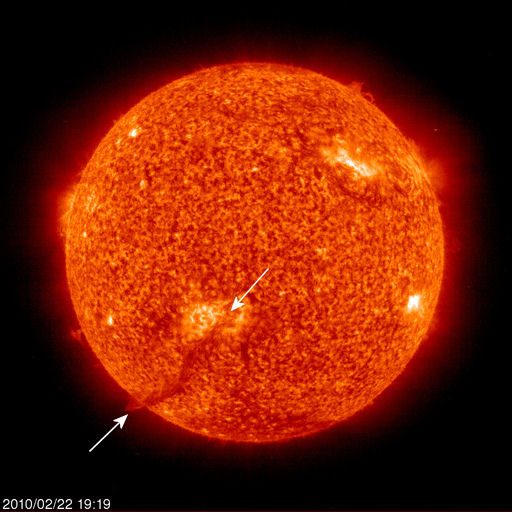


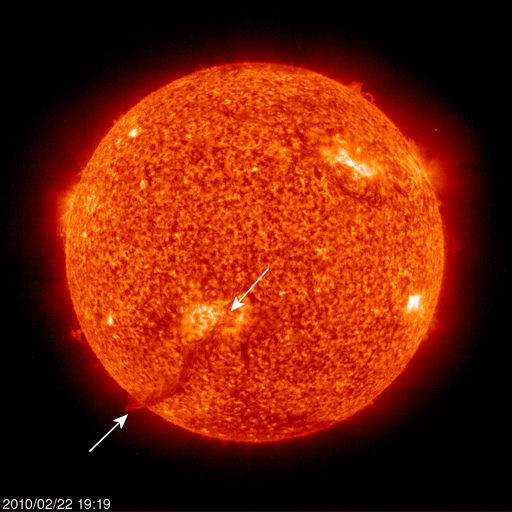
The most recent SOHO image is here
Hyder Flares: from Australian IPS 1. What is a Hyder flare?
Flares are intense brightenings that occur in the solar chromosphere. Flares are generally observed from Earth using narrow band filters, typically with a bandwidth of less than 0.1 nm, and often centred on the Hydrogen-Alpha wavelength of 656.3 nm. (Flares also have counterparts, that is, sudden outbursts, in the radio and X-ray spectrum).
Most flares occur around active regions associated with sunspot groups. However, occasionally a flare (sudden brightening) is observed well away from an active region or sunspot group. These flares are invariably associated with the sudden disappearance of a large (thick, long, ‘bushy’) dark solar filament, and are termed Hyder flares.
2. Why are Hyder flares so named?
Max Waldmeier wrote a paper in 1938 which described the phenomenon of suddenly disappearing filaments (disparition brusque), and mentioned that these can be associated with flare-like brightenings, but it was left to Charles Hyder to postulate the first comprehensive mechanism for the such flares.
Following on work from his doctoral thesis with the University of Colorado in Boulder (1964), Hyder published two papers in the second volume of the journal Solar Physics (1967) in which the mechanism by which Hyder flares might occur was discussed in detail. Hyder was then on the staff of the (US) Air Force Cambridge Research Laboratories at the Sacramento Peak Observatory in New Mexico.
It was these papers in Solar Physics by which Hyder’s name became associated with the flares in question, even though he was by no means the first to observe them.
3. What are the characteristics of Hyder flares?
As previously mentioned, the name Hyder flare is given to a flare that occurs away from an active region or sunspot group and that is associated with the sudden disappearance of a dark filament. The appearance of these flares can range from a string of bright knots on one or both sides of the filament (or rather, the position previously occupied by the filament, sometimes called the filament channel), to a single or double ribbon flare. The ribbons are parallel to the filament channel. If only one ribbon is present, it will lie to one side of the channel, whereas if two parallel ribbons occur, one ribbon will lie on one side of the filament channel, and the other ribbon will lie on the opposite side.
One interesting characteristic of Hyder flares is that they usually develop or rise to maximum brightness much more slowly than do the more common flares associated with active regions. The larger Hyder flares may take 30 to 60 minutes to rise to a peak intensity, and then they may last for several hours. Although they may attain a large area, they usually have a relatively low intensity. Thus, classifications for a large Hyder flare may read 2F, 2N or possibly even 3F. This contrasts to an active region flare in which 3F is very rare. An active region flare that attains sufficient area to put it into the importance class 3, will invariably have either a Normal or more usually a Brilliant brightness classification.
X-ray flares and radio (microwave) bursts associated with the optical Hyder flare, are also generally long lived phenomenon and are classified as the gradual rise and fall type of event (in contrast to the impulsive and complex events associated with large active region flares).
Generally Hyder flares are not associated with energetic particle emission or geomagnetic storms (implying that they may not be associated with a coronal mass ejection). However, this is not always the case, as a large halo CME observed by the LASCO solar coronagraph on board the SOHO spacecraft was most definitely associated with a Hyder flare (2N/M1) observed on 12 September 2000. This same complex also appeared to have produced energetic protons at geosynchronous orbit with energies in excess of 100 MeV, and in substantial numbers at energies of 10 MeV. It is believed that the sudden storm commencement observed at 0450UT 15 September, and the subsequent minor geomagnetic storm was produced by this particular CME.
4. What produces Hyder flares?
Hyder’s explanation of the flare type now named after him depended on the observational evidence that (1) often the flare was a parallel ribbon flare with one ribbon each side of the filament channel, and (2) that geomagnetic storms were not associated with these flares. This led to the speculation that the filamentary material was not ejected far into the corona, but in fact fell back to the chromosphere producing the flare.
Stable or quiescent filaments are believed to lie in and along a magnetic trough. It is thought that the sudden disappearance of such a filament is due to a reconfiguration of the field. In essence, the magnetic trough becomes a magnetic ridge (the bottom of the trough elevating in a period of tens of minutes to become the peak of the ridge). In this process, the filamentary material (cooler gas) is thought to be accelerated into the corona. Hyder’s explanation is that, in the case of the Hyder flare, some or even most of the filament material, instead of suffering acceleration and ejection, falls down the sides of the magnetic ridge and interacts with the lower chromospheric material producing the flare. If the infall process is symmetrical, then the double parallel ribbon flare will result, if asymmetrical, then only one ribbon results. If the infall is sporadic, or the material insufficient, then only bright knots of flare are produced. Hyder did calculations to show that the kinetic energy of the infalling material should be sufficient to provide the required flare energy release observed.
Of late, the Hyder mechanism has come into question. Some people (notably Zirin) have questioned whether infall occurs, stating that the magnetic reconfiguration must always produce ejection. The respective roles of flares and CME’s in solar active processes has also been hotly debated, and this has implications for the exact mechanism of Hyder flares. We certainly have enough observational evidence to show that Hyder flares can be associated with both CME’s and energetic particle production. For the moment, the question of Hyder flare production mechanism appears unresolved, and will probably be sidelined until the more significant (and undoubtedly related) issue of CME – flare production mechanism is sorted out.
The bottom line is that at this stage in solar physics we do not really know what produces a flare nor what produces a CME. There are competing theories, but all tend to have deficiencies with respect to matching the observational evidence. We certainly believe that they all depend on the reconfiguration of magnetic fields as their primary energy source, but in the final analysis, we really only believe this because we can conceive of no other solar energy source of sufficient magnitude.

RE: Mike mcmillan..A couple of years ago hathaway et al were predicting a massive solar cycle 24, now it is expected to max in 2014, at a lower sunspot number.The interesting part is a lot of astro types predict a very weak cycle 25. Its such a facinating subject isnt it?
Fate definitely has a warped sense of humor!
Turning off Earth’s heat source after Al Gore’s long term forecast.
Now teasing NASA and SOHO with unpredictable solar filaments.
The lesson: “To know that you do not know is best,
To pretend to know what you do not know is a disease.”
– – – Lao Tzu
With kind regards,
Oliver K. Manuel
OMG!!!! I just saw the movie. THANK YOU Gardy!!!! Glad we weren’t in bakeout mode when that occurred! There is no diamond I would choose over having a piece of the Sun on my finger. What a marvelous thing.
A good example of the science isn’t “settled”.
Brian Johnson uk (21:44:52) :
Comparative planetary and stellar sizes
http://www.co-intelligence.org/newsletter/comparisons.html
Interesting the size and how this filament is persisting. What say the solar guys?
Leif (I asume you wil be around shortly!)
We have had a brief exchange in the past on the Carrington event and on the likelihood of another one happening and the devastation that would wreak on Earth. Frankly I would be far more concerned about such an event that I am about man made climate change.
My question is; does this current flare have any of the same characteristics of the Carrington flare or are they formed in quite different ways and will have quite different effects?
Thanks for your time
Tonyb
Jim Steele (20:40:07) :
Anyone know if these filaments more common when the solar magnetic field is relatively strong?
weak ? doesn’t matter? sunspot max or minimums?
There are ~10 times as many at solar maximum.
Mike Ramsey (20:42:58) :
I wonder if the Solar Dynamics Observatory has been able to take a peek?
I theory, yes, but probably not. Filaments can live for months, but that is rare, and SDO won’t be ready for another couple of months [at least].
Jim Steele (20:46:52) :
It reminds me of Nobel Prize winner Alfven’s secondary currents in his electric sun model.
Except that that is not how it works.
Mike McMillan (21:15:39) :
So much for another Maunder.
It’s been a long time coming, but now that it’s started, is this ramp up typical so far?
Not unusual, and the Sun wax and wane on its climb up.
Brian Johnson uk (21:44:52) :
I wish they would put an earth size circle/sphere to scale, away in a corner of each pic, so I can really judge the magnitude of the various solar disturbances that occur.
Think of this: the Sun is 109 Earths across.
pwl (22:02:16) :
This is a really cool filament, unless it bakes us that is.
And filaments are really, literally cool, only tens of thousands of degrees embedded in a million-degree hot corona.
Larry (22:13:46) :
Does that mean it is something that could disrupt Earth’s magnetic field to the point where it would screw up cell phones, computers, satellite dishes, and other electronic devices?
Yes, although probably not this particular one as it is at too high latitude to give us a good hit.
OT: great article on the issues with ‘fuzzy’ scientific approaches to complex systems. The first part covering the arcs for science topics is priceless, and reads well with AGW in the back of ones head : ).
http://protein.bio.msu.ru/biokhimiya/contents/v69/pdf/bcm_1403.pdf
Here you can see the Great Filament from the side [a week ago]. The filament is anchored in the active region at its equatorial end:
http://sohowww.nascom.nasa.gov//data/REPROCESSING/Completed/2010/eit304/20100217/20100217_0719_eit304_512.jpg
Ed Murphy (22:57:59) :
how this filament is persisting. What say the solar guys?
Well it is gone now, but such filaments can persist for months. They are ‘curtains’ of cool dense material hanging in the magnetic field of the Sun. As long as the magnetic field is not disturbed by nearby sunspots, the filament can hang there for weeks or months.
Such a refreshing story. A great tonic for us all. Many thanks.
sundogs, filaments, and Hyder flares – been an interesting week around WUWT – thanks!
Dr. Svalgaard,
A million degrees – like the earth’s core?
Sorry couldn’t resist the Al Gore ref – as always appreciate the clarifications. While I might have your attention for a sec, I was curious about the alleged (by NOAA’s climate.gov) up to 10% of GW due to solar imcrease. Could you point me to some further, trustworthy and scientifically solid, reading on the subject and/or care to share your thoughts? Also, ever heard that there has been a .1% increase in solar output – is that a real or spurious reference?
This is interesting and educational. Thank you Mr. Watts & Dr. Svalgaard.
Oliver K. Manuel (22:26:06) :
Now teasing NASA and SOHO with unpredictable solar filaments.
There are thousands of filaments in every cycle. They are clouds in the solar atmosphere and are not subject to prediction, just like individual clouds in the Earth’s atmosphere are not.
NickB. (01:28:12) :
A million degrees – like the earth’s core?
Yes, actually more like 2 million [just like Gore 🙂 ], but in the solar corona. A little bit of thought can show you that the corona must be very hot. Here goes: The Sun’s gravity [in the atmosphere] is 27 times stronger than the Earth’s, so the solar atmosphere ought to be very compact and only be a thin layer as it is held down by the strong gravity. Now, hot air expands, so if the corona was VERY hot it could expand against solar gravity and form an extended atmosphere around the Sun, as it, in fact, does. QED. The upper corona is so hot that it can even escape from the clutches of solar gravity. This is the ‘solar wind’ sweeping through the solar system.
I was curious about the alleged (by NOAA’s climate.gov) up to 10% of GW due to solar increase. Could you point me to some further, trustworthy and scientifically solid, reading on the subject and/or care to share your thoughts?
I think the saying is that no more than 10% is due to the Sun. A good reference [I know and trust Lean] is http://www.leif.org/EOS/LeanRindCauses.pdf paragraph [17].
Also, ever heard that there has been a .1% increase in solar output – is that a real or spurious reference?
The solar output swings 0.1% from solar minimum to maximum and back.
My first encounter with a filament was a few years after the peak of Sun Spot Cycle (SSC) 22. It was during 1993. One of the local astronomical societies that I belong to here in New Zealand ( The Foxton Beach Astronomical Society) has a late 19th Century 5 inch Cooke refarctor fitted with a Lumicon 0.7 degree bandwidth H-alpha filter. Once your eye settles to the light properly ( a black hood helped with the adjustment, but was a struggle to wear in the summer) an observer could see the background colour change from red through orange and on to yellow. By this stage you could see a lot of detail.
My first view of a filament stopped me in my tracks. Once your eye is properly atuned to the right wavelength then the sun reveals amazing details. With the more fine tuned 0.1 degree filters surface detail is run of the mill stuff these days. Not based upon statistics but my own memory, I found that typical filaments were as common as sun spots. Someone else may have a figure on that.
The quiescnt ones need a lot of patience if one is looking for serious activity. When a hedgerow prominence or when it rolls over onto the surface of the sun and becomes a filament, can have dramatic collapse and release events which then lead to the Hyder Flare. Amazing to watch some of this. I hope some of you get the chance to do the same.
Cheers
Coops
p.s. my old solar mentor Merv Loper of the F.B.A.S., alerted me to the problem of the I.P.C.C. back in ’93. He sensed my scepticism of the growing tide of CAGW, even back then! Good onya Merv!
Article at American Thinker today.
http://www.americanthinker.com/2010/02/the_hidden_flaw_in_greenhouse.html
Would appreciate comments if not off topic.
Leif Svalgaard (00:13:10) :
“Not unusual, and the Sun wax and wane on its climb up.”
Agree, except often inexplicably, the sequence is repeated many years later as it can be seen here: http://www.vukcevic.talktalk.net/LFC7.htm
For Peter Whale:
It’s a confused article in so many ways. Maybe the NASA article that they “hang their hat on” isn’t great, I don’t know, but in initially grasping hold of what that specific article did or didn’t say, the “American Thinker” subtly moves the focus to the general climate science theory of how energy moves around in the atmosphere.
If you are only concerned with what the original science educator guide said, you can ignore my post.
If you asked your question because you want to know how valid
the “American Thinker” points are for the general atmospheric theories, then read on..
50 years of physicists got it wrong because they missed that point?
My comment isn’t about what anyone believes about how much the planet has heated up because of CO2 or how much it might heat up in the future. That’s all mixed in with the amazing complexity of climate.
No, this is about how to understand the basics of how heat moves up from the surface and out of the atmosphere.
“American Thinker” have done a a conjuring trick.
Implying “only 1% of gases absorb longwave radiation so therefore this effect is only 1% of what happens in the atmosphere”
Is it true that physicists have ignored convection (and conduction which hardly rates) and latent heat removal (which the article ignores)? No, they have actually worked out the the energy balance through the atmosphere by considering all of these factors.
The article is so confused that rather than picking apart all of the errors it’s easier to start by understanding the basics – take a look at the series that start with CO2- An Insignificant Trace Gas
If time permits I might do an article about the “American Thinker” article in the next week at Science of Doom.
While filaments might look good in media releases, the true story of SC24 is not in the spotlight. It might be more prudent to ask “what is this cycle doing compared to previous cycles?”
To date the cycle appears to be a loner of sorts, a protracted minimum followed by a big upsurge in one hemisphere. Also we see 2 recurring regions in both hemispheres that have produced solid regions for 3 rotations. This did not occur even at cycle max of SC23.
The northern hemisphere is at present totally dominate, the southern hemisphere although having the same recurring region displays a fraction of the overall activity. Very early days.
The sad fact that the enormous magnetic filament on the Sun has for the citizens of planet Earth is just this and nothing less:
1. Research agencies [NAS (National Academy of Sciences), DOE (Department of Energy), NASA, NOAA, etc] that receive our tax funds to stay abreast of knowledge and to protect us from harm have absolutely no idea what the Sun will do next.
Why?
2. NAS (a nongovernmental, private, self-perpetuating, “old-boys club”) reviews the budgets of these research agencies. NAS has used control of the purse to train scientists with grant funds – the same way that Pavlov trained dogs with dog biscuits.
How?
3. To receive grant funds, scientists must think in unison with the opinions of those who control the grant funds.
Consequences?
4. Although life on Earth is totally dependent on the Sun, NAS and its well-trained army of “scientists” [astronomers, astrophysicists, climatologists, cosmologists, nuclear, particle and solar physicists] have manipulated data and deceived the public about the Sun’s size (Earth actually moves through the outer layer of the Sun), its origin, composition and source of energy – misleading us to think that we need only worry about changes in TSI (total solar irradiance)!
What a sad, sad state of affairs!
Regretfully,
Oliver K. Manuel
Emeritus Professor of
Nuclear & Space Studies
Former NASA PI for Apollo
Jim Steele (20:46:52) : , Oliver K. Manuel (22:26:06) :
The lesson: “To know that you do not know is best,
To pretend to know what you do not know is a disease.”
– – – Lao Tzu
James F. Evans (22:56:37) :
The concept of an “electromagnetic universe” (electric universe, plasma universe) it is a real breakthrough, a real KEY, which, once again, appears to let us approach to universal laws which were never hidden but rejected.
Look at another filament: The galaxy andromeda infrared image:
http://antwrp.gsfc.nasa.gov/apod/ap100219.html
A clear necklace, a birkelan current, connecting stars with the galactic center.
vukcevic (03:05:48) :
Agree, except often inexplicably, the sequence is repeated many years later
With enough wiggles, you can always find some that match. Easy to explicate.
As Monty Python might have had it:
“Oh, worship the Great Filament.”
Dr. Svalgaard,
Thanks for the link – I’m looking forward to sitting down and digging through it.
Best Regards!