Steve Goddard points out that warm SST events often have a downside. My view: something like capacitor discharge in an RC circuit. – Anthony

Dr. Roy Spencer reported that January, 2010 was the warmest on record at +0.72C anomaly after a relatively cool +0.28 in December. Dr. Spencer is one of the most trustworthy players in climate science and clearly does not have a warming agenda. So is earth’s climate warming out of control after all?
To answer this question, it is worth looking back at the “second warmest January” which came in 2007. Like 2010, January, 2007 also took a big jump up from the previous month and was at the peak of an El Nino. The warm weather led the Met Office and to forecast a record warm year. Hansen also speculated about the possibility of a “Super El Nino.”
4 January 2007
2007 – forecast to be the warmest year yet
2007 is likely to be the warmest year on record globally, beating the current record set in 1998, say climate-change experts at the Met Office. http://www.metoffice.gov.uk/corporate/pressoffice/2007/pr20070104.html
But the Met Office was wrong in 2007. Instead of breaking the temperature record, temperatures plummeted nearly 0.8C to below normal after El Nino quickly faded – as you can see in the graph below.

Source : Wood For Trees – Late 2006 to mid 2008
One big difference between January, 2007 and January, 2010 is that this time around, land temperatures are not so warm. Many parts of the planet have been reporting near record cold temperatures, in particular Europe, Siberia, Antarctica and the US.
So what is going on in 2010? Bob Tisdale has reported that this is the warmest El Nino since 1998.

http://bobtisdale.blogspot.com/2010/02/preliminary-january-2010-sst-anomaly.html
The ocean makes up 2/3 of the planet and dominates the global temperature average. Bob reports that “NINO3.4 SST anomalies peaked about five weeks ago and they’ve been dropping like a stone” so we may be in for a repeat of 2007. The Met Office is doing their part to make it happen.
Met Office : Climate could warm to record levels in 2010
10 December 2009
http://www.metoffice.gov.uk/corporate/pressoffice/2009/pr20091210b.html
In the meantime, try to stay warm during the “record heat.”

http://wxmaps.org/pix/temp1.html

http://wxmaps.org/pix/temp4.html

http://wxmaps.org/pix/temp3.html
Flashback to 2007
Dr. Roy Spencer reported that January, 2010 was the warmest on record at +0.72C anomaly after a relatively cool +0.28 in December. Dr. Spencer is one of the most trustworthy players in climate science and clearly does not have a warming agenda. So is earth’s climate warming out of control after all?
To answer this question, it is worth looking back at the “second warmest January” which came in 2007. Like 2010, January, 2007 also took a big jump up from the previous month and was at the peak of an El Nino. The warm weather led the Met Office and to forecast a record warm year. Hansen also speculated about the possibility of a “Super El Nino.”
4 January 2007
2007 – forecast to be the warmest year yet
2007 is likely to be the warmest year on record globally, beating the current record set in 1998, say climate-change experts at the Met Office. http://www.metoffice.gov.uk/corporate/pressoffice/2007/pr20070104.html
But the Met Office was wrong in 2007. Instead of breaking the temperature record, temperatures plummeted nearly 0.8C to below normal after El Nino quickly faded – as you can see in the graph below.

Source : Wood For Trees – Late 2006 to mid 2008
One big difference between January, 2007 and January, 2010 is that this time around, land temperatures are not so warm. Many parts of the planet have been reporting near record cold temperatures, in particular Europe, Siberia, Antarctica and the US.
So what is going on in 2010? Bob Tisdale has reported that this is the warmest El Nino since 1998.

http://bobtisdale.blogspot.com/2010/02/preliminary-january-2010-sst-anomaly.html
The ocean makes up 2/3 of the planet and dominates the global temperature average. Bob reports that “NINO3.4 SST anomalies peaked about five weeks ago and they’ve been dropping like a stone” so we may be in for a repeat of 2007. The Met Office is doing their part to make it happen.
Met Office : Climate could warm to record levels in 2010
10 December 2009
http://www.metoffice.gov.uk/corporate/pressoffice/2009/pr20091210b.html
In the meantime, try to stay warm during the “record heat.”
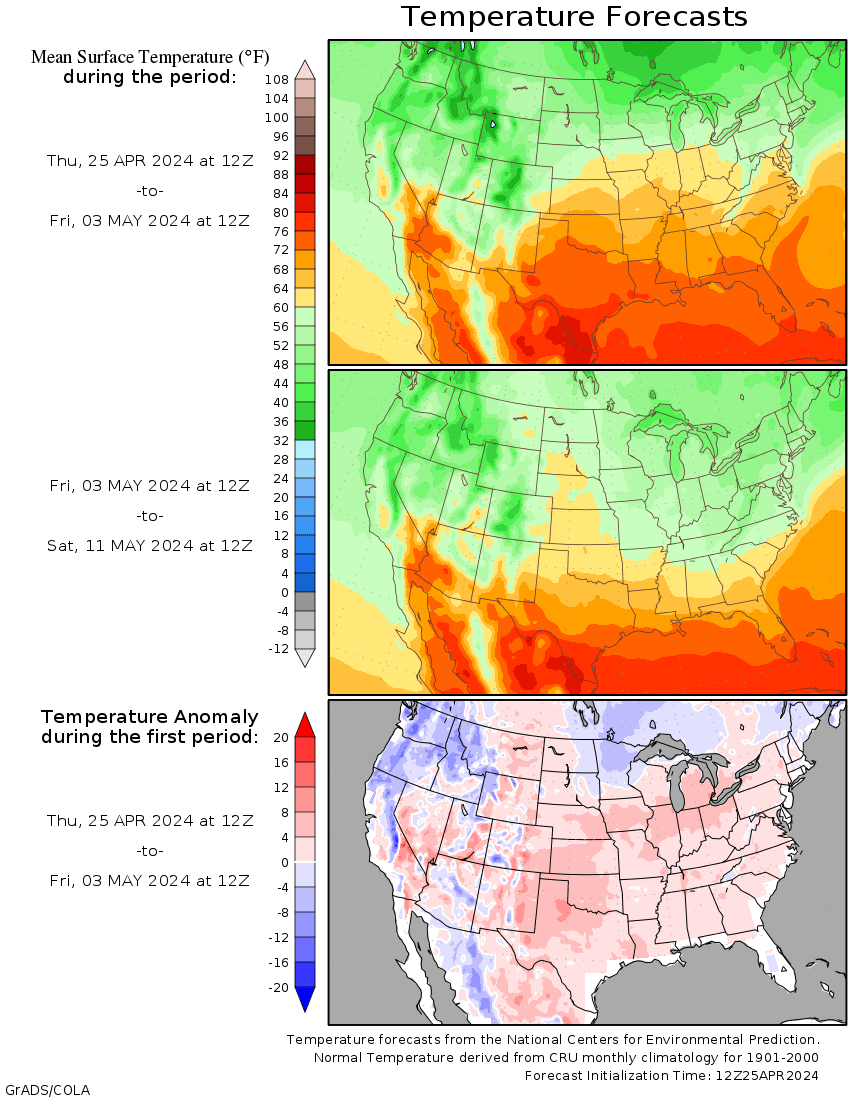
http://wxmaps.org/pix/temp1.html
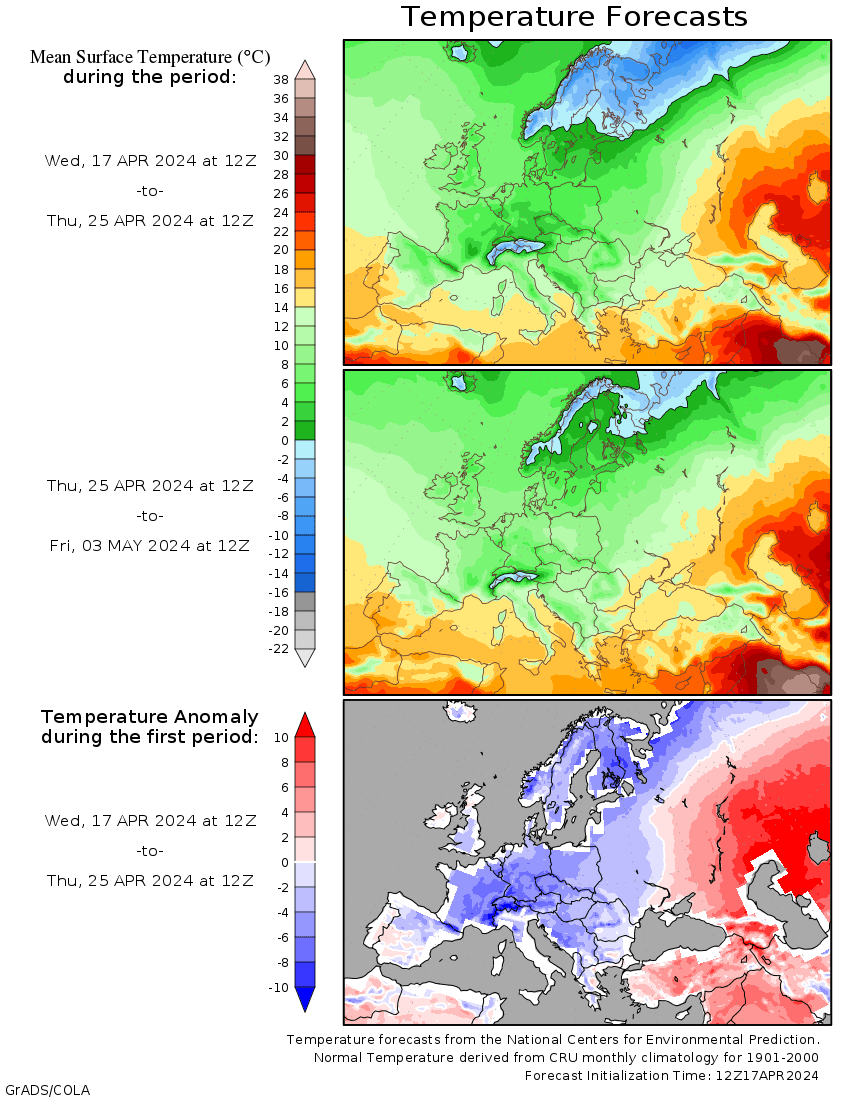
http://wxmaps.org/pix/temp4.html
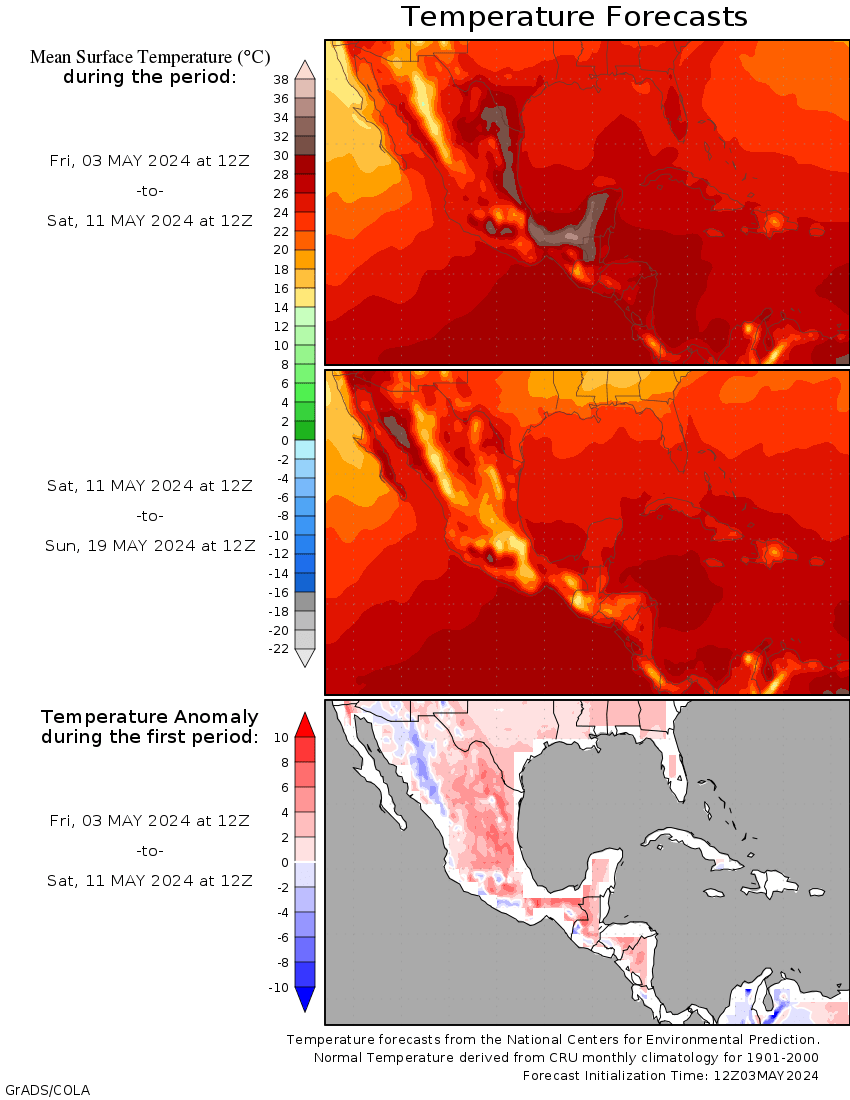
http://wxmaps.org/pix/temp3.html
Steve Goddard (19:32:22) :
My high school girlfriend’s father was a non-smoking dock worker in WWII, who was exposed to asbestos on the docks. He died a horrible death at age 55 from asbestosis.
I’ve known some that have died as badly
in similar circumstances. Asbestos, is not up for trivialiasation
A comparison of the current situation with the decline in sea surface temp from 1880 along with the solar cycles is useful.
http://tallbloke.files.wordpress.com/2010/02/sst-ssn1870.jpg
I’ve been saying for some months the current SST’s would go higher before the crash. I’ve also been saying for ages that according to my analysis big el nino’s occur especially after long solar minima.
http://tallbloke.wordpress.com/2010/01/05/my-simple-solar-planetary-energy-model/
I’ll have a new post on ocean cycles and el nino up later at my blog.
One of the problems that we and the whole of climate science face is that because of deterministic chaos we get periods of stability which appear to show linear trends. However, turbulent systems can also change state very quickly in unpredictable directions, so I’m not holding my breath that another 2007 event will happen. Pattern matching can work well for time scales of a few days but has little or no predictive power even at monthly scale.
During the period of our quiet sun, the Earth’s climate system has been losing energy over the last few years (e.g. fewer hurricanes, lower wind speed, erratic jet stream, slower ocean currents, weak El Nino). I suspect that the reduction in the speed and density of the solar wind, the decrease in strength of the solar/planetary magnetic field connection and the reduction in solar UV will produce new patterns for us to observe – until we observe it who knows?
We are living in interesting times.
By the way, the Hurricane “Oli” that has affected French Polynesia confirms a El nino situation and we know stronger north hemisphere winters influence the translation of the ME southward.
Well there are some people who believe that underwater volcanoes cause El Nino.
http://www.iceagenow.com/Global_warming_may_be_caused_by_underwater_volcanoes.htm
Take a close look at the argo ocean heat content curve:
http://jennifermarohasy.com/blog/wp-content/uploads/2009/03/loehle_ocean-heat-content-blog.jpg
To me it seems that ocean heat content varies slowly and continously and does not fluctuate wildly as the surface temperature does. This makes sense, the large thermal mass of the oceans makes sudden ocean heat content fluctuations impossible.
I strongly suspect that, let’s say, 30 years of high quality and smooth argo data, would revoulutionize our understanding of the climate. We know so little and have started to theorize long before we have any data…
He died a horrible death at age 55 from asbestosis.
Asbestosis – asbestos spread widely in the lung – is technically different from asbestos related mesothelioma – cancer. Apparently lodged asbestos fibers themselves can cause a lot of fibrosis – scar like tissue reaction – which can simply destroy enough lung tissue to compromise lung function. It usually happens from long term exposure and was probably a bigger menace than mesothelioma at one time, and well known at least 40 years ago. Offhand you’d think the little fiberglass fibers could do something similar – I don’t know anything about that except you obviously don’t want to inhale fiberglass, which can literally shower from uninclosed batts.
@Bob Tisdale (15:04:32) :
Thank you sir!
Now I have two resources to study that are “peer approved” as to quality, wading through Wikipedia or a Google search was not necessary. And more than one person has had a smile, a chuckle, perhaps even a good laugh, as opposed to if I had made a dry request for info. Objectives met, mission accomplished.
Steve Goddard
“One big difference between January, 2007 and January, 2010 is that this time around, land temperatures are not so warm. Many parts of the planet have been reporting near record cold temperatures, in particular Europe, Siberia, Antarctica and the US.”
Actually the land mass is on average very warm at present. RSS give the current lower troposphere anomaly over land as +0.795 C. An area of relative cool temperatures for January was over the continental USA and Europe: go to http://www.remss.com/msu/msu_data_monthly.html and hit anomaly.
There is no contradiction between an exceptionally warm January globally and the very cold winters experienced by many readers.
As for an upcoming drop in temperatures, the current UAH lower troposphere temperatures continue to be very high: http://discover.itsc.uah.edu/amsutemps/
These sudden (monthly) jumps in the Global temp “anomolies”, while atmospheric CO2 levels effectively remain unchanged, clearly demonstrates that there is no connection between the two and other factors are at work.
My take on this is that warm water rises to boost Earth temperatures; during a warming phase they provide a series of steps in the warming, while the oceans take in more heat, and during a cooling phase they ameliorate that cooling, while the oceans lose heat.
YES the global climate did warm up during my lifetime but now it is cooling.
I can only echo others its time to stock up with warm clothing and to ensure our housing is well insulated.
I’ve put a post up here with my take on the situation.
http://tallbloke.wordpress.com/2010/02/06/el-nino-and-the-solar-cycle/
Question for BoB Tisdale:
Bob, I have seen no reports, by sceptics or deniers, commenting on the effects that sub-oceanic volcanic action and rifts in the Earth’s crust have on sea temperatures. Can such powerful natural occurances be insignificant?
Aye, Bob
kuhnkat (21:08:09) :
<i?Richard M,
“Well, at least there are two separate analyses that are in close agreement (RSS and UAH). This makes me more comfortable.”
You mean like GISS and HadCrut?
To be honest … yes. While I think both organization suffer from group think and would be much more likely to miss errors on the high side, I do think they’ve made an honest attempt. However, more openness would make their case far better.
Magicjava, maybe you should send an email to Dr. Roy and volunteer to review the code. Same for RSS. I suspect the reasons their code has not been released is the same as other organizations. It’s probably not real well written and they feel uncomfortable showing it where professional programmers might pick it apart. You might have to sign a non-disclosure agreement.
Bob (Sceptical Redcoat) (05:37:11) : You asked, “Bob, I have seen no reports, by sceptics or deniers, commenting on the effects that sub-oceanic volcanic action and rifts in the Earth’s crust have on sea temperatures. Can such powerful natural occurances be insignificant?”
It depends on your definition of insignificant. Is 2% of the surface heat flux significant to you? Refer to “Geothermal heating, diapycnal mixing and the abyssal circulation”, Emile-Geay and G. Madec (2008):
http://www.ocean-sci-discuss.net/5/281/2008/osd-5-281-2008.pdf
They write on page 3 of 45, “Of course, the deep ocean has another source of heat: geothermal heating due to lithospheric cooling. Yet it is usually neglected from an oceanographic point of view because this flux is less than 2% of surface heat fluxes.”
Mike Guerin (14:41:41) :
Right on the nail, Mike. What it can’t be is CO². These variations are the same size as the total global warming of the past 100yrs. That can’t be CO induced. What I like is the debate (scientific) that has been provoked by the ‘sudden’ increase in temp this jan. That is what science is about.
tallbloke: You start your post…
http://tallbloke.wordpress.com/2010/02/06/el-nino-and-the-solar-cycle/
,,,with “As you can see from the chart below, El Nino tends to occur away from the peak of the solar cycle.”
But when I look at the graph and start at the beginning of the data (logical place to start)…
http://tallbloke.files.wordpress.com/2010/02/ssn-nino3-4.jpg
…the El Nino events occur at solar minimums. Then as time progresses the El Nino events occur at solar maximums, minimums, and anywhere in between. Sorry, I don’t see it.
tallboke: Disregard my 06:39:46 comment. Excuse my mistake. I missed the word “away” in your opening sentence. I must not be awake. I’ll read your post after some coffee.
Bob ( Sceptical Redcoat) (05:37:11)
Sub-Oceanic Volcano’s
In 1968 while in the New Zealand Navy, we were going from Auckland,NZ. to Norfolk Island (North of NZ about halfway to Australia ) when the Engine temp. increased, upon investigation it was discovered that the seawater intake temp. had increased some 8C. We could see a “bubble” on the ocean horizon several miles away, after a check,
water depth, 4.4 miles,
length of bubble, 2.3 miles,
hight of bubble in center 16 feet,
radius of temp. affected water, 17 miles,
temp. in center 21C higher than outside affected zone,
we spent 2 days in the area collecting water samples etc, the above numbers are what I recorded at the time, but I am sure there are NZ government records,
This is just one of hundreds of underwater volcanoes, which like the straw on the camels back ?
J.Peden (02:30:21) :
OT The same phenomena was observed in garment industry workers in spinning mills – fibers coating the lining of the lungs leading to death. Dust of any form can be deadly – silicosis, asbestosis, and others of the same form, small particles, air borne. I’m concerned about the carbon fibers being used increasingly in brakes, and other wearing structures leading to fine dust in the air, not to mention nano-technology. I’m for it, but concerned just the same.
Moderators, maybe this topic deserves its own thread.
According to Timo Niroma
According to my theory about Jovian effect on sunspots, based on facts measured since 1700 and estimated since 1500 (Schove)
– The Jupiter perihelion and sunspot minimum never coincide and the nearing perihelion in 2011 will slow the rise of the height of sunspot cycle, as now is happening to the cycle 24.
– The Gleissberg cycle almost reached its lower limit, which is 72 years in 2005.
— In fact this low it has not been ever after the Maunder minimum.
— So it must go up, the short cycles of the 20th century has created a debt that must be paid.
— This means lower cycles and if the past is a good predictor, colder times on Earth.
As at 23/06/2009
@Rob m (14:17:49) :
“OT: All climate scientists should reaad this:
Why Climate Science is on Trial.
“The findings of climate science will (and should) be held to a much higher standard of accuracy and certainty than normal scientific studies.”
Agreed. The late Dr. Carl Sagan’s statement “Extraordinary claims require extraordinary evidence” is certainly applicable to climate science’s AGW hypothesis.
Bob Tisdale (06:28:11): Thanks Bob, very interesting (and complicated for me!)
George Tetley (07:04:25) :Thanks George. Not many folks sail over volcanoes and realise it, I guess!
Bob Tisdale (06:28:11),
I’m a little concered that this article uses the assumed thermohaline structure as assumed in 1998. A more recent paper shows that biological influences affect this structure more than previously thought.
I didn’t read the paper and I’m not likely to understand it with my current knowledge in the field. However, I can see a relationship. Just sayin …
Here’s an interesting view of what’s happened with El Nino in the past month:
http://i48.tinypic.com/292rblj.jpg
This is from this past week’s CPC ENSO report. Note all the blue along the equatorial Pacific. And the SH hotspot looks to be moving west.