By Bill Steigerwald
“Junior gets brainwashed”
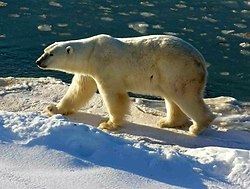
Of all the animals the Inuit traditionally hunted, Nanuk, the polar bear, was the most prized. Native hunters considered Nanuk to be wise, powerful, and “almost a man.” Some called the bear “the great lonely roamer.” Many tribes told legends of strange polar-bear men that lived in igloos. These bears walked upright, just like men, and were able to talk. Natives believed they shed their skins in the privacy of their homes.
– Polar Bears International
TASIILAQ, EAST GREENLAND
“Guess what I learned today?” Junior asked as he came running in from school.
“I can’t imagine,” Grandpa mumbled.
“Shush, Dad,” said Mother. “What did you learn, Junior?”
“I learned all about ‘global melting,’ ” Junior began breathlessly. “The whole world is getting hotter because humans drive too many cars. The sea ice is going to go away forever and — ”
“Whoa!” interrupted Grandpa. “Who taught you that stuff? Rosie O’Donnell?”
“No,” said Junior. “Principal Hansen. She came to homeroom today. Her big computer says Earth is getting hotter and hotter and Greenland is melting really, really fast. All the ice will be gone when I get as old as you.”
“That’s preposterous,” Grandpa said.
“Principal Hansen said the oceans will get taller and taller,” Junior said with a worried look on his face. “Principal Hansen said polar bears and lots of other animals will get ‘stinkt if humans keep burning stuff like coal. It’s really scary, Grandpa.”
“Principal Hansen’s even crazier than Al Gore,” Grandpa said to Mother so Junior couldn’t hear. “Didn’t I tell you that boy should have been home-schooled?”
Later that same night, after midnight, Grandpa was at his desk sending his usual round of disparaging e-mails to the politicians in Washington when Junior’s cry pierced the stillness.
“Grandpa!” Junior wailed. “Help me. I’m burning!”
Grandpa and Mother raced to Junior’s bedside. Junior was crying in his sleep. “Help me, Grandpa,” he pleaded mournfully. “I’m too young to melt.”
“Junior, wake up,” Grandpa said, shaking him. “You’re dreaming.”
Junior’s eyes popped open. “Grandpa! Mother! The ice was all gone! We were stuck on a tiny iceberg. The ocean was boiling!”
“It was just a silly nightmare, Junior,” soothed Mother. “The ice isn’t melting. See?” she said, patting the rock-hard wall of their cave.
Grandpa was fuming. He gritted his big teeth and looked Junior straight in his teary eyes.
“Boy,” he said firmly, “I’m going to tell you something I want you to remember for the rest of your life. We are polar bears. We are the largest land carnivores on Earth. We are the species ursus maritimus – ‘bears of the sea.’ We can swim 200 miles. We can walk 100 miles a day.
“We learned how to live on this frozen wasteland at the top of the world thousands of years before humans discovered fire. There are 25,000 of us alive today – twice as many as 50 years ago. We are not going to become extinct – no matter what Principal Hansen and her computers say. Now go to sleep – and no more silly nightmares.”
“That was no nightmare,” Grandpa whispered angrily to Mother. “That boy’s being brainwashed by a bunch of kooks.”
“That’s all the schools teach,” said Mother. “It’s like a new religion. Every cub I know thinks the ice will be gone before they grow up. All the mothers are complaining.”
Grandpa was fuming. “Polar bears having nightmares,” he snarled. “That’s pathetic. It’s time somebody stood up to lunatics like Hansen and their doomsday stories.”
Hi WWUT,
I found a graph published by NSIDC which I found to look strange. I have looked at other Arctic and Antarctic sea ice data and even downloaded data.
The averages in this graph don’t look right to me.
http://nsidc.org/images/arcticseaicenews/20091207_Figure3.png
Here is the global ice chart I got from Cryosphere, which seems to give another impression:
http://arctic.atmos.uiuc.edu/cryosphere/IMAGES/global.daily.ice.area.withtrend.jpg
Maybe it is just the scale of the thing.
I downloaded the data and found that the standard deviation of all sea ice extent from 1979 to be 2.6 million sq km. Three standard deviations equals 8.9 million sq km of ice. So in my mind (only having taken one course in stats) is that to be statiscally significant, there would have to be a variation from the mean of at least 8.9 million sq km of ice.
Help.
[snip – pointless sarcasm]
Cute, but no less an appeal to emotion than the Build-a-Bear cartoons.
Here’s a creepy cartoon from the Guardian:
http://www.guardian.co.uk/theobserver/cartoon/2009/dec/20/climate-change-cartoon-chris-riddell
Here’s a gushing review of James Hansen’s new book, “Storms of My Grandchildren: The Truth About the Coming Climate Catastrophe and Our Last Chance to Save Humanity” in the LA Times:
http://www.latimes.com/entertainment/news/la-ca-james-hansen27-2009dec27,0,5460299.story
And here’s the WUWT thread on the recent Build-A-Bear propaganda videos:
http://wattsupwiththat.com/2009/12/23/unbearable-global-warming-threatens-the-north-pole-christmas/
The Warmists’ use and manipulation of children to propagate the catastrophic anthropogenic global warming narrative makes my skin crawl…
With the rise in bear population I’m sure we could find food for them…. [snip]
Not so sure this is helpful.
Sure isn’t to me.
Merry XMas!
Just 16 Ships Expel as Much Pollution as All the Cars in the World
http://www.infowars.com/just-16-ships-expel-as-much-pollution-as-all-the-cars-in-the-world/
Thumbnail (20:49:09) :
Hi WWUT,
I found a graph published by NSIDC which I found to look strange. I have looked at other Arctic and Antarctic sea ice data and even downloaded data.
The averages in this graph don’t look right to me.
http://nsidc.org/images/arcticseaicenews/20091207_Figure3.png
Here is the global ice chart I got from Cryosphere, which seems to give another impression:
http://arctic.atmos.uiuc.edu/cryosphere/IMAGES/global.daily.ice.area.withtrend.jpg
Maybe it is just the scale of the thing.
I downloaded the data and found that the standard deviation of all sea ice extent from 1979 to be 2.6 million sq km. Three standard deviations equals 8.9 million sq km of ice. So in my mind (only having taken one course in stats) is that to be statiscally significant, there would have to be a variation from the mean of at least 8.9 million sq km of ice.
Help.
Not sure about the stats, but the first graph is from the Arctic sea ice extent, and the second from the Antarctic. The Antarctic is cooling and gaining ice (despite what you may be told from time-to-time). When added to the Arctic ice, there is no overall global trend at all.
The first graph looks scary until you consider the ‘hidden’ part of the graph from 0 to 9. So the bit that has been lost is one sixth (2/12) of the whole at the maximum loss. It is gaining since 2007 (not quite sure about that 2009 plot?).
Interestingly it does not follow the ‘global warming trend’ as that has not been up for the last 15 years (see previous post). It could possibly be a delayed effect, however, although the oceans seem to be cooling right now.
In any case, it is only 1/6th down at the absolute worst extent and is recovering nicely, so we don’t need to panic just yet.
A little satire does the soul good.
Try this one on the school staff. You have 2,500 cups of tea (coffee whatever) prepared for the coming meeting. The cups arranged in fifty rows, fifty deep. Your job is to keep them warm. You are only allowed to heat up one cup. You then share that heat with the other 2,499. You can heat up that one cup as many times as you want, just don’t let the tea go cold. Go for it!
About 2/3rds of the Continental United States was covered with snow for Christmas this year of 2009. I will be 74 years old in a few days, and remember most of those years quite well. I have never seen so much of the US covered in snow at Christmas in my entire life. No where near so much. “Baby, it’s cold outside”.
Thumbnail: The problem is that the warmists are like people who believe in ghosts, a creak on the stirs is a manifestation of the ghostly presence rather than the natural movements of the house. Take a look at these:
“It will without doubt have come to your Lordship’s knowledge that a considerable change of climate, inexplicable at present to us, must have taken place in the Circumpolar Regions, by which the severity of the cold that has for centuries past enclosed the seas in the high northern latitudes in an impenetrable barrier of ice has been during the last two years, greatly abated….
….. this affords ample proof that new sources of warmth have been opened and give us leave to hope that the Arctic Seas may at this time be more accessible than they have been for centuries past, and that discoveries may now be made in them not only interesting to the advancement of science but also to the future intercourse of mankind and the commerce of distant nations.” A request was made for the Royal Society to assemble an expedition to go and investigate.
President of the Royal Society, London, to the Admiralty, 20th November, 1817, Minutes of Council, Volume 8. pp.149-153, Royal Society, London. 20th November, 1817.(from) http://www.john-daly.com/polar/arctic.htm
“The arctic ocean is warming up, icebergs are growing scarcer and in some places the seals are finding the water too hot. Reports all point to a radical change in climate conditions and hitherto unheard-of temperatures in the arctic zone. Expeditions report that scarcely any ice has been met with as far north as 81 degrees 29 minutes. Great masses of ice have been replaced by moraines of earth and stones, while at many points well known glaciers have entirely disappeared.”
—US WEATHER BUREAU, 1922
New Scientist has done an article on climategate. I reckon Jones Mann ect will not be ble to employed in any decent university after this…. They (NS) seem to distancing themselves from the UEA crowd
Darrell (21:01:09) :
Cute, but no less an appeal to emotion than the Build-a-Bear cartoons
The Polar Bear series here is intended for adults, not children. The emotion appealed to is adult humor. It states some well known facts. Do they frighten you?
Thumbnail (20:49:09) :
Hi WWUT,
I found a graph published by NSIDC which I found to look strange. I have looked at other Arctic and Antarctic sea ice data and even downloaded data.
The averages in this graph don’t look right to me.
http://nsidc.org/images/arcticseaicenews/20091207_Figure3.png
Here is the global ice chart I got from Cryosphere, which seems to give another impression:
http://arctic.atmos.uiuc.edu/cryosphere/IMAGES/global.daily.ice.area.withtrend.jpg
Maybe it is just the scale of the thing.
I downloaded the data and found that the standard deviation of all sea ice extent from 1979 to be 2.6 million sq km. Three standard deviations equals 8.9 million sq km of ice. So in my mind (only having taken one course in stats) is that to be statiscally significant, there would have to be a variation from the mean of at least 8.9 million sq km of ice.
Help.
I read in a piece by Dr. Ole Humlum of Svalbard (www.unis.no) that although global temps. peaked in the mid-1930’s, the arctic temps peaked in the early ’40’s. If this is correct, then maybe the same thing is happening again.
————
The Poe-faced warmagists can’t stand the humour, so bring it on!
This series is very…um… (YAWN…) …Ineffective? Condescending…? I’ve got it: Fatuous.
This GP Bear stuff may be funny, but, really, it’s in the same camp as the Coke/Pepse/UK TV ads propaganda. And all the worse for being aimed at children.
Cut it out, Anthony.
They are indeed preying on children by pumping them full of horror stories and plain old superstitions. Reads much like a modern-day Grimm’s Fairy Tales.
Yes Billy, there are monsters in the dark, only they live in darkened minds, not closets.
New Scientist, in this article, appears to be shifting its position and is now supportive of openness, the artlce also links the hocky stick directly to the Briffa data and CRU, its encouraging.
When New Scientist contacted Jones about the data wars in July this year, he said: “McIntyre has no interest in deriving his own global temperature series. He just wants to pick holes in those that do. I’m getting pretty fed up with this. It is just time-wasting.”
(NO jones was aware that the only data set that mattered to the IPCC was his and if that were to be proven fraudulent his carreer would be finished, its nothing to do with confidentiality agreements)
http://www.newscientist.com/article/mg20427393.600-battle-for-climate-data-approaches-tipping-point.html
the stupidity training starts real young with the collection of tabs from soda cans. the lesson to be learned is that your time is worth nothing and if enough people get together and do something very stupid together, then it isn’t stupid anymore, because everyone is doing it.
P. Olson (02:46:07) :
This series is very…um… (YAWN…) …Ineffective? Condescending…? I’ve got it: Fatuous.
Yous missed one – WRONG
http://www.polarbearsinternational.org/
Polar bears walk on average at a speed of 5-6km/hr
assume 24 hours and 6 km/hr
= 144km/day = 89.5 miles
Swim 200 miles??
“They have been known to swim more than 60 miles without a rest and have been clocked swimming as fast as six miles per hour.”
Can polar bears swim at max speed for 33 hours ??
I could be completely wrong, but:
The graph covers 30 years and there are 30 data points shown in it, one per year. Still, it claims to be representing *montly* sea ice extent. How can that be?
It says “November 1979 to 2009”. Is it November data only from each year?
Having a daughter which is a helicopter pilot, until last year working at the North Slope (Alaska), she told us that her colleagues traced a polar bear, swimming 300 miles (500 km) from the sea ice to the mainland… Not a big problem for it. They had a lot of work to keep the bears away from the worker’s settlements (especially the waste dumps), as there are an increasing number of bears, all looking for (easy) food…
http://www.abc.net.au/news/newsitems/200508/s1436787.htm
Last Updated:Saturday, August 13, 2005. 0:07am (AEST)
Polar bear makes 74 km Arctic swim
A polar bear has been tracked swimming 74 kilometres [46.0 miles] in one day.
Scientists have tracked a tagged polar bear swimming at least 74 kilometres in just one day – and maybe up to 100 kilometres [62.1 miles]- providing the first conclusive proof the bears can cover such giant distances in the water.
Bears often roam thousands of kilometres in a year in search of prey such as seals and there has often been anecdotal evidence of prodigious ursine swims, with bears turning up on remote islands or across wide bays.
Previously there had been doubts about whether the bears had walked over ice part of the way or hitched a ride on an iceberg.
“What’s new this time is that we have data showing how long the bear was in the water,” Jon Aars, a researcher at the Norwegian Polar Institute, said on Friday.
“This is the first time that such a long swim has been documented by satellite telemetry for polar bears,” the institute added.
A very chuckle worthy piece of satire !!!
Very good !!!