
I might add that the likelihood of a hurricane strength storm striking Southern California is low. Since 1900, only four tropical cyclones have brought gale-force winds to the Southwestern United States. They are an unnamed tropical storm that made landfall near San Pedro in 1939, the remnants of Hurricane Joanne in 1972, the remnants of Hurricane Kathleen in 1976, and Hurricane Nora in 1997 which entered California as a tropical storm.
The storms that do make it close enough to be a threat are often weakened by two facts: cold sea surface temperatures and upper level steering winds that tend to take them away for SoCal. But it’s a fun exercise to discuss the possibility. – Anthony
Guest post by Roger Sowell
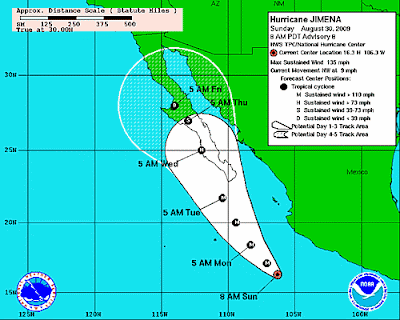
A hurricane hitting Los Angeles. No, it hasn’t happened yet, but it could. I am using the same reasoning as the Carbon Is Going to Kill Us crowd, where it is deemed prudent and even mandatory that we take action now to prevent a future catastrophe. AGW believers insist that all mankind (well, except for developing countries, of course!) curtail or stop altogether emitting carbon dioxide, as that may cause ice caps to melt and oceans to rise and population disruption.
There is a hurricane in the Pacific Ocean, headed directly toward Los Angeles. It’s name is Jimena (pronounced him -ay – nuh, accent on the ay). Jimema currently has winds of 135 miles per hour, and is just south of the tip of Baja, California. Its course is to the northwest, up the Baja peninsula.
Judging from the mass confusion a couple of years ago when Houston evacuated ahead of hurricane Rita, Los Angeles might want to start packing and driving today. Houston only had around 1 million people exiting the city, and had at least five freeways on which to do it. Los Angeles has approximately 3 million people, probably closer to 4 million, but the metropolitan area has 18 million, and only three ways out. There is the Interstate 10, going due East; Interstate 5 going North; and highway 101, also going north. I-5 also goes south, but little good that will do since one runs into San Diego and the hurricane.
A hurricane hitting Los Angeles. We must take prudent steps to avoid the certain disaster and destruction from a hurricane. We will not be required to wait 100 years for the results to be in. This hurricane will be here in less than 10 days. We must act today, while there is still time. The science is settled. Hurricanes hitting major population centers are a serious threat. Remember New Orleans and Hurricane Katrina. Houston and Hurricane Rita. We must mobilize FEMA so they can get their red tape all in order, ready to send trailers and water and food packs to Los Angeles.
The low-lying areas of Southern California are at risk of inundation from the storm surge. Ports and river basins will be swamped with seawater, causing un-told devastation to precious seashore that is a national treasure, as the California Coastal Commission regularly reminds us. A storm surge from a hurricane can be several feet. The California Coastal Commission was in a tizzy recently over the prospect of the ocean rising just one foot, in the next century. Where is the alarm, the hysterical and frantic activity, over a storm surge of 5 to 10 feet in the space of 24 hours?
Where is the clarion call to action from our state and city leaders? Governor Schwarzenegger, Mayor Villaraigosa, are you watching this hurricane? Have you prepared the state and city and county to deal with this?
Or, are you hoping the hurricane does arrive, and right away, so that the wildfires will finally be put out and the firefighters get some much-needed rest?
Stay tuned, sports fans. This is about to get interesting.
Will it be roughly the size of Manhattan? And how would the media exploit this when they can’t use photos of black children or furry animals? When we celebs and gangs suffer we don’t really give a hoot.
And neither should we.
Nice one Roger. And congrats on your first post here. Stay safe if… well you know.
The rain would help with the fires , but then would probably trigger mud/debris flows . I read about the fire/rain/debris flow cycle in one John Mcphee’s books – The Control of Nature , I think .
On December 19, 1973, Johnny Carson made a tongue-in-cheek comment on a toilet paper shortage. Within a few days there was a TP shortage. One has to be careful what one does in these days of mass silliness.
Good post, though. Too bad Jimena is a week away. I’m guessing the rain will be considered beneficial if it puts the fires out and doesn’t cause mud slides. In any case, I would not try 101 as an escape route unless you are first to head north.
Actually, some of dry Arizona’s so-called “400-year floods” happen as a result of Pacific hurricanes that peter out as they mosey up the Baja gulf. I always keep an eye out for such storms at this time of year. We get the leavings of a hurricane every 10 or so years.
Thank you, Ellie. This is great fun.
Here is a link to the hurricane track map, showing just how few ever strike the U.S. west coast. From zooming in, it appears that only one has really hit close to Los Angeles, and that one came in over Long Beach (a suburb of Los Angeles). Another came ashore at San Diego.
http://csc-s-maps-q.csc.noaa.gov/hurricanes/viewer.html
Anthony is quite right, of course, that the cold ocean water and wind conditions make it extremely unlikely that a hurricane will strike Los Angeles. One did, though, and this one might.
Australian researchers now claim to have “proven” that their country’s drought is a result of AGW. (http://www.theage.com.au/national/its-not-drought-its-climate-change-say-scientists-20090829-f3cd.html)
Robust! Tipping point! Precautionary pimple! Everybody who opposes this is in the pocket of Big Oil. Ooooh! When in trouble, when in doubt, run in circles, scream and shout! Vote for Fear, Incorporated.
Being a resident of the Phoenix area, I’m reminded of Hurricane Nora. Predictions called for 4″-6″ of rain for the area (our yearly total is about 7″). The center of the storm headed due north in western Arizona. Here in Phoenix we actually recieved a 3 minute sprinkle. Barely enough to cover the ground. The local paper ran a cartoon showing the media all crowded around a puddle of water proclaiming “The remants of Tropical Storm Nora”.
All joking aside, Arizona has seen some large rainfall events from remnants of dieing tropical storms. However, it has been an exceptionally dry “Monsoon” season. We will gladly accept any rainfall to end our Depressing non-stop sunshine. And to think I moved here to escape the typical dreary cloudy days back east. Most Phoenicians get excited by rain/clouds and depressed by cloudless days.
And yes, droughts come and go. That’s the way it’s always been here in the Southwest. We only have water shortage problems when too many people try to live (and irrigate) off of a given supply during drought times. I just want to puke every time I hear a warmer claim that droughts in the Southwest are becoming more common and things are accelerating at a scary pace, blah blah blah. The only thing that has increased in the Southwest is the minimum temperature readings from measuring stations located near urban areas.
Maybe they’re too busy taking care of the fires and sizzling temperatures?
Here’s a live webcam at Mt Wilson (UCLA astrophysics observatory):
http://www.astro.ucla.edu/~obs/towercam.htm
Ah ye of little faith. The end is nigh, and thou must apply the precautonary principle—NOW!. Abandon the city at all costs, lest ye be called a hurricane denier!
We don’t need no stinkin’ risk/benefit analysis.
Don’t forget Hurricane Ike and the order to evacuate Galveston after the road(s) was/were already under water. That took real careful planning.
The rain would/will be terrible. There will be massive mud flows the first storm that arrives. If you don’t know the area of Big Tujunga Canyon, there are very steep mountains with only a couple of outflow. We’ll be testing the flood control basins for sure.
Will this one leave a track of cold (exausted heat) waters behind?. Have you noticed that Nino 2+3 anomaly is over ( in the northern hemisphere), not below the equator line and nino 1 is cold?
http://www.osdpd.noaa.gov/data/sst/anomaly/2009/anomnight.8.27.2009.gif
BTW Danny´s track still lingers.
Wait for more informed interpretations.
“Precautionary pimple” LMAO
Some “coyotes” are helping this Nino to cross the US southern border line!
Bring it on. We need the rain.
Gee, I don’t know. Hurricane Bill was Cat 3 – and was still Cat 1 near Nova Scotia. The water there is cooler than the water near Los Angeles. Jimena may be a Cat 4 and has warm water most of the way. Unlikely, improbable – yes. But not due to water temp – due to steering air currents.
http://www.weather.com/newscenter/hurricanecentral/2009/bill.html
http://www.wunderground.com/tropical/
Look on the bright side…we need the rain and it would blow all the smoke from the fires over the hill out into the dessert. For us choking from the smoke and our dead lawns, it’s a win-win!
The trajectory above of this huriicane it is the modelled one. I have heard that the real one will be westward (btw. earth circles from west to east).
Nogw (14:58:32) :
I don’t doubt that the path of the hurricane will likely differ from the modeled one but what does “earth circles from west to east” have to do with it? Surely the folks working on these issues learned this at some point in their career!
Also, you must mean you expect the path to be “west of” the modeled path and not “westward” for that seems to say it would curl out into the Pacific Ocean rather than into the continent. Just wondering as I’m unclear which you do mean.
A particularly silly argument, even for this site.
Outstanding thread, Anthony. We should add that it’s all the fault of Santa Barbara Offshore Oil and the Diesel Death Zones (that’s what they call them down there) where the container ships unload.
What is missing is the ocean temps off the coast to support a hurricane skirting Baja to enable Jimena to hydrostatically flow the LA Basin. The consolidation of the rock formations in So. Ca is akin to a pile of cake dough. i.e. – those in the mining industry refer to it as the “Peanut Butter Formation”. The remnants of the storm would then travel north to Big Sur and take out Highway One built on the Soapstone Formation (highly fractured Serpentine).
Run for your lives. Flee, LA, the freeways will go down faster than the Northridge Earthquake
The volume of goo, rock and debris will render the area impassable for months on end.
Then comes the “Big One” 8.0+ Quake, followed by a 400 year Santa Anna wind.
Lord have Mercy, Coastal California won’t sink beneath the waves, it will be melted off by 40″ rains.
John F. Hultquist (15:38:33) :
It would have to head out to the West then curl back in to slam into LA like a brick wall.
The resultant 4 feet of water will run down the hills taking LA out to sea to form a new extended concrete reinforced rubble coastline. Airborne Tsunami.
Wow, this sci-fi stuff is wild.
“alphajuno (13:54:24) :
Gee, I don’t know. Hurricane Bill was Cat 3 – and was still Cat 1 near Nova Scotia. The water there is cooler than the water near Los Angeles. Jimena may be a Cat 4 and has warm water most of the way. Unlikely, improbable – yes. But not due to water temp – due to steering air currents.
http://www.weather.com/newscenter/hurricanecentral/2009/bill.html
http://www.wunderground.com/tropical/”
The circulation of the northeastern Pacific is different from the northwestern Atlantic. The cold water from the north eastern Pacific is moving clockwise down the Alaskan coast towards the equator. There is no similar circulation in the northwestern Atlantic.