Meanwhile, China’s top-secret ‘dragon’ space plane just released another unidentified object over Earth.
Posted by Leslie Eastman

China is leaving a growing trail of spent rocket stages in low Earth orbit, and the pace is picking up.
A new report warns this practice is increasing the risk of collisions for both military and commercial satellites operating in an already crowded region of space.
The analysis from space monitoring firm LeoLabs, provided to Breaking Defense, found that from January 2021 to January 2025 China has abandoned 51 spent rocket bodies in LEO above 650 kilometers (about 404 miles) in altitude, more than doubling the number for the previous five years to bring the total to 96.
During that period, Beijing accounted for 86 percent of the global number of rocket bodies left in LEO, nearly seven times more than the rest of the world combined, it adds. By contrast, the US left four, and Russia, only one.
Even more importantly for calculations of potential debris creation, the analysis shows that the “amount of R/B mass abandoned above 650 km from China has more than tripled,” rising from 98,000 kilograms to 305,000 kilograms. This accounts for “98 [percent] of the global increase in abandoned R/B mass is from China meaning China has left over 40x the amount of abandoned R/B mass in long-lived orbits in LEO than rest of the world combined.”
Darren McKnight, author of the LeoLabs study, said a major reason for the large jump in mass is because China uses bigger rockets than most other nations for launching its LEO satellites. The more massive a space object, the more debris it will create if it breaks up of its own accord or it smashes into another space object.
China dumping more rocket bodies in space, endangering low Earth orbit satellites: Report – Breaking Defense https://t.co/v3sWXTHYHN
— US NCVA (@NcvaUs) June 26, 2026
It turns out these discarded rocket bodies are especially dangerous. Many still contain leftover fuel, which can trigger explosions after they are abandoned, which can turn a single piece of debris into space shrapnel.
At the end of last year, the trend lines did not look promising. China is the only major space power moving sharply in the wrong direction on upper‑stage abandonment, with the mass of Chinese abandoned rocket stages in long‑lived orbits jumping from under 100 metric tons to around 250+ metric tons in roughly five years.
China, on the other hand, frequently abandons upper stages in orbit. China launched 21 of the 26 hazardous new rocket bodies over the last 21 months, each averaging more than 4 metric tons (8,800 pounds). Two more came from US launchers, one from Russia, one from India, and one from Iran.
This trend is likely to continue as China steps up deployment of two megaconstellations—Guowang and Thousand Sails—with thousands of communications satellites in low-Earth orbit. Launches of these constellations began last year. The Guowang and Thousand Sails satellites are relatively small and likely capable of maneuvering out of the way of space debris, although China has not disclosed their exact capabilities.
However, most of the rockets used for Guowang and Thousand Sails launches have left their upper stages in orbit. McKnight said nine upper stages China has abandoned after launching Guowang and Thousand Sails satellites will stay in orbit for more than 25 years, violating the international guidelines.
It will take hundreds of rockets to fully populate China’s two major megaconstellations.
Meanwhile, China’s top-secret space plane just released another unknown object over Earth.
The clandestine spacecraft has now deployed at least nine payloads around our planet since 2022 — and we don’t know what any of them really are.
The Shenlong, or “divine dragon,” space plane is a reusable, robotic spacecraft that China has repeatedly launched into low Earth orbit (LEO) on board vertical rockets, before reentering the atmosphere for a horizontal runway landing — similar to the iconic spacecraft from NASA’s now-defunct Space Shuttle program.
The space plane has never been photographed by otuisde nations, so we have no clear idea what it looks like or how large it is. Officials from China’s space sector have yet to reveal any meaningful information about its design or purpose.
Space tension rises as China’s Shenlong space plane releases unknown object tracked by global monitoring systems. #Shenlong #China https://t.co/KAWyiAwS4r
— GEEKSPIN (@geekspinco) June 25, 2026
China’s pattern of treating low Earth orbit like a dumping ground at the same time it is expanding potential military space capabilities should raise serious concerns for anyone relying on satellite infrastructure — which, at this point, is pretty much everyone.
The combination of negligent debris practices, rapid megaconstellation deployment, and a lack of transparency is not just bad stewardship, it is also a growing strategic and environmental risk that we can ill afford to ignore.
(Image by perplexity.ai)
[Editor’s Addendum]
Space Junk
Song by
Devo
Well, she was walking all alone
Down the street, in the alley
Her name was Sally
I never touched her, she never saw it
When she was hit by space junk
When she was smashed by space junk
When she was killed by space junk
“In New York, Miami Beach
Heavy metal fell in Cuba
Angola, Saudi Arabia
On Christmas Eve”, said Norad
A soviet sputnik hit Africa
In India, Venezuela, in Texas, Kansas
It’s falling fast, Peru too
It keeps coming, it keeps coming, it keeps coming
And now I’m mad about space junk
I’m all burned out about space junk
Walk and talk about space junk
It smashed my baby’s head, space junk
And now my Sally’s dead, space junk
If left there, would they eventually “run out of steam”, re-enter the atmosphere, and fall to earth we know not where?
Yes
I am afraid they are not powered by steam.
Don’t be too literal; it was a simile. That’s why I put the phrase in inverted commas.
Don’t be too literal, that was a joke.
My response was an attempt at sacrasm.
It seems like only yesterday the CCP was warning about all the Starlink satellites. Maybe they were doing that for cover.
Sum Ting Wong.
I went to school with his brother. Verry Verry Wong.
They’ve turned their own country into a toxic waste dump. Why would they treat space any differently?
My thought exactly, they use their own country as a dumping ground, don’t expect them to treat space, or anywhere else, any differently.
A sufficiently cautious person would well consider whether space junk was being deliberately scattered in order to conceal functional assets.
A sufficiently
cautiouscynical person….FIFY
I agree that the Chinese are being irresponsible. But, that said, I think the “danger” is overblown.
Let’s do some arithmetic, shall we?

The Earth’s radius averages about 6371 km, so its surface area is about 4·π·(6371^2) = 510 million km².
At an altitude of 650 km that increases to 4·π·((6371+650)^2) = 619 million km^2.
Divide that by 96 rocket bodies and you’ll find that there’s one rocket body per 6.45 million km².
That’s nine times the size of the State of Texas (which is 695,662 km²).
So it’s not exactly “crowded” up there, just yet.
Let’s assume the author is unfamiliar with rockets, so that when she worries about unexpended “fuel” in orbit causing an “explosion”, she really has in mind the type of event seen at or shortly after launch when large amounts of “fuel” and “oxidizer” mix in the presence of high pressure and very hot flame. Any unused upper stage propellants are usually liquids that don’t stay around long, and would be quite tame if the oxidation occurred in the vacuum of space. Believe me, the “flaming debris” that “falls” out of space in Star Wars battle scenes is purely the construct of Hollywood imagination.
Well, not really.
The “flaming debris” can be—often is—real and can be caused by any material heated to the point of radiating substantial energy in range of human visible light perception . . . that is, “red hot” to “blue-white hot”. This does not necessarily require the action of fuel-oxidizer combustion . . . molten hot metal alone would appear visually to be “flaming”.
Some obvious examples:
— the “flaming” seen on meteors and meteorites entering Earth’s atmosphere,
— the “flaming” plasma sheath seen enveloping manned and unmanned spacecraft from the Mercury flights to the Space Shuttle flights to the crewed Dragon capsules to the televised Starship vehicle test flights during their re-entries into Earth’s atmosphere, and
— the “flaming” seen on debris entering the atmosphere from the several Starship orbital vehicles that have exploded before controlled re-entry along their planned suborbital path. Note that this last example includes both air friction heating and active metal-oxygen chemical combustion resulting from such heating in the presence of atmospheric oxygen. The end of the Space Shuttle “Columbia” also comes to mind here.
Do you not understand that the Earth’s atmosphere is not “space”?
I DO understand that your comment
“Believe me, the “flaming debris” that “falls” out of space in Star Wars battle scenes is purely the construct of Hollywood imagination.”
has the implication of referring to many scenes in many individual Star Wars films from the viewpoint of humans and aliens watching debris entering the atmosphere over the planetary surface upon which they are standing or sitting, as well as scenes in which the POV is from an external viewer following a “flaming”, disabled spaceship as it is entering a planetary atmosphere.
But, of course, it is absolutely true that the “Stars Wars” franchise meme and each and every one of its associated battle scenes is purely an artificial event. Basic understanding, you see?
Your example assumes a static, one time snapshot.
The reality is that these objects are whizzing around at high speed. Just because they aren’t impacting with anything right now doesn’t mean that 5 minutes from now they won’t impact something.
A few years ago, an ESA satellite was destroyed when it collided with a defunct Soviet era satellite.
The US’s space shuttle was hit be space debris several times.
The ISS has had to shift orbits multiple times to keep a safe distance from space debris.
It’s a big problem and it’s growing.
It’s time to make a simple, single use space tug to launch and grab onto those rocket bodies and take them home to China. With today’s dirt cheap solid state gyros, accelerometers, and GPS chips a control board to sense the payload’s rotation and location shouldn’t cost a lot to manufacture.
Give the tug a single thruster, tell the thing where to aim, then let it calculate the thruster firing times and durations so that as the hunk of junk spins the tug can fire at the right times to lower altitude until atmosphere friction takes over.
China should appreciate the return of all that expensive aluminum and other materials.
Why bother? Orbital decay will kill all of the space junk over time. And there’s nothing useful left up there.
Above 650 km it will take a very long time.
At 360 km (typical for many recent Starlink satellites), a dead satellite will naturally deorbit in a matter of months, due to atmospheric drag.
The ISS is at about 420 km, and it loses about 2 km/month between boost burns. The sawtooth-like altitude plot is due to sharp increases during boost burns, and slow decreases between them:
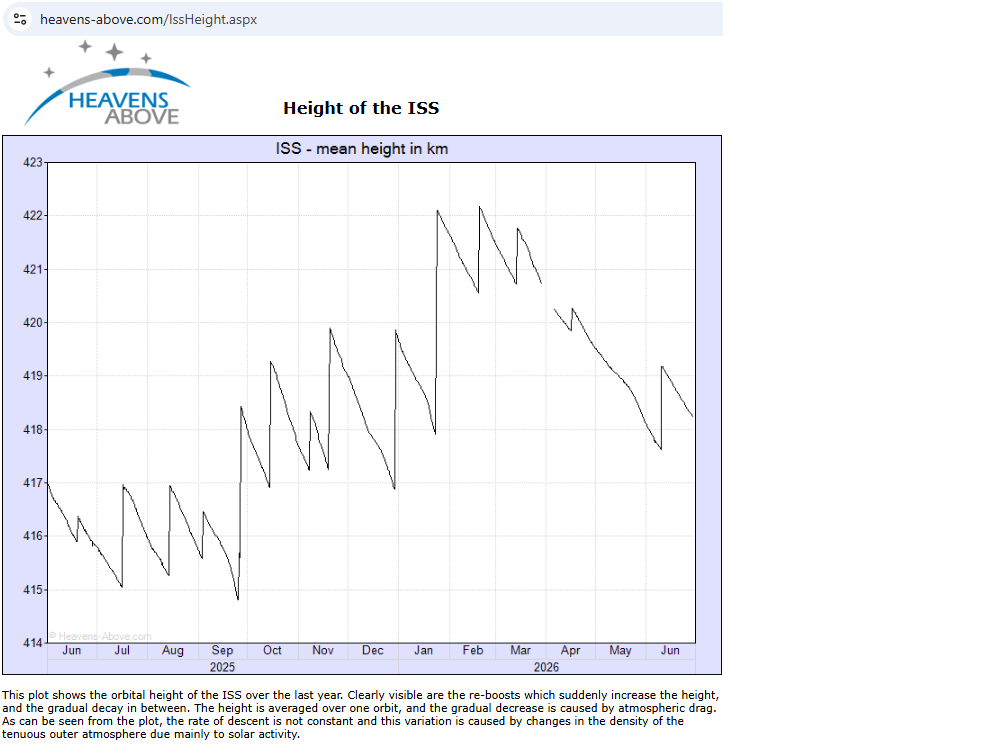
https://heavens-above.com/IssHeight.aspx
The higher you go, the slower the orbit decays. At 450 km, a 1/2 ton dead satellite would stay up for 3-10 years.
At the 590 to 630 km altitudes of Amazon’s Leo/Kuiper satellites, a dead satellite will stay in orbit for many decades.
At 650 km and above they stay up a lot longer. Some of the Chinese spent upper stages are above 800 km, and it will take centuries for them to come down.
The spent upper stage from Voyager 2 is still in orbit, 67 years later, and its orbital parameters have barely changed. It was initially in a 557 by 3,319 km orbit, and now it’s 561 by 3,292 km. It will be up there for centuries.
Just making sure it de-orbits over China, and not somewhere else.
Given that is true, it does not address where the junk falls and not all junk completely burns up on re-entry, not to mention what kinds of toxins enter the atmosphere during burn-up.
The biggest cost of a satellite is not the satellite itself, but the cost of getting it into orbit.
This might become the “Orbital Trash Collection Service”: https://nypost.com/2026/06/28/science/nasa-rushes-to-save-swift-telescope-from-falling-back-to-earth-with-30-million-rescue-mission/
SpaceX has its Starlink worldwide Internet service based on tens of thousands of comsats orbiting in LEO (low Earth orbit) at altitudes in the range of of 340 km to 550 km (~ 210 to 340 miles). There are currently about 10,400 Starlink satellites in LEO, but SpaceX has filed regulatory applications with international authorities to expand the constellation to up to 42,000 satellites.
Maybe SpaceX will shortly be developing and launching specialized “sweep up” satellites—perhaps based on its Starship system—to get rid of all the Chinese trash in LEO as discussed in the above article.
IMHO, directed-entry of that carelessly discarded trash over the land mass of the PRC would be appropriate.
And in case you’re wondering, Starlink satellites are actively steered into Earth’s atmosphere to safely burn up at the end of their operational lifespans. Each satellite is designed for an average operational life of 5 to 6 years, after which they are commanded to perform a controlled, propulsive deorbit. It’s known as “exercising proper LEO environmental etiquette”, but apparently that phrase doesn’t translate to Standard Mandarin.