
Cap and Trade and the Illusion of the New Green Economy
Dr. Roy Spencer, from his blog at www.drroyspencer.com
July 1st, 2009
I don’t think Al Gore in his wildest dreams could have imagined how successful the “climate crisis” movement would become. It is probably safe to assume that this success is not so much the result of Gore’s charisma as it is humanity’s spiritual need to be involved in something transcendent – like saving the Earth.
After all, who wouldn’t want to Save the Earth? I certainly would. If I really believed that manmade global warming was a serious threat to life on Earth, I would be actively campaigning to ‘fix’ the problem.
But there are two practical problems with the theory of anthropogenic global warming: (1) global warming is (or at least was) likely to be a mostly natural process; and (2) even if global warming is manmade, it will be immensely difficult to avoid further warming without new energy technologies that do not currently exist.
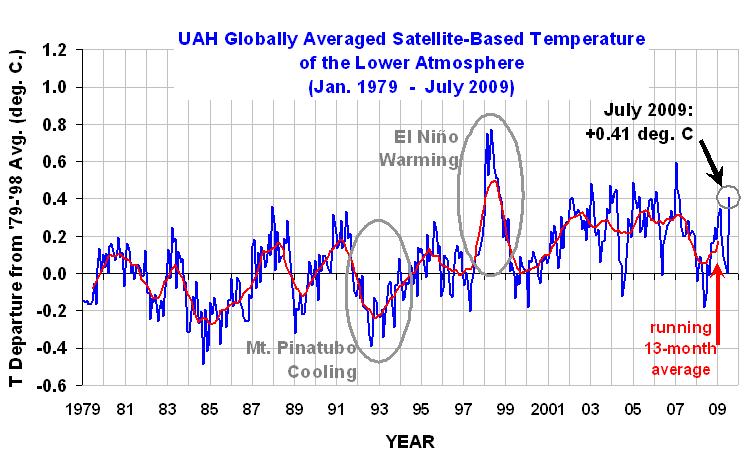
On the first point, since the scientific evidence against global warming being anthropogenic is what most of the rest of this website is about, I won’t repeat it here. But on the second point…what if the alarmists are correct? What if humanity’s burning of fossil fuels really is causing global warming? What is the best path to follow to fix the problem?
Cap-and-Trade
The most popular solution today is carbon cap-and-trade legislation. The European Union has hands-on experience with cap-and-trade over the last couple of years, and it isn’t pretty. Over there it is called their Emissions Trading Scheme (ETS). Here in the U.S., the House of Representatives last Friday narrowly passed the Waxman-Markey bill. The Senate plans on taking up the bill as early as the fall of 2009.
Under cap-and-trade, the government institutes “caps” on how much carbon dioxide can be emitted, and then allows companies to “trade” carbon credits so that the market rewards those companies that find ways to produce less CO2. If a company ends up having more credits than they need, they can then sell those credits to other companies.
While it’s advertised as a “market-based” approach to pollution reduction, it really isn’t since the market did not freely choose cap-and-trade…it was imposed upon the market by the government. The ‘free market’ aspect of it just helps to reduce the economic damage done as a result of the government regulations.
The Free Market Makes Waxman-Markey Unnecessary
There are several serious problems with cap-and-trade. In the big picture, as Europe has found out, it will damage the economy. This is simply because there are as yet no large-scale, practical, and cost-competitive replacements for fossil fuels. As a result, if you punish fossil fuel use with either taxes or by capping how much energy is allowed to be used, you punish the economy.
Now, if you are under the illusion that cap-and-trade will result in the development of high-tech replacements for fossil fuels, you do not understand basic economics. No matter how badly you might want it, you can not legislate a time-travel machine into existence. Space-based solar power might sound really cool, but the cost of it would be astronomical (no pun intended), and it could only provide the tiniest fraction of our energy needs. Wind power goes away when the wind stops, and is only practical in windy parts of the country. Land-based solar power goes away when the sun sets, and is only practical in the sunny Southwest U.S. While I personally favor nuclear power, it takes forever to license and build a nuclear power plant, and it would take 1,000 1-gigawatt nuclear power plants to meet electricity demand in the United States.
And no one wants any of these facilities near where they live.
Fortunately, cap-and-trade legislation is not necessary anyway because incentives already exist – right now — for anyone to come up with alternative technologies for energy generation and energy efficiency. Taxpayers and consumers already pay for billions of dollars in both government research (through taxes) and private research (through the cost of goods and services) to develop new energy technologies.
Whoever succeeds in these efforts stands to make a lot of money simply because everything we do requires energy. And I do mean everything…even sitting there and thinking. Using your brain requires energy, which requires food, which requires fossil fuels to grow, distribute, refrigerate and cook that food.
Economic Competitiveness in the Global Marketplace
Secondly, when instituted unilaterally by a country, cap-and-trade legislation makes that country less competitive in the global economy. Imports and trade deficits increase as prices at home rise, while companies or whole industries close and move abroad to countries where they can be more competitive.
The Obama administration and congress are trying to minimize this problem by imposing tariffs on imports, but this then hurts everyone in all of the countries involved. Remember, two countries only willingly engage in trade with each other because it economically benefits both countries by reducing costs, thus raising the standard of living in those countries.
The Green Mafia
Third, cap-and-trade is a system that is just begging for cheating, bribing, and cooking the books. How will a company’s (or a farm’s) greenhouse gas emissions be gauged, and then monitored over time? A massive new bureaucracy will be required, with a litany of rules and procedures which have limited basis in science and previous experience.
And who will decide how many credits will initially be given by the government to each company/farm/industry? Does anyone expect that these decisions will be impartial, without political favoritism shown toward one company over another, or one industry over another? This is one reason why some high-profile corporations are now on the global warming bandwagon. They (or at least a few of their executives) are trying to position themselves more favorably in what they see to be an inevitable energy-rationed economic system.
Big Oil and Big Coal Will Not Pay for Cap-and-Trade
Fourth, it is the consumer – the citizen – who will pay for all of this, either in the form of higher prices, or reduced availability, or reduced economic growth. Companies have no choice but to pass increased costs on to consumers, and decreased profits to investors. You might think that “Big Business” will finally be paying their “fair share”, but Big Business is what provides jobs. No Big Business, no jobs.
The Green Jobs Illusion
Fifth, the allure of “green jobs” might be strong, but the economic benefit of those jobs is an illusion. The claim that many thousands of new green jobs will be created under such a system is probably true. But achieving low unemployment through government mandates does not create wealth – it destroys wealth.
Let me illustrate. We could have full employment with green jobs today if we wanted to. We could pay each other to dig holes in the ground and then fill the holes up again, day after day, month after month. (Of course, we’ll use shovels rather than backhoes to reduce fossil fuel use.) How’s that for a green jobs program?
My point is that it matters a LOT what kinds of jobs are created. Let’s say that today 1,000 jobs are required to create 1 gigawatt of coal-fired electricity. Now, suppose we require that electricity to come from a renewable source instead. If 5,000 jobs are needed to create the same amount of electricity with windmills that 1,000 jobs created with coal, then efficiency and wealth generation will be destroyed.
Sure, you can create as many green jobs as you want, but the comparative productivity of those jobs is what really matters. In the end, when the government manipulates the economy in such a fashion, the economy suffers.
And even if a market for green equipment (solar panels, windmills, etc.) does develop, there is little doubt that countries like China will be able to manufacture that equipment at lower cost than the United States. Especially considering all of our laws, regulations, limits, and restrictions.
So, What’s the Alternative?
If anthropogenic global warming does end up being a serious problem, then what can be done to move away from fossil fuels? I would say: Encourage economic growth, and burn fossil fuels like there is no tomorrow! Increased demand will lead to higher prices, and as long as the free market is allowed to work, new energy technologies will be developed.
As long a demand exists for energy (and it always will), there will be people who find ways to meet that demand. There is no need for silly awards for best inventions, etc., because the market value of those inventions will far exceed the value of any gimmicky, government-sponsored competitions.
Why are Politicians so Enamored by Cap-and-Trade?
Given the pain (and public backlash) the EU has experienced from two years’ experience with its Emissions Trading Scheme, why would our politicians ignore that foreign experience, as well as popular sentiment against cap-and-trade here at home, and run full-steam with eyes closed into this regulatory quagmire?
The only answer I can come up with is: more money and more power for government. As a former government employee, I am familiar with the mindset. While the goal of a private sector job is to create wealth, the government employee’s main job is to spend as much of that wealth as possible. A government agency’s foremost goal is self preservation, which means perpetuating a public need for the agency. The idea that our government exists to help enable a better life for its citizens might have been true 100 years ago, but today it is hopelessly naïve.
All Pain, No Gain
And finally, let’s remember what the whole purpose of carbon cap-and-trade is: to reduce future warming of the climate system. Even some prominent environmentalists are against Waxman-Markey because they do not believe it will substantially reduce carbon dioxide emissions here at home. To the extent that provisions are added to the bill to make it more palatable to politicians from agricultural states or industrial states, it then accomplishes even less of what it is intended to accomplish: reductions in carbon dioxide emissions.
And even if cap-and-trade does what is intended, the reduction in CO2 emissions as a fraction of global CO2 emissions will moderate future warming by, at most, around one tenth of a degree C by late in this century. That is probably not even measurable.
Of course, this whole discussion assumes that the climate system is very sensitive to our carbon dioxide emissions. But if the research we are doing is correct, then manmade global warming is being overestimated by about a factor of 5, and it is the climate system itself that causes climate change…not humans.
If that is the case, then nothing humanity does is going to substantially affect climate one way or the other. Indeed, given the fact that life on Earth depends upon the tiny amount of CO2 in the atmosphere, I continue to predict that more atmospheric CO2 will, in the end, be a good thing for life on Earth.
Yet, many politicians are so blinded by the additional political power and tax revenue that will come from a cap-and-trade system that they do not want to hear any good news from the science. For instance, in my most recent congressional testimony, the good news I presented was met with an ad hominem insult from Senator Barbara Boxer.
I can only conclude that some politicians actually want global warming to be a serious threat to humanity. I wonder why?
Flanagan (02:35:51) :
The car industry also provides a good example. Why do you think the US car industry is si low rightnow? And what about Fiat buying Chrysler?
European constructors had to cope with increasingly stricter rules about CO2 emissions, something I think that could never be accepted in the US. The consequence is that those cars actually have incredibly low fuel consumption – in American standards. 70 mpg? 80 mpg? And these cars cost exactly the same as the American ones. The consumer doesn’t need to think twice before choosing… It is time the US wake up before it’s too late.
Sir, you are what is commonly known as a pratt!
70mpg?
No car I’ve driven!
A Ford Fiesta diesel 1.4 driven 450+ miles overnight? 39mpg on cruise control!
I got better from my Peugiot 405 1.9TD dated 1996 with my right foot as cruise control.
The Toyota Pious?
Forget that for economy too! actually got better mileage from a Landcruiser on a run.
C&T has made our energy bills intolerable, I don’t care which government department you work for, you seem to be one of the few Europeans that holds your views!
Pensioners & other people on fixed incomes are struggling & people like you couldn’t give a toss!
Dr. Spencer.
Your efforts are commendable but I’m afraid you are pi$$ing in the wind with people like Flanagan around 🙁
DaveE.
timetochooseagain (09:22:35) :
It looks like the US West coast really doesn’t get ‘canes
Yes, very interesting. Nothing in the equatorial region, what seem to be cockwise paths in NH and anticockwise paths in SH. Looks to me like 1. rotation of the earth; 2. temperature gradients moving away from tropics; 3 landmasses (physical barriers+dry) getting in the way. Clearly no CO2 signature.
It is worth pointing out that there is absolutely no need to “develop” new energy sources. We have them in abundance and they work just fine. Many came out of the Arab Oil Embargo of the ’70s. The problem is not a lack of alternatives, the problem is that oil and coal are just dirt cheap in comparison. The whole notion that we need to “develop new alternatives” is a fantasy.
http://chiefio.wordpress.com/2009/03/20/there-is-no-energy-shortage/
Also, oil is almost entirely used for transportation. Gasoline, Diesel, bunker fuel oil, jet turbine fuel. To replace fossil fuels requires “fleet change” (unless you want to go with a dramatic expansion of crop based biofuels… which has it’s own “green” issues). The e-car as a replacement for gasoline is another fantasy since it passes through the issue of “fleet change”. The present automotive fleet has about a 12 year average vehicle life. It is longer for trains, ships, airplanes, trucks, tanks, construction equipment, harvesters, tractors…
So any solution requiring “fleet change” is a 20 year or longer solution. (We are not selling non-petroleum cars in any volume, so you must add the lag time for design, production, and SALES… there will not be a lot of new cars sold for several years as the economy stagnates…) And as the AGW Advocates have pointed out, 20 years is “way too late”. (You MIGHT be able to get a small change in 10 years. It would be good to have alternative powered vehicles on sale now for that reason. Just don’t expect this to reduce total fuel use by then.)
So shutting down coal fired electricity does nothing for oil use. Windmills, solar panels, geothermal, hydroelectric, you name it. Nada. Zilch. Zero.
Because they don’t make the gasoline and Diesel fuels used by the present fleet. And any path the runs through “fleet change” is a 20 year plus path… What it can (and will) do is kill the only really viable choice the U.S.A. has for energy independence: coal. Within 5 to 10 years we could have a substantial part of our oil use converted over to liquids from coal. But not if coal is defined as “evil”. (South Africa did this, so there is an existence proof).
Oh, and a final note on solar and “green jobs”. The bulk of all solar factories and companies are in China already. Folks may develop here, but production goes to the lowest cost and lowest regulatory burden country. That’s China. Maybe some Mexican construction workers will bolt the panel on your roof, but that’s about it. (No, that’s not a pejorative statement, it is a recognition that the bulk of the home construction tradesmen in this country had come from Mexico. Any typical job site had more Spanish being spoken than English, back when we were building houses… thanks to NAFTA and the H1-B visa programs. Remember when the Republicans and Democrats both were pushing for all those new immigrants we needed to fill all the jobs “American’s just won’t do”? …)
So those “green solar jobs” are mostly going to be Chinese manufacture, Chinese shipping (perhaps to Mexican ports, Mexican trucking into the USA), and installation with many Mexican trades. Oh, and a U.S. management company… Not all, just mostly.
Wind will be a bit better, since the big ones are made by G.E., but not many of those are needed and the jobs don’t last past installation. Biofuel doesn’t fair much better – farm jobs have been dominated by Mexican labor for at least 50 years that I know of ( I grew up when the Brassero program was still fresh in folks memories…)
Basically, the notion that anything in Cap and Tirade is a “jobs bill” is so hideously broken that it makes me want to spit. And, as noted in the article, jobs bills are mostly “make work waste wealth” bills. True jobs and true economic improvement come from net economic gain, not from consuming tools and labor to produce a net economic loss.
Somehow business managers “get it” and politicians don’t “get it”. You can have full employment any time you want it with government jobs; you just don’t get economic improvement while doing it… And frankly, if I’m going to be poor, I’d at least like to be able to enjoy the free time while I’m being poor. Doing “shovel time” for the privilege of being poor does not appeal…
(The basic problem is that at the end of the day, if the society makes 10 pizzas and 10 bottles of beer, putting 100 folks to work digging holes and filling them in does not make any more pizzas and beer; and at the end of that day 90 people are still going to be unhappy and hungry, just more tired and with worn out shovels too… )
Same reason minimum wage laws and price controls fail to make life better. There is only so much “stuff” and it will absorb the available money in being distributed. Cap the price, you get less “stuff” made due to lack of any profit to make it (or quality degrades). Now the money chases the remaining stuff… Raise the minimum wage and, over time, prices rise to absorb it. (When I was a kid, minimum wage was $0.80, now it’s $8.00 but bread was $.30 and now it’s $3.00 and postage was 5 cents now it’s headed for 50 cents… )
Yet our political class constantly sells the same snake oil “economic” solutions that never accomplish anything other than reelection. The laws of economics are not subject to political control. Yet politicians in all systems for all time periods try, repeatedly, and never learn.
Interesting example? I have been watching the price of Pb Lead skyrocket. Couldn’t quite figure out why… Turns out that in China an e-bike has caught on with the masses. The excess demand just for the tiny battery to go on bikes has moved world lead prices dramatically. Now just imagine what 100 times as much demand for batteries for e-cars is going to do to resource costs… only it’s not just lead, it will be copper, lithium, nickel, … But we are all magically going to transform the fleet over night into a non-fuel driven fleet. Yeah, right.
There was a reason our constitution left economics to markets. What is sad is that the “Commerce Clause” has been stretched from something to “prevent tariffs between the states” into being carte blanche for DC Politicians to meddle in the economy. Want to fix things? Have an amendment that strikes the Commerce Clause from the constitution. The States could do this on their own…
For those who think I’m being too hard on politicians, this link could be describing our present housing / banking crisis, but for a few details and the financial instruments being more convoluted. Even the same solution: Pour government money at it…
http://en.wikisource.org/wiki/The_Influence_of_Wealth_in_Imperial_Rome/The_Business_Panic_of_33_A.D.
Yes, that really IS the Business Panic of 33 A. D. as in time when Christ was wondering around… I especially like the parts about government rule changes precipitating the panic and the failure of the Ostrich Feather market 😉
It looks like WordPress stole the trailing period in the wiki link, so I’ve pasted the text into a posting at this link. We’ll see if it works…
http://chiefio.wordpress.com/2009/07/04/business-panic-of-33ad-things-never-change/
Not sure it could be dismantled. None of the politicians seem to have given much thought to how we might unravel ourselves from the C&T/ETS “spaghetti” that will inevitably be created. It strikes me that as the politicians have come to this from “the science is settled” they have not given much thought to what happens when science returns CO2 back to being a harmless but beneficial trace gas.
Once the “carbon market” has been around for a few years and real pension funds and the like are invested there it would be a brave government that announces that it is all over and they are pulling out in the next fiscal year. Even a hint of the US/EU pulling out would cause an overnight collapse. If, as some think, “carbon” becomes the worlds biggest market who would risk collapsing that?
If C&T becomes a reality there is no turning back no matter what the science tells us or indeed what the climate does in the next few decades. It will be impossible to dismantle without creating a worldwide crisis.
Nev (03:03:36) : We need more voices like Anthony’s and Roy’s. And for those who haven’t seen it yet, Monckton of Brenchley has posted this Air Con extract which underlines Roy’s post above with some very disturbing facts and figures:
http://scienceandpublicpolicy.org/commentaries_essays/seriously_inconvenient_truth.html
Seconded, Nev. I’ve wondered for a long time what was driving the obviously bad science of AGW, feeling that “follow the money” while true was not enough, and this chapter made sense of a lot.
Benjamin (03:18:58) : Wheather you do or don’t though, be warned that GDP alone is NOT the full story!
GDP isn’t even the beginning of the story… First you must deflate it by whatever passes for the real inflation rate (IF you can find data not compromised by government manipulation…) then you have the bigger issue:
GDP is NOT economic gain and certainly not quality of life improvement.
Digging and filling holes on a government contract would add to GDP, but be a real loss. Similarly, building bridges to nowhere and windmills that make electricity with a negative real worth are counted as part of GDP. Further, if you make a chemical that causes 1,000,000 people to go to the hospital for medical care running into the billions of Euros of costs after exposure, BOTH the medical care AND the clean up of the toxin are counted as increases in GDP. If I buy a widget from China for a buck, and sell it for 2, that’s an addition to GDP. If I double my price to $4, that’s a big increase in GDP (even though all that really happened is that more pretty pictures of dead presidents changed hands). If I tune up my car, that is not in GDP, nor if I have a wonderful home cooked meal. If you tune up my car that is in GDP and if my spouse works at Taco Bell and I eat there, that is in GDP. My garden is not part of GDP, yet is worth a great deal to me.
And I won’t even begin to explore the more esoteric brokennesses of GDP. Basically, it’s a number that everyone uses because it isn’t that hard to calculate it; it just doesn’t have much real truth in it. Hmmm… kind of like global average temperature…
So ask the folks on the ground: Did ETS make things better or worse, then be quiet and listen. All I hear is “worse”.
Flanagan (11:13:37) : Ron and Pierre: 2009 is a very special year because of the crisis, and the US is doing even worse than EU. Unemployment in the US is now higher than in Europe – you known the crumbling continent with horribly reduced incomes.
The US always has a higher beta in it’s unemployment numbers. We don’t do much to soften the economic truth, so it’s over quicker. The EU has all sorts of ways to prevent job losses (like several month notice to shut down a factory) so it spreads it’s pain out over much longer time periods.
Traditionally, this gave the USA a quick sharp recession with a much more rapid recovery. Unfortunately, thanks to our politicos being enamored of EuroSocialism, we are playing with the socialism shiny thing this time. But we still have less impediments to rapid adjustment.
To really have a clue how 2009 will sort out, you need to look back at it from about 2012… but that doesn’t do much for the discussion.
The bottom line is that economic statistics are almost as variable and cooked as the temperature series and you can’t really compare them much across systems. The EU system is much more lethargic both in fall and recovery, so any comparison in less than half decade time scales is more comparing the legal systems than the economic results.
In the longer term, the EU is going to have major issues. Their mercantilist behaviours will hold it off a little bit better for a while, but in the end, just whom will be buying an over priced German car when they can get a Jaguar from India for less? A lot less.
The US will play with the Socialism Shiny Thing for a couple of years, and wear the AGW Cap & T until the tantrum hits, then, just like metric, we’ll toss it aside as uncomfortable and move on. Europe will continue it’s basic stagnation with the only real growth coming from added ex-Soviet countries. Eventually, when that runs out, the EU will add Turkey, (and probably lose Greece if they do…) and that will be the end of it. Disintegration back into bickering will follow shortly after. Unfortunately, these kinds of processes run in 10 to 20 year ruts, so the result is a ways off.
I just hope the USA has the good sense not to come over and clean up the mess a third time if your disintegration leads to a third Great War.
Flanagan (02:35:51) :
The car industry also provides a good example. Why do you think the US car industry is si low rightnow? And what about Fiat buying Chrysler?
European constructors had to cope with increasingly stricter rules about CO2 emissions, something I think that could never be accepted in the US. The consequence is that those cars actually have incredibly low fuel consumption – in American standards. 70 mpg? 80 mpg? And these cars cost exactly the same as the American ones. The consumer doesn’t need to think twice before choosing… It is time the US wake up before it’s too late.
Flanagan,
You are telling our American friends that a bloody FIAT is a car?
There is nothing wrong with American cars and compared to the (size and weight)
European cars there is not much of a difference in fuel consumption.
If we look at the 4WD cars the European cars even use more fuel, much more fuel.
(BWW X5, AUDI and PORCHE)
You can not ask people who spend half their lives in their cars to drive a FIAT!
These cars will not be sold in the USA, anyhow, not in big numbers.
Flanagan (04:37:37) :
Probably GDP does not tell the whole story. The debt-to-GDP ratio for EU was 57% in 2007, in the US it was 65% following OECD.
Flanagan,
2007 is history.
As the political establishments in the world have pumped all our wealth into the financial system in order to keep it afloat, the gamble was made that economic recovery would happen short term. Unfortunately it is not.
We now see the slow collapse of our economies and communal and social structures.
You have no idea how close we are to a total collapse of the international monetary
system.
We are in an extremely vulnerable situation now and the lives of millions of people is at stake.
There very well could be a situation where discussions about climate and windmills are nothing more but a faint memory as people are occupied with the single and most powerful reflex of life, survival.
This is what will happen if the financial system collapses and governments are not able to pay the law enforcers.
Look what happens in California and several other States right now.
They are shutting down the parks, they can’t pay the teachers etc.
You don’t realize it, but your own country Belgium is on the edge of financial collapse as well.
See what will happen if people lose their pension, lose their income, their jobs and the supermarkets don’t receive any supplies because the entire distribution system has collapsed?
People forget very quickly but it was only 65 years ago when people in the Netherlands were starving, steeling trees from the park to keep warm and marching for days to find some food.
It has taken decades of blood sweat and tears to build the society at the standard we are used to today, but it can be destroyed in a very short period of time.
The thin veneer called civilization can wear of very quickly and before you know it you live in a place that resembles a nightmare.
Thousands of Americans who have lost their jobs and their homes are already in such a situation.
Entire towns have fallen into the hands of organized crime.
At this moment in time there is no light at the end of the tunnel.
Europe in 1945 could count on the economic and military support of the USA.
Who is going to help us or the USA for that matter if the economic house of cards is going to collapse?
The Chinese or the Russians?
Our leader are playing with fire.
They have planned a total reform of Governance based on a very sick doctrine.
There are powers in this world who have their own Agenda waiting for our weak spot at the right time.
We can not afford to be weak and we can not afford to reduce our economies to rubble because our leaders believe or make us believe we are a menace to the climate and the planet.
We can not afford to spend massive amount of capital and resources to green fantasies if our basics are undermined.
It is time for you to wake up Flanagan, you are living in a dream.
You call yourself a European, a type of citizen that does not exist in the real world.
The political establishment took steps bypassing the democratic rights of the French, the Dutch and the Irish to introduce the Lisbon Treaty.
Although people love the idea of free trade and free travel within the European Union, they detest the political powers that take away their democratic and civil rights, especially if they don’t trust the political establishment which is the case.
Now, before the EU has grown into a solid body, our leaders are working on a world government, handing over major powers to the UN.
The only thing the UN and the EU have in common is covered with a single word.
And that word is “corruption”.
People don’t want to handover extensive powers to corrupt Government bodies.
That is why we have opposition and that is why we are going to stop the current process.
We don’t want to lose our freedom and we still can prevent the Climate Treaty.
urederra (06:58:07) :
Flanagan,
As an European, I am ashamed at the lack of democracy that the EU has become.
First, I didn’t approve the European Constitution, and not only me, but also the majority of the Europeans didn’t approve the European Constitution in the terms the french guy, I am not going to look for his name, wrote it. Being approved by the individual parliaments doesn’t count in my opinion. The European Constitution is something important enough to require a mayor consensus of the people of Europe.
Second, I know that CO2 is good for the environment, as thousands of experiments and publications prove it. Doubling CO2 levels increase plant growth rate by at least 20%. The cap and trade system only hurts the economy, the whole of it, agricultural, industrial and services economy.
Third, I don’t believe in AGW. And that is all they can offer me, Beliefs in a lousy religion. They can’t prove that the climate sensitivity to doubling CO2 levels is 3º C, 2.4º C, 4.5º C or 0.3º C. If you can’t measure the climate sensitivity they are not talking about SCIENCE, they are talking about cargo cult. AGW is, therefore, a religion, not a branch of science. And last time I checked there was freedom of religion in Europe. I don’t have to pay to support the Catholic or protestant churches in Europe and I don’t want to pay to support AGW.
And Fourth, anything above the tithe or diezmo tax (10% of agricultural production) is institutionalized armed robbery. And we are already suffering from taxes well higher than 10%. IIRC, VAT in Germany is 21%. The roman empire flourished while the only taxes the romans had to pay was the tithe. and It collapsed when they started taxing everything.
For all of the above, I think Europe is not a Democracy, but an Idiocracy.
(Or maybe you should say Idiocrazy?)
Urederra,
I agree 100%, thanks.
“California in ‘fiscal emergency'”
http://news.bbc.co.uk/1/hi/world/americas/8129840.stm
“California has been one of the US states hardest hit by the recession.” Observing across the pond it seems California is one of the Greenest US states. Doesn’t seem to be helping them.
Dr Spencer,
There is other alternatives, not that any sane person would entertain them.
Geo-engineering,
some concepts coming from:-
Dr John Holdren, particulate matter injected into the atmosphere, similar to volcanic ash. (hate to surmise how this would be achieved, probably nuke a volcano)
Dr Tim Flannery, sulphur injected into he atmosphere, yellow sunglasses for the planet. Others have also fronted up with this idea.
Micro mirrors to reflect radiation back into space.
Millions of man made trees to remove CO2 from the atmosphere.
Already tried – iron sulphate, tonnes dropped into the southern Atlantic Ocean, near South Georgia Islands by the German vessel Polarstern – to sequester CO2 into a algal bloom, feeding plankton which die and take the CO2 to the ocean bottom – failed – must have looked good in someones computer modeling.
Heaven forbid if any of these concepts get up , with approval and funding from the POTUS.
Then we have the ridiculous – lets paint all the roofs, buildings, roads and parking lots – WHITE. Someone must have a premium on white paint. Then maybe this is the ‘green jobs’ Obama keep telling us about, along with most of the compliant governments around the world. – Yes I know, white reflects!!
paulID (12:15:50) :
Flanagan
Ron and Pierre: 2009 is a very special year because of the crisis, and the US is doing even worse than EU. Unemployment in the US is now higher than in Europe – you known the crumbling continent with horribly reduced incomes.
according to Eurostat the Eu’s unemployment rate in may was 9.5 percent that is the same as the U.S. not lower. Second countries like Spain that are fully on cap and trade unlike other E.U. countries unemployment is 18.7 percent as of May. Spain is the poster child for cap and trade and you can see what is happening there, just wait till it happens in your home country then we will see what a supporter of cap and trade you are OK?
PaulID,
I am not a supporter of C&P, a supporter of the Lisbon Treaty or any European or Global Government scheme.
I am 100% for personal freedom, capitalism and against big Government, high taxes,
stupid rules and meddling. I am also against Corporatism (read Fascism) and against the corrupt UN. And I can”t stand the lies about our climate.
“Flanagan (03:42:22) :
Pat: your assertion on no reduction is somewhat strange. A whole bunch of countries decreased their emissions of CO2. Examples are: Belgium, France, Ireland, Portugal, Lithuania, Luxembourg, Sweden, etc. Other countries still increased their emissions, resulting in a globally slightly positive balance which is MUCH less than the US and than what would have been observed without these rules, of course. ”
I hope you have read the replies to your initial post and has cleared up your delusional view of ETS, Cap and Trade systems etc.
The Irish economy shrank 8.5% in this year. Where is the money going to come from to pay for an ETS? (OK, the Irish economy was built on billions of EU grants in the first place. It was (In the mid-70’s before the EU funded “boom”), as it is today, a very depressed place to be).
PS. Not sure what year it was..but an Australian based company trading “carbon emissions” between Europe and Asia turned over AU$10bil. Nice little earner if you are in on the top floor, say like Al Gore (Whose family wealth was dervied from oil).
The best example we have of a country that takes reducing its CO2 emissions seriously is Zimbabwe.
http://www.classicalvalues.com/archives/2009/07/meeting_the_tar.html
E.M.Smith (03:22:49) : … more on GDP…
Of course, you’re right about GDP and I don’t think we really disagree on anything in that regard. As you so wonderfully illustrated through many examples, it grows but we have to look at the productivity vs debt behind it that makes it grow. Is it, for example, economical to create more Taco Bell/GREEN jobs so that we can say we’re employing more people? GDP can’t answer that question except in the affirmative if only because it got a bit bigger or didn’t shrink. It’s the ultimate “yes man”.
Some economists look to something called “gross output”, and say that that is far more representative of true economic activity than GDP. My jury is still out on that one, but I suspect gross output wouldn’t be any more helpful. All that need be done is to look at debt levels, though. They’re there, for the whole world to see, so even if this gross output reads better (or worse), there is no escaping the fact that excess credit-debt is destined to contract at some point (followed, in all likelihood, by a vast explosion of it).
Similar to the GDP falsehoods…
As I hoped to point out much earlier on in the gold to oil price ratio, is that higher prices, as is so often contended by anti-peak oil opposition, can not sustain production. They hold that higher prices will be the new order, but insist we will not run out any time soon because of that market mechanism.
And I WOULD agree, except for one thing… Financing will not allow even higher prices to sustain oil production (and food production, and silver, copper, lead… all commodities). Why? I beleive that increasingly higher prices are a result of interest rates (thus stability of investment) being wildly out of controll. And since interest rates are in the hands of governments and their central banks, and not the free market (if there is such a thing), sustainability of oil production, among other things, will simply not continue, at higher prices or otherwise.
And so we arrive at cap and trade. It is generally well-understood by the wonderful system government and centalized banking that elastic currency/credit leads to eventual bankruptcy. Thus, governments, in order to assure some supply until the day comes, handle things like oil production. They know there is no private firm out there that could endure what their controll on interest rates can dish out, especially over the longer haul, which is nessecary for private firms to undertake such tasks.
They might let private firms handle some things, but they always come back to nationalize them. Only now, governments are getting tired of taking their own punches… thus cap and trade and more and more prophecy on peak oil. They just aren’t going to advocate privatizing oil production. They’re not even going to discuss oil. Period. They’re not going to advocate privitization of alternatives. Period. They’re not going to allow privitization at all. And wheather they know it or not, they aren’t even going to allow intervention.
What I’m saying is that fiat currencies, and more to the point government securities creating unlimited credit and risk, is doing the opposite of gold. The price of oil in gold (and indeed all other commodities below gold, which is every last one of them) is telling us that the utlimate government intervention (fiat money) is not cutting it. Nor will it ever. Not other commodity pricing another commodity would tell you this story. When gold is used, it is just as economical to grow/mine/pump things from the ground today as it was 60 years ago. By the same token, it is just as economical to develop and most importantly deploy new tech to provide a wealth of commodity production as it was 60 years ago.
Roger Sowell pointed out why gold is best, but I think he missed the point despite that realization. He correctly pointed out that gold tends to accumulate vs other commodities. BINGO! That is the concept of marginal utility and stocks to flow. And because no other thing known to man has such a high marginal utility and stocks to flow ratio than gold, there is nothing better that can provide stability to interest rates, and thus investment, as gold can. And with stable interest over a long period of time, via Gibson’s paradox, price ranges in gold also tend to stabilize in range over the longer term.
Government bonds, credit bubbles, and the resulting money-printing bankruptcy, on the other hand, have highly uncertain value and that uncertainty only increases with time. But that was the point of them. Central banks wanted to create an elastic currency, a lie for all occasions, so that a supposedly benevolent government could regulate us to a better world (unlike that no-good cut-throat free market, they said and continue to maintain today)
No, peak oil isn’t a near-term certainty, or, I contend, even a longer-term concern, any more than AGW is real and cap and tax desirable. Many realize this and thats good. But what we must remember is that in the past, peak oil and AGW resistence was routinely disproven/repelled because…
a) In the past, gold was at least somewhere in the system to have the effects that it does on interest.
b) that debt-backed fiat money almost always has at least a short term stability to it which it allows it to do some good. For a while anyway.
That is not true today. Not even the Swiss use gold to back their currencies anymore. And now the whole world is in a recession and they’re talking seriously about just walking away from oil for reasons that I don’t really think most in govt truly beleive. That CAN bring about peak energy. But not because of an actuall shortage of resource left in the earth but rather for the want of stable financing.
GDP would never tell us that story except perhaps in the most vague of ways. And just the same, so do prices in currencies fail to tell that story. And that story, I’m not the least ashamed to admit… scares the hell out of me. I come here frequently to read what the genuine scientists have to say. And I confess, a lot of it is greek to me (it is interesting greek though! :-). Its nice to know that the science is being done. But that, to me, is mostly a smaller comfort. I know that no matter what they have to say about it, other considerations are going to see the science ignored. Its a shame, because while its all mostly greek to me, I can see that these people clearly put a lot of effort into their work. But even if cap and trade is repelled this time, it will be back and I can almost assure that it will be under far uglier circumstances than today. Take North Korea and it’s mud-slinging. Its mud, maybe with some pluto mixed in to create a dirty nuke or two. But they won’t stop until China reels them in. And China will not be able to reel them in until we make sure that all the debt that China holds of the US is worth something. We would have bought off NK already, ourselves, if we were able to afford it. WWI was started and fought under very similar cirumstances. Governments lied about their fixed rates to gold and so the system defaulted. That increases hostility in the world.
So again I urge all to learn about the virtues of gold vs imaginative fiat values, and pester their reps to come clean about it, and reintroduce it into the poisoned monetary bloodstream. It is not enough to protest bad science. To learn more about gold, I highly recommend one Professor Antal Fekete…
http://www.professorfekete.com/articles.asp
I can’t point to any one essay, but there are common themes all throughout. Anything about the Mint and the Depression, especially. And there’s no Waxmanship! No sir, most of them are ten pages or less and within reach of those who have at least a basic grasp of financials.
@Benjamin (03:12:55) :, re price of oil relative to gold;
I would not get too worked up over any prices relative to gold. What matters, from a mythical “Peak Oil” perspective, is the price (in any currency) of oil relative to the next most expensive fossil fuel, whether that be tar sands, coal-to-liquids, shale oil, etc. The relative prices are key.
The interest rates you mentioned are not important, either, what is crucial is obtaining access to energy resources. High interest rates merely put more money in the banks’ pockets temporarily, and result in more innovation from oil companies – thus further reducing the real cost of producing oil. This produces more oil, and reduces interest rates over time.
Have another look at that graph in the link I provided from EIA on the real price of gasoline since 1919. Interest rates have fluctuated, and so has the price of gold since 1919. The key point is oil price has gone up in real dollars *only* when the oil market was severely disrupted. The steady downward trend in the real price of oil is quite obvious.
Economic theory is a fascinating subject, and there are endless theories and proposed mechanisms; but at the end of the day, the men who drill for oil do not worry too much about theoretical economics. What matters is access to oil reserves. We know where the oil is, and we know how to get it. All we need is access.
Such access has always been the key, as for example Rockefeller strove to restrict access to oil refineries – and was so successful his empire was broken up under monopoly laws. One can no longer restrict access via refineries, so oil-rich regions restrict access to the oil in the ground. The USA is complicit in this by restricting access to ANWR on environmental issues, and by restricting drilling off the East Coast and the West Coast, again on environmental issues. Whatever the reason given, the effect is the same: higher oil prices because of restricted access. Other countries do the same.
This is about the market — Wall Street’s market.
Wall Street will be trading these credits — for an outrageous fee — to suckers all over the world.
There will be a bubble, then a bust, and we will be fleeced again — first by the government in taxes and then by Wall Street. Deja vous.
Interesting link
http://sites.google.com/site/disclosuredelta/
Here’s how it works: If the bill passes, there will be limits for coal plants, utilities, natural-gas distributors and numerous other industries on the amount of carbon emissions (a.k.a. greenhouse gases) they can produce per year. If the companies go over their allotment, they will be able to buy “allocations” or credits from other companies that have managed to produce fewer emissions: President Obama conservatively estimates that about $646 billion worth of carbon credits will be auctioned in the first seven years; one of his top economic aides speculates that the real number might be twice or even three times that amount.
The feature of this plan that has special appeal to speculators is that the “cap” on carbon will be continually lowered by the government, which means that carbon credits will become more and more scarce with each passing year. Which means that this is a brand-new commodities market where the main commodity to be traded is guaranteed to rise in price over time. The volume of this new market will be upwards of a trillion dollars annually; for comparison’s sake, the annual combined revenues of all’ electricity suppliers in the U.S. total $320 billion.
Goldman wants this bill. The plan is (1) to get in on the ground floor of paradigm-shifting legislation, (2) make sure that they’re the profit-making slice of that paradigm and (3) make sure the slice is a big slice. Goldman started pushing hard for cap-and-trade long ago, but things really ramped up last year when the firm spent $3.5 million to lobby climate issues. (One of their lobbyists at the time was none other than Patterson, now Treasury chief ofstaff.) Back in 2005, when Hank Paulson was chief of Goldman, he personally helped author the bank’s environmental policy, a document that contains some surprising elements for a firm that in all other areas has been consistently opposed to any sort of government regulation. Paulson’s report argued that “voluntary action alone cannot solve the climate-change problem.” A few years later, the bank’s carbon chief, Ken Newcombe, insisted that cap-and-trade alone won’t be enough to fix the climate problem and called for further public investments in research and development. Which is convenient, considering that Goldman made early investments in wind power (it bought a subsidiary called Horizon Wind Energy), renewable diesel (it is an investor in a firm called Changing World Technologies) and solar power (it partnered with BP Solar), exactly the kind of deals that will prosper if the government forces energy producers to use cleaner energy. As Paulson said at the time, “We’re not making those investments to lose money.”
The bank owns a 10 percent stake in the Chicago Climate Exchange, where the carbon credits will be traded. Moreover, Goldman owns a minority stake in Blue Source LLC, a Utah-based firm that sells carbon credits of the type that will be in great demand if the bill passes. Nobel Prize winner Al Gore, who is intimately involved with the planning of cap-and-trade, started up a company called Generation Investment Management with three former bigwigs from Goldman Sachs Asset Management, David Blood, Mark Ferguson and Peter Hanis. Their business? Investing in carbon offsets, There’s also a $500 million Green Growth Fund set up by a Goldmanite to invest in green-tech … the list goes on and on. Goldman is ahead of the headlines again, just waiting for someone to make it rain in the right spot. Will this market be bigger than the energy-futures market?
“Oh, it’ll dwarf it,” says a former staffer on the House energy committee.
………
But this is it. This is the world we live in now. And in this world, some of us have to play by the rules, while others get a note from the principal excusing them from homework till the end of time, plus 10 billion free dollars in a paper bag to buy lunch. It’s a gangster state, running on gangster economics, and even prices can’t be trusted anymore; there are hidden taxes in every buck you pay. And maybe we can’t stop it, but we should at least know where it’s all going.
…
and they’re talking seriously about just walking away from oil for reasons that I don’t really think most in govt truly beleive. That CAN bring about peak energy. But not because of an actuall shortage of resource left in the earth but rather for the want of stable financing.
Um, no, it can’t. “Peak Oil” has a very specific PHYSICAL definition. It is that rate of production that can never be exceeded. Nothing at all to do with resource in the ground nor with the value in the marketplace. It is a simple statement of maximum gallons (or bbls or L or cubic furlongs…) you can pump per day. Period. NOTHING can change that.
GDP would never tell us that story except perhaps in the most vague of ways. And just the same, so do prices in currencies fail to tell that story.
Very true. Both GDP and currencies are “rubber rulers” that have great travails in the interpretation…
And that story, I’m not the least ashamed to admit… scares the hell out of me.
Which, IMHO, makes you a wise and perceptive person…
… Take North Korea and it’s mud-slinging. Its mud, maybe with some pluto mixed in to create a dirty nuke or two. But they won’t stop until China reels them in.
N. Korea is just trying to re-play the “shakedown” they pulled on Clinton. He was dumb enough to hand over cash based on their promise to ‘play nice’. Dictators never play nice. They realized they had a good scam going and tried the same shakedown on Bush. It didn’t work. Obama is a democrat, so maybe it will work on him (they think). We’ll see. If Obama has a brain and, er, oblate spheroids sub pubic bone… he will simply have a predator drone make any launch site into a pile of rubble and announce that N. Korea has had a “launch failure”… The proper answer to a “protection racket shakedown” is to put the shakedown artist in a body bag… Chicago knows this, so I hope to see Obama display an innate understanding of this too…
(A friend has suggested that any nuke building site could benefit from a predator launched nuke coupled with a public announcement that N. Korea ought to be be more careful since nuclear materials are unstable and dangerous … but I’m not sure thats the right answer at that scale… though it does have a certain charm about it… 😎
And China will not be able to reel them in until we make sure that all the debt that China holds of the US is worth something. We would have bought off NK already, ourselves, if we were able to afford it.
2 issues here.
1) China will do what is best for China. The US $ is not tied to N. Korea in any way. China is already moving away from the $ (today had the news flow that the first “settlement” of a trade had happened in Yuan… and Brazil and China have agreed to trade sans US $…) As long as N. Korea is doing what benefits China, China will do nothing. Once it hurts China, N. Korea will be speaking Mandarin…
2) It NEVER EVER EVER works to pay a blackmail shakedown. Ever. Nuke em. Kill em. Sic the police on them. Promise to pay, then double cross them. Slip them a poison money packet. ANYTHING other than letting them profit. If they profit, they will return. Just don’t go there. That is the fundamental mistake Clinton made last time. THE ONLY proper answer to a blackmail attempt is to attack the blackmailer with overwhelming force and as much lethality as you can muster. Period. Got it? Yes, it has risks. But the risk is the same as NOT doing it and having a new blackmail event next year. You can not reduce the risks. You CAN reduce the blackmailer…
So again I urge all to learn about the virtues of gold vs imaginative fiat values, and pester their reps to come clean about it, and reintroduce it into the poisoned monetary bloodstream. It is not enough to protest bad science.
Well, gold is better than fiat currencies, but not by much. Most of the world supply comes from Russia and South Africa, so you are handing over control of the money supply to two not very good places… I’m not sure there is a better answer, though. I’d probably go with silver and copper as a basis, but that’s just me…
Roger Sowell (07:43:41) :
@Benjamin (03:12:55) :, re price of oil relative to gold;
I would not get too worked up over any prices relative to gold. What matters, from a mythical “Peak Oil” perspective, is the price (in any currency) of oil relative to the next most expensive fossil fuel, whether that be tar sands, coal-to-liquids, shale oil, etc. The relative prices are key.
BINGO! And the alternatives come on line between $40 and $80 / bbl (which is why we have oil sands in play now, but not coal to oil) …
High interest rates merely put more money in the banks’ pockets temporarily,
Um, minor nit: It is the “yield curve” not the absolute yield that puts money in the pocket of the bank. They “borrow short” and “lend long” so it’s the ratio of short term to long term rates that makes profit (a “steep yield curve”) Rates could be at 19% for a 6 month bond and 20% for a 10 year and banks would go broke, while a 1% to 4% ratio is literally “money in the bank”…
Have another look at that graph in the link I provided from EIA on the real price of gasoline since 1919. Interest rates have fluctuated, and so has the price of gold since 1919. The key point is oil price has gone up in real dollars *only* when the oil market was severely disrupted. The steady downward trend in the real price of oil is quite obvious.
In direct proportion to technological improvement. It is the improvement of technology that drives all cost changes.
Economic theory is a fascinating subject, and there are endless theories and proposed mechanisms; but at the end of the day, the men who drill for oil do not worry too much about theoretical economics. What matters is access to oil reserves. We know where the oil is, and we know how to get it. All we need is access.
BINGO! again!
… so oil-rich regions restrict access to the oil in the ground. The USA is complicit in this by restricting access to ANWR on environmental issues, and by restricting drilling off the East Coast and the West Coast, again on environmental issues. Whatever the reason given, the effect is the same: higher oil prices because of restricted access. Other countries do the same.
Yup. Interesting enough, the Elk Hills Naval Oil Reserve was sold to a company who’s stock was heavily owned by AlGores family… a “sweetheart deal ” to a government employee if ever there was one. Now we have the Naval OIl Reserve to the west of ANWR (out to the pacific) with more proven oil than ANWR ever will have, and we are bickering over ANWR…
Were I in charge, I’d be building enough coal to oil factories to power the navy should they ever be needed and drilling in the Alaska Oil Reserve.
http://www.blm.gov/ak/st/en/prog/energy/oil_gas/npra.html
But don’t be surprised if the democrats sell it to one of their own and do NOT build the coal to oil facilities to replace it… they have in the past…
Mike Guerin (11:44:14) : The more productive the average worker is the higher the standard of living and the government can not artifically manipulate wealth. The government can only manipulate how productive the workers are with policy decisions, not directly manipulate wealth or standard of living.
Um, I’d assert that the government can’t even do that. All it can do is mandate how the workers productivity is distributed. They can not make the worker more productive, only technology can do that. The can “spread the wealth around” and they can destroy wealth, but that’s about it.
Right now most green energy jobs produce less product (their less productive) than fossil fuels. Therefore it is without question, undebatable that the governments manipulation of policies that create jobs in solar or wind etc will result in a net LOSS in productivity and therefore wealth.
BINGO! Again!
davidgmills (12:48:18) : Wall Street will be trading these credits — for an outrageous fee — to suckers all over the world.
There will be a bubble, then a bust, and we will be fleeced again — first by the government in taxes and then by Wall Street. Deja vous.
Not just Wall Street. The London exchanges are expecting to profit from trade in Quatloos too. Both ICE and CME expect to make big money on big markets… (ICE is InterContinental Echange, while CME is the Chicago Mercantile Exchange … hmmm isn’t Obama from Chicago?… )
E.M.Smith,
Wow…two Bingo’s and a Yup. I’ll take that as high praise!
You might be interested in an expanded version on the Grand Game, which relates to the place played by oil in the world-wide energy/transportation/electricity arena.
http://energyguysmusings.blogspot.com/2009/07/peak-oil-and-unicorns-both-mythical.html
Roger,
Yes, I have seen the EIA chart before, and seen many an argument made from it. Unfortuneately, they make convinving ones 🙂
And I ought to know, as that once served to convince me of some things. I’ll have another go at it, though, and see if I can’t reconsider. Heck, I even know of an economics prof that likes to talk about that (and favorably, at that). But I have to warn… it’s tough to sell ice to an eskimo.
Now about ANWR, and probably a number of other blocks against development, just humor my argument for a moment that the financial/monetary system is so corrupt and then ask yourself why they WOULDN’T…
a) Invent and maintain stories about polar bears, caribou, melting ice, hot air etc in order to justify not undertaking any large financial commitments (democrats)
b) Dismiss all that, but insist that a puny investment would somehow have a meaningful impact even in the face of world-wide demand ramping up (and good lord should Africa join the party), such that the US would pretty much still be doing more of the same, which is not make any big commitments towards expanding it’s resource base/output in order to sell an actual something in the world instead of govt promises that make Wall Street happy (republicans)
c) Tell the truth. The empire is broke, or would be if it tried to do anything significant like expand it’s resource bas/output. Perhaps your people and enemies will forgive and forget. (not in a million years)
Unfortunately, the emperor always has clothes even when he does not. Sad, but true. At least if our monetary system is so corrupt to make the stories seem more tempting to our government. I hope I’m wrong, but history does not support my shred of optimism. Nor does monetary science. So it’s even harder to sell sunshine to this eskimo than it is to sell ice. Speaking of which, about interest…
You’re right. Rate per se does not matter… so much as stability of rate over time.
With that difference in mind, let’s put that in the context of something else…
“Interest is not so relevent to real estate. What is crucial is making and selling houses”
We’ve recently seen the fallacy of that of assumption, though. The housing bubble went pop. And so we’ve seen it in every single bubble we’ve had since bubbles became the order of the day. And those bubbles were the result of FALLING interest from the day that Fed Chairman Volcker said “UP!”. And if they trend up?
Volcker’s failed feat aside proves that another bounce to the opposite is no medicine. Nothing stopped it from lowering to dangerous levels in his time. Nor did anything stop it from trending lower over the past couple decades, to just as if not more dangerously low levels. Still, many think the opposite nessecarily means correction. They still think we’re in Kansas, classic economics. They mistake rate for stability of rate. Since there was no backstop to excess in the lowering trend, it may well turn out that there isn’t a backstop on the rising trend either. Ie, a depression, where more credit than has right to will evaporate.
And that is the difference between steady fluctuation and gyrating interest. Debt-based monetary policy can not stabilize interest to save the day. What production and deployment of tech that takes place and has taken place is mostly if not entirely government strong-arming. And cap and trade, imv, is the shrugging Atlas.
E.M. Smith said earlier that this was not peak oil, in the pure sense, and I agree. I never meant peak in geological supply. What I meant to say all along is peak production. There is one example I can think of when peak production did in a civilization even though geological abundance said it was impossible. The Incan civilization, some argue, took a big hit that sent them into oblivion. They didn’t produce enough water, didn’t expand their structure for doing so. For whatever reason, the leadership/culture went lax in that in endeavor and the rest is history. Some states are complaining about water these days.
Anyway, even if we still don’t see eye to eye, just so you know, I’m not “a bit” worked up because we do not. I’m just a nut on the subject and I’ve rather liked talking about it 🙂
Btw, I did read those links and while the peak energy one didn’t offer a fresh perspective, the one on nuclear was an oft not heard take on the issue. Not the usual anti-science, ie, but a good case against. I think like AGW, it will have it’s day when it’s called to the carpet to be debated.
E.M. Smith,
I’ve had a skim over your recent commentary. I’ll have to have a closer look later, but I wanted to clarify something right now…
“2) It NEVER EVER EVER works to pay a blackmail shakedown.”
Absolutely! I wasn’t advocating that, just trying to illustrate how weak our financial system is and what that implies for cap and trade, presently and in the future. In fact, if we did have a strong financial/monetary policy we probably wouldn’t have to worry about NK for entirely different reasons. Perhaps not even China, for that matter.
And yes, China does indeed have it’s own reasons. It’s very fascinating subject, but not a topic for discussion here unfortunately. Suffice to say, they are having their own problems in controlling impoverished populations. They had a riot the other day. They don’t want that on their border with Korea. Unity is not beneificial to the security of the status quo. So they would reel NK in if they could, but for the same reason we haven’t through bribe, they haven’t either. Cap and trade would allow a temporary releif, though. It’s political TO THE CORE, and so I don’t think scientific arguments can be used to defeat it, hard as the scientists work to do so.