Foreword: I give thanks to Steve McIntyre for this analysis. Steve came to a conclusion similar to what I alluded to in my initial rebuttal where I said:
“For all I know, they could be comparing homogenized data from CRN1 and 2 (best stations) to homogenized data from CRN 345 (the worst stations), which of course would show nearly no difference.“
Steve does a superb job of deconstructing the memo’s undocumented results. Perhaps someday Dr. Thomas Peterson of NCDC will tell us how he did his analysis and show supporting data and methods. – Anthony
The NOAA Talking Points memo falls well short of a “full, true and plain disclosure” standard – aside from the failure to appropriately credit Watts (2009).
They presented the following graphic that purported to show that NOAA’s negligent administration of the USHCN station network did not “matter”, describing the stations as follows:
Two national time series were made using the same gridding and area averaging technique. One analysis was for the full data set. The other used only the 70 stations that surfacestations.org classified as good or best… the two time series, shown below as both annual data and smooth data, are remarkably similar. Clearly there is no indication for this analysis that poor current siting is imparting a bias in the U.S. temperature trends.
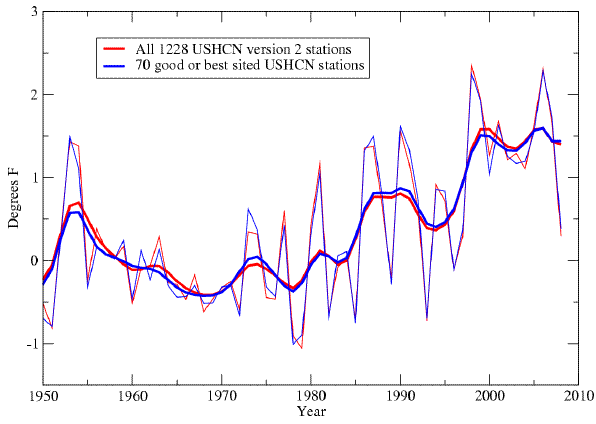
Figure 1. From Talking Points Memo.
Beyond the above sentence, there was no further information on the provenance of the two data sets. NOAA did not archive either data set nor provide source code for reconciliation.
The red graphic for the “full data set” had, using the preferred terminology of climate science, a “remarkable similarity” to the NOAA 48 data set that I’d previously compared to the corresponding GISS data set here (which showed a strong trend of NOAA relative to GISS). Here’s a replot of that data – there are some key telltales evidencing that this has a common provenance to the red series in the Talking Points graphic.

Figure 2. Plot of US data from www1.ncdc.noaa.gov/pub/data/cirs/drd964x.tmpst.txt
An obvious question is whether the Talking Points starting point of 1950 is relevant. Here’s the corresponding graphic with the 1895 starting point used in USHCN v2. Has the truncation of the graphic start at 1950 “enhanced” the visual impression of an increasing trend? I think so.
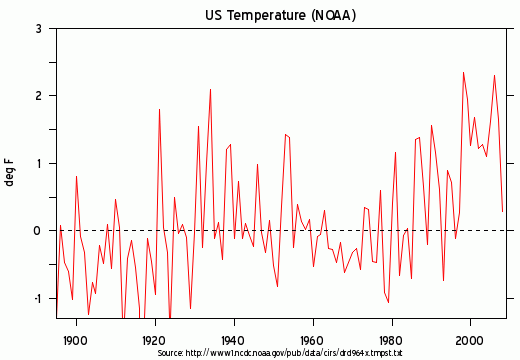
Figure 3. As Figure 2, but to USHCN v2 start
The Talking Points’ main point is its purported demonstration that UHI-type impacts don’t “matter”. To show one flaw in their arm-waving, here is a comparison of the NOAA U.S. temperature data set and the NASA GISS US temperature data set over the same period – a comparison that I’ve made on several occasions, including most recently here. NASA GISS adjusts US temperatures for UHI using nightlights information, coercing the low-frequency data to the higher-quality stations. The trend difference between NOAA and NASA GISS is approximately 0.7 deg F/century in the 1950-2008 period in question: obviously not a small proportion of the total reported increase.

Figure 4. Difference between NOAA and NASA in the 1950-2008 period. In def F following NOAA (rather than deg C)
As has been discussed at considerable length, the NASA GISS adjusted version runs fairly close to “good” CRN1-2 stations – a point which Team superfans have used in a bait-and-switch to supposedly vindicate entirely different NASA GISS adjustments in the ROW, (adjustments which appear to me to be no more than random permutations of the data, a point discussed at considerable length on other occasions.)
For present purposes, we need only focus on the observation that there is a substantial trend difference between NOAA and GISS trends.
Given that, when NOAA’s Talking Points claim that there is a supposedly negligible difference between the average of their “good” stations and the NOAA average (which we know to run hot relative to GISS), then arguably this raises issues about the new USHCN procedures.
Y’see, while NOAA doesn’t actually bother saying how it did the calculations, here’s my guess as to what they did. The new USHCN data sets (as I’ll discuss in a future post) ONLY show adjusted data. No more inconvenient data trails with unadjusted and TOBS versions.
When I looked at SHAP and FILNET adjustments a couple of years ago, one of my principal objections to these methods was that they adjusted “good” stations. After FILNET adjustment, stations looked a lot more similar than they did before. I’ll bet that the new USHCN adjustments have a similar effect and that the Talking Points memo compares adjusted versions of “good” stations to the overall average.
So what they are probably saying is this: after the new USHCN “adjustments” (about which little is known as the ink is barely dry on the journal article describing the new method and code for which is unavailable), there isn’t much difference between the average of good stations and the average of all stations.
If the NASA GISS adjustment procedure in the US is justified (and most Team advocates have supported the NASA GISS adjustment in the US), then the Talking Points memo merely demonstrates that there is something wrong with the new USHCN adjustments.
I think it is extremely disingenuous of NOAA to claim that the rating system on their stations is irrelevant. If it doesn’t matter, why rate them in the first place? Also, if you know the algorithm used to ‘fill in the blanks’ you should apply it to the CRN 1/2 stations and fill in the blanks just to see what you come up with. I would be interested to know.
I’ve just done something incredibly stupid – I went over to realclimate to see what they had to say about the latest issues. They were on about the suppressed EPA paper. For those honest and sincere people scouting these blogs trying to decide which side is right (as I was ten months ago), here is a classic example of a phenomenon I quickly noticed repeating over and over: the warming alarmists cannot put together an honest and clear argument. Here’s what I found them saying: “Finally, they end up with the oddest claim in the submission: That because human welfare has increased over the twentieth century at a time when CO2 was increasing, this somehow implies that no amount of CO2 increases can ever cause a danger to human society. This is just boneheadly stupid.”
Well I can’t find that in the report! (Help me out folks if I have missed it.) Here is what I actually found: “In fact, there is no better way to obtain a good picture of how human health and welfare may trend in the future under increases in greenhouse gas emission than to assess how we have fared in the past during a period of increasing greenhouse gas emissions.”
See the problem(s) here? Misrepresenting the strength of the claim (an assertion of likelihood misrepresented as a conclusion of impossibility); misrepresenting the scope of the claim (how welfare may trend under future increases misrepresented as a statement about no effect under unlimited CO2 increases). Yes, you’ll see this all the time in the scaremongerist literature. It is a sure sign of, at minimum, variance with the truth; at maximum, much worse.
If they didn’t use the Raw data for the chart, we should thank NOAA for comparing 70 stations with an average 4.2 CRN rating with the full 1221 station network with an average 4.2 CRN rating (and then trying to pass that off as a valid comparison).
Since the global temperature series of the NCDC uses a very similar homogeneity adjustment as the USHCN (in other words, just averaging the poor stations records into the good station records and thus, just simply accepting the poor station records as part of the average temperature record) …
http://www.ncdc.noaa.gov/oa/climate/ghcn-monthly/images/ghcn_temp_overview.pdf
… Let’s just do some simple math for the NCDC global temperature record – assume the global stations have the same rating as the US (or more than 50% with a 4 CRN rating) – assume these poor stations are contaminated by 1.0C worth of poor siting, urban heat island etc. over the past 120 years.
That would mean temperatures have actually only increased by about 0.1C in the last 120 years since there is 0.5C worth of artificial contamination in the 0.6C rise in temperatures. [Not including any artificial increase in the records from over-enthusiastic Time of Observation Bias adjustments].
OT
This finally hit Drudge.
Sen. Inhofe Calls for Inquiry Into ‘Suppressed’ Climate Change Report
http://www.foxnews.com/politics/2009/06/29/gop-senator-calls-inquiry-supressed-climate-change-report/
OT sort of. By visiting this fine site and CA almost daily I really appreciate the badness of the ideological and political agenda being driven by the US Government climate science departments – presumably being driven by indirect instruction from highest levels of Government.
The clever thing to do now is for an entity to find a way to transcribe the good skeptical science being done here and at CA into a format that the MSM will readily pick up on. Hearing this morning a National Radio NZ news person chatting to their Washington correspondent about the recent success of the Waxman/Markey Bill reminded me what an enormous task this will be. I was particularly struck by these news people giving such positive endorsement to Obama and his efforts to finally to stem industrial pollution of the US atmosphere. Like he was some kind of super hero.
FatBigot (16:58:51) : Excellent synopsis.
I would add that the relevant question for a scientist is not: “How accurately would the estimate agree with the true value of the parameter in the long run over all possible data sets?” but rather: “How accurately does the one data set that I actually have determine the true value of the parameter?”
@ur momisugly James Allison (17:58:50) : It’s a hopeless task. I sent a link to this website to Chris Laidlaw and Kim Hill (Radio NZ famous media critters) many moons ago, to no avail. They are wedded to the “CO2 is bad for you” meme and won’t entertain any other options.
Lucy Skywalker (16:46:20)
In a discussion of TOB on a previous thread, Nick Stokes provided a link to a 1985 Karl et al paper. I am still working through it, but I have already found some areas I want to look into further. I noticed that some of the work is model based and the paper’s conclusions mention climate change. Now I am very suspicious due to your mention of Thomas Karl’s involvement in other warming advocacy.
I am beginning to suspect that Mr. Karl’s pet rat Toby crawled inside an instrument screen and died. Nobody noticed the smell at the time, but 20 years later I think the skeleton may still be there.
Nick indicated the paper has been unchallenged for more than 20 years. It may be time to check on Toby’s whereabouts, and provide a proper burial if required.
There is a reason Rush has started calling the mainstream media, “state-run media.” We are at an odd juncture of history where the agenda of the power-brokers is aligned with the world-view of the press. The media won’t tattle on itself. They want the same thing the current crop of elites and bureaucrats wants: a reduction in individual liberty and a flattening of the distribution curve (except for the elites’ carve-out at the top). Warming is just a tool in the hands of very clever and dangerous people. The scientists go along because it’s a winner for them, too.
……So NCDC have produced a graph that shows that thermometers sited next to air conditioning outlets, car parks and on rooftops don’t matter because adjusting them makes it all better?
Well then, it would seem that this AGW is a very well “adjusted” Hypothesis.
It’s amazing really…. What one group calls “adjusting” another would call “fraud”.
No name for the people being rebutted, no data or code for the rebuttal. Sounds like advocacy to me.
I’m glad you carried this here Anthony, I read it at CA earlier but the behavior of our scientists needs to be noticed as much as possible.
Gavin’s up to his ears in it over at RC.
http://www.realclimate.org/index.php/archives/2009/06/bubkes/#more-691
He’s saying everything he can to discredit Carlin’s critique. He’s mentioned everything except the main critiques that everything is based on models which can’t predict next year and the measured temperatures don’t match the models.
I’m not defending Carlin, but gavin is down right funny in his shrill defense. These guys need a PR group.
TOBS is all very well. I have questions about the degree of adjustment, but at least I agree with the +/- sign.
I wonder about UHI. Raw data for stations designated as urban trend around 0.5C warmer over the century and around 9% of stations are rated as urban. So the -0.05C adjustment may be on target. Or not. Because that presupposes that the sites designated as urban are actually urban and non-urban actually non-urban. And night-lights are a bogus method of determination. If the designations are wrong or the methodology flawed it all becomes very moot.
But SHAP being a positive adjustment is an outrage for the magpies. The bogus reason they give is that a number of stations (about 72 out of 1221) were relocated to airports between 1950 and 1980. The airports were cooler (and so they were), and an upward adjustment was made. Okay, so far . . .
But thing is that airports grew like crazy and their trends (sic!) are a LOT higher than average over the last three decades. Deregulation, urban creep and HO-83 sensor issues have all played a part. But no adjustment was made for THAT.
All but three CRN1 stations are located in airports, and the upwards of a third of our CRN2s as well. Airports have a much better CRN rating on average than non-APs. So you can bet this affects the bum end of the NOAA graph.
The MMTS adjustment is minor, but a crock. Yes, yes, an MMTS runs a wee tad cooler than an CRS. But that (falsely) presupposes that the MMTS is going to be sited in the same exact location as the CRS it replaces. Well, it ain’t, see? Not in most cases. Usually what happens is that, thanks to cable trenching limitations, it winds within 10 meters of the housing. Six out of ten of the current sites are CRN4, and the great majority of them are MMTS.
FILNET (without the trimmings) is big bug in my, um, ear. That is a simple infill of missing data. That’s a neutral adjustment. So how did it get to be one of the biggest honking upward adjustments going (duking it out with TOBS for the #1 spot)? The observers all went fishing on the cool days? Well, there’s something fishy going on here, that’s for sure.
And as for homogenization, well, that’s what the cook does when (s)he wants to conceal the pedigrees of the ingridimints. By the time he’s through, all the chunks are the same color and you can’t tell ’em apart. A procedure recommended when cooking bad stew–or bad data.
It’s an illusion, it’s a game,
Or reflection of someone else’s name.
When you wake in the morning,
Wake and find you’re covered in cellophane.
Well, there’s a hole in there somewhere.
Yeah, there’s a hole in there somewhere.
Baby, there’s a hole in there somewhere.
Now there’s a hole in there somewhere.
He’s mentioned everything except the main critiques that everything is based on models which can’t predict next year and the measured temperatures don’t match the models.
How’s he doing with the PDO/AMO correlation?
OT, but I am reflecting on everyone’s effort in urging the Representatives not to vote for the climate bill. I haven’t called any of them; and as a Canadian living in the States, I don’t even know who is representing my district, even though I do pay Federal and State tax. While I appreciate everyone’s effort, I would like to go deeper and ask, why do we even need to call? My position is, if they can’t vote according to the Constitution (that 200+ year old document that the Representatives have vowed to follow and defend), and if they are open to be swayed by lobbyists and/or ordinary citizens, they should not be representing us.
Imagine a lowly man living in a tyrannical regime (e.g. China during the Cultural Revolution) begs the state thugs on his knees not to confiscate his properties, harass his wife, and enslave his children. Well, our situation is really not that different, if our Representatives simply ignore our enormous outcry and vote according to the marching order, while at the same time take our tax dollar. We have given those parasites too much of our money, and too much power. It doesn’t matter all the facts and truths point against AGW; they’ll do what they can to further impoverish the mass, all with a snare, “yeah, what are you going to to about it?”
That’s where we’re heading.
evanmjones (20:04:36) :
I’m not sure Toby the rat (TOBs) is at all well, but I’m going to a quick check with my cad software tonight.
As to the rest of the USHCN adjustments, I can see so many problems. Infilling aside, UHI, site and instrument change adjustment plots do not show evidence of known station histories. The shapes of the plots are very strange. Where is the rural station dropout dip, the short cable dip and the latex paint dip?
evanmjones (20:04:36) :
Evan, I’m finishing up a study of the temperature trends in South Central Texas (using raw data).
Conclusions:
San Antonio has a UHI over 3°F / Century (in line with several Melborne studies)
Surrounding rural sites have a linear temperature trend of ≈ – 1°F / Century,
i.e., a long term (100+ years) cooling trend. (not this month tho)
“Tmin – Tmax” trends have me scratching my head.
Please stop debating climate change! It’s happening! In the 1st week of June it was 40 degrees in Wisconsin! I burned logs in the cast iron stove to keep warm! It is now 50 degrees with July around the corner! Climate change is real! I am glad that congress has taken bold action by submitting a bill they didn’t read, with a 300 page addition by staff and lobbyists right before voting. We don’t have time to think, it’s time to take action! Climate change is happening! We need to give the government total control of the climate. I want Summer to return to Wisconsin!
Don’t the models say the SW U.S. will be the canary in the coal mine?
Well they were right on. We’re cooking down here – 103°F again today.
Forecast is for 50% chance of thunder storms tomorrow.
I’ll believe that when I see it.
My lawn is brown and it hasn’t rained since ’07.
D. King (17:45:24) :
That’s the kind of thing that can make Al Gore disappear, and major backpeddaling begin.
Sen. Inhofe.
Well I’ll be.
“Tmin – Tmax” trends have me scratching my head.
Mine, too, though I am not at liberty to go into details at this time.
Don’t the models say the SW U.S. will be the canary in the coal mine?
Well, Texas runs at a loss over the century. And the 30-year trend just about breaks even with the national average.
If you don’t like the adjustment, we’ll just adjust the adjustment until you just stop bothering us about the adjustments.
Tom in Texas (20:41:04)
Look to your north, Tom.
What is needed is a video of what has been happening to the Jet Stream the past 3 years.
The SW is known for MegaDroughts, and the last one was in the 1450’s-1500’s.
It was so bad that whole civilizations got up and left. Others were destroyed by the barbarians, whom they had subjugated when thier sustenance was compromised by the climate change.
It was in one of those darned ‘minimums’, wouldn’t you know.
Where is the rural station dropout dip, the short cable dip and the latex paint dip?
What you will see is a lot of step changes which often mysteriously coincide with recorded station moves.
But since MMS station move records are so blasted incomplete and downright erroneous, it’s hard to tell.
I don’t think too terribly many of the USHCN rural stations have dropped out. Only c. 110+ are classified as urban. But so many of the rural sites have egregious violations. Believe it or not, urban sites (thus alleged) actually have a better CRN rating, on average than rural!
If the badly sited stations make no difference, one wonders what the comparison would look like if they only used, say, 35 or 10 of those stations classified as good …or 1 for the comparison?
…to paraphrase Lewis Carroll, it appears that “the data mean exactly what they want them to mean.”