Minus 13 degrees – the coldest it’s been in April
From Weatherzone – Brett Dutschke,
Wednesday April 29, 2009 – 14:58 EST
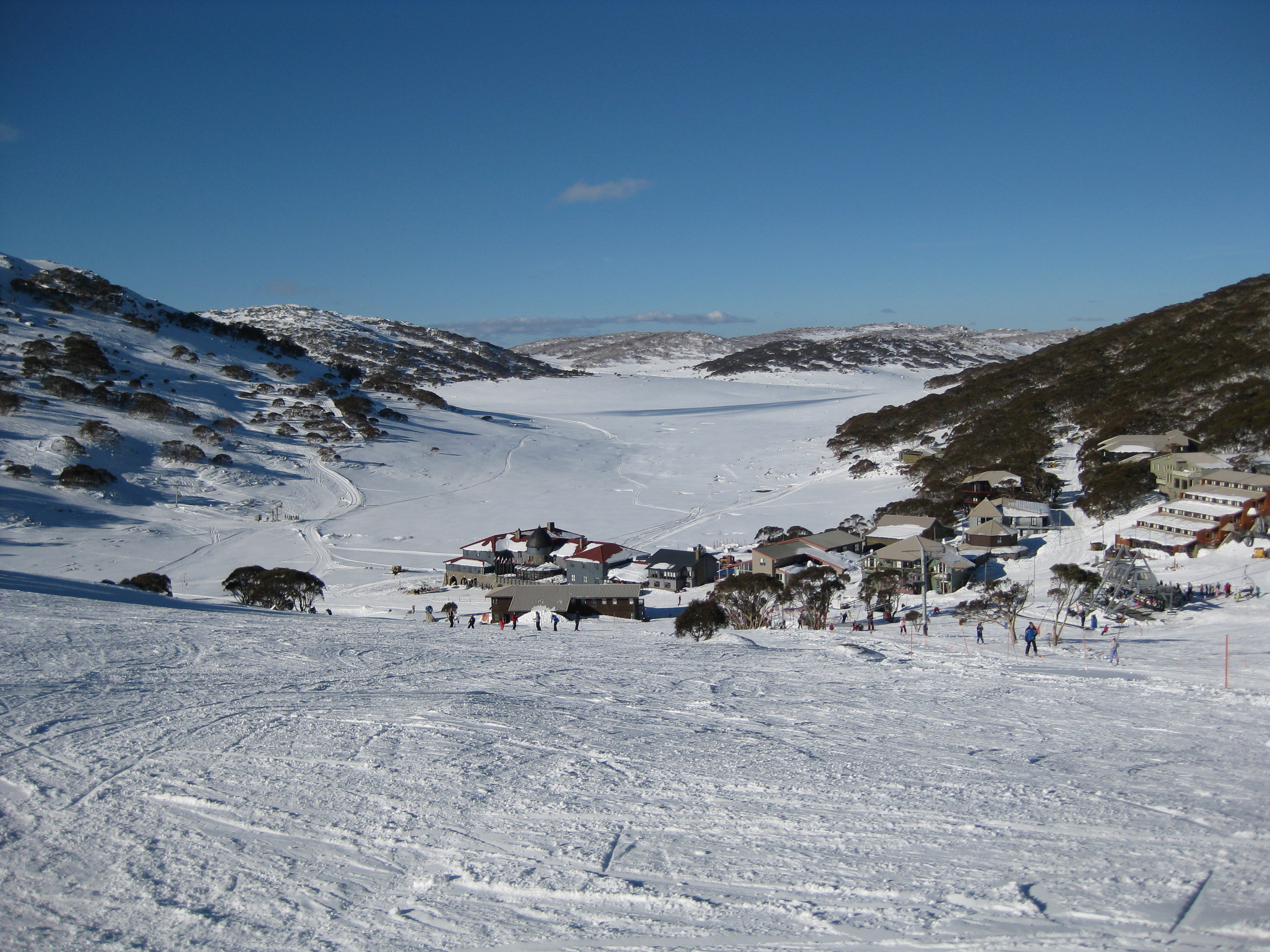
A new Australian record was set early this morning, a temperature of minus 13 degrees, at Charlotte Pass on the Snowy Mountains.
This is the lowest temperature recorded anywhere in Australia in April and is 13 below the average. Nearby at Perisher it dipped to minus 11 degrees and at the top of Thredbo it dipped to minus 10.
Across the border, on the Victorian Alps April records were broken at Mt Hotham where it chilled to minus eight degrees and Mt Buller and Falls Creek where it got as low as minus seven.
 A few other locations set April low temperature records also. In Tasmania Lake Leake was as cold as minus six, Sheffield and Dover both reached minus one and Flinders island got to zero. Hobart had its coldest April night in 46 years, recording a low of 1.7 degrees, seven below average.
While much of inland NSW and Victoria will be colder tomorrow morning than it was this morning under clearer skies, the Alps should be a little warmer due to a rise in humidity.
Note, all temperatures in the story above are in Centigrade. Photo and map added by Anthony.
Here are the all-time highs and lows for the continent of Australia (source Perth Weather Center)
HIGHEST RECORDED TEMPERATURE:
- Oodnadatta, South Australia 50.7 C (123.3 F) on the 2nd January, 1960
LOWEST RECORDED TEMPERATURE:
- Charlotte Pass, New South Wales -23.0 C (-9.4 F) on the 29th June, 1994
While this is certainly a significant new cold record this early in Australia’s fall going on winter, one must always remember that weather is not climate. – Anthony
(h/t to WUWT reader “Chuck”)
George E. Smith (17:41:37) :
Klima greek for Region, district, climate.
Klimax greek for Ladder, staircase
This looks like what we had in Argentina back in 2007. It started with a snowfall in Bariloche on middsumer on February 14th. Then the earliest snowfall ever recorded in Córdoba mountains in the center of the country (1300 meters a.s.l., at 32ºS), and then a sustained freezing weather (mostly below zero temps) until the last days of the winter.
It was when it snowed in Buenos Aires for the first time since 1918. And then we saw severe late frosts on Novemeber 4th, 2007 that killed 50%-100% of crops in Buenos Aires province, and then again 0º C on December 4th, barely two weeks away from summer.
Regarding cycle 23 spot 1016…
In what year was an instrument capable of seeing that spot developed?>
In Houston, we’ve had a 51 degree temperature difference between our warmest temperature of the month of April (88F), and the coldest (37F). Neither were records – on April 7th, the record high is 91F in 1909 and the record low was 32F in 1971. That was a 59F difference for just one day. We did break the all-time rainfall record by about 50%. All in all though my air conditioning bill will be quite low for an April…
I know we are talking about climate as it relates to weather. But climate describes more than the weather. Think about the differences in climate here at WUWT compared to CT for instance. It’s like the difference between night and day. The business climate seems to be following the mistaken idea of climate chaos, and I’m sure that the business climate has been adversely affected by the mishandling of the response to global warming. Every organization or group we belong to has it’s own climate, and that climate is directly related to the leadership and membership of that group.
“In a happy marriage it is the wife who provides the climate, the husband the landscape.”-Gerald Brenan
Mark Twain said that climate is what we expect and weather what we get, but he also said, “Go to Heaven for the climate, Hell for the company.” , So Twain was a really proactive kind of guy…
Most people appreciate a predictable climate, in fact we create our
our own climate within our houses. Do you like it 70F, 72F or 74F? No problem… we can even set the humidity. I know people that have left Hawaii, a real paradise, because they longed for the seasons and the changes.
John Steinbeck said, “I’ve lived in good climate, and it bores the hell out of me. I like weather rather than climate.”
So what’s the real difference then? I think that climate can best be described after it’s passed, like anything you see on a journey. Wiki says that it’s about thirty years, I think it’s more like a generation or so. My grandfather and my father enjoyed a climate very different than mine… not better, just different. Neither of them changed the climate around them in any way except by moving, and that is the only way that we or our contemporaries can change climate also.
So how else can we change climate? By changing the ways we interact with each and every person around us.
Thanks to all here for the great climate!
Mike Bryant
“Thanks to all here for the great climate!”
–Mike Bryant
Just fluffy snowflakes riding on waves of warm sunshine sparkles.
Following the record low of -13C yesterday at Charlotte Pass, this morning was an almost balmy -12C.
Since the 25th the temperature has not risen above 1C (night or day) which is about 9 degrees below the April average (9C = 16F absolute)
Prior to this year the lowest April temperature was -11.5C, so the past two mornings have both broken the previous April record for CP and Australia.
This is weather not climate but is very interesting and worthy of note.
Mighty good post, Mike Bryant.
Les Francis (19:04:42) :
…
(g) A recent paper established that Australia’s weather patterns were related to the Indian Ocean Dipole effect.
…
All great points, however (g) is apparently not applicable to the north east of the country, i.e Northern Territory, Queensland and northern New South Wales.
These areas have had floods, etc.. while the SE has been especially dry.
REF: is http://www.science.unsw.edu.au/news/indian-ocean-drought/
I would suspect that NE Australia has been impacted by the PDO flip from warm to cool, as current NE weather is similar to the 1970s.
Cheers G
No problem – this will be retroactively predicted next week and, of course, found to be completely consistent with the AGW “models”.
Mike Bryant (19:42:27) :
…
So how else can we change climate? By changing the ways we interact with each and every person around us.
Thanks to all here for the great climate!
Mike Bryant
Mike – Thanks, as good an answer as I have seen.
http://www.wgntv.com/news_at_nine
As reported there ” every day the corn does not go into the ground a 2% loss in yield results” It’s not weather it’s climate.
It seems to be at the North Pole, too after having risen gradually from -25 or so up to about -15, it seems to have plummeted back below -20 for the past several days.
The Australian Bureau of Meteorology [ BOM ] is forecasting a slightly above normal warm [ southern ] winter temperatures for most of Australia.
http://www.bom.gov.au/climate/ahead/temps_ahead.shtml
Mean while the experimental climate research division of the BOM and the CSIRO, POAMA, are predicting well below normal winter temperatures for all of Australia right through to the mid winter period and into the early spring in another panel.
POAMA Maximum temperature forecast anomalies;
http://poama.bom.gov.au/experimental/poama15/sp_tsfmax.html
POAMA Minimum temperature forecast anomalies
http://poama.bom.gov.au/experimental/poama15/sp_tsfmin.html
Recently the Southern Annular Mode [ SAM ] an ocean oscillation that drives a lot of the weather and climate in the Great Southern Ocean changed phase and has apparently reverted back to a phase situation of a couple of decades ago.
Not a lot is as yet known about the SAM as being so far from the main centres of climate and weather research in the northern hemisphere where all of the research money has been concentrated, nobody has regarded the Great Southern Ocean as particularly important in the world of climate research.
Yet a quick look at any global map will show that the Southern Ocean is the only large Ocean that connects all of the world’s major ocean basins.
It is the only ocean that all the main global ocean currents traverse as they move in their great meanderings around the globe.
The Southern Ocean has only one land mass disruption to the ring of Circumpolar ocean and atmospheric currents that surround the Antarctica continent and that is the narrow Antarctic Peninsula and the southern tip of South America.
The Drake Passage between the tips of the Peninsula and the tip of South America is the only channel through which the Antarctic Circumpolar currents can flow.
After being diverted north by the Antarctic Peninsula, a part of the Southern Ocean Circumpolar currents flow up the west coast of South America and then turn westwards in the equatorial Humbolt current which has a close linkage to the phases of the ENSO.
There is some little evidence that changes in the Antarctic Circumpolar currents may lead to long term changes in the ENSO phases and ultimately to the PDO through this linkage.
The Southern Ocean completely surrounds the Antarctic continent, the fifth largest continent out of the Earth’s seven continents.
The Antarctic continent is about half again as large as the USA [ and Australia ] in area.
To put the Southern Ocean in context with the northern hemishere, the Southern Ocean other than the Antarctic Peninsula and the tip of South America has no land mass intruding south of about 47 degrees, the southern tip of New Zealand’s South Island.
The equivalent sized ocean in the northern hemisphere would extend down to some 300 kilometres south of the Canadian border, across the very south of France, just north of the Black Sea and across central Asia to a line across central Mongolia.
Changes in the Southern Ocean’s circulation patterns and oscillations such as the SAM are likely to have unresearched and long term impacts on the climate right across the rest of the world through teleconnections that are only just now being researched in their most basic forms.
Just to add, the Southern Ocean is the most important source of krill which is at the food chain base of a great deal of the global ocean’s life.
All this is almost totally ignored in all debates on the future of the Earth’s climate except when it suits some extremist warming propaganda purposes.
Flanagan (05:25:37) : I clearly remember the hot records that were broken in Australia at several locations were not reported here at all, although they were all-time absolute maximum temperatures. Now, a record cold for April is the headline. Weather is not climate, we all agree on this. But where does this tendency to “forget” hot records come from?
Not only that, but this guy:
http://globalfreeze.wordpress.com/2009/04/09/austin-hits-all-time-record-low-for-month-of-april/
Seems to think that there was an all time low in Austin, yet I don’t remember a peep about it here. Clearly our host is failing to be omniscient and omnipresent. He has clearly failed to be all things to all people. OH the SHAME! /sarcoff>
(Still in ‘watchful waiting’ mode over my tomatoes and the present very unusual very late season cold in N. California… Why oh why hasn’t our host given me a personally customized weather report and planting calendar! … ok, so I didn’t quite manage to get /sarcoff> done in time 😉
Sidebar: Yes, I know, trolls come with snark and are not curable. I don’t expect them to go away. All I ask is that they make it at least a little bit interesting and give use something to work with in the way of debate. Having a foil to practice against, even if a broken one, has some merit. Unfortunately, all too often it’s just empty pedantic sophistry, and that’s no fun for anyone… If I wanted to read RC talking points or have a clue what Soros thinks, well, I know where to find it… So please, AGW trolls, “cowboy up” a little bit, be yourself and not a stereotype cardboard you, and actually participate rather than just tossing BS grenades and running away…
While this is certainly a significant new cold record this early in Australia’s fall going on winter, one must always remember that weather is not climate. – Anthony
Yes BUT!
The climate metric used by the AGW crowd (average of last 30 years weather) is clearly broken, so it isn’t really “climate” either! We know that there are 17x year solar cycles that track with some weather patterns. We know that there are 1500 year Bond Events. We know that the idea that the 30 year average of weather has some meaning as “climate” is broken.
So, can’t we find some half way house on this? How about using 400 years of baseline and calling 30 year weather what it is: weather.
Prediction: Long cold winters and dropping agriculture production, forcing up food prices and starving the worlds poor will – unfortunately – be a poster child for breaking the AGW Meme.
US food production looks like it’s going to take a hit from the cold.
When people who are already taking it tough from the GFC, find that food has gone up in price, expect them to start asking questions, and demanding answers.
Ray (13:18:05) “. . . climate is the average of weather.”
NO! NO! NO! Consider a place that has a hot summer and a cold winter. Its average temperature is useless for describing the kind of place it is. Another place might have the same average with a very small variation.
Would the two places have the same climate? NO!
Time sequenced patterns of the variables of temperature, precipitation, humidity, and so on can be used to classify climate types. One place might have a wet winter season and a dry summer. Another can have a dry winter and a wet summer. There are many patterns of seasonal differences. Try this for a start:
http://en.wikipedia.org/wiki/K%C3%B6ppen_climate_classification
simon from South Australia (16:26:22) : firewood
I just came in a few hours ago from loading a pickup with what I call trash wood – cottonwood, aspen, mostly, and a few others – willow and hawthorn. A friend needs a supply as May arrives.
Here in central Washington State wood is sold by the cord (4x4x8 feet) rather than by weight.
I thought places in Australia did not allow you to cut trees! What’s up with you?
George E. Smith (17:41:37) : The standard averaging period is 30 years,
As established by international agreement. 30 year averaging period ends in a year with “0”, as in 1990, 2000, 2010.
Les Francis (19:04:42) : A great proportion of the continent is above the Tropic of Capricorn.
Not to let a good snark opportunity pass without a snark-attack:
Does that goodly portion of the continent float up there or is it supported from above or below?
Climate change = wild fluctuations in temperatures, rainfall, hours of sunshine and yes snowfall. GW is, as most of you will know, the incorrect term to use and is misleading. Of course if you want to mislead in your discussions you’ll continue to use the term global warming.
Weather is a function of climate.
Good question. Since the continent of Australia is floating upwards towards the Tropic of Capricorn at the rate of 7cm a year
I posted on another thread, lowest April morning temperature since 1957 in Melbourne, Victoria, Australia, 2.7c. That’s Melbourne CBD, other suburbs recorded *ZERO*.
NH had record lows during it’s winter. Looks like here in Australia, this winter will be cold too. All under a “quiet” Sun.