Guest post by Steve Goddard
Yesterday, Dr. Walt Meier from NSIDC again graciously updated us about the NSIDC sensor problem, and also about his current thinking with respect to polar ice trends. The key concepts being that Arctic ice continues to decline, and that Arctic and Antarctic ice are separate entities – so the current near normal global sea ice area “has no meaning in terms of climate change.” This article examines both of those concepts.
NSIDC is still having sensor problems on their satellite, as seen below on 2/28/09. Note the speckled white areas, and the large dark gray sliver in the Sea of Okhotsk near the top.
http://nsidc.org/data/seaice_index/images/daily_images/N_daily_extent_hires.png
Fortunately there is another ice extent data source, AMSR-E which has not suffered sensor problems and their data is unaffected. NSIDC also explains on their web site that “AMSR-E has a lower absolute error” than the NSIDC sensors, even when functioning properly. AMSR-E (below) has been recording sea ice since 2002. The maximum ice extent for 2009 (red) and 2008 (orange) are both in the top three on the AMSR-E record, at more than 14M km2. The only year which had greater ice extent than the last two years was 2003. So clearly we are on a recent trend of higher Arctic ice maximums, which is a fact that is rarely if ever reported by the main stream media. Also note in the NSIDC map above, all of the ice basins are close to the 1979-2000 normal.
If there is a dramatic downwards trend in maximum Arctic extent, it certainly isn’t visible in either the map or the graph.
 http://www.ijis.iarc.uaf.edu/seaice/extent/AMSRE_Sea_Ice_Extent.png
The NSIDC graph below also shows Arctic ice extent nearly back to the 1979-2000 mean.

http://nsidc.org/data/seaice_index/images/daily_images/N_timeseries.png
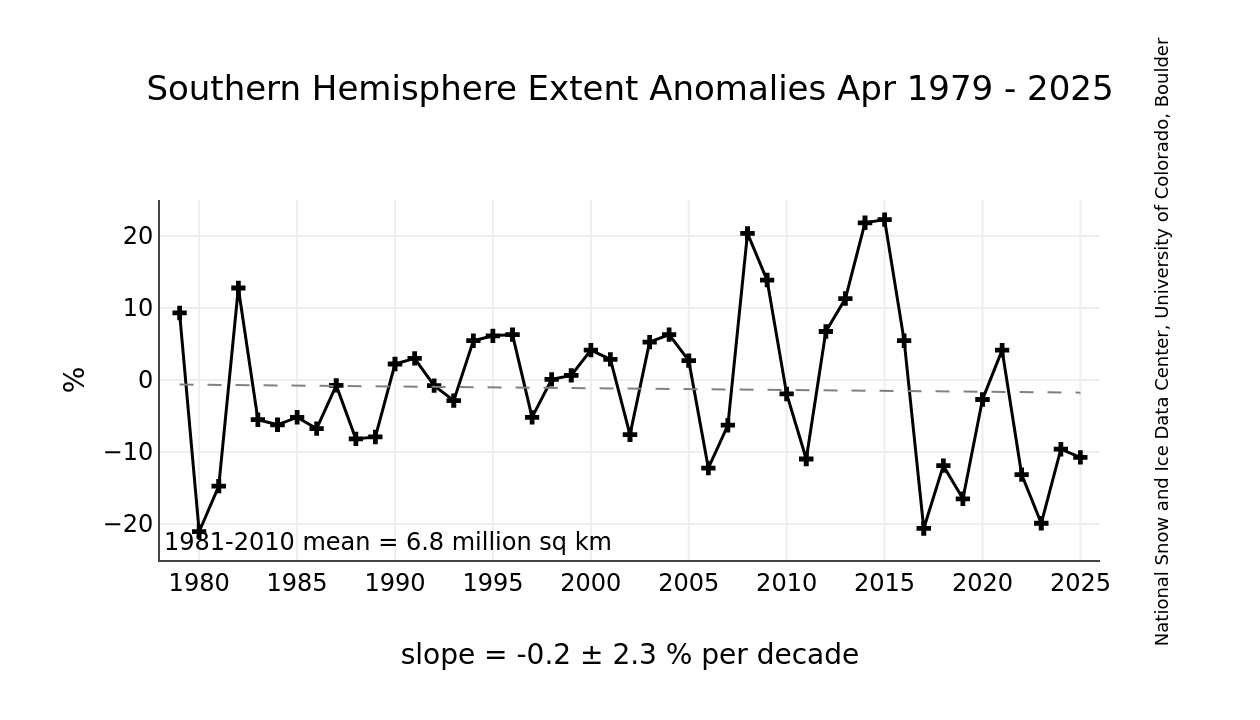
Turning our attention to Antarctica. Dr, Hansen predicted in 1980 that ice loss in Antarctica would be symmetrical to the Arctic. But the current thinking, as expressed by Dr. Meier, indicates that view is no longer valid. In fact, NSIDC data shows that Antarctic ice extent has actually increased substantially, as seen below.

http://www.epa.gov/climatechange/effects/downloads/Challenge_chapter2.pdf
It was reported last week that the IPY (International Polar Year) released a study claiming that both polar ice caps are melting “faster than expected.” Given that NSIDC shows Antarctica gaining ice at a rapid pace, I find myself surprised that IPY would release a study saying exactly the opposite. But then again, an IPY official reportedly forecast that last summer (2008) might have an “ice free Arctic.”
Columnist George Will reported that overall global sea ice area is normal, and was correct. Dr. Meier confirmed that on January 1 global sea ice levels were normal.
Walt Meier (16:04:59)
1. He (George Will) was factually incorrect on the date that he reported his “daily
global ice” number. However, he was merely out-of-date with his facts
(it was true on Jan 1, but wasn’t 6 weeks later).
The UIUC graph shows global ice levels well within one standard deviation of the 1979-2000 mean. Dr. Hansen was correct that according to global warming theory, both poles should be losing ice – though we know now it theoretically should be happening more slowly in the Antarctic. Yet 20 years later we actually see the Antarctic gaining ice, which is contrary to Dr. Hansen’s theory, contrary to IPY claims, and probably contrary to Steig’s questionable temperature analysis .
The main trend I see in polar ice is an increasing disconnect between hype and reality. Given that the AO (Arctic Oscillation) has been neutral this winter and polar drift has been less than last year, I forecast that the summer Arctic ice minimum in 2009 will show more ice than either of the last two years. What do you think?
Discover more from Watts Up With That?
Subscribe to get the latest posts sent to your email.
To: Antonio San (18:18:42) :
DJ writes:
“Maximum sea ice extent is constrained by geography”
Please clarify because it makes very little sense as is.
—
The Arctic Sea is bounded by land (Alaska, Canada, Greenland and Siberia primarily) so that only a few channels are entrances and exits. (This has made submarine work in the Arctic more difficult as well: you only have to look at a couple of places to find out if a sub has gone by.) So, when the Arctic freezes over each winter, it pretty much freezes over the entire available surface area. Then the water just freezes “deeper” (thicker) since the ice coverage can’t go “wider”.
Variants then from year to year changes more in the summer – when wider (or narrower) areas can melt.
Does anyone know if the suspect satellite data are used to compute the “Reynolds” analysis product used by GIStemp (that some folks like to call “satellite data”.) ?
In chasing down an issue that popped up under the Japanese Scientists thread, I ran into the fact that the Reynolds data are partly produced from simulations based on ice extent…
I’m going to reproduce that posting here, since it seems germaine to this thread, especially in the context of “which ice data” it uses:
As an addendum to earlier response, here a bit more detail on the “satellite” component of the GISS stew. First, notice that this all talks about SST for Sea Surface Temperature. It’s not about satellite data coverage for land. From:
http://www.emc.ncep.noaa.gov/research/cmb/sst_analysis/
Analysis Description and Recent Reanalysis
The optimum interpolation (OI) sea surface temperature (SST) analysis is produced weekly on a one-degree grid. The analysis uses in situ and satellite SSTs plus SSTs simulated by sea ice cover.
So here are your first clues. It’s an “analysis” not a reporting of satellite data. It uses “in situ”, that is surface reports from ships, buoys, etc.; along with satellite Sea Surface Temperatures and, my favorite, SSTs simulated by sea ice cover. Given the recent “issues” with sea ice reporting it kinda makes you wonder…
So, ok, a stew of ships, buoys, whatever, a dash of satellite data, and some simulations (based on a broken ice cover satellite?) are used to create this analysis product (that some folks want to call “satellite data”…)
Before the analysis is computed, the satellite data is adjusted for biases using the method of Reynolds (1988) and Reynolds and Marsico (1993). A description of the OI analysis can be found in Reynolds and Smith (1994). The bias correction improves the large scale accuracy of the OI.
Oh, and the satellite data are adjusted based on an optimal interpolation method. We’re getting even further away from “data” and into the land of processed data food product…
In November 2001, the OI fields were recomputed for late 1981 onward. The new version will be referred to as OI.v2.
The most significant change for the OI.v2 is the improved simulation of SST obs from sea ice data following a technique developed at the UK Met Office. This change has reduced biases in the OI SST at higher latitudes. Also, the update and extension of COADS has provided us with improved ship data coverage through 1997, reducing the residual satellite biases in otherwise data sparse regions. For more details, see Reynolds, et al (2002).
And they have had a change of method lately with “improved simulation”. Frankly, I’m not real fond of having my data be a simulation… especially when based on the sea ice data that are, er, questionable. Even if they do say they think it may have reduced the “biases in” the optimal interpolation at higher latitudes (which I presume means in the arctic where the ice was, er is, er, ought to be…)
But these “data” are just fine for calling “satellite data”… at least as long as you don’t mind your data simulated, interpolated, averaged, homogenized, etc. etc. etc. Me? I like my data to be from instruments, natural, whole, and minimally processed. Certainly not synthetic, er, simulated…
To: DJ (18:01:20) :
>If there is a dramatic downwards trend in maximum Arctic extent, it certainly isn’t visible in either the map or the graph.
… What matters is the minimum extent which is going down and fast.
—-
Er, uhm, ahm. No. You are wrong.
Summer 2007 sea ice extent was low. If Hansen’s extremist religion (er, AGW predictions) were correct about sea ice and reflectivity of radiation, we should not have ever been able to recover – since “everybody knows” global warming is getting worse and “everybody knows” that 2000-2009 is the “hottest ten years ever.”
But 2008 rebounded right smartly. And now 2009 and 2008 are two of the three highest areas ever recorded for sea ice at this time of year: February and early March.
What will happen this summer?
I can’t tell. But I do predict that Hansen will be wrong. Again.
(Because he has never been right.)
Ken Feldman (18:26:38) : We find that realistic constraints to the trend in ice mass loss derived from GRACE data determine a range of variation substantially wider than commonly stated, ranging from an important ice loss of −209 Gt yr−1 to an accumulation of +88 Gt yr−1 in Antarctica, and Greenland ablation at a rate between −122 and −50 Gt yr−1. However, if we adopt the set of most probable Earth parameters, we infer a substantial mass loss in both regions, −171 ± 39 and −101 ± 22 Gt yr−1 for Antarctica and Greenland, respectively. “
Their instrument shows somewhere between -209 and + 88 Gt/yr of ice loss/accumulation in Antarctica. But when they adjust the data with their “best guess” (which they call “most probable”) they get −171 ± 39 Gt/yr of ice loss in Antarctica. This is three times the simple average of the data.
Sorry, but this level in uncertainty in the raw data does not make for a compelling argument.
” Rocket Man (17:58:05) : I think the phrase you are looking for is “more rigorous” instead of stricter.”
You’re right, that is more perfect. But I usually have the layman in mind when I am making comments. So I use a more common vocabulary.
“Make things as simple as possible, but no simpler.”
~Einstein (at least it’s attributed to him)
Just want truth… (17:29:00) :
===========================
Looking over the comments can you see how
blogger-review is stricter than peer-review?
===========================
“more thorough” might be convey the situation better. This reminds me of two sayings. One is from Open Source programming (Eric Raymond?)… “With many eyes, all bugs are shallow”. And there was an old Russian proverb that Ronald Reagan latched onto during nuclear arms reduction talks… “Trust; but verify”.
I can understand that for consistency sake, that NSIDC might wish to maintain the current baseline average from 1979, but I would think it would simple to add a couple lines of code to simultaneously also compute the standard 30 year meteorological average of available data (for consistency with other meteorological system data), and also to compute a long term average since satellite data began (for future use, as it grows to 50-100 year length).
If the long term average matches up well with both the 1979-2000 data, and the standard meteorological 30 year average, than we lose nothing and it would strengthen the value of the shorter terms and diminish the significance of long period cyclical variation. A 30 year running average might also be useful for comparison.
If on the other hand, the long running average at 40, 50 , 60 durations departs significantly from the standard 30 year average, then that would tell us we have a long period cycle to account for and the shorter averages would be of much less significance.
It was useful to standardize on a fixed interval of 30 years in days gone by when much of this sort of data was processed on relatively slow computers or even manually, but with today’s computer resources, processing a couple more equations in a spread sheet/data base is essentially zero effort once the code is added. It would help defuse some of the questions in the climate community, and watching those other averages and comparing their behavior to the current methods would provide some interesting validity tests to our current data and assumptions regarding arctic climate stability.
Larry
So what melts sea ice more? Air or water. Ice thickness can be reduced by currents while at the same time cooling the sea water. Sea ice thickness is not the marker some think it is. Sea ice does not form the way fresh water ice does.
When looking at sea ice area I Keep asking what is happening where the sea water is open to the air? We seem to forget that Sea ice insulates the water below it slowing down it’s winter cooling while open sea water radiates 10 – 100 times the energy that sea ice does in the winter. 85% sea ice still gives 15% of open water.
When we talk about sea ice lets think about the amount of sea ice that melts and refreezes every year and what effect it has on the cooling of the worlds oceans.
Regarding 30, 40, or 50, etc. year ice and Arctic current cycles, I think there are several cycles that periodically coincide in the Arctic. Sometimes they coincide perfectly and wipe the windshield together for several swipes. But that perfect coincidence happens only every other cycle, or every third, or forth, etc. If different cycles only occasionally work together to create the perfect ice storm (or the reverse, the perfect meltdown), there will be times when we might think we are heading for warming, or cooling, but it doesn’t quite happen. We are not in perfect sync. Some people call that weather. When the trend becomes steeper (in either direction) and we enter the perfect storm, we suddenly change our thinking and say that this is something different, it is climate change. I think this creates in us ideas (because we whites have not kept oral records that go back many, many generations, and scientists still poopoo oral records and ship logs anyway) that WE are causing global [fill in the blank].
But here is the bottom line. The Earth tilts away from the Sun up there (and down under), resulting in witch-teat cold conditions. Ice will form. It will continue to form every time the area tilts away from the Sun. The ocean temperature may work against those cold temperatures and limit ice creation, or make it grow even more. But the continents can move, and ocean temperature vary, yet we will still see ice cold poles. The CLIMATE of frozen poles will not change as long as the periodic tilt remains. But weather patterns will change. Oceans have very large affects on weather pattern variations. I think we are seeing a natural oceanic sourced weather pattern variation in the Arctic CLIMATE that has nothing whatsoever to do with AGW caused by human emitted CO2. Especially since CO2 just doesn’t like it up there or down under in the cold latitude circles we refer to as the poles. Besides, when the Sun is just glancing off the pole surface anyway, CO2 will not make a tinkers damn bit of difference in how much heat is reflected away or kept in the atmosphere.
So Mr. Meiers, please help us understand your stance (that I admittedly see reading between the lines) that CO2 is causing ice caps to melt.
Robert E Cook,
Maximum Arctic extent has increased substantially over the last three years. Given the geographical constraints near the pole, the implication sis that there has been colder winter weather at lower latitudes in recent years, and that sea surface temperatures have declined.
Just Want the Truth says:
Don’t kid yourself. For example, about a year ago, Roy Spencer wrote a piece on this blog with a very blatant error ( http://tamino.wordpress.com/2009/01/19/a-bag-of-hammers/ ) and, not only was it not caught here, but, as of a week or so ago, people have continued to bring up his piece as if it was actually correct…and I imagine will continue to do so.
I’m not saying that the blogosphere can’t be useful in some regards. Certainly, it has been good in finding some data errors like NASA GISS’s Y2K bug or the error in the October 2008 data or the problem with that one automated data site in Antarctica.
However, there are also some dramatic downsides, one being that very little ever gets decided because a lot of folks don’t have the necessary background to agree on basic points of science. (As an example, so many here don’t even seem to accept the basic forcing of CO2 or the anthropogenic nature of the CO2 rise…which puts them so far outside of the scientific mainstream.) And another being that the “skepticism” displayed tends to run primarily in one direction (as the issue with Roy Spencer’s post illustrates).
Joel Shore,
Dr. Hansen says that we “only have four years to save the planet.” Is that within the “scientific mainstream?”
TonyB (15:50:28) :
E M Smith
http://pubs.aina.ucalgary.ca/arctic/Arctic38-2-121.pdf
Hope this helps
It does. There’s enough in the one graph in it for me to ‘eyeball fit’ to the pre-1870 Upsalla Sweden temps for a first test. I still need to find an 1870 to present record for further test fitting, but that can wait for a first fit…
Thanks!
If you are rowing in a ship towards a known destination using a known map, and one person is feverishly rowing in the opposite direction, the prudent captain ascertains the reason for the rower’s insistence on going another way. In a world of group-think habits, the single dissenting opinion often is closer to the truth than the consensus.
Joel Shore (19:34:54)
“And another being that the “skepticism” displayed tends to run primarily in one direction.”
Err….. Had you noticed Joel that nearly all of the ‘corrections’ and ‘adjustments’ to the temperature record by James Hansen and Phil Jones all “tend to run primarily in one direction”. And do you think, given his recent statements, that James Hansen is a dispassionate, objective, scientist?
Really??
And also you comment: “As an example, so many here don’t even seem to accept the basic forcing of CO2 or the anthropogenic nature of the CO2 rise…which puts them so far outside of the scientific mainstream. ”
Actually, I have never seen a serious skeptic doubt the “basic forcing of CO2” which so far as I can see is generally regarded to be between 0.6 deg C and 1 deg C for a doubling of CO2 in atmosphere. Where the issue of contention lies is in feedback loops. James Hansen asserts that the feedbacks are “tipping point” positive, likely to result in a 3 Deg C increase in Global Mean Temperature for a doubling of CO2, whereas others argue that the feedbacks are essentially neutral or even negative, which would mean a 1 deg C or less increase in GMT for a doubling of CO2.
To: E M Smith (and TonyB)
http://pubs.aina.ucalgary.ca/arctic/Arctic38-2-121.pdf
Hope this helps ..
…
Gee. (Robt makes a quick, very biased) check to see if there is a 25- 35 (average of 30) year pattern of ice extent in the Hudson Bay records….
Nah. Ice is steady every year before CO2 induced global warming became popular funding source in the 1980’s and 1990’s …
(Robt must ignore peaks in sea ice extent at 1760 – 1785 – 1816 – 1838 – 1860 ….)
What Hansen said is being widely misinterpreted and, at any rate, involves much more than purely scientific questions. For one thing, what he was talking about is getting started on a task where there is a huge amount of societal inertia in addition to the inertia in the climate system. So, there are all sorts of political and economic questions involved about how fast we will be willing to reduce our emissions and so forth that are coming into play.
As a second point, the “save the planet” part is a vague statement that encompasses what he sees as points where things change enough that the planet is no longer in his view very much like the one that we have grown accustomed to, which again involves a lot of value judgements that can certainly be informed by science but are ultimately not entirely scientific in nature.
Steve, since you wrote that primer on the greenhouse effect, let me ask you: Do you think it is helpful (even to the “skeptic cause”) that there are so many people around who do not accept the basic settled science regarding the anthropogenic nature of the CO2 rise and the basic physics of the greenhouse effect? Couldn’t these people be investing their energy more wisely if they were asking about legitimate scientific issues such as cloud feedbacks instead?
(To be honest, in my more cynical moments, I am tempted to tell people here that I think it is great that they are questioning all of these things and if they communicate with scientists or policymakers on this issue, I think they should put these things in the forefront of their communications so that those people can quickly ascertain how seriously to take their opinions. However, in a less cynical sense, I really do think it would be better if people spent their time on somewhat more legitimately-uncertain and interesting scientific questions.)
@joel Shore (19:34:54) :
I would not regard taminos blog as helpful in discussing science.
If his own “findings” contain errors, you would not be able to correct them, as this type of comment is generally deleted.
Ken Fieldman: estimates of snowfall accumulation in Antarctica’s interior derived from a regional atmospheric climate model spanning the past quarter century.
OK, we have estimates and models again. You had me going up to that line. So now I have to ask: Is the “ice loss” number the gross falling off the end of the glaciers or the net of: that minus the gain in the interior? “Loss” by itself is ambiguous and if there is one thing I’ve learned it’s that ambiguity will be exploited.
So: Is there more, or less, TOTAL REAL ICE in ALL of Antarctica NOW than in the last few years? That’s NET of everything.
Sheesh, this climate data stuff is like trying to audit a lawyer…
Robert Cook I really appreciate your candid answer… to my not so candid question. My point was that for the same latitude there is still plenty of ocean space to be frozen should temperatures decide to dip seriously: along the Northern Europe’s coast toward Norway, surrounding Iceland from the eastern coast of Greenland… but one limitation to sea ice extension growth has also to do with warm air advection paths as pointed out by Marcel Leroux and Alexis Pommier.
Joel Shore,
Has Tamino ever been wrong? Can you name one time? What makes you sure he is right this time?
Also, how many do cloud feedback research? Andrew Dessler doesn’t mention it one time in his paper, yet his paper is allowed to pass “peer review” with the statement:
http://geotest.tamu.edu/userfiles/216/Dessler2008b.pdf
“The existence of a strong and positive water-vapor feedback means that projected business-as-usual greenhouse gas emissions over the next century are virtually guaranteed to produce warming of several degrees Celsius. The only way that will not happen is if a strong, negative, and currently unknown feedback is discovered somewhere in our climate system.”
Business-as-usual (where have we heard that before)? Virtually guaranteed? He doesn’t even address cloud feedback and yet makes such unsupported statements of authority? He didn’t even perform one significant test. How did it get published in a journal with such drivel?
Joel,
As I said in that article, there is a huge amount of misinformation on both sides. However, the misinformation from the AGW camp is far more disturbing, because they are completely in control of the US and UK governments, as well as nearly every press outlet in the world. Having said that, people who don’t believe in the greenhouse effect, damage the ability of skeptical scientists to get their point across.
Obama is now tying his diminished tax cut to cap and trade. Did he say that during the campaign? I don’t remember it from the debates. At the time of the debates he was still pretending to be someone who cared about the middle class.
http://www.sciencemag.org/cgi/content/summary/323/5913/458a
Stephen Goddard,
Something that appears to be missing is any reference to AMSRE.visual.png – diagrams.
I have been downloading Polar View for the Arctic and Antarctic since 22/12/2008 (our Summer soltice) from the University of Bremen, to view, and every 3 – 4 days, printing them out. Very informative, as you can see the changes in cover, density and even see the effects of the Gulf Stream as it flows around the British Isles and on toward Scandinavia.
In Antarctica, the summer melt was obvious in Dec ’08, but since mid Feb ’09 signs of the sea ice cover returning is shown in the Weddell Sea and today (your 02/3/09) the gap in the Weddell Sea is now closed.
Sir Ernest Shackleton’s “Endurance” Expedition’s loss of the ship Endurance Jan 18 1915, were the ship was trapped and crushed occurred in the Weddell Sea.
See the map and record here:
http://main.wgbh.org/imax/shackleton/sirernest-three.html
AMSRE has the facility to down load the previous 10 year animations of the Arctic and Antarctic sea ice cover, which as it plays can be stopped, stepped forward or back to see changes in cover.
“The existence of a strong and positive water-vapor feedback”
If there is a positive water vapor feedback, why hasn’t it kicked in at some point in the last 3 billion years and turned the earth into a low rent Venus, and once that happened why would it ever cool off?
Like I said, my role here is to ask the stupid questions.
Sorry,
Wrong link to the Obama article.
http://voices.washingtonpost.com/postpartisan/