Many readers are familiar with a number of solar proxies used to gauge the activity of the sun, the most familiar being sunspot counts and type. However they aren’t the only metric you can use to determine when one cycle ends and another begins. The Heliospheric Current Sheet sounds a bit like a “newsletter” and in a sense it is, because it can announce the true end of solar cycle 23.
Here’s what it looks like:

Heliospheric current sheet – click for larger image
From Wikipedia:
The heliospheric current sheet (HCS) is the surface within the Solar System where the polarity of the Sun’s magnetic field changes from north to south. This field extends throughout the Sun’s equatorial plane in the heliosphere.The shape of the current sheet results from the influence of the Sun’s rotating magnetic field on the plasma in the interplanetary medium (Solar Wind). A small electrical current flows within the sheet, about 10−10 A/m². The thickness of the current sheet is about 10,000 km.
The underlying magnetic field is called the interplanetary magnetic field, and the resulting electric current forms part of the heliospheric current circuit.[4] The heliospheric current sheet is also sometimes called the interplanetary current sheet.
What the Heliospheric Current Sheet is telling us.
David Archibald writes:
One of the things that the now disbanded NASA Solar Cycle 24 Prediction Panel told us was that is that solar minimum is marked by a flat heliospheric current sheet. The heliospheric current sheet can be found here: http://wso.stanford.edu/gifs/Tilts.gif
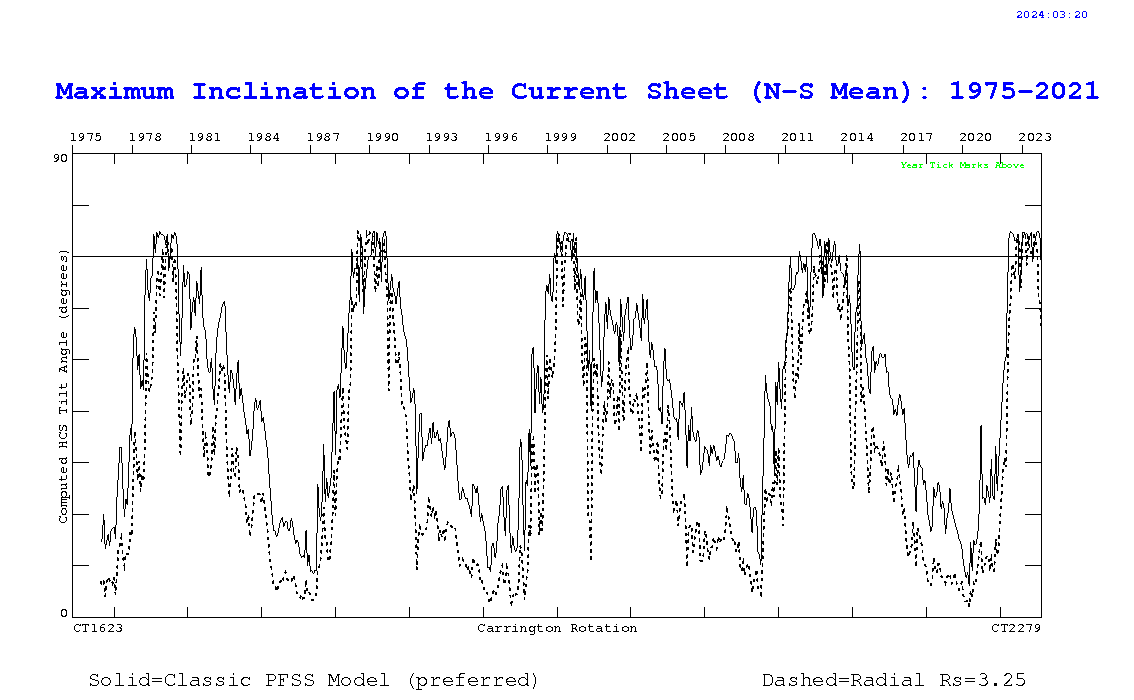
The site provides two data series – the classic and the radial, and notes that the radial may be possibly more accurate. Plotting up the radial data, the following chart is generated:

The heliospheric current sheet, for the last three minima, has got down to 3°. The last reading was 8.7°. It has been declining at an average of 8.6° per annum. If it holds that rate, solar minimum will be in August 2009. If it holds to the orange bounding line, solar minimum could be as late as April 2010. The last reading on the classic series is 22.8° and this series got down to 10° on average in previous solar minima. At its decline rate, solar minimum will be in another 1.9 years, which is late 2010.
To paraphrase a popular aphorism, Solar Cycle 23 isn’t over until the heliospheric current sheet has flattened, and it has a way to go yet.
Discover more from Watts Up With That?
Subscribe to get the latest posts sent to your email.
Thanks again Leif, most informative.
I’m still puzzling over this simulation of realtime data from a Japanese site:
A massive bowshock on 21st just before midnight UT.
Could this have contributed to the splitting in two of the polar vortex in the sudden stratospheric warming event?
HasItBeen4YearsYet? (18:46:05) :
Leif Svalgaard (14:54:55)
Gentlemen, the idea was not to have an argument about science of logic. The challenge should be, when something odd turns up, to find reason, to link cause and the consequence. The arguments that either it should be accepted at face value, or rejected as just a coincidence; it does not move issue forward. If the formula has its roots in reality (rather than being just speculation) then certainly is worth pursing. Since the numbers involved are precise astronomical values, then it is even more important to explore all avenues, be it purely mechanical, HMD, magnetic, electromagnetic or even combination of all. So use your scientific knowledge and intellectual ability in cooperation not a conflict.
I greatly value Dr. Svalgaards advice and contribution, but wouldn’t be great if his knowledge and experience is used not only to disqualify, but to also to look for gaps in existing scientific understanding, which may allow for further breakthroughs.
Thank you for your attention.
vukcevic
idlex (00:01:51) :
I suppose that if charged particles generally follow magnetic field lines, then conversely magnetic field lines might be said to follow charged particles?
The first step is to get that picture out of your mind. A parcel of the solar wind moves radially outward [does not follow any field lines]. The escape velocity decreases with distance from the Sun [at the Earth’s distance it is only 52 km/s] so the solar wind does not orbit the Sun, but really leaves the Sun behind. The kinetic energy of the outward flow is larger than the magnetic energy, so the magnetic field does not guide the flow [except very near the Sun where the ratio between the two energies is reversed], in fact, the magnetic field is tied to the plasma instead and moves with it. Consider a nozzle that spits out a parcel every day. If the Sun were not rotating these parcels with line up along a radius like beads on a string. A magnetic field line rooted in the nozzle would thread all the parcels along the straight radial line. Now, because the Sun is rotating each succeeding parcel [still to move out radially] with be emitted in a slightly different direction [changed by 360/27 degrees because the Sun rotates once in 27 days], so now the parcels would no longer be lined up along the initial radial line, but along a curved spiral [like drops from a garden sprinkler]. The magnetic field line threaded through all the parcels would then follow that spiral, so the flow is radially out, but the field curves.
The cartoon shows the magnetic field looking towards the Sun along the spiral. The circles are particles gyrating around the field lines [which they would still like to do locally], so you see that there will be a current circling the Sun. That is the HCS. As you move further and further away from the Sun, the magnetic field becomes more and more twisted around the Sun [eventually going around the Sun some 20 times] and the current becomes more and more radial.
tallbloke (00:13:58) :
A massive bowshock on 21st just before midnight UT.
Could this have contributed to the splitting in two of the polar vortex in the sudden stratospheric warming event?
I don’t know. Nothing special happened in the solar wind at that time, so I wouldn’t think there should be any effect on the Earth. Geomagnetic activity was low http://www-app3.gfz-potsdam.de/kp_index/definitive.html at that time.
vukcevic (03:12:44) :
If the formula has its roots in reality (rather than being just speculation) then certainly is worth pursing.
That is precisely the problem with it, that the root of the formula is not reality but speculation [something with planets lining up]. At times, speculation might be worth following up if the correlation is very good, but the correlation is not good. So it is hard to get excited.
Leif Svalgaard (05:09:16) :
to
vukcevic (03:12:44) :
If the formula has its roots in reality (rather than being just speculation) then certainly is worth pursing.
That is precisely the problem with it, that the root of the formula is not reality but speculation [something with planets lining up]. At times, speculation might be worth following up if the correlation is very good, but the correlation is not good. So it is hard to get excited.
The formula parameters are precise planetary orbital times, they are real as real it can be, they were there long before us, and will be long after. With due respect, it is not the planets lining up (lining up means presumably conjunctions, that is not case with this formula) but periodic motions of their magnetospheres trough the solar magnetic field and possible mutual interaction.
I am bit puzzled by your conclusion that correlation is not good, as far as data is available 1967 to present, correlation is excellent, but let others judge that.
http://www.vukcevic.co.uk/PolarFields-vf.gif
http://www.geocities.com/vukcevicu/PolarFields-vf.gif
For the whole period = 93% and for the period 1980 to present even better 97%. Are there data (not estimates what it should have been, but measured data) available prior to 1967?
Btw, nothing wrong with planets lining up, NASA uses it all the time for navigating and acceleration their space probes.
Jovian planets, due to their inclinations, the inclination of the solar equator and the narrow angle of HCS, continuously move in and out of the most intense areas of the solar wind. Further more the assertion that planet’s magnetic field is confined to the enclosed space of a magnetosphere may not be entirely correct, there it is just strong enough to hold off charged particles, but that does not mean that a planet’s magnetic field does not extend further on, theoretically to infinity.
You also said :
All field lines go ‘back in’ eventually. The open/closed terminology is simply one of convenience: the ‘closed’ ones go back in close to the Sun where we can see them; the ‘open’ ones make a detour way out into interplanetary [maybe even interstellar] space and we don’t know where they come back.
That is precisely point: we do not know.
Why not investigate possibility that some of them might envelop planetary magnetospheres before reconnect back ‘somewhere’ at high latitudes of the solar surface.
The idea, however popular, of a two dynamos running in parallel is highly extraordinary, while aspects of SSN asymmetry could be easily explained by planetary magnetic equatorial plane oscillations due to above mentioned inclinations.
Even smallest of external magnetic field and gravity force would affect MH dynamic flow of plasma.
I shell not go into aspects of distortions in the magnetic fields of the heliosphere (trough which magnetospheres orbit) which were only recently discovered by Pioneer and Voyager probes.
To conclude as Donald Rumsfeld put it so eloquently:
As we know, there are known knowns. There are things we know we know. We also know there are known unknowns. That is to say, we know there are some things we do not know. But there are also unknown unknowns, The ones we don’t know.
Leif
I don’t know. Nothing special happened in the solar wind at that time, so I wouldn’t think there should be any effect on the Earth. Geomagnetic activity was low http://www-app3.gfz-potsdam.de/kp_index/definitive.html at that time.
Very strange. Does anything else apart from the sun lob stuff around (bigger than a quarter pounder) which could cause such a bowshock?
Please could you comment on these farside images. There seems to be some blobbyness going on with the sun. Is this an artefact?
http://soi.stanford.edu/data/full_farside/crots/2080.html
Thanks as always for your time.
tallbloke (00:13:58) :
I’m still puzzling over this simulation of realtime data from a Japanese site:
A massive bowshock on 21st just before midnight UT.
see also
http://www.swpc.noaa.gov/weekly/pdf/prf1743.pdf
page 6 & 7.
Leif Svalgaard (04:53:11) : A parcel of the solar wind moves radially outward [does not follow any field lines]. The escape velocity decreases with distance from the Sun [at the Earth’s distance it is only 52 km/s] so the solar wind does not orbit the Sun, but really leaves the Sun behind.
Thanks again. Yes, I understand that the solar wind particles move out radially, but because the sun is rotating, this creates a ‘garden sprinkler’ spiral. And when I said that these particles would “behave like orbiting bodies”, I should really have said that I assumed that they are influenced by gravitational forces. i.e. a packet of solar wind is just another mass moving in the gravitational field of the solar system.
Earlier today, I took my numerical simulation model of the solar system, and modified it to fire small masses radially outwards from the surface of the sun at a little under escape velocity (618 km/s). These particles travelled radially outwards, slowing as they went under the influence of the Sun’s gravitation, and eventually slowed, stopped, and then fell radially back into the Sun. If I increased their radial velocity to values greater than escape velocity, they would keep on going, and exit the solar system. And this is what I expected they would do.
Then, of course, the Sun is rotating and everything gets wrapped around the Sun many times [like 20] before hitting the ‘edge’ of the heliosphere twice as far out as Pluto.
I am now beginning to suppose that the heliosphere is made up of all the particles in the solar wind which do not exceed escape velocity, and which consequently fall back to the Sun, like the particles in my simulation. And that the heliosphere is a bit like the Earth’s atmosphere, which is made up of all the particles in it which aren’t fast enough to escape into outer space. But in the heliosphere, unlike the terrestrial atmosphere, the particles are always moving radially (or almost radially), out and back in.
My simulation model is inaccurate, because it doesn’t include the magnetic force, but if I give the particles at the surface of the sun a radial velocity of 400 km/s (which is quite a lot less than escape velocity of 618 km/s), they don’t get very far. They fall back into the Sun before they’ve gone a half solar radius. So when someone speaks of a solar wind of 400 km/s, does this mean the velocity at the surface of the Sun, or at the orbit of the Earth? The solar wind, it seems to me, must be slowing as it moves outwards, as the Sun’s gravitation pulls it back, and something that is moving at 400 km/s at the orbit of the Earth must have left the Sun’s surface quite a lot faster than that.
And I’m still rather puzzled at the shape of the Sun’s magnetic field in your paper. Given that you describe the magnetic field lines as being threaded through all the parcels, then if the sun is throwing out parcels in all directions, why doesn’t the solar magnetic field consist of a set of radial spokes? Why are they curved in this strange way towards the solar equator? Is it because, before they escape from the Sun’ s magnetic field, the packets in the solar wind are turned by it in that direction?
vukcevic (06:24:14) :
periodic motions of their magnetospheres trough the solar magnetic field and possible mutual interaction.
If the Sun had only one planet (Jupiter) what would the formula look like?
I am bit puzzled by your conclusion that correlation is not good, as far as data is available 1967 to present, correlation is excellent,
And on 27 March, 1997, at 8:32 UT the correlation was perfect. There is something called ‘degrees of freedom’ and with only the data after 1967, that number is very small [approx. equal to the number of cycles]. Since the polar fields are a proxy for the sunspot number [with a lag], one should examine the whole record since ~1700, and there it is not excellent.
The assertion that planet’s magnetic field is confined to the enclosed space of a magnetosphere may not be entirely correct, there it is just strong enough to hold off charged particles, but that does not mean that a planet’s magnetic field does not extend further on, theoretically to infinity.
It may, but away from the Sun. The Earth’s magnetic tail is about 500 earth radii long, but away from the Sun, so do not act back on the Sun.
You cannot base science on the unknown unknowns
tallbloke (06:47:52) :
Very strange. Does anything else apart from the sun lob stuff around (bigger than a quarter pounder) which could cause such a bowshock?
yes, bad data. this is ‘real time’ data with all the glitches and errors that you find from time to time in real time data before the quality control.
Please could you comment on these farside images.
This technique is still in its infancy and sometimes produces garbage, like now.
Leif Svalgaard (08:32:38) :
to
vukcevic (06:24:14) :
periodic motions of their magnetospheres trough the solar magnetic field and possible mutual interaction.
If the Sun had only one planet (Jupiter) what would the formula look like?
If Jupiter is removed we can’t even speculate what solar system would look like, how Sun would behave, let alone what my formula would be. Now you are dealing with unreal, so the question is irrelevant.
And on 27 March, 1997, at 8:32 UT the correlation was perfect.
I would not particularly guaranty that (it is irrelevant, what kind of science is that?), I am dealing with correlation for nearly 1200 measured values.
http://www.vukcevic.co.uk/PolarFields-vf.gif
http://www.geocities.com/vukcevicu/PolarFields-vf.gif
There is something called ‘degrees of freedom’ and with only the data after 1967, that number is very small [approx. equal to the number of cycles].
Since the polar fields are a proxy for the sunspot number [with a lag], one should examine the whole record since ~1700, and there it is not excellent.
As far as I understand it, you and your colleagues are happy to say polar fields are a proxy for the sunspot number over the same period ( 4 SCs) , so your objection is not valid for someone else to apply the same principle. My formula correlates well with nearly 1200 measured values, while your predictions use only short periods at max, to come to the conclusion of a good proxy. I do not see polar fields replicating themselves accurately either with SSN or SS groups, my latest plots appear to correlate far better if a single hemisphere is considered (work in progress), but as you bring it up, the old work is shown on:
http://www.vukcevic.co.uk/combined.gif
For not a moment, I would claim that a single formula would cover whole variety of SC wayforms, as you can see from the above, there are number of them, but all use precise astronomical values, no guess work or assumptions. As you will remember, you slightly corrected one of my numbers (by the NASA’s recalculations) which then gave even better approximation of Maunder minimum, that should speak for itself.
The assertion that planet’s magnetic field is confined to the enclosed space of a magnetosphere may not be entirely correct, there it is just strong enough to hold off charged particles, but that does not mean that a planet’s magnetic field does not extend further on, theoretically to infinity.
It may, but away from the Sun. The Earth’s magnetic tail is about 500 earth radii long, but away from the Sun, so do not act back on the Sun.
There is no particular proof of that. Two magnetic fields (planetary and spinning particle’s fields) are of totally different kind, instruments may add or subtract total, but they mix very rarely (when their vectors align, case of a reconnection), otherwise we would not have Aurora, where a charged particle spins down the earths field (neither gets obliterated by the other), Btw, Faradey cage does not work for DC magnetic fields (labs use ‘mu’ metal for shielding).
You cannot base science on the unknown unknowns
(Higgs boson?, billions spent there on an ‘unknown’ at CERN)
Agree, but we should not ignore fact that many ‘unknowns’ are there and they are part of reality, and therefore should be vigorously pursued by science. If the science was scared of ‘unknowns’ I might have been instead scribbling on a cave wall (may be not a bad idea !).
To reader of blog following this exchange, (visited my webpage 16.30GMT ) from Alabama , Huntsville ISP National Aeronautics And Space Administration
Your views are welcome, publicly or privately, anonymously or personally,
I am looking for cooperation.
idlex (08:10:13) :
So when someone speaks of a solar wind of 400 km/s, does this mean the velocity at the surface of the Sun, or at the orbit of the Earth?
At the Earth and actually throughout most of the solar system as well.
The solar wind, it seems to me, must be slowing as it moves outwards
No, it is speeding up. See: http://www.obspm.fr/actual/nouvelle/jun05/solarw.en.shtml
Why are they curved in this strange way towards the solar equator? Is it because, before they escape from the Sun’ s magnetic field, the packets in the solar wind are turned by it in that direction?
Yes. And the parcels don’t really escape from the field, they end up dragging the field with them.
vukcevic (10:27:20) :
“If the Sun had only one planet (Jupiter) what would the formula look like?”
If Jupiter is removed we can’t even speculate what solar system would look like, how Sun would behave
I asked what the formula would look like if Jupiter was the only planet there. I.e. remove Saturn. Surely, the effect of Jupiter’s magnetosphere should be there even if Saturn is removed.
My formula correlates well with nearly 1200 measured values
Suppose we had measured the polar fields every 45 seconds instead of only every ten days, then you would have had 2,500,000 measured values but the correlation would not have been any better because than the 1200 or the 4 values, because these values would not have been independent [the field changes very very little between values]. BTW, the new SDO spacecraft we are working on right now will make a measurement every 45 seconds.
About your mechanism:
A varying electric/magnetic field cannot penetrate a collision-less highly conducting plasma.
(Higgs boson?, billions spent there on an ‘unknown’ at CERN) a known unknown!
Leif Svalgaard (11:20:00) :
to
vukcevic (10:27:20) :
I asked what the formula would look like if Jupiter was the only planet there. I.e. remove Saturn. Surely, the effect of Jupiter’s magnetosphere should be there even if Saturn is removed.
Makes no difference, solar system is as it is, no one knows how sun would react, if present balance is altered, still irrelevant.
My formula correlates well with nearly 1200 measured values
Suppose we had measured the polar fields every 45 seconds instead of only every ten days, then you would have had 2,500,000 measured values but the correlation would not have been any better
You are misinterpreting my words. It was a response to a pointless statement:
And on 27 March, 1997, at 8:32 UT the correlation was perfect.
I was making point that there are 1200 measured values, should have added over 40 years.
but the correlation would not have been any better because than the 1200 or the 4 values, because these values would not have been independent [the field changes very very little between values].
http://www.vukcevic.co.uk/PolarFields-vf.gif
http://www.geocities.com/vukcevicu/PolarFields-vf.gif
But if you had 4 values over 40 years, you might not be able to say:
[the field changes very very little between values].
Bit of a strange logic:
the new SDO spacecraft we are working on right now will make a measurement every 45 seconds.
What is the point of measuring every 45 seconds if 4 measurements over 40 years are good enough ?!?!
About your mechanism:
A varying electric/magnetic field cannot penetrate a collision-less highly conducting plasma.
Not certain about that, this plasma is highly rarefied (remember big Mac with fries), I am talking about fixed DC planetary magnetic fields, not varyng electrical field.
Van Allen belt is a good example of two magnetic fields coexisting in time and space, without destroying each other, so I am not prepared to accept that:
A varying
electric/magnetic field cannot penetrate a collision-less highly conducting plasma.I have carried a simple experiment with a compass needle within a much longer coil with DC and AC current in the windings, and the compass needle still reacts if permanent magnet is brought in vicinity, conclusion: presence of an electric current generated magnetic field (nor Faraday cage of the coil) prevents fixed (DC) magnetic field penetrating both.
It would be far more productive to offer some help (as with the corrected orbital period).
BTW. The previous invitation for cooperation is not only addressed to the blog reader from NASA, but also to all from number of Universities and research establishments who visited my website during last few months.
(Click on ‘Bratstvo Vukcevic’)
@Pamela Gray (19:06:52) :
“Dear Hasitbeen4years, I get up every morning before the Sun rises. Without fail. And I kinda look like an Irish midget sized woman with long unruly red hair. Give me a cauldron and you get the idea. Therefore, according to your correlation logic, I cause the Sun to rise. Offerings of money most appreciated. But beer works too. Just leave it at the entrance of my cave.
Soooooo, you ADMIT it’s all your fault??!!
Confession duly noted.
Leif Svalgaard (11:20:00) :
to
vukcevic (10:27:20) :
it should be:
conclusion: Nor presence of an electric current generated magnetic field or Faraday cage of the coil, prevents fixed (DC) magnetic field penetrating both.
vukcevic (12:23:47) :
“I asked what the formula would look like if Jupiter was the only planet there. I.e. remove Saturn. Surely, the effect of Jupiter’s magnetosphere should be there even if Saturn is removed.”
Makes no difference, solar system is as it is, no one knows how sun would react, if present balance is altered, still irrelevant.
Here you are evading the issue [and do you think that I would ask something irrelevant?]. The total effect should be the interplay between the individual effects. So, if Jupiter and Saturn are on opposite sides of the Sun, the effect of Jupiter’s magnetosphere on the side where Jupiter is should be felt. In getting at the physics, one must be able to understand the partial effects or demonstrate from physics that only when both effects are present do you see any of them.
But if you had 4 values over 40 years, you might not be able to say:
[the field changes very very little between values].
Your values change very little.
What is the point of measuring every 45 seconds if 4 measurements over 40 years are good enough ?!?!
4 measurement are good enough to establish PF->SSN prediction, in fact in our prediction paper we only use 2. For other reasons do we want to know what the Sun’s magnetic field is doing, how it is maintained, and how it changes. Rapid changes may be the key to predicting flares and CMEs.
“A varying electric/magnetic field cannot penetrate a collision-less highly conducting plasma.”
Not certain about that
The very existence of the Earth’s [and Jupiter’s] magnetosphere is a consequence of this fact [rather the converse, but it works both ways]. A plasma cannot penetrate a magnetic field: the solar wind is deflected around the Earth, does not get any closer than about 10 Earth radii, and is effectively excluded from the magnetic field around the Earth. Fluctuations of the solar wind make the boundary unstable and a small amount of plasma can enter. A lot of the plasma in the Van Allen belts come from the Earth, not from the Sun.
It would be far more productive to offer some help (as with the corrected orbital period).
The most productive is to point out errors early on, so you do not waste time on pursuing dead ends.
UNKOWN KNOWNS?
It appears that vukcevic isn’t the only one interested in the phenomenon. There definitely appears to be something there, but getting to the bottom of what it is, and quantitating the finer aspects of it, will take a while.
So I do hope that Dr. Svalgaard isn’t advocating abandoning that research for the superficial reason that we don’t yet know what we’re trying to discover? (That’s an attitude that infects many researchers, and one of the vectors of transmission is the grant process that refuses to fund someone unless he adheres to entirely too rigid parameters that more often prevent new discoveries than foster them.)
HasItBeen4YearsYet? (13:08:01) :
So I do hope that Dr. Svalgaard isn’t advocating abandoning that research for the superficial reason that we don’t yet know what we’re trying to discover?
Of course not, but your subsequent statement about attitude is completely wrong. Every scientist dreams about out of the box revolutionary discoveries. It is just that these are HARD. What I basically rail against is substandard statistics, incorrect physics, use of wrong data [willingly or not], and the attitude that what we don’t know must be true. In short, I advocate research. Speculation is OK, as long as you know it is just that. Wild ideas are OK, as long as you drop them when they don’t pan out or are shown to be wrong. Critique should be taken into account, not pushed aside by comparing one’s work with that of Kepler, Galileo, Einstein, Velikovsy, and other luminaries. Such critique could be devastating, but such is Science, and such should be Science.
Leif Svalgaard (13:01:31) :
to
vukcevic (12:23:47) :
“I asked what the formula would look like if Jupiter was the only planet there. I.e. remove Saturn. Surely, the effect of Jupiter’s magnetosphere should be there even if Saturn is removed.”
Makes no difference, solar system is as it is, no one knows how sun would react, if present balance is altered, still irrelevant.
Here you are evading the issue [and do you think that I would ask something irrelevant?]. The total effect should be the interplay between the individual effects. So, if Jupiter and Saturn are on opposite sides of the Sun, the effect of Jupiter’s magnetosphere on the side where Jupiter is should be felt. In getting at the physics, one must be able to understand the partial effects or demonstrate from physics that only when both effects are present do you see any of them.
That is your way of looking at things. I see more factors there, such as asymmetry of the heliosphere, When the magnetospheres are at head end they enter different conditions to the heliosphere’s tail end. One of the reasons why no one has managed to tie sunspot maxima and minima to a particular J-S angular displacement. One could even think of the heliosphere as an inverted Einstein’s space (magnetospheres are mountain peaks, that solar wind is unable to clime up to, so flows around it, as a river around an island, have you noticed shape of rapid river islands ? )
But if you had 4 values over 40 years, you might not be able to say:
[the field changes very very little between values].
Your values change very little.
I never claim my values change anything, they just agree extremely well with what your colleagues at Wilcox Solar Observatory measure (why not discuss my formula with them, I do not mind even if you have a laugh).
http://www.vukcevic.co.uk/PolarFields-vf.gif
http://www.geocities.com/vukcevicu/PolarFields-vf.gif
What is the point of measuring every 45 seconds if 4 measurements over 40 years are good enough ?!?!
4 measurement are good enough to establish PF->SSN prediction,
in fact in our prediction paper we only use 2.!
OK with me if you think so, your prediction, not mine
For other reasons we want to know what the Sun’s magnetic field is doing, how it is maintained, and how it changes. Rapid changes may be the key to predicting flares and CMEs.
I am happy with that, I whish someone could measure frequently J-magnetosphere. I never questioned your conclusions, I am sure there are more qualified people to do that, but it appears it was not necessary.
Hence, more predictive power to my formula, since it can look ahead further than half a cycle!
That is I hope, why NASA (wcne-32-186-024.gsfc.nasa.gov 128.154.186.24 )is looking in at
http://www.vukcevic.co.uk.
Come on, NASA drop us a line!
“A varying electric/magnetic field cannot penetrate a collision-less highly conducting plasma.”
Not certain about that
The very existence of the Earth’s [and Jupiter’s] magnetosphere is a consequence of this fact [rather the converse, but it works both ways]. A plasma cannot penetrate a magnetic field: the solar wind is deflected around the Earth, does not get any closer than about 10 Earth radii, and is effectively excluded from the magnetic field around the Earth. Fluctuations of the solar wind make the boundary unstable and a small amount of plasma can enter. A lot of the plasma in the Van Allen belts come from the Earth, not from the Sun.
Or may be a magnetosphere is an area where planet’s field is able to repel charged particles field, once with enough energy (according to NASA) to penetrate it and end up (for a wile) in the Van Allen belts and when their energy is dissipated, looping back and forth between two magnetic poles, end up in the atmosphere.
A lot of the plasma in the Van Allen belts come from the Earth, not from the Sun.
Do not know what a lot is: 90%, 10% ? and how can you tell which proton comes from the Earth?
The most productive is to point out errors early on, so you do not waste time on pursuing dead ends.
I value corrections, and appreciate constructive criticism, which may help advance a step forward, but not if it is just because somehow planets are involved, everything has to be rejected.
We are all eventually at dead end, I would say very dead dead end, but until then it is better pursuing any challenge, than no challenge at all. Who knows, SC24 might make hero of Dr. Hathaway, if that is case, I will whistle in the wind, try to prove that Beaufort gyre is run by the sunspot cycle; have you any plans if SC24 is 120 ? (come to think about it, one of my formula allows for that as well).
I suggest we here agree to disagree, I hope I was not giving you to much of hard time. It is all good fun, and that is what should attract younger generation, the science is good fun, right or wrong.
I am off to see BBC 10 o’clock news.
@ur momisugly Leif Svalgaard (13:37:56) :
“your subsequent statement about attitude is completely wrong.”
No, it’s not. I was not making a blanket statement about every scientist. It’s like in every population, some individuals are more susceptible to infection than others, so not everyone will suffer to the same extent. If you aren’t affected, I’m happy for you. But I have seen it first hand on too many occasions to know it isn’t a little problem. How much would things be better without such micromanaging by bureaucrats? I don’t know, but if it’s anything like the difference between socialist markets and capitalism (and it probably is), then we are likely missing out on a lot of wonderful stuff.
vukcevic (14:25:32) :
“I asked what the formula would look like if Jupiter was the only planet there. I.e. remove Saturn. Surely, the effect of Jupiter’s magnetosphere should be there even if Saturn is removed.”
I can see that we cannot progress further along the other questions, but this one you should not evade [as you have now done repeatedly]. Here there is no knowledge needed of plasma physics or statistics, so please make an effort to answer, what you think it should be. Then the same question, if Saturn was the only planet.
HasItBeen4YearsYet? (14:58:00) :
I was not making a blanket statement about every scientist.
So simply saying that the statement applies equally well to any segment of the population?
@ur momisugly vukcevic (14:25:32) :
“That is I hope, why NASA (wcne-32-186-024.gsfc.nasa.gov 128.154.186.24 )is looking in at
http://www.vukcevic.co.uk.
Come on, NASA drop us a line!’
It’s interesting that at least someone connected with them is referencing you…
http://adsabs.harvard.edu/abs/2004astro.ph..1107V
…citing this paper…
http://arxiv.org/ftp/astro-ph/papers/0401/0401107.pdf
@ur momisugly Leif Svalgaard (16:04:06) :
“So simply saying that the statement applies equally well to any segment of the population?”
No. They aren’t doing research, so why would funding constraints and publish or perish be irrelevant to them?
Not all scientists are dependent on government grants, and among those who are some have more flexibility than others, depending on the nature of their work. But, as a general rule, there is a major down side for a talented scientist relying on the government for his livelihood. Of course, some of the negatives are independent of government ‘forcing’, as it is just due to the human nature of certain principle investigators who may just be naturally less creative, more controlling, narrow minded and/or suffer some other disruptive personality disorder that’s not conducive to a productive work environment for colleagues or staff.