Many readers are familiar with a number of solar proxies used to gauge the activity of the sun, the most familiar being sunspot counts and type. However they aren’t the only metric you can use to determine when one cycle ends and another begins. The Heliospheric Current Sheet sounds a bit like a “newsletter” and in a sense it is, because it can announce the true end of solar cycle 23.
Here’s what it looks like:

Heliospheric current sheet – click for larger image
From Wikipedia:
The heliospheric current sheet (HCS) is the surface within the Solar System where the polarity of the Sun’s magnetic field changes from north to south. This field extends throughout the Sun’s equatorial plane in the heliosphere.The shape of the current sheet results from the influence of the Sun’s rotating magnetic field on the plasma in the interplanetary medium (Solar Wind). A small electrical current flows within the sheet, about 10−10 A/m². The thickness of the current sheet is about 10,000 km.
The underlying magnetic field is called the interplanetary magnetic field, and the resulting electric current forms part of the heliospheric current circuit.[4] The heliospheric current sheet is also sometimes called the interplanetary current sheet.
What the Heliospheric Current Sheet is telling us.
David Archibald writes:
One of the things that the now disbanded NASA Solar Cycle 24 Prediction Panel told us was that is that solar minimum is marked by a flat heliospheric current sheet. The heliospheric current sheet can be found here: http://wso.stanford.edu/gifs/Tilts.gif
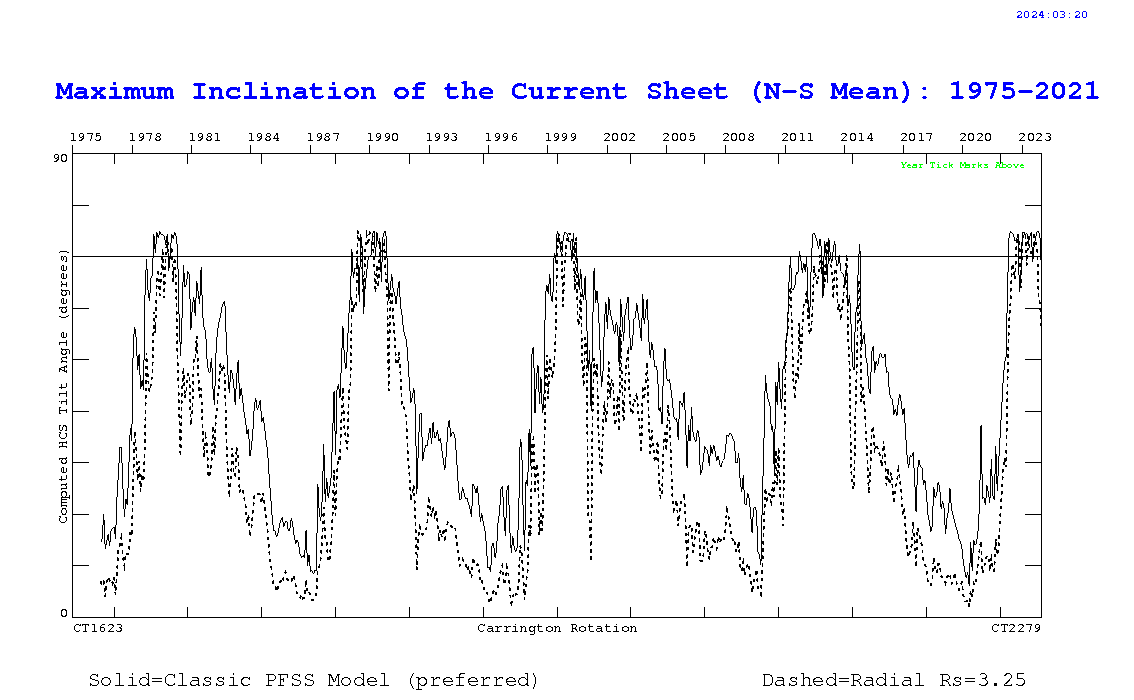
The site provides two data series – the classic and the radial, and notes that the radial may be possibly more accurate. Plotting up the radial data, the following chart is generated:

The heliospheric current sheet, for the last three minima, has got down to 3°. The last reading was 8.7°. It has been declining at an average of 8.6° per annum. If it holds that rate, solar minimum will be in August 2009. If it holds to the orange bounding line, solar minimum could be as late as April 2010. The last reading on the classic series is 22.8° and this series got down to 10° on average in previous solar minima. At its decline rate, solar minimum will be in another 1.9 years, which is late 2010.
To paraphrase a popular aphorism, Solar Cycle 23 isn’t over until the heliospheric current sheet has flattened, and it has a way to go yet.
Discover more from Watts Up With That?
Subscribe to get the latest posts sent to your email.
“The IMF is also flatlining at about 4 nT.”
But an authority had the floor at an invariable 4.6 nT just a few years back. It would appear new depths are being plumbed.
Question s: What is the earth’s position within the normal range of its orbit variability during this period? What is the angle of the planetary axis relative to the solar axis?
Is it likely that changes in Earth’s magnetic field coincident with the solar field fluctuation has a significant impact on climate? Please keep answers reasonably simple, I’m not a scientist, just curious.
Leif
tallbloke (23:59:51) :
the sun’s 7 degree tilt precesses at virtually the same rate as earth’s, though for reasons which are opaque to me.
I didn’t know that it did [does it?]
Hmmm. can’t find the reference. Maybe I misunderstood a reference to the sun prcessing as seen from earth. It’d be unusual if a spinning body with an axial tilt didn’t precess though wouldn’t it? Has anyone estimated it to your knowledge?
Did you like the painting BTW.?
gary gulrud (08:09:33) :
“The IMF is also flatlining at about 4 nT.”
But an authority had the floor at an invariable 4.6 nT just a few years back. It would appear new depths are being plumbed.
New depths of scientific illiteracy is been plumbed, it seems. Any figure has an associated uncertainty. As we said in a paper discussing the floor: “Our debate with Lockwood and colleagues on the long-term evolution of the coronal magnetic field and the solar wind may be resolved within the next few years if our prediction [Svalgaard et al., 2005] of a solar maximum with peak sunspot number comparable to that of cycle 14 bears out. If so, direct measurements of solar wind properties during conditions similar to those during the previous minimum of the Gleissberg cycle would take the estimates of IMF B out of the realm of extrapolation.
The value for the ‘floor’ that we had earlier was based on the higher values that were directly observed several years back. With conditions now approaching the low values of ~1900, direct measurements will allow us to refine the early estimates. This is what is happening.
tallbloke (04:42:20) :
to
vukcevic:
……. solely from the two cycles of data shown?
Yes, there are two Hale (4 sunspot) cycles there, since magnetic polarity is taken account of.
http://www.vukcevic.co.uk/PolarFields-vf.gif
http://www.geocities.com/vukcevicu/PolarFields-vf.gif
Leif Svalgaard (06:58:41) :
tallbloke (06:36:25) :
we get a 4 year ‘prediction’ of sunspot activity by looking at the polar field strength?
Yes, and no need for quotes. http://www.leif.org/research/Cycle%2024%20Smallest%20100%20years.pdf
Thanks Leif, very interesting. I noticed on your fig 1 a faint grey line extending from the end of the R(int) line of sunspot numbers, at the end of the polar field data in 2004. Does this represent a ‘prediciton’ derived from the polar field data?
I’m still using quotes because the ‘prediction’ has solar min at 2007.4 and an R(int) value of around 40 at the start of 2009. 🙂
Have you updated the polar field plot?
Leif Svalgaard (20:46:20) :
Robert Bateman (20:13:07) :
The sun, overly active or acutely inactive, is a driver of human behavior.
A Soviet scientist I once worked with was convinced that the agitation of inmates in insane asylums peaked on the day the HCS sweps over the Earth.
When I think of inmates (criminals) the connection there is the Full Moon.
What I would throw out here is the monetary behavior of hoarding/greed presaging recession/panic which all comes before a big Solar Minimum.
The animals know of an impending volcano or earthquake.
What do humans know at an animal instinct level with regards to Grand Minimum or even Grand Maximum?
You needed a break.
Slightly OT but what the heck did this to the earth’s magnetosphere on 21st Jan???
@vukcevic (03:26:03) :
“One of the most reputable solar scientists qualified it as:
Such a formula has no predictive power, unless you assume that one or both of these statements are true:
That’s an odd way to say it. Wouldn’t it be more correct to say that “If it has predictive power [as judged empirically by accuracy of it’s predictions], then one may assume that one or both of these statements are probably true:” He’s got the cart before the horse, it seems.
Kepler had no clue how gravity worked, but his phenomenology had pretty darn good predictive power, and it laid the groundwork for Newton to build on.
“I am unable to satisfy the rigour of accepted science with either of the above quoted conditions,…”
Don’t sell yourself short, M.A.V.
http://www.climate-skeptic.com/2009/02/most-useless-phrase-in-the-polical-lexicon-peer-reviewed.html
http://www.iscid.org/papers/Tipler_PeerReview_070103.pdf
The AGW model of climate change appears to have a lot poorer correlation to the data than does your (and others’) model(s) of solar activity.
http://www.theage.com.au/news/opinion/a-lot-of-hot-air/2007/06/15/1181414543054.html
Something has gotten ahold of something as HCS, IMF, 10.7 flux, AP index , Sunspot contrast, and who knows what else are all getting pancaked.
I’ll be the 1st to admit I don’t know of all the indices/indicators that are affected, so could someone build up a list?
Seems other than Badalyan, the physical modelers have over-reached and are quite displeased.
HasItBeen4YearsYet? (11:25:14) :
to
vukcevic (03:26:03) :
The AGW model of climate change appears to have a lot poorer correlation to the data than does your (and others’) model(s) of solar activity.
Thanks for the vote of confidence.
PJ (08:45:56) :
What is the earth’s position within the normal range of its orbit variability during this period?
We are in for a lot less variability the next 200,000 years.
What is the angle of the planetary axis relative to the solar axis?
about 23 degrees [for the Earth, but you have to specify which planets]
Is it likely that changes in Earth’s magnetic field coincident with the solar field fluctuation has a significant impact on climate?
the short answer is no.
tallbloke (09:30:20) :
It’d be unusual if a spinning body with an axial tilt didn’t precess though wouldn’t it?
No, not really, because what is the axis tilted against? For the Earth, you have the Moon and the Sun acting on a non-spherical Earth. Not the same for the Sun.
Has anyone estimated it to your knowledge?
No, but it is bound to be extremely small and has not [cannot] be measured.
Did you like the painting BTW.?
A lot nicer than my sketch 🙂
tallbloke (06:36:25) :
I noticed on your fig 1 a faint grey line extending from the end of the R(int) line of sunspot numbers, at the end of the polar field data in 2004. Does this represent a ‘prediciton’ derived from the polar field data?
No, just a continuation of the previous cycle to place the polar fields in perspective [not everyone has a solar cycle engraved on the inside of their retina].
Have you updated the polar field plot?
Yes, http://www.leif.org/research/AGU%20Fall%202008%20SH51A-1593.pdf
HasItBeen4YearsYet? (11:25:14) :
That’s an odd way to say it. Wouldn’t it be more correct to say that “If it has predictive power [as judged empirically by accuracy of it’s predictions]…
It has made no verified predictions, so cannot be judged on that basis.
The AGW model of climate change appears to have a lot poorer correlation to the data than does your
is a fallacy, like ‘other people are more mistaken than you are, therefore you are wrong’
REALITY CHECK!!!!!! How about instead of looking at some graph or reading about it we take a look.
http://www.esa.int/esaSC/SEMSMHSVQ9F_index_1.html
http://sohowww.nascom.nasa.gov/gallery/Movies/sunspots.html
Or for CME Activity
http://sohowww.nascom.nasa.gov/gallery/Movies/flares.html
http://sohowww.nascom.nasa.gov/gallery/Movies/C3may98/C3may98.mpg
Now lets look at the sun today…
http://sohodata.nascom.nasa.gov/cgi-bin/data_query
(here you have to pick start date/end date, the longer you pick the longer it takes to load, and it will time out if the request is too big.) If anyone knows of a place for year to year animations please let me know.
Now sit there and tell me that the sun’s changes year to year, or over the course of a cycle can have no noticeable effect on our planet. Even now, our quiet sun beans us now and again with a solar wind from coronal holes, associated (Leif will correct me if I misinterpreted) with the magnetic leftovers of sunspots. Just imagine the sheer power of a sun in full swing magnetically.
Furthermore a sun that is “spitting” matter out (CME) like say the sun in 1998, 2000, 2001, ect. It should not only be beaming us with matter immediately but leaving behind slower moving matter that our planet would have to pass thru on its travel around the sun. After all, the definition of a planet is a body that clears its path around the sun, and since the other planets have shown climate change symptoms without man’s intervention, it seems to me someone is missing part of the big picture. Maybe we should pull our heads out of our centrist errrrr….ideas and look for the real cause of our NATURAL, climate change.
http://www.sciencedaily.com/releases/2007/08/070824131445.htm
http://umtof.umd.edu/pm/
http://umtof.umd.edu/pm/FIGS.HTML
hmmm imagine that 🙂
pkatt (14:14:14) :
REALITY CHECK!!!!!! Furthermore a sun that is “spitting” matter out (CME) like say the sun in 1998, 2000, 2001, ect. It should not only be beaming us with matter immediately but leaving behind slower moving matter that our planet would have to pass thru on its travel around the sun.
The amount of solar wind matter impinging on the Earth every second has the same mass as one BigMac with Fries. Better be afraid and duck!
The January solar data update at http://www.swpc.noaa.gov/ftpdir/weekly/RecentIndices.txt is finally available. The January 2009 Ap is 3, and the July 2007 smoothed Ap is 6.6. Can someone explain how the smoothed Ap is derived from the Ap numbers? I can’t seem to duplicate it.
While we’re on the subject of updates, the early Hadley update for January is out at http://hadobs.metoffice.com/hadcrut3/diagnostics/global/nh+sh/monthly with a value of +0.370
Wherever it is that SC23-24 is taking us……
It’s still taking us there.
Are we there yet? No, now pipe down and eat your nice Big Mac w/ Fries.
Where are we? I dunno.
Are we there yet? Don’t make me stop this car.
Where are we going again? Oh, shut up
– Warning: Forces beyond our control are at work. Remain seated, keep your visors on, and for God’s sake, don’t stick any body parts out the window.
IF REALITY ISN’T LOGICAL, DOES THAT MEAN LOGIC IS UNREAL?
@ur momisugly Leif Svalgaard (14:54:55)
“It has made no verified predictions, so cannot be judged on that basis.”
logical fallacy, ‘you haven’t made any predictions, so any you do make don’t need to be tested’ — (and from before, ‘because you haven’t told us why they should verify to begin with, any subsequent verification must be dismissed as meaningless.’ — Sorry, Mr. Kepler, your geometry is very pretty, but you didn’t base it on gravity so we can’t use it.)
Bottom line, EVERYTHING is phenomenology, so if you have a rule that works, that’s what counts. Now, let’s see what predictions he makes, and let the chips fall where they may.
_______________________________________________________
“The AGW model of climate change appears to have a lot poorer correlation to the data than does your
‘is a fallacy, like ‘other people are more mistaken than you are, therefore you are wrong’.’”
LOL. That’s some pretty fuzzy tail-chasing logic you’ve got there. Let’s see, if others are “more wrong” than I am, then I am “wrong,” albeit “less wrong than they.” That’s not a logical test, it’s a definition, and a sloppy one at that. And it has nothing to do with what I said.
Let’s see if I can put this another way that won’t confuse you… the better the correlation of two phenomena, the more likely they are to be related, (all science is based on that premise). And solar activity appears better correlated to the short term global temperature than is [CO2].
Logic is a great tool, but it doesn’t trump reality.
idlex (22:18:21) : But then I couldn’t see where the nozzle of the hose was on the sun’s surface.
Leif Svalgaard (07:14:19) : There is just not one nozzle, but many all over the Sun. I forgot to mention that some of the bigger nozzles are indeed visible, they are called coronal holes. They are the dark areas visible here: http://sohowww.nascom.nasa.gov/data/realtime/eit_171/512/ especially near the poles for the moment, but they can appear at any location.
Thank you, Dr Svalgaard. Then the spiralling outbound solar wind must go in all directions. And above the Sun’s poles the solar wind must twist into ropes.
Do these nozzles always point radially out of the sun, and do they all eject the solar wind at 400 km/s? I read somewhere that there’s a ‘slow’ solar wind of 400 km/s and a ‘fast’ solar wind of 750 km/s. Are there ‘fast’ nozzles and ”slow’ nozzles?
And although I can understand this, I haven’t been able to relate it to the Heliospheric Current Sheet, which seems to be something that only exists in the Sun’s equatorial plane, while the solar wind goes in all directions.
Or does it? If the solar wind is made up of charged particles of one polarity or other, they will prefer to move along the Sun’s magnetic field. If they are not charged, they will ignore the Sun’s magnetic field and go on whichever way they started out from the Sun’s surface, acting only under gravitational influence.
If the solar wind is made up of charged particles, then because of the Sun’s rather peculiar magnet field, they will tend to follow the sun’s magnetic field, and either be drawn towards the solar equator if they are near it (and perhaps back into the Sun), or be sprayed out from the solar poles if they are near to those. And so instead of the solar wind going in all directions, it will tend to mostly twist in ropes out of the poles, or spiral out over the solar equatorial plane, just above or just below the Heliospheric Current Sheet.
Am I getting anywhere? Or am I still hopelessly confused?
Dear Hasitbeen4years, I get up every morning before the Sun rises. Without fail. And I kinda look like an Irish midget sized woman with long unruly red hair. Give me a cauldron and you get the idea. Therefore, according to your correlation logic, I cause the Sun to rise. Offerings of money most appreciated. But beer works too. Just leave it at the entrance of my cave.
idlex, I spit my wine out all over my puter screen!!!! Reminds me of my very first nursing experience. I thought they were made just like a bottle nipple. You know. Just one hole at the tip. Not so much. Imagine my surprise when it sprayed up my nose as I was trying to connect my faucet with newborn baby.
idlex (18:46:52) :
Do these nozzles always point radially out of the sun, and do they all eject the solar wind at 400 km/s? I read somewhere that there’s a ’slow’ solar wind of 400 km/s and a ‘fast’ solar wind of 750 km/s. Are there ‘fast’ nozzles and ‘’slow’ nozzles?
Very near the Sun [within a couple of solar radii] the flow is not quite radial, but from there on out, the flow is radial. That is, the flow does not follow spirals, anymore than water from a garden hose does [it just looks like a spiral, but each drop of water continues in a straight line]. The speed varies from 250 km/s to 750 km/s with occasional [rare] bursts up to perhaps 2500 km/s.
The solar wind is charged, but the particles do not follow the magnetic field lines, rather the other way around: the magnetic field is dragged out by the flow, so when the Sun continues to turn, the field line is drawn into a spiral, because the foot pint of the field line moves with the Sun’s rotation.
In the simplest case [like we have right now] the north pole has a magnetic field of one polarity and the south pole one of the opposite polarity. This means that out in the solar wind field lines point one way in the northern half of the space and the other way in the southern half, so somewhere midway you will meet field lines of both directions. Such a configuration forces charged particles [a current] to flow along the boundary between the two fields [the heliospheric current sheet] as in this little cartoon http://www.leif.org/research/Current-Sheet-Cartoon.png
Near the Sun, the Sun’s magnetic field is strong enough to channel the particles, but a few radii away, the kinetic energy of the flow is larger than the magnetic energy of the field, so the flow is radial far from the Sun and curved near the Sun. Then, of course, the Sun is rotating and everything gets wrapped around the Sun many times [like 20] before hitting the ‘edge’ of the heliosphere twice as far out as Pluto.
idlex (18:46:52) :
Do these nozzles always point radially out of the sun, and do they all eject the solar wind at 400 km/s? I read somewhere that there’s a ’slow’ solar wind of 400 km/s and a ‘fast’ solar wind of 750 km/s. Are there ‘fast’ nozzles and ‘’slow’ nozzles?
Very near the Sun [within a couple of solar radii] the flow is not quite radial, but from there on out, the flow is radial. That is, the flow does not follow spirals, anymore than water from a garden hose does [it just looks like a spiral, but each drop of water continues in a straight line]. The speed varies from 250 km/s to 750 km/s with occasional [rare] bursts up to perhaps 2500 km/s.
The solar wind is charged, but the particles do not follow the magnetic field lines, rather the other way around: the magnetic field is dragged out by the flow, so when the Sun continues to turn, the field line is drawn into a spiral, because the foot pint of the field line moves with the Sun’s rotation.
In the simplest case [like we have right now] the north pole has a magnetic field of one polarity and the south pole one of the opposite polarity. This means that out in the solar wind field lines point one way in the northern half of the space and the other way in the southern half, so somewhere midway you will meet field lines of both directions. Such a configuration forces charged particles [a current] to flow along the boundary between the two fields [the heliospheric current sheet] as in this little cartoon http://www.leif.org/research/Current-Sheet-Cartoon.png
Near the Sun, the Sun’s magnetic field is strong enough to channel the particles, but a few radii away, the kinetic energy of the flow is larger than the magnetic energy of the field, so the flow is radial far from the Sun and curved near the Sun. Then, of course, the Sun is rotating and everything gets wrapped around the Sun many times [like 20] before hitting the ‘edge’ of the heliosphere twice as far out as Pluto.
Walter Dnes (17:14:17) :
Can someone explain how the smoothed Ap is derived from the Ap numbers? I can’t seem to duplicate it.
The SWPC Ap-numbers are still too small [should have been 4.3 for January]. And in the table they TRUNCATE the numbers, so the ‘3’ is really ‘3.7’ [see the graph] and the ‘2’ was really ‘2.9’. I imagine they use the un-truncated numbers for the smoothing.
Leif Svalgaard (19:51:26) : The solar wind is charged, but the particles do not follow the magnetic field lines, rather the other way around: the magnetic field is dragged out by the flow, so when the Sun continues to turn, the field line is drawn into a spiral, because the foot pint of the field line moves with the Sun’s rotation.
Thank you again, Dr Svalgaard. So my original idea that the solar wind flies out in all directions, despite being made up of charged particles, would seem to to be the right one. I suppose that if charged particles generally follow magnetic field lines, then conversely magnetic field lines might be said to follow charged particles?
Is this what explains (in part) the shape of Sun’s magnetic field? That is, if the Sun wasn’t spewing out so many charged particles, its magnetic field would be much like that of a bar magnet?
This means that out in the solar wind field lines point one way in the northern half of the space and the other way in the southern half, so somewhere midway you will meet field lines of both directions. Such a configuration forces charged particles [a current] to flow along the boundary between the two fields [the heliospheric current sheet] as in this little cartoon http://www.leif.org/research/Current-Sheet-Cartoon.png
Your cartoon is a liitle cryptic, but I am supposing that it is the radial view along the Current Sheet, with outgoing particles at the top with field lines around them going in one direction, and incoming particles with field lines going round them in the opposite sense, producing a transverse flow of charged particles in between (and so flowing around the sun?). I’m supposing that the outgoing (and incoming) charged particles – which might be electrons – can be regarded much like direct current flowing in a wire, setting up a circular magnetic field around it. In which case the solar wind is must itself be a current flow?
Near the Sun, the Sun’s magnetic field is strong enough to channel the particles, but a few radii away, the kinetic energy of the flow is larger than the magnetic energy of the field, so the flow is radial far from the Sun and curved near the Sun. Then, of course, the Sun is rotating and everything gets wrapped around the Sun many times [like 20] before hitting the ‘edge’ of the heliosphere twice as far out as Pluto.
So once these charged particles escape from the Sun’s magnetic field, they will behave like orbiting bodies? And follow elliptical paths until they return. I’ve been constructing an orbital simulation model of the solar system, and it occurs to me that I might be able to see for myself what happens to them. From memory, I think that escape velocity from the Sun is somewhere around 600 km/s, in which case the fastest particles will never come back. To be at all accurate, I would have to include the magnetic forces acting on these particles as they came near to the Sun. And I don’t know how to do that. Yet.