Many readers are familiar with a number of solar proxies used to gauge the activity of the sun, the most familiar being sunspot counts and type. However they aren’t the only metric you can use to determine when one cycle ends and another begins. The Heliospheric Current Sheet sounds a bit like a “newsletter” and in a sense it is, because it can announce the true end of solar cycle 23.
Here’s what it looks like:

Heliospheric current sheet – click for larger image
From Wikipedia:
The heliospheric current sheet (HCS) is the surface within the Solar System where the polarity of the Sun’s magnetic field changes from north to south. This field extends throughout the Sun’s equatorial plane in the heliosphere.The shape of the current sheet results from the influence of the Sun’s rotating magnetic field on the plasma in the interplanetary medium (Solar Wind). A small electrical current flows within the sheet, about 10−10 A/m². The thickness of the current sheet is about 10,000 km.
The underlying magnetic field is called the interplanetary magnetic field, and the resulting electric current forms part of the heliospheric current circuit.[4] The heliospheric current sheet is also sometimes called the interplanetary current sheet.
What the Heliospheric Current Sheet is telling us.
David Archibald writes:
One of the things that the now disbanded NASA Solar Cycle 24 Prediction Panel told us was that is that solar minimum is marked by a flat heliospheric current sheet. The heliospheric current sheet can be found here: http://wso.stanford.edu/gifs/Tilts.gif
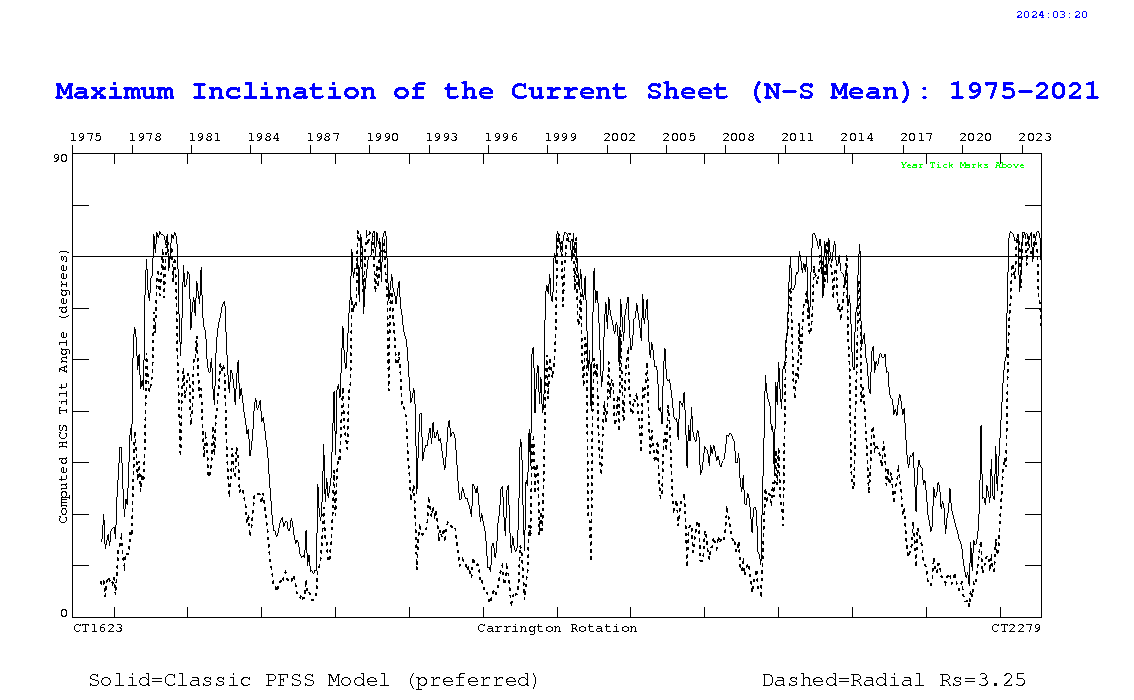
The site provides two data series – the classic and the radial, and notes that the radial may be possibly more accurate. Plotting up the radial data, the following chart is generated:

The heliospheric current sheet, for the last three minima, has got down to 3°. The last reading was 8.7°. It has been declining at an average of 8.6° per annum. If it holds that rate, solar minimum will be in August 2009. If it holds to the orange bounding line, solar minimum could be as late as April 2010. The last reading on the classic series is 22.8° and this series got down to 10° on average in previous solar minima. At its decline rate, solar minimum will be in another 1.9 years, which is late 2010.
To paraphrase a popular aphorism, Solar Cycle 23 isn’t over until the heliospheric current sheet has flattened, and it has a way to go yet.
Discover more from Watts Up With That?
Subscribe to get the latest posts sent to your email.
Mid 2009 makes for a long cycle, but mid or late 2010 adds a whole new dimension to SC23 and what comes next.
I have long suspected that from observing populations that they are programmed to respond according to thier climes. The sun, overly active or acutely inactive, is a driver of human behavior. This is my suspicion.
The response seems to be sumliminal, and it would be mass learned behavior.
Again, only a suspicion, but this is an outgrowth of something that I learned from my history teacher: to observe and pay attention to crowd behavior.
I have a question:
If the heliosphere is taking a very long time to reach it’s bottom (resting point), what then does this do to the strength (if anything) to the magnetic fields on the Sun or anywhere else?
I am thinking along the lines of ‘line drop’ or a battery that is used too long before charging.
Robert Bateman (20:13:07) :
The sun, overly active or acutely inactive, is a driver of human behavior.
A Soviet scientist I once worked with was convinced that the agitation of inmates in insane asylums peaked on the day the HCS sweps over the Earth. [see, I’m even on topic]. Pigeon races are canceled if the Kp-index exceeds 4. [This latter factoid may have some foundation in physiology as it is claimed that pigeons partly use the Earth’s magnetic field for navigation].
pay attention to crowd behavior.
Humans have a large component of herd behavior: follow the forceful leader… They do not want to be alone with something…the nail that sticks up is the one that gets hammered down…
@ur momisugly Pamela Gray (19:20:26) :
“hasitbeen4yearsyet, correct me if I’m wrong, but the thread is about the Sun. No?”
A website dedicated to climate just happens to be talking about the sun, for no particular reason. Must be a slow day finding errors in NASA’s
propaganda, uh, I mean “data” (wink wink nudge nudge). Silly me. Whatever was I thinking.I mean, just because, over the last 2300 years, the OORT, WOLF, SPOERER, MAUNDER and DALTON minima were all correlated with sun cycle activity (apparently coupled to the orbits of Saturn and Jupiter), and just because we are at (almost?) the exact point of the next expected minimum, is no reason for me to be making the solar/climate connection.
http://www.schulphysik.de/klima/landscheidt/iceage.htm
http://earthobservatory.nasa.gov/Newsroom/view.php?old=200112065794
Oh, how will I ever live with my shame?
Robert Bateman (20:20:20) :
I have a question: If the heliosphere is taking a very long time to reach it’s bottom (resting point), what then does this do to the strength (if anything) to the magnetic fields on the Sun or anywhere else?
I’ll let David Achibald get a first stab at answering that one…
@Robert Bateman (20:13:07) :
Some time ago there was a study where the inmates of insane asylums (as they were referred to when that study was done) would always act more loony when the moon was full, …but only if they KNEW it was full (i.e., they could see it out the window or from some other cue). But from that we learn nothing whatever about the physics of the moon.
Jane (13:09:28) :
Back to reality folks:
The difference between the solar minimum and solar maximum over the 11-year solar cycle is 10 times smaller than the effect of greenhouse gases over the same interval.
———————-
Starting off an AGW post with “Back to reality folks” and then linking to the New Scientist and the BBC is the highest form of satire Jane.
At first, I thought that the excerpt that I quote from your post was a misspeak, but that was how it was at the BBC link. Surely they (and you) are not meaning to say this ?? The posters on here with the numbers at their fingertips can probably weigh in on this, but if the solar contribution is ten times smaller than the greenhouse gas contribution (i.e. all water vapor/vapour, CO2 and methane, et al combined), then its contribution, relative to anthropogenic greenhouse gases only, wipes out most of or essentially all of the entire AGW theory ??
Are you/the BBC meaning to say “ten times smaller than anthropogenic greenhouse gases”?
Can someone help me with this please? Is Jane more prescient than she knows, and isn’t that a bit of a (another) clanger dropped by the BBC ??
Anthony/Leif,
Anthony has noted a step function on the AP Index (I think?) in October of 2005. Is there a similar function illustrated by this graph for the HCS? 2005 is not marked out, but I would guess the big fall after the peak at “40” might be it. Also, there is a big “crash” in what looks like 2001, maybe, and then a decent recovery but still a steady decline generally after that crash (down to “10”). Any explanations as to that? If this has been asked/answered, just direct me. But also, one last note: SC 23 looks similar to SC 21, but it’s a good deal more erratic it woud seem. Any ideas as to why?
@ur momisugly Lee Kington (14:27:37) :
“The problem is that the mechanism of that ’something else’ has not been identified. “
Svensmark’s on it…
http://www.kolumbus.fi/larsil/SDOC2681.pdf
Bobby Lane (21:17:35) :
Anthony has noted a step function on the AP Index (I think?) in October of 2005.
This ‘step’ is due to a very strong single storm in September and does not represent an important change in the solar wind.
Also, there is a big “crash” in what looks like 2001
due to equipment problems and should be disregarded.
But also, one last note: SC 23 looks similar to SC 21, but it’s a good deal more erratic it woud seem. Any ideas as to why?
there is no ‘law’ that says they should be similar in any way. The Sun is a messy place. An earlier reply [scroll up a bit] explains why we should not even expect the HCS warp to be similar at different minima. There is a good reason [see above] why the calculated current sheet flatness is not expected to go as low as it did the last couple of cycles. There has been cases in the past where the tilt fell to zero for a whole year. So you cannot just extrapolate as was done.
I’ve been fascinated by this Heliospheric Current Sheet. I’d never heard of it before. I’ve been trying to understand what it is all evening.
At first I thought it was like a garden sprinkler, and the sun was hosing a 400 km/hr solar wind out into space as it rotated, and that was why the picture showed a spiral. But then I couldn’t see where the nozzle of the hose was on the sun’s surface. So I began to think I’d gotten hold of the completely wrong idea.
So I went back and read that the Heliospheric Current Sheet was where the polarity of the sun’s magnetic field changed from north to south. And so I thought about the magnetic field of a bar magnet, which sprouts out of the north pole and loops back round to re-enter the south pole, and I began to wonder where along one of those lines the field changed from ‘north’ to ‘south’. But I couldn’t figure that out either.
Now I’ve been looking at Leif Svalgaard’s paper, which has very strange-looking magnetic field shown in Figure 1. It looks a bit like the magnetic field of a bar magnet, but one which someone’s taken a giant pair of pliers and squeezed together the field lines at the sun’s equator. Am I reading it right, and the current sheet is where outgoing field lines and incoming field lines pass very close to each other in the sun’s equatorial plane? And is what is meant by “closed” field lines ones that come out of the sun and go back in, and “open” field lines ones that come out of the sun but don’t go back in?
If I’m on the right track, then I don’t understand why the sun’s magnetic field is shaped like this, and not like that of a simple bar magnet. Is it shaped this way because there’s some external magnetic influence? Or because the sun isn’t a simple bar magnet?
I think that maybe if I manage to get this right, I just might be able to move on to try to understand how this sheet behaves like a “ballerina’s skirt”. It might even be quite fun, chasing this particular skirt…
I hope this isn’t OT, it is about the sun’s effect on climate on earth, but not specifically the Heliospheric current sheet.
It’s about this study :
The Milky Way Galaxy’s Spiral Arms and Ice-Age Epochs and the Cosmic Ray Connection
at this link :
http://www.sciencebits.com/ice-ages
I’d like to read comments about it from he scientific minds here, if you would.
@Pamela Gray
The sun IS important, …but not JUST for it’s own sake…
http://jennifermarohasy.com/blog/2008/01/you-cant-tax-the-sun/?cp=2
Robert Bateman, good question. The IMF is also flatlining at about 4 nT. No ramp up yet detectable in that data series either.
Leif Svalgaard (15:07:16) :
Leif Svalgaard (14:33:32) :
tallbloke (12:27:14) :
“When does the earth reach it’s maximum height above and below the flattened HCS”
On March 7th we are the most North of the HCS and on September 7th we are the most South of the HCS.
In my haste I had this backwards. In September we have better look at the north pole and are thus above [north of] the HCS, and vice versa for south.
Leif, thanks for the correction, you are a most meticulous and thorough scientist. And a perceptive one, it was the direction of the suns tilt I was primarily after. Your original comment had me confused because the earth would cross the suns nodes on the plane of invariance in december and june, and be fully north or south of the flattened HCS shortly after, but wouldn’t reach it’s maxima until the dates you provide. Just a note of interest, the sun’s 7 degree tilt precesses at virtually the same rate as earth’s, though for reasons which are opaque to me. Could it have anything to do with synchrony between the earth and sun’s magnetism?
Incidentally Leif, a bit of culture for you. The colour your graphic artist chose for your image of the HCS, and the shape of the emanating spirals, reminded me of this painting by Frieda Harris called ‘The Star’
http://www.keepsilence.org/liber22/assets/img/medium/trump_17_thestar.jpg
Now that should join your tiled screen background for a bit of contrast. 😉
Lief, personally I find David’s illustrative ‘orange line’ useful. What it represents is not less contentious than a statistical correlation of some kind.
Having been involved in the successful use of computer models and statistical methods … drawing lines to make a point is not outrageous. Most of what I see in the study of the sun, climate and atmosphere is however. Like ‘corn for fuel’, you can follow the money and see the subsidy (vs science) in action.
Anyway, what is your thought on the Jose Cycle or a medium term cycle between the Milankovitch cycle and Sunspot Cycle and why would the energy transport mechanisms be any different in the 3 cases. I would think the moderating effects on Earth would mask the shorter cycles more (ie: solar irradiance, solar insolation).
I read all this stuff and I keep going back to the Jose Cycle. … and recently I discovered reference to the snake (cloud) in the Milky Way which will soon hold the sun in its mouth. I might have to make a trip to see that, but then I might end up travelling 3000 miles just to talk to a lot of 2012 types 😀 All this is interesting but I just can’t see why what we are observing now isn’t just part of a repeating 172 year Barycentric Tidal phenomena created in the Sun by the Planets (especially the gas giants). Everything else is just detail and nuance which is only important after the gross phenomena is recognized.
From the plethora of predictions and precursors for the future solar activity, one by Dr. Svalgaard (and colleagues), based on polar magnetic field intensity, from my amateur’s point of view, makes most sense.
As some of you might be aware, I have produced a simple formula closely tracking the polar magnetic fields (correlation factor over 0.93), as measured over the last 40 years.
Formula extrapolation beyond 2010 shows some interesting results, which are in line with one or two recent statistical or hypothetical estimates.
http://www.vukcevic.co.uk/PolarFields-vf.gif
http://www.geocities.com/vukcevicu/PolarFields-vf.gif
One of the most reputable solar scientists qualified it as:
Such a formula has no predictive power, unless you assume that one or both of these statements are true:
1) there is an underlying reality we don’t know about but that the formula somehow expresses it.
or
2) there is a plausible and viable physical theory that specifies that the sun should work as expressed by the formula.
Unfortunately (if indeed there is such a link), I am unable to satisfy the rigour of accepted science with either of the above quoted conditions, perhaps due to a lack of a detailed knowledge, rather than enthusiasm or inventiveness.
If Anthony, and some of you believe, that a wider exposure on this blog, may move it step forward, I would more then welcome any sensible assistance or cooperation.
Note: I am well aware of barycentre, torque and other mechanical hypotheses, what is needed here is a credible electromagnetic link.
Jeff (09:45:24) :
Not the world but central England just had the coldest January since 1997.
http://hadobs.metoffice.com/hadcet/cetml1659on.dat
Vukcevic:
does your formula driven curve increase in amplitude further in the future?
Is it derived solely from the two cycles of data shown?
tallbloke (04:42:20) :
to
Vukcevic:
does your formula driven curve increase in amplitude further in the future?
Is it derived solely from the two cycles of data shown?
Yes, it recovers slowly, and by 2060 has values comparable to 1995.
Polar magnetic field strength was first measured (existing data) by the Mount Wilson observatory in 1965; Wilcox observatory (started their measurements by Dr. Svalgaard and co.) in 1975. Their data appears to be less prone to noise then the MWO’s, hence switch over in1975.5 from MWO to WSO data. My initial data were obtained by a private communication from Dr. S; WSO data is also available on their website.
The formula is not derived from the data (it is my old formula, tracking sunspot cycles, moved forward by about 4 years, the average cycle rise time. It has much closer correlation to the polar field strength; so if there is a link, then appears to be to the polar fields.
Thanks, so in effect, and noting your point about correlation strength, we get a 4 year ‘prediction’ of sunspot activity by looking at the polar field strength?
Robert Bateman (20:20:20) :
I have a question:
If the heliosphere is taking a very long time to reach it’s bottom (resting point), what then does this do to the strength (if anything) to the magnetic fields on the Sun or anywhere else?
David Archibald (23:12:23) :
Robert Bateman, good question. The IMF is also flatlining at about 4 nT.
Cause and effect are the other way around: it is the Sun’s magnetic field that determine what the heliosphere is doing. The HCS is not seeking its resting place. Its shape is simply determined by the balance between the polar fields and the low-latitude magnetic fields [solar activity]. If everything has flatlined [the IMF sitting at its floor; average 4.1 nT over the last year] the HCS should not flatten any further. Once again: the warp of the HCS is not required to go down to any specific level at solar minimum and most likely will not flatten any further; the polar fields are simply too weak for that.
tallbloke (23:59:51) :
the sun’s 7 degree tilt precesses at virtually the same rate as earth’s, though for reasons which are opaque to me.
I didn’t know that it did [does it?]
Could it have anything to do with synchrony between the earth and sun’s magnetism?
No such thing, so, no.
idlex (22:18:21) :
At first I thought it was like a garden sprinkler, and the sun was hosing a 400 km/hr solar wind out into space as it rotated, and that was why the picture showed a spiral.
Yes, that is basically how it works [except it is 400 km per second!]
But then I couldn’t see where the nozzle of the hose was on the sun’s surface.
There is just not one nozzle, but many all over the Sun.
And is what is meant by “closed” field lines ones that come out of the sun and go back in, and “open” field lines ones that come out of the sun but don’t go back in?
All field lines go ‘back in’ eventually. The open/closed terminology is simply one of convenience: the ‘closed’ ones go back in close to the Sun where we can see them; the ‘open’ ones make a detour way out into interplanetary [maybe even interstellar] space and we don’t know where they come back.
Or because the sun isn’t a simple bar magnet?
is the correct picture.
tallbloke (06:36:25) :
we get a 4 year ‘prediction’ of sunspot activity by looking at the polar field strength?
Yes, and no need for quotes. http://www.leif.org/research/Cycle%2024%20Smallest%20100%20years.pdf
idlex (22:18:21) :
But then I couldn’t see where the nozzle of the hose was on the sun’s surface.
There is just not one nozzle, but many all over the Sun. I forgot to mention that some of the bigger nozzles are indeed visible, they are called coronal holes. They are the dark areas visible here: http://sohowww.nascom.nasa.gov/data/realtime/eit_171/512/ especially near the poles for the moment, but they can appear at any location.