Many readers are familiar with a number of solar proxies used to gauge the activity of the sun, the most familiar being sunspot counts and type. However they aren’t the only metric you can use to determine when one cycle ends and another begins. The Heliospheric Current Sheet sounds a bit like a “newsletter” and in a sense it is, because it can announce the true end of solar cycle 23.
Here’s what it looks like:

Heliospheric current sheet – click for larger image
From Wikipedia:
The heliospheric current sheet (HCS) is the surface within the Solar System where the polarity of the Sun’s magnetic field changes from north to south. This field extends throughout the Sun’s equatorial plane in the heliosphere.The shape of the current sheet results from the influence of the Sun’s rotating magnetic field on the plasma in the interplanetary medium (Solar Wind). A small electrical current flows within the sheet, about 10−10 A/m². The thickness of the current sheet is about 10,000 km.
The underlying magnetic field is called the interplanetary magnetic field, and the resulting electric current forms part of the heliospheric current circuit.[4] The heliospheric current sheet is also sometimes called the interplanetary current sheet.
What the Heliospheric Current Sheet is telling us.
David Archibald writes:
One of the things that the now disbanded NASA Solar Cycle 24 Prediction Panel told us was that is that solar minimum is marked by a flat heliospheric current sheet. The heliospheric current sheet can be found here: http://wso.stanford.edu/gifs/Tilts.gif
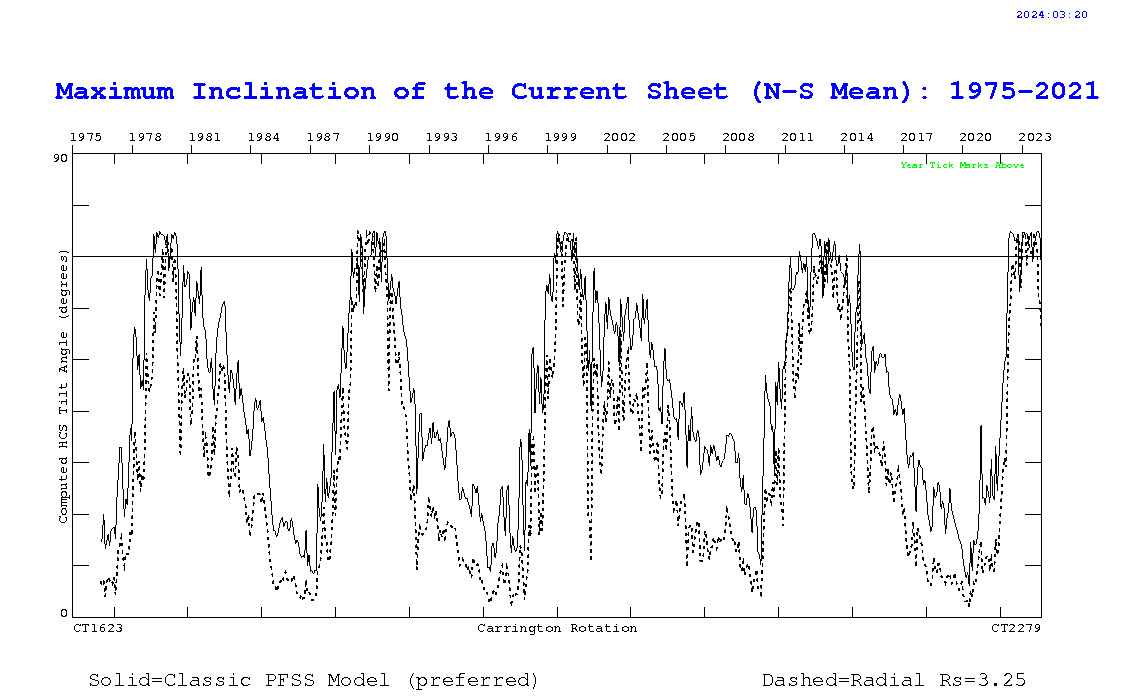
The site provides two data series – the classic and the radial, and notes that the radial may be possibly more accurate. Plotting up the radial data, the following chart is generated:

The heliospheric current sheet, for the last three minima, has got down to 3°. The last reading was 8.7°. It has been declining at an average of 8.6° per annum. If it holds that rate, solar minimum will be in August 2009. If it holds to the orange bounding line, solar minimum could be as late as April 2010. The last reading on the classic series is 22.8° and this series got down to 10° on average in previous solar minima. At its decline rate, solar minimum will be in another 1.9 years, which is late 2010.
To paraphrase a popular aphorism, Solar Cycle 23 isn’t over until the heliospheric current sheet has flattened, and it has a way to go yet.
Discover more from Watts Up With That?
Subscribe to get the latest posts sent to your email.
Leif Svalgaard (14:33:32) :
tallbloke (12:27:14) :
“When does the earth reach it’s maximum height above and below the flattened HCS”
On March 7th we are the most North of the HCS and on September 7th we are the most South of the HCS.
In my haste I had this backwards. In September we have better look at the north pole and are thus above [north of] the HCS, and vice versa for south.
gary gulrud (14:00:29) :
Ramping up? Schadenfreude is delicious.
It takes a certain kind of nasty person to enjoy such fruits.
Dr Svalgaard (12:21:37) :
On 14th February at (16:11:20), you wrote:
On the subject of NASA, we haven’t heard from the Solar Cycle 24 Prediction Panel for a while.
And you won’t because, there will be no more meetings as we didn’t produce the desired [high] consensus so NASA/NOAA has lost interest.
I stand corrected. It is not disbanded, just no more meetings.
Still on the subject of NASA, Dr Hathaway has a fresh presentation given at Astrofest here:http://solarscience.msfc.nasa.gov/presentations/20090207Astrofest_SunspotCycle.ppt
I have borrowed the blue background he used for my own presentations.
Re TitiXXXX1892 (14:03:34)
I overcame my pain barrier and read the Jager and Duhau paper. The first third of the paper is taken up with making a prediction of Solar Cycle 24 amplitude using a geomagnetic index at minimum. Any fool can do that, and I have done it myself. The rest of the paper is based on dreamt up solar activity states with transition periods between them that give the authors a fudge factor. Their predictions are based on a fantasy world they created.
Back to the graph above. I drew the orange line because four points line up. The statistically minded amongst us can tell us what the chances of that happening at random are. From my experience, it is non-existent. So the orange line marks an upper activity boundary. We see similar things in the IMF data. When that line is breached, Solar Cycle 23 will definitely be over, but it may touch the green one first.
Jane
“The difference between the solar minimum and solar maximum over the 11-year solar cycle is 10 times smaller than the effect of greenhouse gases over the same interval.”
I keep reading assertions like that and I keep asking (as a non-scientist), “please provide some evidence”. Your statement seems to tie in rather well with the old saw that 68.7% of statistics are made up on the spur of the moment.
Where, please, is your PROOF?
To me the focus on the sun alone is just a distraction. The variation in TSI only causes a tenth of a degree or so of climate change. The interesting part is how all the climatic influences work in unison or opposition. The cool PDO shift will have more impact on global climate than the sun. A shift to a cool AMO will have about the same impact as the sun. La Nina versus El Nino may have 0,2 tenths of a degree influence. When influences get synchronized is when things really happen.
Own its own the Sun can’t make a dramatic impact on climate based on past performance. But a solar minimum synchronized with a cool phase of one or more oscillations can.
It is like the museum with the huge mass of iron hung from a rope. With a small magnet on a string you can get the tons of metal swinging with small harmonic tugs. To me this is the beauty of our planet. The mystery of our chaotic climate.
Jane (13:09:28) :
Back to reality folks:
Solar variations do affect climate, but they are not the only factor. As there has been no positive trend in any solar index since the 1960s (and possibly a small negative trend), solar forcing cannot be responsible for the recent temperature trends. The difference between the solar minimum and solar maximum over the 11-year solar cycle is 10 times smaller than the effect of greenhouse gases over the same interval.
http://news.bbc.co.uk/1/hi/in_depth/629/629/7074601.stm
Direct satellite measurements of solar activity show it has been declining since the mid-1980s and cannot account for recent rises in global temperatures, according to new research.
The findings debunk an explanation for climate change that is often cited by people who are not convinced that greenhouse gas emissions from human activities are causing the Earth’s climate to warm.
This is an interesting period because we have now all kinds of sensors in place to study what happens with our sun.
That is the current reality.
http://www.newscientist.com/article/dn12234
Jane.
The reality is that most of the past warming and the current cooling we have experienced is caused by a natural cycle of the PDO and that went from positive (warm) into negative (cold) phase combined with an El Nino(extra cold) (La Ninja=extra warm).
Since the Atlantic now also is cooling, both natural cycles are getting in sync.
It could get more colder this time than we experienced during the past cold period (negative PDO phase (this time it could be more like the winters we had during the 18th century, even a Dalton or Maunder Minimum is mentioned.
This colder situation is here to stay for at least the next twenty years.
The last time the PDO and AMO were in negative phase (from 1948 – 1976) and scientists warned for a new ice age.
Now scientists are trying to find out what mechanism triggers the PDO and AMO to go from positive to negative. It is very well possible that the sun plays a role in this, as is the effects from interaction(s) between the Eart’s and Sun’s magnetic field, solar wind and intergalactic particles that enter the earths atmosphere when the solar magnetic field is low as well as other possible effects that influence our weather, oceans and climate.
Anyhow this is what is discussed here and this is our reality.
P.s The articles from the BBC (especially BBC) and Nature are toxic = BS (Bad Science)
Leif: Thanks
now clear
About Lulin: ‘disconnection event’
The ‘disconnection event’ [comet losing its tail] is not by solar wind ‘blasts’ or pressure, but by the solar wind magnetic field abruptly changing direction as the heliospheric current sheet sweeps over the comet.
Is it just me or perhaps an Urban Myth, but does anybody see a similarity between 21 and 23; at least on the down stroke. Do we have 19 and 20 to look at too to see if there is an odd-even effect; or a full magnetic cycle effect.
Well one day it will all make sense to somebody, I suppose.
George
Right now, over on http://icecap.us, there is a graph of solar irradiance from 1611 to 2001. It shows a ramp up starting in 1911 and reaching a max. in 1941 and oscillating around an elevated level till 2001. WUWT? the graph is near the top of the right hand column.
Ref. mr.artday
Right now, over on http://icecap.us, there is a graph of solar irradiance from 1611 to 2001. It shows a ramp up starting in 1911 and reaching a max. in 1941 and oscillating around an elevated level till 2001. WUWT? the graph is near the top of the right hand column.
That chart is a bit small for my eyes, but it appears similar to the Lean 2000 TSI reconstruction. Very well cited study that has been superseded by many including the original author. It is used by both warmers and skeptics to prove points. It is unfortunately obsolete. It is a brilliant example of how unintentional bias can creep into reconstructions, looking for what you want to find versus reality.
“It takes a certain kind of nasty person to enjoy such fruits.”
Touche, but then “why kick against the goads?”
“”” Jane (13:09:28) :
Back to reality folks:
Solar variations do affect climate, but they are not the only factor. As there has been no positive trend in any solar index since the 1960s (and possibly a small negative trend), solar forcing cannot be responsible for the recent temperature trends. The difference between the solar minimum and solar maximum over the 11-year solar cycle is 10 times smaller than the effect of greenhouse gases over the same interval.
http://news.bbc.co.uk/1/hi/in_depth/629/629/7074601.stm
Direct satellite measurements of solar activity show it has been declining since the mid-1980s and cannot account for recent rises in global temperatures, according to new research.
The findings debunk an explanation for climate change that is often cited by people who are not convinced that greenhouse gas emissions from human activities are causing the Earth’s climate to warm.
http://www.newscientist.com/article/dn12234 “””
Well Jane,
Thanks for jerking us back to reality. Reading between the lines in your note; which is somewhat difficult given the presence of non-SI units such as “forcings” which aren’t listed in ANY Physics book I ever Studied (but then my studies only go back a bit more than 50 years) so if “Forcings were discovered long before that I might not have read about them.
But I infer from the tone of your message, that it is well known that the only way in which the sun effects the planet earth; besides it’s gravitational attraction of course; is by way of the so-called “Solar Constant” which only variaes about 0.1% peak to peak over the duration of a sunspot cycle, and since that number is the ONLY solar “Forcing”, then it can’t be responsible for any significant earth warming; not that there has been any significant earth warming, although there has been some.
Can you elaborate on how the solar constant affects earth’s temperature; apart form the presumably near black body radiation connection, which could account for about 0.072 deg C temperature change over a solar cycle.
George
It’s obvious that environmental activity on the sun effects envirionmental activity on the earth. It’s not possible that it doesn’t. What the exact effects are–from reading these comments I can see even those who love to study it don’t know for sure.
It would be nice to see Piers Corbyn’s ideas on the sun’s effect on the earth posted here. But I suppose if he revealed to much his business would be in jeopardy. It would be like Colonel Sanders telling what his 11 herbs and spices are. So I don’t expect to see Piers here. 🙁
————————-
On Wikipedia :
It’s a nice little tool if you want an introduction to something. But still, if you really want to understand something you’re going to have to go a lot more sources. It seems most people like to use Wiki as a short cut to understanding something. Those kind of short cuts are never good.
What Anthony may be refering to when he cautions people about Wiki is summed up vividly by Lawrence Solomon in his article, “Wikipedia Zealots”
at this link :
http://network.nationalpost.com/np/blogs/fpcomment/archive/2008/04/12/wikipedia-s-zealots-solomon.aspx
Wow! It looks like pick on Jane night! Without any ad homs or derogatory remarks Jane, there are a few valid questions about the degree of warming due to GHGs. First, the amount of warming due to GHGs depends on the amount of water vapor feedback which is unknown. Second, the warming since the 1970’s would include both GHG and natural variation. The percentage of each is unknown. A rather smart guy A.A. Tsonis who likes to deal with chaotic mathematics, determined that synchronization of natural climate forces are very significant in climate change. Possible much more that GHGs.
Does that mean that GHGs are not a problem? No, just that natural variation is more significant than many suggest at this time in history.
Since you mentioned that solar has not had an impact since the 1960s, I recommend that you click on Lief Svalguard’s site to update from the obsolete solar reconstruction you are using. There are a lot of interesting things out there if you avoid the herd mentality.
“On the subject of NASA, we haven’t heard from the Solar Cycle 24 Prediction Panel for a while.
And you won’t because, there will be no more meetings as we didn’t produce the desired [high] consensus so NASA/NOAA has lost interest.”
Why would they lose interest? Possibilities include:
a) a nonsevere solar cycle will reduce orbital erosion of satellites and thus reduce the need for large budget requests for replacements….
b) … as well as a lack of need for budget for other stuff like emergency ruggedizing of earth-based electronics/electrical infrastructure against the consequences….
c) …. and/or…. while they would have loved to trumpet a severe solar cycle as additional reason for arguing for the US to support Kyoto and IPCC, the weak cycle means they’d rather continue to deny the solar influence on climate.
David Archibald (15:11:03) :
I overcame my pain barrier and read the Jager and Duhau paper.
I agree it is junk. But then I call so much of what I see junk, so this will not deter the enthusiasts.
the orange line because four points line up.
one of which is artificial. Perhaps it is time to substitute eye-balling with some understanding. Did you study and understand the detailed explanation I gave for what governs the flatness? and why not?
Sam the Skeptic (15:13:53) :
Where, please, is your PROOF?
direct measurement of solar irradiance: http://www.pmodwrc.ch/pmod.php?topic=tsi/composite/SolarConstant
Mike Lorrey (17:43:50) :
Solar Cycle 24 Prediction Panel…
Why would they lose interest?
My take is that they wanted a high prediction [insurance companies lobbying the Goverment; NASA and NSF support for ‘breakthrough’ science – they like the breakthrough to actually come through] and since we would not give them that, what’s the point?
But, we’ll see what the last gasp turns out to be. Watch http://www.swpc.noaa.gov/sww/index.html
Well most here should know that these “drive bys” like that of Jane is only intended to get you off the subject and if you ignore then they go away. That being said I have looking at the connect between the ionosphere and troposphere and what happens in the tropical thunder storm regions and if you can change cloud cover by 2% from the effect of VLF on cloud forming nuclei then that can have a measure effect on atmospheric circulation and cloud cover in general. VLF is from the electrical connection between the two regions and it is VLF we use to measure water vapor and its interaction with water vapor is understood. The solar connection is about magnetism and the interaction between Earth and Sun magnetic fields. When the Sun’s magnetic field is reduced this changes the “charge” in the ionosphere and troposphere connection which then allows more/less clouds to form and changing the atmospheric circulation. There are a few factors like CME’s and flares that also change this connection. When I look at this connection it reminds me of a FET( field effect transistor). I am still looking into this but have to bring in the bread first.
I now understand Leif’s desire to view the Sun outside the Earth’s atmosphere (people as well as air). To study the Sun as an entity all to itself sounds like heaven to me. I am still trying to find a realtime video of the boiling surface. I love that view of the Sun and wished I had a dress made out of a fluid fabric that was screen printed that way. I also, in my mind’s eye, see an Andy Warhol-like series of color filtered views of the roiling Sun. It would look great on my walls.
This absolutely fascinates me. I should be able to understand it (my major in grad school was electrophysics) but I’m hung up on one thing. The sheet twists more than I’d expect. Shouldn’t the magnetism propagate outward at the speed of light?
Yup. It’s the sun, all right, …and some other stuff that influences the sun?
http://www.publish.csiro.au/nid/138/paper/AS06018.htm
http://motls.blogspot.com/2008/06/sun-jupiter-saturn-spin-orbit-coupling.html
http://lep694.gsfc.nasa.gov/gunther/gunther/MikulaSS2006Article.pdf
http://www.vukcevic.co.uk/solarcurrent.pdf
http://www.vukcevic.co.uk/solarsubcycle.pdf
(Interesting stuff, M.A.V.)
I wonder if that NASA Spaceweather Workshop referred to by Leif Svalgaard (17:57:52) : is where Gepeto and Jiminy Cricket are planning on showing off what they hope will one day magically become a “real” theory, instead of a wooden one with that’s manipulated with a lot of AGW strings?
Frederick Michael (18:26:04) :
Shouldn’t the magnetism propagate outward at the speed of light?
In a vacuum it would, but interplanetary space is not a vacuum. It is filled with a highly conduction dilute gas. If you change the magnetic field in the presence of a conductor, the change would induce a current in the conductor [that is how your bicycle dynamo light worked: a magnet turning inside a copper coil]. This current would itself have a magnetic field opposing that of the first magnetic field. The only way to move the magnetic field is to move the conductor; this is often expressed by saying that the filed is ‘frozen into the plasma’ and moves with it. Since the solar wind plasma moves at 400 km per second, that becomes the speed of magnetic [and electric for that matter] changes as well…
Pamela,
Here are some spectacular images of the sun.
http://www.boston.com/bigpicture/2008/10/the_sun.html
Keep scrolling down there are a bunch of ’em…
Mike
hasitbeen4yearsyet, correct me if I’m wrong, but the thread is about the Sun. No? Reading between the lines of your post, I assume you are wanting to connect the Sun to the temperature variations of our planet. I know about the links you provide. Only one has a very tenuous attempt to connect Earth’s temperature to the Sun, and that one has no reference section that I can see, and less in terms of mechanism.
It seems to me that the topic in this thread, along with the calculations provided by those who know what they are talking about, seems clearly separate from the topic of Earth’s temperature, in thread name as well as in possible mechanisms.
Maybe what we need is a thread about the oceanic oscillations and jet stream influences on climate zones. Once that is well understood, we can entertain the less major weather pattern variations (which some people like to call climate change) and forcings.
It is interesting to see there is a fast rise and slow dropoff. We’ve seen that in old temperature estimates.