From ICECAP
By Joseph D’Aleo CCM, AMS Fellow
2008 will be coming to a close with yet another spotless days according to the latest solar image.

This will bring the total number of sunspotless days this month to 28 and for the year to 266, clearly enough to make 2008, the second least active solar year since 1900.

See larger image here.
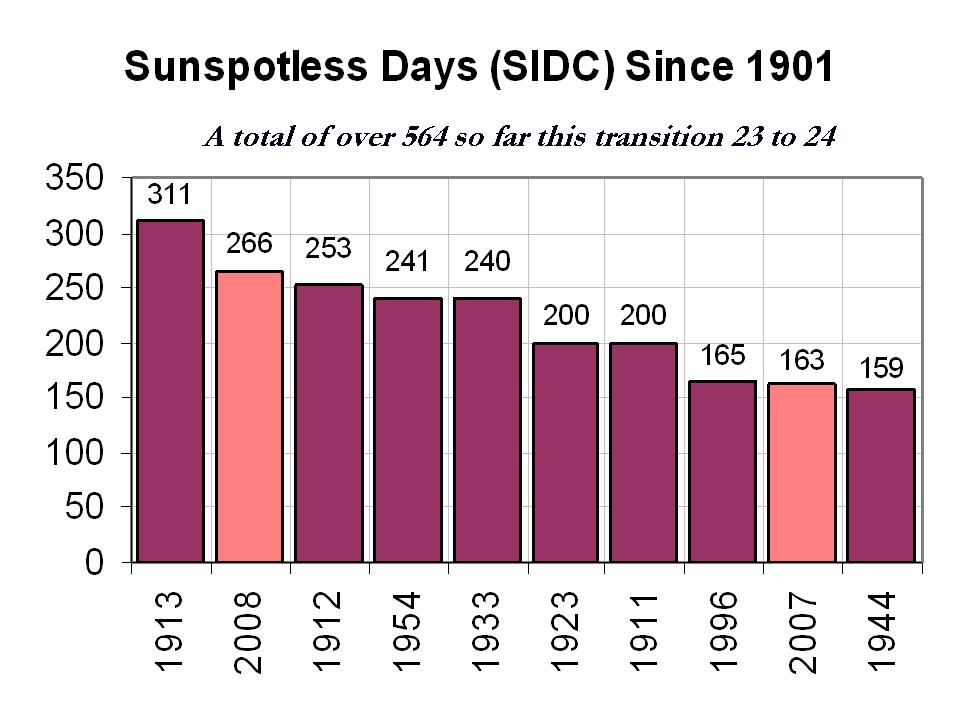
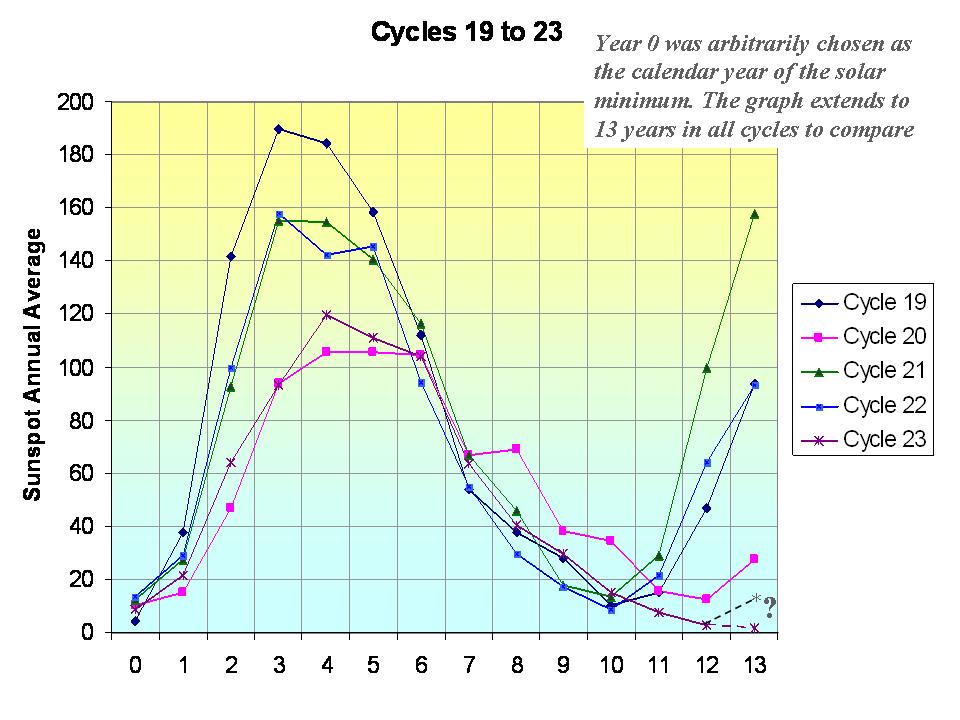
The total number of spotless days this spolar minimum is now at around 510 days since the last maximum. The earliest the minimum of the sunspot cycles can be is July 2008, which would make the cycle length 12 years 3 months, longest since cycle 9 in 1848. If the sun stays quiet for a few more months we will rival the early 1800s, the Dalton Minimum which fits with the 213 year cycle which begin with the solar minimum in the late 1790s.

See larger image here.
Long cycles are cold and short ones like the ones in the 1980s and 1990s are warm as this analysis by Friis-Christensen in 1991 showed clearly.

See larger image here.
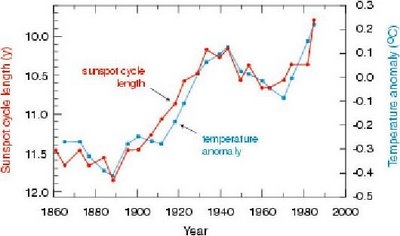
In reply to the arguments made that the temperatures after 1990 no longer agreed with solar length, I point out that it was around 1990 when a major global station dropout (many rural) began which led to an exaggeration of the warming in the global temperature data bases. Also the length from max to max of 21 to 22 was 9.7 years and cycle 22 length min to min 9.8 years, both very short suggesting warm temperatures in the 1990s. The interval of cycle 22 max to cycle 23 max centered in the mid 1990s began to increase at 10.7 years and the min to min length of cycle 23 is now at least 12.3 years.
With the Wigley suggested lag of sun to temperatures of 5 years and Landscheidt suggested 8 years, a leveling of should have been favored around 2000-2003 and cooling should be showing up now. Looking ahead, put that together with the flip of the PDO in the Pacific to cold and you have alarming signals that this cooling of the last 7 years will continue and accelerate.
Magnus!
Thank you for the Youtube video!
The context you established for it has me smiling broadly.
Happy New Year all!
Stay cozy chicks :0)
David Archibald has plots from specific regions/stations that show a correlation of sunspot cycle length and temperature
http://www.warwickhughes.com/agri/Solar_Arch_NY_Mar2_08.pdf
figs 4 and 5
I had not seen a global temperature chart before the figure above..
A bit of poetry from the Dalton Minimum:
ST. AGNES’ Eve—Ah, bitter chill it was!
The owl, for all his feathers, was a-cold;
The hare limp’d trembling through the frozen grass,
And silent was the flock in woolly fold:
Numb were the Beadsman’s fingers, while he told 5
His rosary, and while his frosted breath,
Like pious incense from a censer old,
Seem’d taking flight for heaven, without a death,
Past the sweet Virgin’s picture, while his prayer he saith.
–John Keats
Jeff L (12:40:29) :
(potentially quantifiable – Hathway I believe is calling for a 2.1 deg C decrease, if I recall correctly)
… wait – that was Archibald, not Hathaway ( I didn’t recal correctly) :
See link at Icecap:
http://icecap.us/images/uploads/fyingtheUSAgriculturalProductivityResponsetoSolarCycle24.doc
‘It will make interesting reading while I freeze my tucas off here in Saskatchewan.’
Where in Saskatchewan did you acquire that glorious NewYork Yiddishism?
How sad! Catching the typo just as the message has been irrevocably launched into cyberspace!
Reply: Fixed! ~dbstealey, mod.
“However, they make no mention of the Pacific Decadal Oscillations etc. which may invalidate their conclusions.”
So may their dependence also on global temperature data of the last 30 years.
How can anything that scientist Schneider publishes or says be trusted based on his statement quoted above? The only way is if he clearly and thoroughly explains his assumptions, methods, and data so they can be replicated.
Perhaps scientists that make statements like this or who perform what might be fraudulent work (like the hockey stick) need to be put on probation by their colleagues or on a special scrutiny watch list by all journal editors and reviewers.
Happy New Year from Western NY!
After a couple days with temps in the 60’s, all the snow we had (1-2 feet) melted. Now that the last of the flood warnings are ending, there’s another 10″ of that global warming on the ground waiting to be shoveled, with temps diving toward single digits, though quite warm compared to Fairbanks.
All this solar inactivity ought to translate into quite a few nasty winters in the next couple decades. Just what I’m not looking forward to…
Somewhat related story in Saturday’s National Post (Canada) about the Vendee Globe around the world single handed yacht race. The 30 boat fleet has been hit by the worst weather in the 19 year history of the race. Huge storm systems have battered the boats now for two weeks straight. 13 sailors have dropped out. One boat has been lost completely. The remaining yachts are currently south of Tasmania heading easterly. Happy New Year to all.
David L. Hagen (13:24:51) :
Thanks for the links. I see that the replies are not linked from Dr. Schneider’s site. Perhaps this is in keeping with his dilemma between honesty and effectiveness? Or perhaps he is simply awaiting a timely response from D&L — after all, it’s only been four years.
Maybe we should start a contest to come up with a name for the expected deep freeze . . . . a la the Maunder Minimum.
How about:
The Barak Ball Chiller
The Hansen Holy Crap it’s Colder’n a Witch’s Left Tittie
or ??
I hate to break in to your Holiday thoughts but Tamino’s last post calls Mr. Watt stupid and/or a Liar. He also implies that all readers of wattsup are stupid also.
What a ~snip~ head Tamino is!
A low energetic Sun plus the “hot water bottle effect” (http://co2sceptics.com/news.php?id=1487) seems logical to me.
The following question: what makes the Sun lower its activity?, we know it has two answers: One from the Sun´s internal dynamo, the other (heretical) that of the barycentric movements (see: http://www.giurfa.com/charvatova.pdf)…For a naive,guileless, ingenuous, credulous, gullible and susceptible layman, it seems to me that both will coincide in the future by means of a field of forces we do not yet detect, and that will remind us again the “music of the spheres”.
Jim Arndt (13:40:08)
I reckon the time constant of the oceans, in response to a step change in insolation, is around 60 years. That means that solar cycles would have to be stronger over several, 5-6 11 year cycles, to have an impact; the current low cycle, if that is what it is, will only have long term effect if it is repeated for a few more cycles.
But regarding the oceans as giant accumulators, with their own resonant frequencies, is, I think, the right approach.
There are many intereacting cycles here: The solar cycles; the oceanic thermal “resonant frequencies”; the Earth’s orbit; cloud formation; jet stream motion. With so many intereacting variables, no wonder the planet’s “climate” appears chaotic, but slow but sluggish (no rapid changes).
Things will get really cold with a succession of weak cycles coinciding with la Ninas and -ve AMOs (if I have the terminology right).
Note to the above:
The term “thermal resonant frequencies” I threw in there is the best way I can describe the idea of warm and cold water sloshing around in an oceanic basin.
Yellowstone sits a top of a thin crust spot and at the end of a series of faults that stretch from southern Cal, thru Utah and Idaho to Yellowstone. The last time this fault line had activity here in Idaho it effected Yellowstone and dropped part of our landscape about 5 feet in one area. There has been increased activity all along those fault lines but usually thats a good thing in small doses because in the world of earthquakes a bunch of little ones let off pressure rather than letting stress build up and cause a massive one.
http://earthquake.usgs.gov/eqcenter/index.php
This site lets you watch animations of earthquakes by area or even over the entire world. Its pretty cool to do the 7 day you can get a bit of an idea how the earth releases the stress of continental plate movement. While some would say , nothing to see here move along, I think with the recent eruptions along the ring of fire we might be seeing our plate movements a bit more dramatically over the next few years. Depending of course on what our lovely Earth has in store for us.
“The earliest the minimum of the sunspot cycles can be is July 2008, which would make the cycle length 12 years 3 months, longest since cycle 9 in 1848.”
Note above quote from the article. How will the end of the minimum be determined? The above statement looks back to July as the earliest it could be. Does this mean that after every month of solar activity data the we look back six months to see if the minimum has been achieved?
Also, is the 213 year cycle referred to related to the cycle of solar inertial motion?
As much as I like the sunspot duration/temp graph, it’s old. The last data is 1980. We now have 28 more years of data. Why hasn’t that graph been updated?
Richard deSousa (11:34:47) :
Nothing like a good old Dalton or Maunder Minimum to gag forever the likes of Hansen, Gore, Mann and company. The hubris of these so called scientists (Gore, excepted) is breath taking. They should all be crawling under rocks and never be heard from again.
I would expect at least an ongoing attempt to morph to “Man Made Emissions of CO2 Cause Extreme Climate Change Events”. Which would allow for either Warming or Cooling scenarios.
Then if/when it cools, they can claim a successful prediction.
The key point is to keep hyping the fear, maintain control and get the $$$ rolling in.
So no gag – sorry. What will gag them is to be roundly and publically discredited which hasn’t yet happend.
Arthur Glass (13:47:07) :
‘And like most people we’d like to see the world a better place…’
So did Lenin.
As do all Tyrants (and associated Psychopaths) – it’s better if it conforms to their personal vision of what is better.
Unfortunately for the rest of us – their visions are our nightmares.
Speaking of Tamino, can someone deconstruct this graph for me: http://tamino.files.wordpress.com/2008/12/5yr.jpg?w=489&h=361 . I thought that 1934 was the hottest year in the last century, yet this graph shows that this year, one of the coldest in recent memory, was far hotter. What’s up?
Fred from Canuckistan . . . (14:37:29) :
“Maybe we should start a contest to come up with a name for the expected deep freeze . . . . a la the Maunder Minimum.
How about:
The Barak Ball Chiller
The Hansen Holy Crap it’s Colder’n a Witch’s Left Tittie
or ??”
The new “Maunder Minimum” already is named after Dr. Theodore Landscheidt and it’s called the Landscheidt Minimum which will have it’s Maximum by 2030.
“THE RECOGNITION OF SCIENTIFIC COMMUNITY
Elected member of the American Geophysical Union, the New York Academy of Sciences, the European Science and Environment Forum, the European Academy of Environmental Affairs, and the Wittheit zu Bremen. Director of the International Committee for Research in Environmental Factors of Brussels University. In 1992 recipient of the. Award of the Edward R. Dewey Institute of Cycle Research, California, in recognition of “outstanding accomplishments in the field of Solar Cycle Research”, and for “many contributions to the study of solar-terrestrial cycles.” According to an offer of the group of geophysicists-climatologs from different countries the period of minimum of solar activity forecasted by Dr. Landscheidt around 2030 will be identified as “Landscheidt Minimum”.”
Source:
http://bourabai.narod.ru/landscheidt/
Our best wishes for all the “greenies” in the next “warmest year of the century”, if they succeed removing all the CO2…they will surely die.
By the way, has anybody noticed the big,big contradiction in GW´rs beliefs which promote a decrease in CO2, and, at the same time, an increase of forests?
I believe the correct statement is “the second least active solar year since 1901. There were 287 spotless days in 1901. Or you could almost say “since the first year of the 20th century” (which was, contrary to popular misconception, 1901.)
Happy New Year and a hearty Nov Shmoz ka Pop!