Many people that have have an interest in the interaction between the Sun and Earth have been keeping a watchful eye on several metrics of solar activity recently. The most popular of course has been sunspot watching.
The sun has been particularly quiet in the last several months, so quiet in fact that Australia’s space weather agency recently revised their solar cycle 24 forecast, pushing the expected date for a ramping up of cycle 24 sunspots into the future by six months.
On August 31st, at 23:59 UTC, just a little over 24 hours from now, we are very likely to make a bit of history. It looks like we will have gone an entire calendar month without a sunspot. According to data from NOAA’s National Geophysical Data Center, the last time that happened was in June of 1913. May of 1913 was also spotless.
With the current space weather activity level of the Sun being near zero, and the SOHO holographic imaging of the far side of the sun showing no developing spots that would come around the edge in the next 24 hours, it seems a safe bet to conclude that August 2008 will be the first spotless month since June 1913.
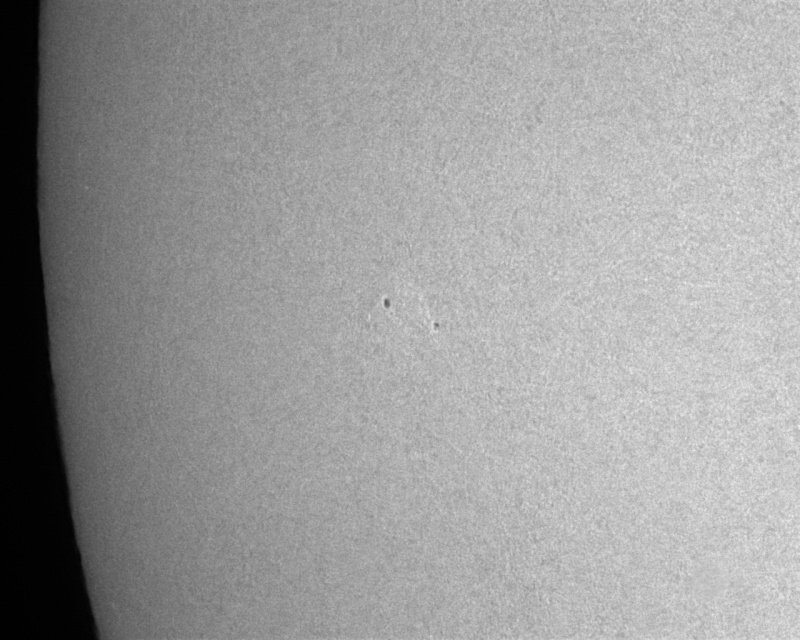
Here is the sun today, at 09:14UTC August 30th:

Click for a very large image
Some people who watch the sun regularly might argue that August wasn’t really spotless, because on August 21st, a very tiny plage area looked like it was going to become a countable sunspot. Here is an amateur astronomer’s photo of the event:
August 21st, 2008 spots – Photo: Pavol Rapavy
But according to solar physicist Leif Svalgaard, who regularly frequents this blog:
According to NOAA it was not assigned a number on Aug.21st nor on Aug.22.
So without an official recognition or a number assigned, it should not be counted in August as actual sunspot.
It has also been over a month since a countable sunspot has been observed, the last one being on July 18th. Since then, activity has been flat. Below is a graph of several solar metrics from the amateur radio propagation website dxlc.com for the past two months:

Click image for original source
They have a table of metrics that include sunspots, and their data also points to a spotless August 2008. See it here: http://www.dxlc.com/solar/indices.html
So unless something dramatic happens on the sun in the next 24 hours, it seems a safe bet that August 2008 will be a spotless month.
Update: As commenter Jim Powell points out,
There was a stretch of 42 spotless days from 9/13/1996 to 10/24/1996. Today we have equaled this period. Check out Jan Janssens spotless days page http://users.telenet.be/j.janssens/Spotless/Spotless.html.
I used {a href=”http://www.leif.org/research/DiffTSI(PMOD-SORCE).png”}try this{/a} with braces replaced by brackets. So this works. Good to know a workaround for the blogging software. And, everybody: excuse me for using bandwidth for this kind of testing, but “know thy tool”.
Leif Svalgaard (17:00:31) :
“http://www.leif.org/research/DiffTSI(PMOD-SORCE).png”
maybe this works…
Worked for me (cut & paste), this might work on a click:
http://www.leif.org/research/DiffTSI%28PMOD-SORCE%29.png
Russ Steele (14:16:35) :
While I’ve never lived there, apparently so many Novembers in the Lake Superior & Lake Huron area have a major storm that the phenomenom has been named “The Witch of November”. There was a good article in Weatherwise a long time ago.
The Edmund Fitzgerald sank on November 10, 1975, and later Gordon Lightfoot wrote a ballad to honor the ship and crew. And the Witch:
The wind in the wires made a tattle-tale sound
And a wave broke over the railing
And every man knew, as the captain did too,
T’was the witch of November come stealin’.
The dawn came late and the breakfast had to wait
When the Gales of November came slashin’.
When afternoon came it was freezin’ rain
In the face of a hurricane west wind.
See
http://www.corfid.com/gl/Albums/Summertime_Dream/The_Wreck_Of_the_Edmund_Fitzgerald.htm
http://www.corfid.com/gl/wreck.htm
Note to moderators – check the spam folder, I posted a working link to Leif’s image, but the message doesn’t show up as awaiting meticulous moderation.
Dr. David Hathaway of NASA commented on the lack of solar activity in an interview earlier this week.
http://www.earthfiles.com/news.php?ID=1465&category=Science
“…There has not been a spot on the sun for at least a month and this is about the third rotation of the sun this cycle where we have not seen any sunspots at all.
“It is suggesting that the next cycle 24 might be a small cycle – much to my consternation! – since I’ve been predicting a big cycle.
“But the fact that it’s taking this long to get started and that it’s starting out so slowly are hallmark signs of a small solar cycle…”
I’m interested to hear what you’all think of Drs. Dikpati and Gilman’s prediction of cycle 24 being 30% to 50% stronger than cycle 23 but will not start until late in 2008. They say they have a 98% accuracy rate going back over the last 8 cycles with their model.
“It has also been over a month since a countable sunspot has been observed, the last one being on July 18th.”
From the official numbers from the SIDC in Brussels
http://sidc.oma.be/products/ri_hemispheric/
and the US Space Weather Prediction Center in Boulder
http://www.swpc.noaa.gov/ftpmenu/forecasts/SRS.html
July 20 was the last day with an “official” spot, so the current spotless streak starts as of July 21. Eleven days in July, plus 30 days (so far) in August, makes the current spotless days streak 41 as we speak.
We tie the 1996 42-day streak tomorrow (and make the top ten on Jan Janssens Spotless Days Hit Parade).
After that, the way it’s been going, only the #2 & #1 spots look challenging (69 & 92 days respectively).
I’ve always been of the mind that on a global scale very few people would notice any significant changes to climate. That’s why it is so difficult to track even major changes; for every region that had a significantly cold summer or winter, another place would see a corresponding warm episode. Real temperature or precipitation changes are too small to measure -especially using GISS or NOAA data. The changes accumulate over a generation or two before it becomes obvious to scientists -and by then it is too late. Even the LIA took 3 centuries to manifest itself, and to this day, we do not have a solid physical model that can coorelate climate with solar activity. I don’t think Lief is trying to be cantankerous; he’s just sticking to what he knows. Science is Science.
I’m a major AGW sceptic. But, I am also the first to say I haven’t a clue what’s caused climate variation since the beginning of the Roman Empire. What we do know is merely ancedotal evidence (albeit important evidence, but totally lacking in scientific precision). Most of our paleo climate reconstructions sufffer serious deficincies after 400 years , which means we have no real idea what the “global mean temp” was before 1650. What really is upsetting is the fact that there are today many climate scientists who claim to know the global temperature anomaly down to a hundredth of a degree C going back a thousand years. Yet, these same people have no issue with the constant GISS adjustments to the surface record.
Climate models like economic models are now in the purview of politics and not scientists. The lines have been drawn. In economics, there are liberal theorists such as Keynes, and conservative ones such as Friedman; niether is considered “scientific”. Climate Science has crossed that Rubicon. Even if next year we had several July freezes in Dallas TX, Rome Italy, and Hong Kong, there would be plenty of AGW Alarmists ignoring these events as weather, and the GISS folks would surely “adjust” these anomalies out of the record.
Dan Gibson (14:10:06) :
“So-post May/ June 1913 what did earthy temps do?”
It’s possible to peruse the official Daily Weather Map for any date back to 1871 (back to when they were “War Department Weather Maps”)
http://docs.lib.noaa.gov/rescue/dwm/data_rescue_daily_weather_maps.html
There’s an early warning on spaceweather.com about a ‘coronal hole’ due to shoot some solar wind in our general direction. Anyone out there understand what’s going to hit Earth? Or not?
JP says: “What really is upsetting is the fact that there are today many climate scientists who claim to know the global temperature anomaly down to a hundredth of a degree C going back a thousand years.”
Could you name one of these many…Or were you using major hyperbole here? FYI, here is Mann et al.’s first paper going back 1000 years: http://wdc.obs-mip.fr/pubs/millennium-camera.pdf . Note that the data in Fig. 3 has 2-standard-error limits of about +-0.5 C before 1600.
Right. So as of Monday, September 1st, end of the day, we will have the longest spotless period since 1913, passing the 42 days recorded in the last solar cycle minimum in 1996. More significant, perhaps, is the fact that this period will have been preceded by a 25 day spotless period with only a brief 3 day period of spots in the third week of July. Of interest, I think, is the fact that the Dikpati model only went back the last 8 cycles, through solar cycle 16. Yet, that is the breakpoint at which we see a significant change in total spotless days in a cycle between the cycles 10-15 versus 16-23. So far, we have with cycle 24, 5 periods of spotless days greater than 20.
This is a larger number of such periods than any of the last 8 cycles. We have also exceeded 420 spotless days as of Monday without a minimum. It seems to me that we may be seeing some kind of change in the sun switching to a mode more similar to cycles 10-15 than cycles 16-23, thus negating the Dikpati model’s prediction for cycle 24.
I would be interested in knowing why Dikpati did not try to extend the model back through previous cycles. Was it due to the fact that the model broke down, or that they felt they didn’t have accurate data?
So whether solar cycle 24 is low or high will help science in a lot of ways in refining models of the sun.
And if Livingston and Penn are correct, we may be seeing a new Maunder Minimum, which Dr. Svalgaard has proposed we call the Eddy Minimum, in honor of Jack Eddy.
Kim
According to this gentelman, the moon is on top of the correlation “food chain” with climate change. This puts CO2 fourth on the correlation list.
Meteorologist and climate researcher David Dilley of Global Weather Oscillations http://www.globalweathercycles.com, says the gravitational cycles act like a magnet by pulling the atmosphere’s high pressure systems northward or southward by as much as 3 or 4 degrees of latitude from their normal seasonal positions. As the current gravitational cycle declines, global temperatures will begin cooling during 2008-09 with dramatic global cooling by 2023.
Very interesting, very interesting indeed.
Kim, Jack Eddy liked words; he chose Maunder Minimum for the alliteration.
=============================================
Pamela Gray (13:57:37) :
To me, this is the most fascinating time. When the Sun is blank, it whispers its secrets to those curious enough to wait, watch, and listen.
I agree, and I have looked forward to this for a long time. We need to learn what is the ‘ground state’ of the Sun.
Kim Mackey (20:09:27) :
I would be interested in knowing why Dikpati did not try to extend the model back through previous cycles.
Because they used sunspot areas as input and the high-qulaity record starts in 1874, then they need three cycles [=35 years] to ‘prime’ the model and only then can the ‘prediction’ begin.
[…] at Watts Up With That: On August 31st, at 23:59 UTC, just a little over 24 hours from now, we are very likely to make a […]
on solar scientists.
John-x points out to Dr. Hathaway’s interview with earthfiles.com, long talk about SC 24 and so on. Dr. Hathaway is a senior scientist at NASA. He does not mention the Livingston/Penn paper: Does he not know it? It is a paper in his field, solar physics. Leif Svalgaard assesses the Livingston/Penn as very important, hard data. Now, I guess, Leif is not a senior scientist. He seems to be a retired scientist, who has the time to communicate his superb knowledge on solar physics to this blog. That PMOD vs SCORE comparison is great: it looks as if the Davos people have done too much skiing, lately.
Now Dr. Hathaway has also been asked the sun and climate question in that earthfiles interview. He has given the standard answer: TSI does vary with solar cycles, but the variation is not strong enough. The standard 1/3 answer of solar scientists. No mentioning of Svensmark of course.
Now I quote from a standard compendium on elementary particle physics: ‘There is a significant anti-correlation between solar activity and the intensity of the cosmic rays with energies below about 10 GeV’ .
The irony is: earth is not getting warmer from the heat of the burning fossile coal, oil and gas. Instead it is claimed to come through a side door, the greenhouse warming.
The side doors of solar activity to influence the earth climate such as cosmic ray intensity variations are just put aside. Unimportant.
I used to get excited about these “quiet sun” posts hoping that a longer solar minimum may help cool the planet and help discredit the AGW crowd. But I recently read in this blog or another that Leif Svalgaard doesnt believe the sun’s output is variable enough to substantially impact the climate. I also thought I read that he wasnt convinced that increased gamma rays from reduced solar flux did indeed increase cloud formation. Just curious if there are any experts that have documented a correlation between solar cycles and climate change.
And Leif, if I misinterpreted your views, I’m sure you’ll be quick to point it out!
REPLY: The question really is this. Is TSI the climate driver directly, or is it something else like magnetic/GCR interaction? The third possibility is a gate effect of some sort, whereby a small change in some aspect of of the sun is amplified on earth. – Anthony
I have just read that Sydney, Australia, has just had it’s coldest August since 1944. On the other side of the continent I can say it hasn’t been much better. Matty, Perth, Western Australia
Before everybody gets too excited about this spotless streak being in the “Top 10”, let’s allow for a missing observation here or there. As pointed out at http://users.telenet.be/j.janssens/Spotless/Spotless.html
> One of the longest spotless periods (since 1818) is probably
> from 24 October 1822 till 12 March 1823 (140 days!), but
> unfortunately, the series are broken on 29 December 1823
> (no observation available for that day).
There are *A LOT* of spotless streaks early in the record, which are broken by 1 day of missing observations. I downloaded the daily sunspot number file http://sidc.oma.be/DATA/dayssn_import.dat from SIDC and “adjusted” it (ducking the tomatoes and rotten eggs). Specifically, I wrote a bash script that changed missing to zero, where both the day before and the day after are zero. Instead of being “Top 10”, 42 days now ties us for 17th. I believe that this is a more accurate interpretation of the data. Here is everything longer than 30 days. The format is…
From YYYY MM DD to YYYY MM DD spotless_days
From 1822 10 24 to 1823 3 12 140
From 1913 4 8 to 1913 7 8 92
From 1822 8 4 to 1822 10 22 80
From 1823 3 16 to 1823 5 25 71
From 1901 3 11 to 1901 5 18 69
From 1823 8 7 to 1823 10 1 56
From 1879 2 16 to 1879 4 10 54
From 1821 12 24 to 1822 2 14 53
From 1902 3 17 to 1902 5 4 49
From 1855 8 14 to 1855 10 1 49
From 1823 5 28 to 1823 7 15 49
From 1878 4 4 to 1878 5 20 47
From 1902 1 16 to 1902 3 1 45
From 1878 9 14 to 1878 10 28 45
From 1912 1 21 to 1912 3 3 43
From 1822 6 9 to 1822 7 21 43
From 1996 9 13 to 1996 10 24 42
From 1856 4 22 to 1856 6 1 41
From 1901 11 26 to 1902 1 4 40
From 1821 5 5 to 1821 6 13 40
From 1924 1 6 to 1924 2 13 39
From 1913 7 15 to 1913 8 22 39
From 1866 12 29 to 1867 2 4 38
From 1855 12 12 to 1856 1 18 38
From 1878 7 27 to 1878 9 1 37
From 1876 5 17 to 1876 6 22 37
From 1944 4 18 to 1944 5 23 36
From 1933 11 5 to 1933 12 10 36
From 1834 4 7 to 1834 5 12 36
From 1867 4 20 to 1867 5 24 35
From 1821 8 20 to 1821 9 23 35
From 1824 12 22 to 1825 1 23 33
From 1933 12 12 to 1934 1 11 31
From 1912 7 12 to 1912 8 11 31
From 1900 11 25 to 1900 12 25 31
And in this first spotless month (38 days total) since June 1913 and the aftermath that followed, do you think there is the slightest hope that science will crawl out from under it’s rockand at least give the public a hint as to what may happen next?
We warn of Hurricanes, we try with tornadoes, we hope to try someday with Earthquakes. Tell me what is so bad about warning about this? I already see here on the West coast unmistakable phenomena of the change. The public knows something is not right, they just don’t know what to make of it.
Steph_LA,
All of this is based on theories. Until we have definite proof, Lief is correct. But then so are the people who theorize that climate is related to solar activity. Anthony begs a good question. All too often, we tend towards the “single driver” explanation. Solar activity may not be the forcing agent, but it could well be a catalyst (of sorts) that allows or facilitates other forcing agents to act. We see catalysts at work in many other situations, why not here as well? Being a biologist and not a physicist, I can’t say for sure, so I’m open to debate on the subject.
We have only one specimen planet. We are pretty well confined to observational study since it would be difficult to try out various tests like dosing the planet with enormous amounts of this gas or that radiation. We are, then, stuck with observing what ahppens when conditions change. This often means observing coincidences. CO2 is rising and the average temperature has gone up, whether a little or a lot is debatable. Is that cause and effect (CO2 drives temperature), or effect and cause (temperature drives CO2), or just coincidence? If you can’t change parameters its difficult to tell with any certainty unless it happens repeatedly and with significant similarity, all else being equal. There is a tral temptation to say I see two things happening together so one must be causing the other. In medicine, that kind of thinking has lead to some pretty amazing notions, most of them wrong, some disasterously wrong.
Likewise, solar minimums and cooling may just be coincidence. We can’t stir up the sun on September 1, 2008 and see if it gets warmer, then settle the sun down and see if it gets cooler again. We have to rely on historical records for solar activity compared with similar records for temperature. Both sets of records have enough problems to raise some doubts. There is a long history for sun spots, but the instruments used hundreds of years ago were pretty limited compared with those we use today. The record of temperatures that we would use in conjuntion with the sun spot records is likewise of limited value, before the invention of the thermometer and the telescope, which is a very short time, we are limited to what can only be called eye-balling. Until we have high quality records covering several hundreds or better yet, thousands of years, we are really speculating and theorizing. Even then, an experiment with one subject is still a pretty poor experiment.
For my part, I think that if the sun spots remain low or absent and the earth cools, then we can say that something happened. What that something is I’m not sure. So, for now, I’m willing to take Leif’s theories at face value. I also take opposing theories at face value. We can only wait and see.
But that shouldn’t stop us from having fun speculating.
Kim Mackey: “And if Livingston and Penn are correct, we may be seeing a new Maunder Minimum, which Dr. Svalgaard has proposed we call the Eddy Minimum, in honor of Jack Eddy.”
I’ll vote for that motion.
Off topic, but here is an article in a mainstream news site over here in the UK (The Telegraph) that serves the IPCC up on a plate for the manipulative political organisation that it is.
The ‘consensus’ on climate change is a catastrophe in itself
its historic! in 12 hours august is over (in france) and no sunspot! sunspot oh 19 july was of the cycle 23 ans was very very very small :
http://www.spaceweather.com/archive.php?view=1&day=18&month=07&year=2008
they are more and more blog french who are climat sceptic and we speak about sun ferquently
the bester:
http://skyfal.free.fr/
http://www.pensee-unique.fr/froid.html#spinorbite
“When its noisy you can’t hear anything over the din and reminds me of when my kids were little….”
Having watched my 6 month-old most days over the past 4, your metaphor is particularly significant.
‘Before everybody gets too excited about this spotless streak being in the “Top 10″’
I agree with Walter Dnes, we may well rival cycles outside those ‘recorded’, for spotless days. Although this is getting facile, I predict the current stretch will not be #24’s longest, whenever it ends, provided NOAA remains firm on it’s criteria.
We’ve waited since March for another #24 so I expect more #23s, and the the sun, though seemingly near flatline, is settling lower still.