Yesterday I showed satellite imagery of the North Pole and areas into northern Canada. It was still quite icebound.
Today I offer this graph from the National Snow and Ice Data Center, which was oft cited back in early June with the phrase “if this trend continues…”.

Click for larger image – annotation added
You can see the source graph here, updated daily:
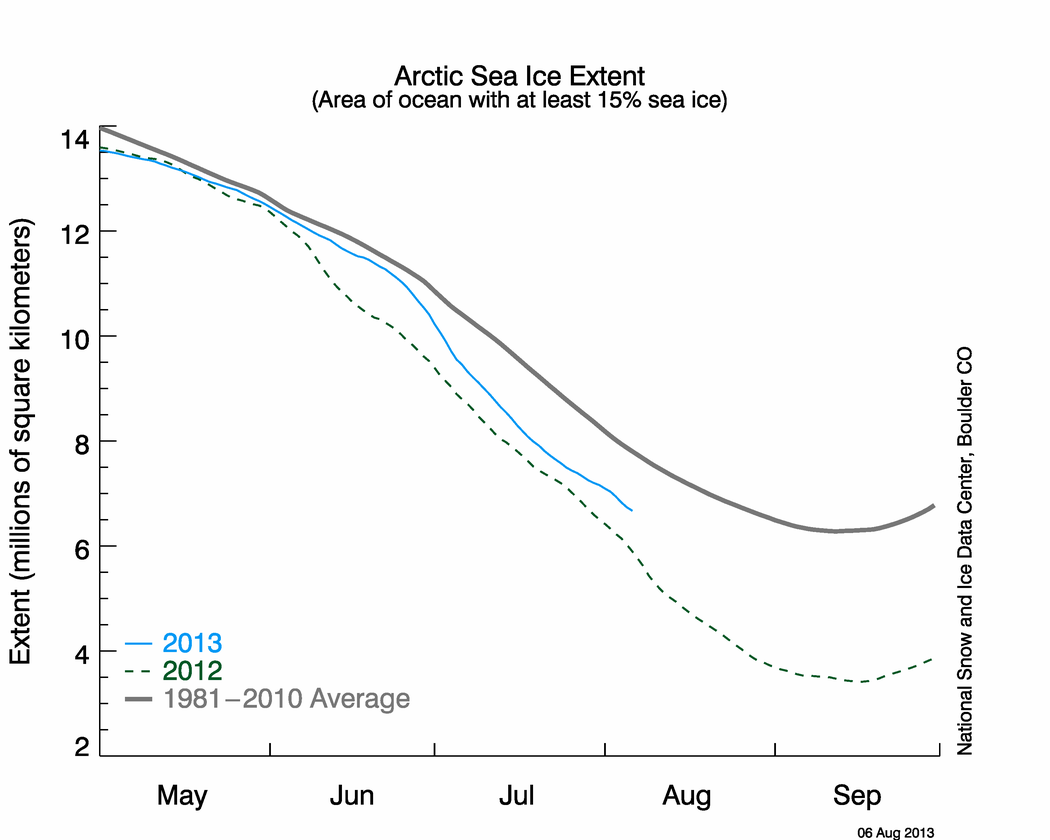
Nature is a kick in the pants, isn’t she?
Anyone know when the ice stops melting? My guess would be sometime in Sept., and looking at the graph it does start to flatten out towards the end of August. I’m just wondering when it can be said that we didn’t hit any record low ice level this year.
Pierre,
Regarding your link to the NOAA SST anomalies, and from looking at the BBC track, they are currently well above the 80-degree latitude line, meaning that they are in the “White” area of the anomaly chart, (where it is still pretty dense ice) somewhere around 20-30 degrees longitude.
Again, this story doesn’t smell right.
“In mid June 2007, there was an abrupt melting. Ányone know why, or can provide a link explaining that?”
A sudden reduction in ice coverage does not have to mean it melted. Remember that the graph is areas with at least 15% sea ice. This means areas with 85% open water. If the wind comes up and packs this ice together, you are going to see an immediate reduction in the amount of area with 15% sea ice. You would have had no additional melting but you would now have a greater area that is ice free due to wind changes.
So temperature and melting are only one factor. Sunlight is another factor. There might have been a period of bright, sunny days at that time too. 2007 was unusually clear and had unusual wind patterns. 2008 is looking like something closer to a “normal” melt season.
Today is overcast at the North Pole.
A comment regarding graphs. I notice that the Verticle scale does not start at zero but at 3 1/2, probably done to better illustrate the small divergences. I wish that all graphs whose origin is NOT zero had a caveat warning folks that the % scale as it appears to the eye is off. I’ve seen many graphs showing ppm of CO2 vs year that start off with ppm far above zero at the origin, making the casual viewer surmise that CO2 growth is much more pronounced than it really is.
Patrick
Minimun ice usually occurs the first week of September.
Pierre and BrianMcL,
Click this link to see the station drift track for station 35. At the bottom of the page is a good track map.
Drifting Station North Pole 35
Just wanted to update the total periods of spotless-sun days during the current minimum. Jansen’s chart, last updated in May, only indicates three, but we are currently experiencing the fourth such period.
Mind you, anyone wondering where the media will get its next “North Pole Doomed” story can have a look at this from Friday 11th July:
What an amazingly twisted, skewed article. They deserve an award.
a.) The floe in question is melting (not because it’s warm but because it’s drifted to a warm current).
b.) Scientists say the melt started early (by we don’t say how it has lagged since then).
c.) Scientists have predicted the melt may be as bad as last year. (Not, however, noting last year’s “melt” was due to current, not temperatures, and also not noting that this year’s melt is ‘way offtrack from matching last year).
My hat is off to the beeb! I am in fact in a mild state of shock and awe.
When this NORTH_POLE_ICE_MELT_GATE finally sums ups it will be just another example of the PREDICTION being the bigger news story then the failure of that PREDICTION.
This is so typical of the AGW Propaganda Climate News Networks (CNN)
Serenity now………….
If I look at this graph of the current ice from NSIDC, it appears that that particular area is well within normal ice extents:
They, if you squint real hard, you’ll notice the article DOES say that the whole reason this is happening is the berg drifted into warm currents! (Squint! Then force yourself to ignore the deliberate misdirection. There you go! Are the boyz at the beeb the ReMasters of Deeesaster or, like, what?)
I am obviously too overwhelmed to edit my posts properly. Chalk it up to residual awe.
@jeh and other hypnotised subjects:
“Beware of the false prophets, who come to you in sheep’s clothing, and inwardly are ravening wolves.”
(Matthew; Bible)
Just think, this year’s leftover ice will be next year’s multi-year ice. 🙂
But multi-year ice isn’t like decades old, usually it’s about 2-5 yo. So not so big a deal anyway. Wonder what the warmers will be screaming about next summer? Nothing, because in a week or two they’ll forget the Arctic exists.
Bill Marsh
Good question: But they never cease to amaze me with their creativity in the science of spin. Just when I think they’re trapped, they pull something off to gain a few more months time.
Now what happened to jeh, and related responses?
I got myself worked up for nothing, or what?
Steve Sadlov,
I agree with you that the notion of “multiyear ice” is a bit silly. Since a significant fraction of the ice melts every year, there will always be one-year old ice. But the total ice extent goes up and down every year, so some one-year old ice can become two-year old ice, and vice-versa, and so on… If one-year old ice would melt that easily, it would always leave room for older ice to melt, and soon all the ice would be gone! I guess you’ve got to live in a cold country to appreciate the fact that ice can come and go very fast. The ice here in Montreal (say on the St-Lawrence) is always less than one-year old, yet it comes back every winter!
On the other hand, one can also argue that multi-year ice could be more prone to melting. As there is apparently a continuous amount of dust or soot being deposited on the ice (or the snow that covers it), the older the ice, the more soot it’s got, which makes it more absorbing. Fresh ice, on the other hand, is more reflective. So the whole dynamics is probably quite complex.
All in all, I think the concept of multiyear ice is just another scare tactic.
Frankly, I do not care – in substance – whether the ice over the North Pole waters melts or not. Strictly speaking I prefer Global Warming to Global Cooling. The only reason I want to see Global Cooling is to see egg on the face of Gore and his AGW buddies. And even that not out of personal animosity. I just want to remove the bludgeon from their hand, which they clearly intend to use to destroy the industrial society. And by the way, I also care about the integrity of scientific research, which they are also in the process of destroying
If they have the average 1979-2000 data, why not fit it to a polynomial curve and set up some confidence intervals? The biggest problem with these graphs is that there’s nothing to help assess data variability.
“you’ll notice the article DOES say that the whole reason this is happening is the berg drifted into warm currents!”
There may be something fishy going on, as this bouy track seems to indicate direction bergs would drift.
http://iabp.apl.washington.edu/maps_daily_oceanbuoys.html
Posted this previously on ice pack status
Wyatt A: needs to be updated to mid-July 08. Will look very different.
(1 million Km2 plus over 2007)
http://arctic.atmos.uiuc.edu/cryosphere/IMAGES/current.365.jpg
Again someone tries to mislead by showing EARLY data, I’ve notice quite a lot lately with temp or sun sunspotnumbers etc ending in 2005-2006 never up to date LOL
Aaron Great link shows that in fact only 07 was out of kilter
Pierre ,
Hathaway: “In the early 20th century there were periods of quiet lasting almost twice as long as the current spell.”
And 1910 (in the early 20th Century) was the coldest year IN the 20th Century!
Does anyone have a nice, colorful graph from around 1922?
http://img228.imageshack.us/img228/271/1922bv4.jpg
It seems unlikely that ice sheets would respond dramatically to rather small, marginal temperature changes in a short time frame. Is there some reasonable longer term view acepted by scientists? I guess what I’m asking is (a) is ice sheet size a proxy for climate change in any way ?; (b) Is there some measurable feature of ice that is subject to reasonable prediction and if so, over what time frame?
If the most recent spate of warming leveled off before 2000, and if the current global temperature plateau is warmer than the average decades preceding it, would we still not expect the ice masses to move to a new equilibrium with respect to size and thickness rather than decline in a big way? I recognize there is a big complex albedo issue with ice sheet melting but even so don’t we have some grasp about expected size, some form of prediction to test against observed ice?
The AGW crowd seem to want to leap on ice melting as the only happy news in what has otherwise been a tough decade for climate catastrophe fans. I note that Gavin at Real Climate is too professional and prudent to read much into ice melt stories but the general RC commentariat and what passes for mainstream science journalism seem to be not-so-secretly yearning for zero ice by Labor Day.