Guest essay by David Archibald
Introduction
While Solar Cycle 24 is well into its decline in terms of F10.7 flux and sunspot number, several types of solar activity have risen dramatically over 2015. The solar wind flow pressure, for example, is now at a two decade high. That in turn means that the low in neutron count for this cycle may be more than a year out. This also means that the expected, much-awaited solar-driven cooling could be put off for at least year, with the consequence that the earthly temperature plateau will also continue for another year.
It is also possible that Solar Cycle 24 may end up having the odd combination of being both short and weak. The best analogue for Solar Cycle 24 could be the nine-year long Solar Cycle 2. Lastly, the Sun’s magnetic field strength suggests that Solar Cycle 25 will be as weak as expected.

Figure 1: Ap Index 1932 – 2015
The Ap Index is a measure of geomagnetic activity from eight stations around the planet and reflects disturbances in the horizontal component of the Earth’s magnetic field. Activity has taken off from early 2015.

Figure 2: Solar Wind Flow Pressure 1971 – 2015
Similarly, the solar wind flow pressure has also increased dramatically.

Figure 3: Interplanetary Magnetic Field 1966 – 2015
Again, the interplanetary magnetic field has now increased to levels above that of the 1970s cooling period.

Figure 4: Oulu Neutron Count 1964 – 2015
The flux of galactic cosmic rays outside the heliosphere is constant. Inside the heliosphere it is modulated by the magnetic field carried by the solar wind, which varies with the solar cycle. There is a one year delay between the strength of the interplanetary magnetic field and the galactic cosmic ray flux at the Earth’s orbit. Given the strength of the magnetic field in 2015, the low for the Oulu neutron count may not be seen until late 2016. As the neutron shower at low altitudes caused by the galactic cosmic ray flux influences cloud droplet formation, then cooling caused by increased flux as the solar cycle declines may be put off for another year or so.

Figure 4: Heliospheric Current Sheet Tilt Angle
As measured by the heliospheric tilt angle, we are now well past the Solar Cycle 24 maximum.

Figure 5: F10.7 Flux 2014 – 2015
The F10.7 flux is a measure of the Sun’s emissions at 2800 MHz (10.7 cm) and correlates with sunspot number. It is a cleaner measure than sunspot number in that it is not subject to observer bias and the record can’t be adjusted on a whim. It has a floor at 64. Based on the correlation with sea level, a F10.7 flux above 100 is warming and below that is cooling. The F10.7 flux has been in a narrow, declining band of activity over 2015, suggesting that there is some disciplined process operating at some level in the Sun. At its current rate of decline, the lower bound of activity will reach the floor at 64 in January 2016.

Figure 7: Interplanetary Magnetic Field 4000 BC – 2015 AD
This figure shows the data from Figure 3 combined with the reconstruction of the interplanetary magnetic field (IMF) for the last 6000 years by Steinhilber et al (data courtesy of Dr Gargett). This reconstruction indicates that the cause of the current, pleasant Modern Warm Period is most likely the high level of solar activity over the second half of the 20th century.

Figure 8: Solar Cycle 24 superimposed on Solar Cycle2
There are some indications that Solar Cycle 24 may be a short, relatively weak cycle of perhaps eight or nine years long. In that case, the closest analogue from the record is Solar Cycle 2. Figure 8 shows Solar Cycle 24 (in red) to date superimposed on Solar Cycle 2 (in blue).

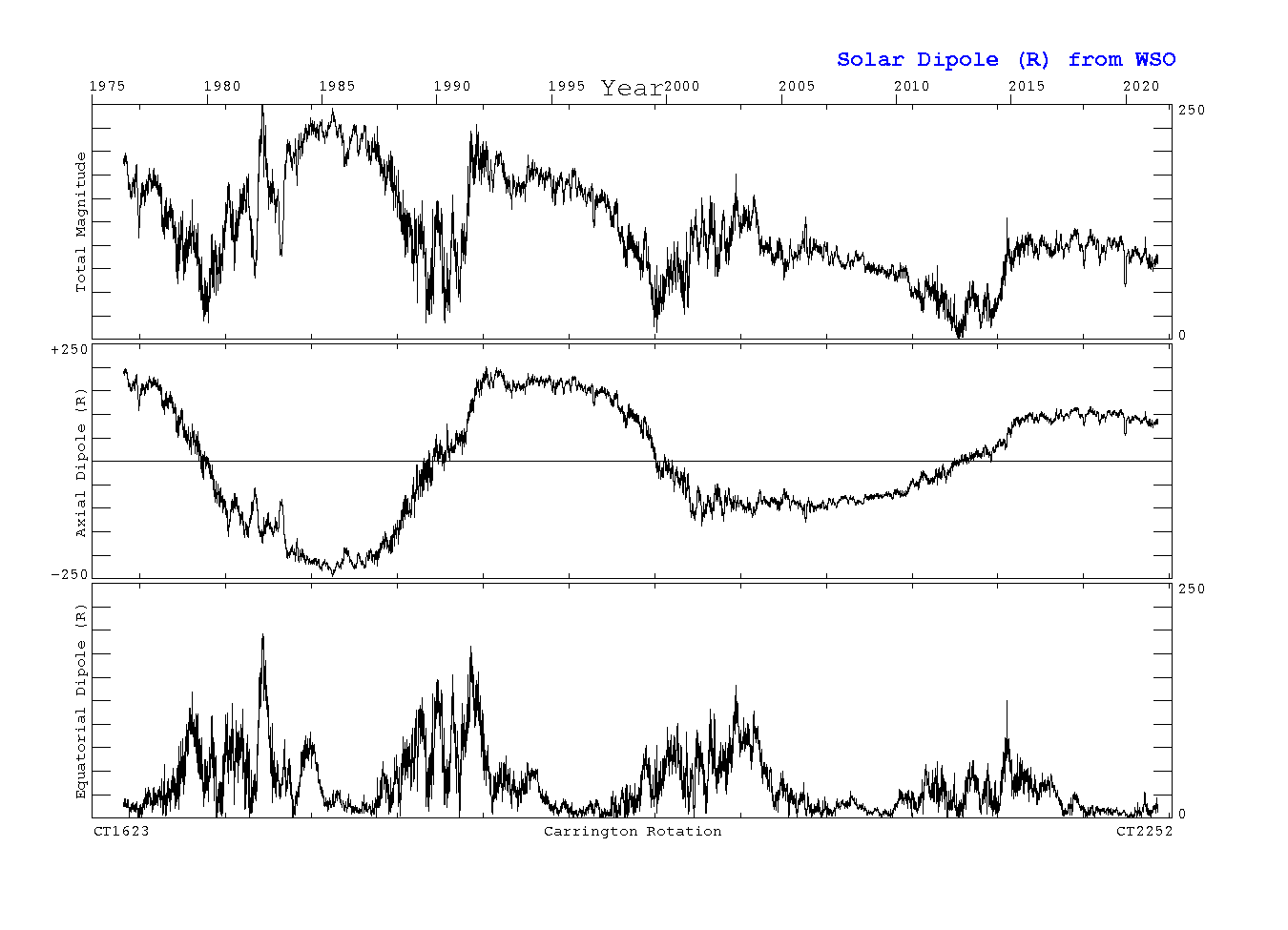
Figure 9: Solar Dipole 1976 – 2015
This figure from the Wilcox Solar Observatory shows that the polar component of the magnetic flux of the Sun has been decling for 30 years. There has been little recovery since Solar Cycle 24 maximum, suggesting that Solar Cycle 25 will be very weak.
David Archibald’s most recent book is Australia’s Defence (Connor Court 2015).
My takeaway is that we are nearing the edge of the plateau? Cliff?
We’ve been waiting for this predicted drop in global temperature for some time now. And while we sure don’t seem to be warming much at all right now, we sure don’t seem to be cooling either….
I propose that it’s difficult to predict the future of global temperatures. Just a thought.
MattN, that depends upon where you look.
If you look at Raw temperature data there have been far more Cold Temperature Records set over the last 3 years than Hot ones. Record breaking Snowfalls both in amounts and in time, ie later in spring and earlier in Autumn than normal. Record breaking Antarctic Sea Ice.
Growth in Glaciers and Snow Persisting right through the summer in Scotland and other European countries.
A cold area in the North Atlantic.
All these things “could” be construed as signs of “cooling”.
AC Osborn,
I think you are right. The hemispheric difference has also been abnormally high through most of ‘the pause’. Typically it was about 0.1˚C a(lthough varying between 0.2 and 0.0˚C) with the SH being cooler than the NH. It has been around 0.3˚C for many years now which to me suggests that the SH will become the planets cooling driver. or maybe it is just the canary in the cage.
What will people be saying if global temperature holds fairly steady for the next 15-20 years?
Well, some will be saying ” Pause? What pause?”
Others will be pulling their hair out at this, and the rest will have stopped caring.
And some will be saying “It’s worse than we thought. Unprecedentedly stable.”
Then some of us would have to say that we were wrong in our outlook, end of story.
If the plateau continues for another decade then the lukewarmers win the debate, which may have serious philosophical implications.
Donald– If global temps stay fairly steady for the next 15-20, scientists will have to say, “the CAGW hypothesis is dead.”
Under the rules of the Scietific Method, if hypothetical projections exceed reality by a statistically significant margin (2+ standard deviations) for a statistically significant duration (15+ years), the hypothesis is effectively disconfirmed.
Since CAGW has, for all intents and purposes, already met the criteria for disconfirmation, it should no longer be taken seriously.
In about 5~7 years, it’s highly likely the disparity between hypothetical projections vs. reality will exceed 3+ standard deviations for almost a quarter century, which is when the CAGW is laughed into oblivion.
The demise of the CAGW hypothesis is getting tantalizing close, which is why CAGW alarmists
are so frantically adding “adjustments” to HADCRUT4 and GISS raw temperature data to keep the disparity within 2 standard deviations of CAGW projections…
The Karl(2015) adjustment was the last straw. CAGW is dead.
Donald,
“What will people be saying if global temperature holds fairly steady for the next 15-20 years?”
I assume you are referring to climate siantists, and they might stick with the wiggle room meaning of ‘warming’ I’ve already seen used several times by the x-perts on high; Global warming continues as long as temps are above what they would otherwise be without human greenhouse gas emissions.
Ice sheets could once again cover half of North America, and there would still be “warming” occurring, you denialist Luddites ; )
Declining F10.7 to hit the floor next year and a La Nina to follow….. nice.
Don’t forget a concurrent negative AMO…
Public policy will be caught blindsided.
Perhaps it will shock the leaders into thinking adaptation, instead of prevention, is the proper proactive measure.
“Lastly, the Sun’s magnetic field strength suggests that Solar Cycle 25 will be as weak as expected.”
The sun seems to fail to meet expectations on a regular basis.
It takes a long time geomagnetic storm.
http://oi59.tinypic.com/33jipmq.jpg
Solar polar fields.
http://www.solen.info/solar/polarfields/polarfields.jpg
Sunspots.
http://www.spaceweatherlive.com/images/SDO/SDO_HMIIF_512.jpg
http://www.spaceweatherlive.com/pl
Colour me Sceptical.
We just don’t know.
Kudos for making testable predictions
Soduk for moving the date of your prediction by a year…
It doesn’t inspire confidence in this solar cooling idea.
“The waiting is the hardest part” (- Tom Petty)
“Mama always told me not to look into the sights of the sun
Whoa, but mama that’s where the fun is” (- Bruce Svalgaard)
Of course even if we freeze over the next 30 years, global warming will eventually return and destroy the planet, though how many people will survive the 30 year freeze and be around to get warmed up? UK death rates in cold winters are around 30k per year.
Suggest we pass a law that all the Warmistas have to put their money where their mouth is by turning off the heat–they can all cluster around their solar panel and their wind mill. Darwin oughta take ’em out quite nicely . . . 😉
David Archibald, while I applaud your continued solar activity reporting, I disagree with your value of the F10.7cm @ur momisugly 100 sfu as the threshold number for warming and cooling, and of your use of sea level as a proxy for sea surface temperature.
Why didn’t you just use sea surface temperatures and leave out the middleman (sea level)? You didn’t specify either whether the threshold’s effect is based on a daily, a weekly, a monthly, an annual, or a running average, so we have no idea at what point to apply your stated figure even if it was right.
Instead of using sea level, I used SSTs, inspired originally by this diagram from Climate4you below, last summer (2014), to determine the threshold for warming and cooling to be ~120 sfu, not 100.
http://climate4you.com/images/SunspotsMonthlySIDC%20and%20HadSST3%20GlobalMonthlyTempSince1960%20WithSunspotPeriodNumber.gif
The 2015 solar F10.7cm radio flux running average went below 120 sfu yesterday, and I don’t expect it will return to a higher than 120 value for many many years, depending on the rise and strength of SC25. The F10.7 solar cycle 24 running average is only 109.5 sfu/day, and is the cause of the “pause”.
The F10.7cm monthly averages this year:
142.0
129.1
126.4
129.1
120.1
123.1
107.0
106.3
102.1
93.8 – October
Yesterday, the evening F10.7cm value was 80.0, the lowest in over 4.5 years, since early 2011.
Only the El Nino with it’s warm water volume is propping tropical SSTs up now, and that’s about to change.
The accumulated solar energy in the ocean from solar activity having been above 120 sfu runs out in 12-15 months, depending on how fast this solar cycle decline occurs, according to my calculations.
So I can agree with you David that there’s a year or so left of accumulated solar heat in the ocean, and with currently insufficient solar activity to warm the ocean more, it’s all downhill from here after the El Nino peaks.
Solar cooling is here now, as evidenced by recent polar ice increases and recent lower UAH NH & SH temps.
Who can forget that chart of sea level rate of change overlain by the solar cycles? With the negative sea level rise coinciding with the solar minima? So I got that graph, turned it into a scatter plot and lo and behold, there is a line of best fit that crosses the x axis at a sunspot number of 40, which in turn equates to a F10.7 flux of 100. No need to ponder much beyond that.
Furthermore, ENSO itself correlates very highly with GMSL. ENSO spreads warm water across the surface such that it increases SST’s and warms the atmosphere more efficiently, but it does not create warm water. Thus we are looking for a force that drives both sea level and ENSO independently of SST.
DA. Link please. After a long day and my evening glass(es) of wine I’d rather look at pictures than try to work out words.
Perhaps I’ve now had too much wine but DAs invite to ponder beyond made me wonder about the known problems with Milankovich theory / hypothesis. How about sustained 100,000 year or so sustained low flux levels ? Leif will now promptly dismiss that idea.
David Archibald October 8, 2015 at 11:00 pm
That would be me, unless you are talking about the chart I discussed here …
… and if that’s the chart, you should definitely read my post.
On the other hand, if that’s not the chart you’re referring to … how about a link?
w.
Being not too ‘bwryt’ in technical matters, the article is fascinating in it’s deep exposure of ‘uncertainties’ that modelers must simply ignore because what may be known of the consequence of these influences is not known. Hence, the models that claim to know everything, must be certain about nearly nothing. And policy built upon such a foundation is a train wreck waiting to give evidence that it happened.
Another interesting point about uncertainty is made by oceanographer Alan Longhurst [http://judithcurry.com/2015/09/20/new-book-doubt-and-certainty-in-climate-science/] in a book which is freely downloadable. I didn’t download it because the author summarizes in bullet points thus: Air temps unreliable and users of unreliable air temps are incompetent. CO2 effects wrongfully extrapolated from poor understanding of ocean and the sun is the cause. Models are misleading and science doesn’t have a clue because even clouds are not understood. Natural oscillations account for climate variations; melting ice not unique; rising sea levels not understood and ocean ‘acidification’ not a problem. He claims the ‘consensus’ premature and decries the lack of unbiased studies!
I think this solar cycle is going to be 12+ years in length.
Yes. And whatever happened to Archibald’s previous expectations of a long Cycle 24? Those were based on extrapolation of the envelope of the butterfly diagram, and I think 2021 still looks good for that.
Rich.
Butterfly diagram at http://solarscience.msfc.nasa.gov/images/bfly.gif .
What happens is that we do new work. I have a joint paper coming out on the force that dare not speak its name. The model for that says that Solar Cycle 24 will be 8 years long. That closest to that is Solar Cycle 2. The shapes are similar, if that means anything. The alternative is that the model breaks down and the Sun does a reset before starting a new model run period. But, like Luke turning off his targetting computer when attacking the Death Star, sometimes you have to have faith in your model. If borne out, we will know soon enough. The Sun at the moment reminds me of a line from Henry V – how constant and unspotted didth thou seem. The spotlessness may mean that the minimum is not too far off.
See – owe to Rich October 8, 2015 at 11:01 am
David Archibald October 8, 2015 at 11:10 pm
Gosh … call me crazy, but that sounds a lot like the excuses the alarmists give when one of their predictions falls on its face.
Mmmm … and sometimes, you have to discuss why your previous model failed.
w.
Only if you view it while squinting and looking in a mirror over your left shoulder. Using words like “most likely” in a scientific appraisal is usually a bad idea unless backed up in some very specific way by a statistical analysis. Attributing causality to a high statistical correlation, once one has been demonstrated, is also a bad idea unless accompanied by the explicit physical science support for the assertion, as causality is the domain of physical science, not statistical correlation.
Just glancing at the magnetic field index you present, one can see that it is entirely backwards to your hypothesis over Holocene temperature reconstructions:
The general linear trend of the magnetic field is low initially and ascending through at least 0 BCE where the general trend of Holocene temps is initially high and descending across the same time period, from similar proxy reconstructions that (I’m sure) similarly have substantially (likely century scale) coarse graining and averaging of the results. I’d be a lot more justified (which is still pretty much “unjustified”, but there you go) in asserting that the data imply that the “cause” of the general cooling trend of the Holocene has been the increase in the interplanetary magnetic field.
Now, I’m sure that you would like to attribute the general cooling to Milankovitch or other (ignored) causes in a complex multivariate problem, which is fine as far as it goes but then for me to take your assertion even a bit seriously you have to not point at a few anecdotal blips in the record and claim success when the general trend confounds our assertion outright, you have to build at least a two component model for Holocene temperatures — one that includes a physically founded dependence of global average temperature on e.g. orbital/precession/NH insolation state PLUS a modulation of some sort that involves interplanetary field as presumably represented by this proxy reconstruction (which, sigh, is presented without any discussion of error or error bars so the viewer has no idea whether or not to take the graph itself seriously or whether it is as likely to be pure noise and utterly meaningless — the one thing we can be pretty sure of is that the error estimate is not the thickness of the line).
Then you’d have to let us see the result of the best fit. OK, so there are some blips that might line up. Are there equally strong blips that fail to line up? Are there temperature events uncorrelated with magnetic field? Oops, evidence of more complex causality that confounds your assertion.
Look, I’m all in favor of solar state affecting global temperatures in some nonlinear, non-obvious way, through one of the proposed mechanisms (that have yet to be validated in situ, although perhaps we will manage it if the sun’s evolution proceeds along its predicted lines for the next couple of cycles — or not, we might refute it just as easily as such is the nature of science). At least we’ll have superior instrumentation looking while everything happens, and maybe we can build a working model that is well-supported by detailed observational data. But what I “favor” is not relevant to claims of fact. I love the idea of magnetic monopoles and a Lord of the Rings parallel Universe, too, but I don’t assert them as fact or amplify my wife’s inability to find her glasses into evidence that they’ve tunneled into a parallel Universe, proving the existence of the latter. Correlation is not causality, and you have yet to even demonstrate correlation, when the bulk of the data is clearly correlated the opposite way to your assertion.
Otherwise, I find your presentation of the data interesting, although it would be better if you omitted the “we might have to wait until 2016 for cooling to start” stuff. Or at least, preface it with a BIT of scientific humility — “the cooling predicted by the GCR cloud nucleation hypothesis is not likely to manifest itself yet, but by (fill in the date, just make sure it is far enough in the future that you have a chance to resolve signal from things like ENSO and other chaotic sources of noise unless you seek transient embarrassment even if the hypothesis is correct).
It’s just amazing. Reading the pages of WUWT, I can find so very many causal explanations for the evolution of the climate. It’s all due to CO2. Oh, wait, CO2 is just a “trace gas”, warming is due to reduction in volcanic aerosols. Oops, no, that’s not right, warming was due to solar state and GCRs. No, that isn’t quite true because of the variable efficiency of the major oscillations — warming has been due to a surplus of ENSOs that have nothing to do with any of the above, it’s an accident of chaotic dynamics, plus the phases of the PDO/NAO etc. Whoops, let’s not forget variations in albedo. And then there is indeed Milankovitch, which marches inexorably on, switch behavior in thermohaline circulation, and my favorite, dark matter clouds that the Sun invisibly passes through that modulate the gravitational compression of its core so that its behavior (which affects temperatures) are really determined by galactic state of a kind of matter we cannot even see 100,000 years ago. Or your favorite invisible fairy — there are more, I’m sure, even before we are stumped by the simple reality that the climate system is multivariate, highly nonlinear, chaotic, and unpredictable by any computational means with a lot better resources than the linearizing human brain.
So if you want me to take the assertion seriously — which I would be perfectly happy to do, except that the Holocene temperature reconstructions themselves above come with moderately hefty error bars as proxy data from different sources and parts of the world are hardly coherent to start with, perhaps you could do some of the analysis above — at the very least remove the Milankovitch trend and fit the remainder to IMF — and then maybe you’ll have some basis for baldly stating a post hoc ergo propter hoc fallacy that doesn’t even work with the actual data you present against the data you wish to explain.
Sigh.
rgb
the simple reality that the climate system is multivariate, highly nonlinear, chaotic, and unpredictable by any computational means with a lot better resources than the linearizing human brain.
Bravo. This is why I scan every WUWT comment thread for Dr. Brown’s terrific mini-essays.
ROFL. My wife asked me from across the house what was so funny.
Peter
Except we have these periodic things called ‘Ice Ages’ that are pretty much like clockwork and we are at the tail end of the present Interglacial based on past records.
Like clockwork? Let’s take a look at this clock: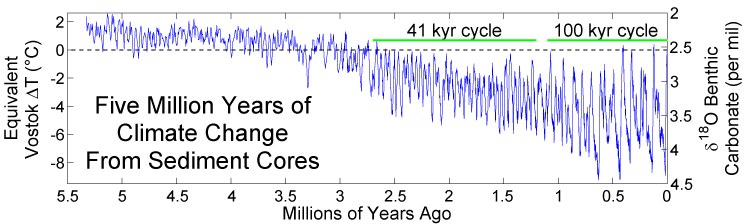
Hmm, sort of like an insane clock with a highly variable period, maybe a pendulum clock that is running down while sitting on the floor of a moonshiner truck that is being chased down a country lane at high speed, killing random possums.
Also, to be picky, we are in an interglacial (the Holocene) of an ice age (the Pleistocene) that might or might not have ended. If you talk to your average warmist, many would assert that the CO2 already added will prevent a return to glaciation indefinitely, independent of what our orbit does (and a few, like Hansen, would froth on a bit about 5 meter SLR by 2100 and boiling seas soon after). Most of the participants in this list are less optimistic about this, but are perhaps hopeful that we have blocked a return to glaciation, since even a comparatively short glacial episode like the LIA that doesn’t cross the “turning point” to full glacial albedo feedback cooling could kill a billion people in five or ten years from successive crop failures in the NH breadbasket (much of which was literally under ice in the Wisconsin). A degree C of warming (since 1850) is almost invisible, but a 2 C cooling back to 1650 temperatures would be catastrophic indeed.
rgb
David says
rgb says
Only if you view it while squinting and looking in a mirror over your left shoulder. Using words like “most likely” in a scientific appraisal is usually a bad idea unless backed up in some very specific way by a statistical analysis.
Bob says:
The modern maximum in solar activity DID CAUSE global warming, because there is no evidence for any other increase from other energy sources during the same time, for the same duration, that could possibly have any sustained warming influence, and no one has proven that there is another such source for the additional energy necessary to drive temps higher.
The sun provided all of that energy, and nothing else did or could’ve provided that energy.
The modern maximum in solar activity occurred from 1935.5 to 2004.5, a 70 year period when v2 SSNs averaged 108.5 annually, versus the previous 70 year period annual average of 65.8 from 1865.5 to 1934.5, a 65% increase in sunspot activity. http://www.sidc.be/silso/DATA/SN_y_tot_V2.0.txt
Dr. Brown, you need to come with an energy source other than the sun’s variation in order to even do a comparative statistical analysis, and if you’re going to come back with the supposed retained heat of the magical molecule CO2 from anthropogenic sources as your alternative, I’m going to LMAO at you, again.
I’d advise you to not waste your time trying, as the IPCC has proven it’s a waste of time.
The photons that circulate through atmospheric molecules such as CO2 come only from the sun originally. If you really think CO2 is ‘the’ driver, then you are welcome to write up a long missive about how SSTs and land surface temps declined until 1976 all the while CO2 atmospheric concentrations were going up.
So I would clarify what David Archibald said this way: “….pleasant Modern Warm Period was caused by the high level of solar activity over the second half of the 20th century.”
The modern maximum in solar activity occurred from 1935.5 to 2004.5, a 70 year period when v2 SSNs averaged 108.5 annually, versus the previous 70 year period annual average of 65.8 from 1865.5 to 1934.5, a 65% increase in sunspot activity.
As usual, careful cherry-picking [e.g. by omitting the three high cycles before 1865] can support otherwise unsupportable claims. Realizing there is a ~100 year cycle one should average with that in mind, e.g. as here:
http://www.leif.org/research/Sunspot-Activity-New-Series.png
Where the colored horizontal lines mark 100-year averages. Within the error bars there is no difference between the centuries.
Hi bob, rgb doesn’t need source of extra energy, he has to move a bit more heat from the equatorial to the polar regions, instead radiating it into space. Job for him is done by faster ocean currents and distributed around the globe by the jet stream.
See: http://wattsupwiththat.com/2015/10/08/a-short-summary-of-soon-connolly-and-connolly-2015-re-evaluating-the-role-of-solar-variability-on-northern-hemisphere-temperature-trends-since-the-19th-century/#comment-2044925
Absence of evidence does not imply your favorite cause is correct. You forget that “we don’t know” is an entirely valid scientific outcome. (Albeit unsatisfying).
You have to prove YOUR cause is distinguishable from noise. From my analysis, there is no cause I’ve seen that’s indistinguishable from noise.
Peter
My claims are completely supported. Your comment really doesn’t matter. Why? Because my research going back further than 1865 takes the prior activity levels into account in my solar accumulation model.
We are in discussions today regarding the MODERN period. That is the period that I focus on here today, although my research does go back to the Maunder minimum.
Using the 70 year period of high activity versus the preceding 70 years of low activity is done that way to show the difference between those two same length periods – it’s not cherry-picking. It-s to show how over the two 70 year time periods the average magnitude of the solar activity was significantly different between those two adjacent and equal periods of time of low activity followed by high activity.
If, for instance, I included the higher cycles prior to 1865 as you would like, there would no longer be two equal time periods to discuss and compare, and so, how would know how to compare them?
What you have to answer to is why you think the vast difference in sunspot output between the two 70 year periods is not an issue. Tell us why a 65% increase for 70 years doesn’t matter.
Your comment does not address that, and the comment appears to have been made to smother out the truth, the truth that higher solar activity for 70 years really happened and that that extra energy from the sun caused global warming.
I have a complete case in preparation for posting, with graphics, to describe everything I am talking about.
The Svalgaard Maximum in solar activity caused global warming.
If you don’t like that Leif, then withdraw your new sunspot numbers, and I’ll go back to using the Waldmeier Maximum, where the discrepancy between the same length periods was 89% Your choice.
If you go back in time from 1880-1925 to 1835-1879 solar activity increased from 63 to 96, or 52%. How much did global temperatures increase?
Hunting for periods to support pet views is a popular pass time but does not make much sense. The fact is that solar activity the past three centuries has varied the same [up and down] in each century with no long term trend. Are you claiming the same for global temperatures?
Peter Sable – there is no absence of evidence. What is absent is understanding what the evidence means. “Noise” is not evidence.
Leif, I’ll take your tack to illustrate. Suppose we break the solar record into three sections, 9 whole cycles each:
1712.5-1809.5, 98 years, ave 78.7
1810.5-1913.5, 104 years, ave 71.7
1914.5-2009.5, 96 years, ave 95.1
Which is a greater average? The last section, the MODERN period. The first section was 18.4% less than the last section, and the second section was 22.4% less than the last one.
But is it a completely fair comparison, considering the time periods vary. THAT’s why I use equal time periods.
The modern period had higher solar activity no matter how you slice it. You lost the argument Leif.
You lost the argument Leif.
I don’t consider this to be an argument, but rather a part of continuing education of you. Compare the solar record with the temperature record as far back as you can and learn.
The years 1835-1879 occurred at the end of the Little Ice Age (1300-1850) … which means that there was one hell of a lot of snow and ice to melt …. and cold land and water temperatures to be “warmed up” before the average yearly near surface air temperature began to increase very much.
Just like when a really cold winter is followed by a warm winter, the latter will automatically cause an increase in the average yearly temperature calculation for those two years inclusively.
Bob you are 100% correct the data is the data.
Leif and company can not produce data which shows an overall global temperature rise during a period of prolonged minimum solar conditions and vice versa.
Is there a lack of things to do at Duke? Try battling the Forces of Darkness.
Dear heavens, David. You were doing so well, but now, faced with some opposition from rgbatduke, complete with a graph that clearly shows you to be wrong, you immediately grab for the nearest ad hominem … not impressed.
Gotta say, whenever someone starts throwing mud, it’s a sure sign to me that they are out of scientific ammunition.
w.
Oh Dear, and here I thought I was doing just that.
Darkness consists of making a statement of your opinion as if it is a fact. Silly darkness consists of making a statement of your opinion as if it is a fact that is directly contradicted by the data you are trying to explain over more than 2/3 of the interval you present in the figure above.
The problem is that both sides in this debate are prone to hyperbole, unsupported assertions, presentations of data that “proves” their point without any discussion of error, confounding effects, places where the hypothesis they favor fails to work, and often with a startling naivety regarding statistics and standards of proof. The entire debate is not well served by this, or by a complete unwillingness (on either side) to either take the other fellow’s point of view seriously or consider the vague possibility that your own point of view could be wrong. This leads so quickly to defensive comments when somebody with the best of intentions points out a pretty serious inconsistency in your argument. Would you rather have it pointed out later, perhaps when you are presenting it in a public venue rather than in the warm and friendly WUWT pages?
Do I need to superimpose the two pictures for you to get the picture? Your figure that shows interplanetary magnetic field rising from 4000 BCE right up to the clearly marked “dark ages” plunge; imagine it on top of the figure I posted that shows proxy-derived Holocene temperatures systematically decreasing across that exact interval. Also, if one uses your verbal hypothesis to hindcast the temperature data, one might well expect there to have been a horrific plunge in global temperatures around 3500-3700 BCE completely absent from the proxy reconstruction. The there is also no resolvable difference between the Sporer and Maunder minimum. The general trend and timing doesn’t look quite right. The best you’ve got, maybe, is a coincidence between the Sporer minimum and the LIA that ran from close to the end of the Sporer through the Maunder minimum, but even that would really need to be done quantitatively with a model to be at all convincing.
I repeat, I’d love to be convinced. Convince me. Build an actual model instead of looking at a couple of bumps that look “about right” and asserting that this is proof of your hypothesis. You can start by explaining, quantitatively, why there was no MIA (medium ice age) in mid-Holocene that corresponded with dips in IMF even deeper than the Sporer minimum, why most of the Holocene confounds your assertion, and so on. Gimme an R^2 to be proud of, ideally without using so many parameters that you can make the elephant wiggle his trunk.
Right now conservatively, I’d say R^2 for any direct/linear model on top of smoothed data is what, 0.18? What does 2/3 of the graph moving the wrong way with the opposite of the proposed slope cost you in R^2, anyway?
Look, if you are right, there is nothing to worry about, because even Lief agrees that the next solar cycle or two are likely to be very quiet, possibly even Maunder/Sporer minimal for an extended period of time (whatever/however minimal that might have been). But this time there will be no ambiguity, as we have powerful instrumentation paying close attention. If solar activity drops and global temperatures drop, well, then I guess you — or possibly rather the people who have done the actual work promoting and doing experiments on the GCR hypothesis — will get a lot more attention as most reasonable people would then consider this to be evidence in favor of their hypothesis. If they don’t drop, is that going to be sufficient (as Lief often asks) to convince you that you are wrong, they are wrong, and the comparatively tiny variations in solar activity are NOT enough to have much of an effect on the climate, via GCRs or alterations in polar circulation or what have you?
Or are you so certain you are right that even if it warms all the way through, you’ll cling to the belief? This is almost the precise definition of religious belief, instead of scientific skeptical provisional belief (with evidence against mattering to your degree of belief).
Personally I have no idea. I haven’t found any of the arguments, graphs, fits in favor of solar activity as a primary driver convincing, simply because there just isn’t that good a correlation. Also, I (at least) actually read through Lief’s work on reconstructing solar state in some detail, and I think it is damn fine work. IIRC he has three different measures of solar activity, all fairly accurately recorded all the way back to somewhere in the 19th century, that agree with modern measurements now and that can be used as a reliable yardstick for probable errors in counting sunspots then, and those measures clearly show particular differences associated with particular human counters and instrumentation. So using an uncorrected sunspot record while ignoring the other proxies for solar state just because it appears to agree better with your hypothesis doesn’t seem quite fair.
FWIW, I have absolutely no evidence that Lief is completely convinced by either side of the Great Warming Debate (at least not that I’ve read in these pages). He will hammer — errr — try to “educate” anyone who starts spouting nonsense in any field he has expertise in, but then, so will I and many others. That too is a part of science. Correct known science isn’t a matter of debate, not without powerful and unlikely arguments that will probably have little to do with the subtle matters at hand in climate science. He just reposted the punch line from an astounding poster that made a quantitative claim supported by actual data and statistical fits with pretty good R^2 that CO2 climate sensitivity is around 0.5 C per doubling, one of the lowest values I’ve ever seen. If he were a closet “warmist” or “coolist” I doubt that he would behave like he does. I just think he is interested in figuring out the truth (and maybe he gets a kick out of refereeing an otherwise ill-founded running commentary that badly needs it).
Now, the problem is highly multivariate, so it could be that Mr. Sun’s small fluctuations do have a “strong” effect on the climate but ones that can still be confounded by other strong effects. That would certainly “explain” a lack of perfect correlation between solar activity and climate. I don’t even think that is all that implausible (this is a nonlinear chaotic turbulent non-Markovian etc dynamical system we’re talking about), I just don’t have any good reason yet to think that it is true. Maybe two or three stars have to line up just right and THEN it cools strongly or warms strongly. Not impossible or crazy. However, one of those “other strong effects” could easily be CO2 concentration. Sorry, but that is just a fact. How strong, we just don’t know yet. Lindzen and Choi argue for the “not very” side of things. Hansen argues for “scorchingly strong”. Keen’s fit presented over the last couple of days is downright chilly, making CO2 worth less than 0.3 C of the 0.9 C warming from 1850, if one believes HadCRUT4 and 0.9 C in the first place. The data so far, taken at face value and fit “just” to CO2, favor something in between, but we have such a very short range of halfway reliable data so there is plenty of room for disagreement. Eventually we’ll have enough data to start to settle these and other arguments.
I just wish people would stop asserting opinion as fact, and correlation as causality, in the meantime, especially in the absence of even a pure guess at a quantitative model and with no discussion of error. Feynman would be very sad. How can one assess any assertion when it is made without numbers to back it and obviously contradicts itself within the data?
Sorry my comment annoyed you, time to go back to fighting the forces of ignorance and darkness on a more mundane scale. Solutions to the Laplace equation on a cylinder, the electric field of a dipole next to a large conducting plane, the mysteries of dielectric polarization and the displacement. Damn, I hate grading papers…
rgb
Roll the rock, keep elevating it.
==========
Fixed. You had included a link to the page and not to the image itself.
And thanks for injecting sanity into the discussion.
w.
(grrr … meant for rgbatduke)
Sorry. There is a difference in a click to get to the URL and I probably didn’t make the last one.
As for sanity — I’m trying to teach my undergrads to work in teams on their physics problems in part to audit each other’s beliefs for just that. I find it very interesting to watch my own rate of production of minor errors while lecturing at the board or doing algebra. I will literally say x squared and write x cubed — the part of my brain that is talking and the part that is writing are different, and the part that audits the two to keep them in phase is busy thinking up the next thing to say/do. Teaching my students to audit me and stop me to fix this before it is chiselled into the stone tablets of their notes for eternity, to be puzzled over as inexplicable forever after, is all by itself a challenge.
We have, I have concluded, terribly flawed brains. Different parts of our brains can want to do, and do, different things at the same time. Our interior monologue is just one, and perhaps not the most important, of the many things going on. Some of the things it does are brilliant, some are so wrong that later we cannot understand how we might have done them. If I let my mind wander while driving, I’m likely to find myself driving the road I always drive instead of driving to the store, or the airport, or to pick somebody up. The part of my brain that drives the car isn’t the same part that regulates an intentional destination.
Humans have a strong need to believe in their beliefs, to have the things that they think are right be borne out. Extremes of this tendency lead to religion and gambling and politics. It is the great source of cognitive dissonance and reactions to contrary information. It is all insane from a rational point of view, and yet I can only conclude that it has had some sort of evolutionary value because it goes beyond simple, correctable error to a kind of stubbornness, to keep betting on a horse because sooner or later it HAS to win, to believe in Santa because a world without him wouldn’t be worth living in, to truly think that to be black/gay/female/jewish/muslim/different is to be inferior.
We all need to be audited. Science is the great collective auditing process for the dynamics set of things that it is best to believe about the real, physical Universe. Propositions that cannot be audited may or may not be true, but if we can’t tell in some objective way who cares? Plenty of time to care when the belief can be checked, as long as somebody doesn’t make it a matter of unquestionable dogma and threaten violence if you openly challenge it or even if you just refuse to agree.
It’s a miracle we are as successful (as a species) as we are. There is a little bit of lemming in all of us, just waiting for the day we collectively decide to grab the yoke from the pilot and plunge the whole mess into the sea…
rgb
One of my best lines ever over at ClimateAudit was when someone suggested that I’d wandered into the wrong classroom, and I replied that I was just auditing the class.
=================
It’s not my place to tell you this, but tone it down, write a few posts and have a discussion, you’re just flooding in my opinion, no matter how intelligent you appear to be… I’d hate to read your quip about a quip! 🙂 and that goes for others who have discovered “Copy ‘n Paste”
Sparks October 10, 2015 at 4:28 pm
You are absolutely right. It is not your place to lecture anyone. Your own contribution to the discussions here have been pretty uniformly useless.
For example, you say:
Sparks October 10, 2015 at 9:47 am
That’s not a prediction, that is just egotistical handwaving. A prediction contains NUMBERS. Without them, as I’m sure you’ve counted on, if the global temperature chances to drop by a tenth of a degree for one month, four years after the polar field stops reversing, you’ll be free to count your “prediction” as a success. Ta-da!
If you wish your bogus “prediction” to be taken seriously, let us know HOW MUCH you claim the global temperature will fall, HOW LONG the fall must last in order to be counted, WHICH dataset you will use to measure the fall, and WHEN you say the fall will occur.
Finally, since you haven’t quoted who you are responding to, it’s totally unclear whether you are talking to—kim, rgbatduke, myself, or someone else entirely.
So you are totally correct in your self-evaluation, Sparks. It’s not your place to tell anyone anything.
w.
Willis you’re one of the worst offenders, and you haven’t disappointed without fail as usual. When you, rgbatduke and others give you’re long off topic “I know all about the climate” on a “solar-update post” without anything productive to say, yes I’m going to call you on it. You’re insults, out of order! it’s my “opinion” Wow do you think anything I read from you was anything other than that? don’t flatter yourself!
Get back to the interesting discussion at hand and back off almighty Willis…
Sparks October 10, 2015 at 6:02 pm Edit
So. No numbers to turn your bogus “prediction” into a real prediction.
And no clarification of who you were originally talking to. Just more handwaving. As YOU said, it’s not your place to tell us anything. I agree wholeheartedly.
As to rgbatduke (Dr. Robert Brown at Duke University), I (and many folks here) are overjoyed when he chimes in, because a) he has a PhD in Physics, and b) he teaches physics, and c) he writes very lucidly and clearly, and d) his ideas and insights are almost always very interesting. I disagree with him occasionally … but at my own risk, and it’s bit me a couple times.
You, on the other hand, are a pompous random anonymous internet popup who seems to think that there is no reason for a “prediction” to contain a single number, and who rarely contributes anything even slightly scientific to the discussion.
I know which person I pay attention to, and which one I just laugh at … and so do you.
w.
So basically all the credentials necessary to make a mess, thanks for pointing that out Willis, you know very well I wasn’t getting at rgb, and I was just remarking at his style, his thoughts are worth a post or two, didn’t I say as much?
“Pompous” who me? Anonymous? Well yes to people who don’t know me, I’m very friendly and outgoing to be honest, Oh Noes… I’m a monster!
I do contribute to the discussion here, and enjoy these rare “Solar” posts, you on the other hand like to disrupt the course of debate with your own fantasy opinions…
I find RGB@duke’s contributions to be uniformly useful insightful and on topic, in contrast to yours.
You could learn a bunch by taking your time and reading what he contributes here.
Agree
I do read what he contributes on this site, and how is it in contrast to my opinion? have you ever read a comment of mine?
David, I have a question about this claim:
What is the physical explanation for this? And do you have a link to the data upon which this claim is based?
w.
Although I am not David, I think such a delay would be caused by the propagation of some effects from the sun, such as coronal mass ejections, being slow. CMEs typically take about 3 days to get from the sun to Earth’s orbit, and would take much longer to travel to the edge of the heliosphere.
It tales a year for solar wind to reach the heliopause
Leif once told me that it takes about 9 months for changes in the sun’s magnetic field to reach the heliopause.
Still waiting for David’s answer and link to the data … however, I have gotten three different and unique speculations on the question.
w.
David may not know why, but the explanation is quite simple: Most of the modulation of the cosmic ray flux takes place in the outer regions of the Heliosphere where the magnetic field gets tangled up by collision with the interstellar medium and with itself as solar wind regions with different speed collide. With the speed of the solar wind (400 km/sec or 1 AU in 4 days) is takes about a year for the wind to reach the outer regions of the Heliosphere (100 AU * 4 days).
Thanks, Leif. Why does the tangled magnetic flux affect the cosmic rays but not the regular magnetic nearer to the sun?
All the best,
w.
Not sure what you mean, but the ‘tangledness’ increases with distance from the Sun.
The more true answer is too complicated to explain, but the reason is that the Sun is rotating so that solar wind with different speeds are emitted in the same direction and run into each other and produces shocks that steepen with distance, and such….
Solar wind is ‘organised’ in magnetic flux tubes.
Two or three years ago I saved a paper on the subject; it took me a bit of time to find it. Link to online .pdf
http://onlinelibrary.wiley.com/doi/10.1029/2007JA012684/pdf
from its Abstract:
“It is argued here that the inner heliosphere is filled with a network of entangled
magnetic flux tubes and that the flux tubes are fossil structures that originate at the solar
surface. 65,860 flux tubes are collected from seven years of measurements with the
ACE spacecraft at 1 AU by spotting the flux tube walls with large changes in the magnetic
field direction and the vector flow velocity.”
The article’s text is well above ‘my paygrade’, but good luck if you do have a go.
Leif, you’ve prompted me to look at the data. Here’s what I find:
Interesting. It does point out to me the effect of the slow nature of the changes in both cosmic rays and sunspots. The result is that although the peaks are offset, the no-lag correlation is still quite large at -0.81.
This compares very favorably with the peak correlation of -0.84.
This peak, however, occurs with only four months lag, and visually the lag looks like 4-6 months. By the time you get out to a one-year lag, the correlation is back down again to -0.81.
This would suggest that significant tangling of the magnetic fields (enough to affect cosmic rays) does not just occur out at 100 AU. You say below:
So if my analysis is correct, important amounts of entanglement occurs at distances smaller than 100 AU.
And this shorter lag in part explains the high no-lag correlation. With an ~ 11-year cycle length, a four-month lag is only about a 3% lag.
In any case, I’ve used your new monthly sunspot data from here, and the Oulu cosmic ray data from here.
Your comments always welcome.
w.
Wanting better resolution to see what’s happening, I shifted to daily data for both the Oulu neutron data and the sunspot data. As you might expect, the correlation is lower, but it shows the same shape as the previous graph.
This agrees with the monthly data that the greatest (negative) correlation occurs at around four months.
One thing of interest to me is the spike in correlation at around zero lag in the graph above. It actually occurs at five days after the sunspots, with a value of -0.563. Again, this compares favorably with the peak, which is at 122 days (~ 4 months) with a value of -0.573.
This peak also agrees with the time you give above for the average travel time of the solar wind from the sun to the earth of four days. So it appears that the cosmic rays are affected starting when the change in solar wind sweeps past the earth.
Again, all comments welcome.
w.
Spike at 0 (zero) or 4-5 days is the the hit at the Earth’s magnetosphere. The earth’s magnetic field is by far strongest modulator of the GCR, thus if the GCR’s have an effect on the climate it would be due to changes in the Earth’s magnetic field. However the precipitation’s modulation of the 10Be depositions is just as strong.
One more note:
GCR’s are strongly modulated by Coronal Mass Ejections too, however the CME cycles are not ‘well’ synchronised with the sunspot numbers, their velocity is well above that of the ordinary sunspot’s solar wind. This graph (from appinsys.com) shows only very small proportions of the total, i.e. only those directed towards the earth, those causing disturbances in the earth’s magnetic field.
http://appinsys.com/GlobalWarming/2010080301_kp7.jpg
Most of the CMEs miss the Earth completely, but they still do modulate GCRs from all helio-longitudes.
Further more what we measure here on the Earth, depends on the solar magnetic polarity and the tilt of heliospheric current sheet, hence difference between even and odd numbered cycles.
These are only few problems, but I am sure there are more, why the correlation of the neutron count and SSN is not clear cut as could be expected.
122 days
CMEs typically reach Earth one to five days after leaving the Sun.
Those that reach Earth in one day would reach heliopause in about 100 or perhaps up to120 days, taking into account some deceleration.
if so, the graph would suggest the faster CMEs are more frequent than expected.
I have published plenty of graphs over the years of the Oulu neutron count with the month of solar minimum of each cycle on the chart. It is generally about a year prior to the neutron count peak. Explanations follow in the comments below.
Thanks for the reply, David. Always more for me to learn.
w.
Cycle 24 does seem to be rapidly waning. After watching all of the spotless days between 23 and 24 one has to wonder is this solar minimum will be an extended one…
Cycle 25 only begins after the minimum with reversed polarity (maybe not reverse polarity, but with their positive and negative poles flipped.) spots. Are you expecting Cycle 25 to kick off early, or only after an extended minimum?
Oh, and I’m not convinced that TSI is a primary driver of climate. It is an interesting argument, but… More evidence please.
Nobody claimed that TSI was the primary driver of the climate.
Please try again.
I am skeptical about everything these days. And I’ll be honest, I’m quite skeptical of Dr. Archibald’s claims. To me he seems a bit of an outlier on the other end of the Spectrum. That`s not to say that I ignore him (or even the people claiming the world ‘has a fever’…but I just don’t put a lot of credit in it.
That said, the ongoing solar minimum does give me reason to be concerned. If you only use the minuscule solar forcing numbers used by alarmists, the fact that we’re heading into a deep solar minimum about the time the AMO will be going negative means there will likely be a fall in temperature. And even the IPCC’s (carefully ignored) studies show that every last bit of warming we’ve had so far has been beneficial (and would continue to be until about 2C).
Of course, I’m pretty sure the solar forcing is good for at least .2C of cooling, the full brunt of the cold period of the ocean cycles should be good for another .4C. And that brings us right the heck back to the cold period of the 70s…which is pretty much accepted by everyone as ‘too damn cold’.
NOAA’s spaceweather prediction center (SWPC) updates their solar cycle sunspot number and F10.7 prediction in the first week of every month, here ftp://ftp.swpc.noaa.gov/pub/weekly/Predict.txt, where they give three ranges of forecasts, “LOW”, “Predicted”, and “HIGH” out to 2020.
According to them, we won’t reach an F10.7cm value of under 64 on a monthly basis until April 2018 (using their “LOW” range), August 2019 for the “Predicted” range, and their “HIGH” prediction range doesn’t go below 71.5 at all.
How did you determine a January 2016 date for F10.7 under 64???
Sorry, I glossed over your Fig. 5 extrapolation. If you’re right, it’s one helluva prediction!
Yes, but it’s just as silly to do that extrapolation as to do one of the floor of the values from 2014.1 to 2014.5 when the values were rapidly declining linearly. But then they turned around.
Rich.
Bob, the really interesting thing about that graph is the very disciplined range it has been in all year. Now what is causing that?
More vertical lines in graphs 1 and 5 would be interesting, does the slide down in graph 5 correspond with the move upwards in graph 1?
Any previous examples of this years slide in graph 5 in the prior record of 10.7 flux ? Or is this apparently unique behaviour ?
rgb talks of the Earth perhaps being bistable, a warm interglacial mode and a cold glatial mode. I wonder if the sun may also exhibit similar bistable behaviour with glaciations being a result of or and harmonic between long term solar patterns and Milankovich obliquity in particular.
But with the switch from the 41k world there must be other factors involved, reduced atmospheric density perhaps.
We are observing a once in 6000 to 8000 year solar event. An interruption to the solar cycle as opposed to a slowdown in the solar cycle. The cause of the Heinrich events.
The solar northern large scale magnetic field strength is now oscillating around zero. The solar southern hemisphere is roughly a year behind the solar northern hemisphere.
The solar large scale magnetic field is caused by the residue magnetic flux that is left from the sunspots. As noted below due the continual weakening of the newly formed sunspots and the large number of coronal holes, the coronal holes have stripped of the surface magnetic flux from the sun.
http://wso.stanford.edu/gifs/Polar.gif
http://www.solen.info/solar/
The high solar wind bursts are caused by coronal holes. The solar cycle 24 coronal holes have been anomalous in both number and size. The solar wind bursts create a space charge differential in the ionosphere which in turn causes there to be current flow from high latitude regions of the earth to the equatorial region. This solar wind burst phenomena electroscavenging explains why the planet has not cooled even though GCR is very high for this period in a solar cycle. This is also the explanation for the current El Niño (there is correlation in time with the start of the disturbances of the Ap (changes in the geomagnetic field which are caused by solar wind bursts, and the current and past El Niño events.)
The magnetic field strength of the magnetic flux tubes that rise up to the surface of the sun to form sunspots on the have based on observation continued to decay. The magnetic flux tubes require a magnetic field strength of 20,000 to 30,000 gauss to avoid being torn apart from by turbulence in the solar convection zone. As the magnetic field strength of the magnetic flux tubes has declined the magnetic flux tubes are shredded by turbulence so that what forms on the surface of the sun is group of short lived tiny pores rather than large long lasting sunspots.
The next step in the process as the magnetic field strength of the flux tubes declines further is there is no pore or sunspot only a region on the surface of the sun that has higher magnetic field strength.
It is interesting that the coronal hole rotational speed matches the rotational speed of the solar core rather than the rotational speed of the ‘surface’ of the sun. The solar surface rotational speed slows down by 40% from the equator to the solar polar region. The sun spots float on the surface of the sun and hence have the same rotational speed as the surface of the sun.
The fact the coronal hole rotational speed matches the core of the sun rather than the surface of the sun and does not change with latitude supports the assertion that the cause of the coronal hole (fast moving protons ejected from a region of the sun) is due to something deep within the sun.
http://iopscience.iop.org/article/10.1088/0004-637X/763/2/137/pdf
We are observing a once in 6000 to 8000 year solar event. An interruption to the solar cycle as opposed to a slowdown in the solar cycle. The cause of the Heinrich events.
The solar northern large scale magnetic field strength is now oscillating around zero. The solar southern hemisphere is roughly a year behind the solar northern hemisphere.
As usual, you are off the rail. There is no such thing as ‘interruption’ of the solar cycle. There are large cycles and there are small cycles. What we see now is nothing special: solar activity is low every 100 years or so. The northern polar fields have reversed and are now building as expected. The south is already strong. Cycle 25 looks to be like cycle 24 [if one must extrapolate] based on the rate of increase of the dipole moment:
http://www.leif.org/research/WSO-Polar-Fields-since-2003.png
The fact the coronal hole rotational speed… does not change with latitude supports the assertion that the cause of the coronal hole (fast moving protons ejected from a region of the sun) is due to something deep within the sun.
And the same number of fast moving electrons too [as the solar wind is electrically neutral]. That the coronal holes [and long-lived structures of the corona in general] rotates at a rate independent of latitude [as was discovered by Ester Antonucci and myself way back in 1973 [ http://www.leif.org/research/Rigid-Rotation-Corona.pdf ]] does indeed point to an origin in the interior, but has no baring on your ‘interruption’ notion.
Thanks very much. So the coronal holes are related to something going on in the radiative zone.
“The solar northern large scale magnetic field strength is now oscillating around zero.”
You think? Let’s see what it looks like around the 10th of December when WSO again has a square on view of both poles. North at 15-30 will no longer be oscillating around zero. Gotta watch that tilt when inflections are occurring, note max-tilt readings currently proceeding against the effect …
http://s2.postimg.org/5z2z3gxc7/PFS_2021.png
Or you could wait a couple of years for the filter to catch up.
“This also means that the expected, much-awaited solar-driven cooling could be put off for at least year, with the consequence that the earthly temperature plateau will also continue for another year.”
Reality does not appear to be cooperating with the solar activity slow down. 2015 is likely to be another record warm year. It might be time to consider another hypothesis.
Fascinating how trolls stick to their cooked data when much better data is available.
What I think MarkW is saying is the definition of “cooked data” is the data that he does not like.
Some people can’t live without ” unadjusted ” data !! LOL
Yeah, that’s what religious types do, MarkW! Can’t change them.
The record warm year was built on warmth already deposited in the ocean by the sun during the previous solar cycle, and was added to when solar activity was higher in this cycle. It takes time for that warmed-up water to circulate to the surface at the tropics and beyond. SSTs and OHC are going to drop after this El Nino peaks – which is right around the corner.
Looking at Dr. Spencer’s post chart http://www.drroyspencer.com/2015/10/uah-v6-0-global-temperature-update-for-sept-2015-0-25-deg-c/ we see a 0.03C drop in global temps (UAH), generally in line with my expectations given that we’re just now under my 120 cooling threshold annually.
I think the temperature plateau is heading for a long curve sloping downward.
Bob Weber.
“during the previous solar cycle”
Which solar cycle are you referring to, cycle 23? That was some time ago.
Monthly variations in the TLT synthesized temperature will not tell you much, they are too noisy.
The global stats show the globe to be warming on average. I do not see that process stopping.
For fans of logical fallacies, the non sequitur is always a favorite. An example:
…The global stats show the globe to be warming on average. I do not see that process stopping.
Harry, I was talking about SC23. Even though it was many years ago, the heat the sun deposited in the ocean at depth during those long ago years is still working its way to the surface.
The ocean receives solar energy at depths of hundreds of feet, and that energy warms the water. The amount of time it takes for that solar deposited energy to reach the surface is longer than a single solar cycle. The sea surface temperatures are a combination of the current real-time solar input as modulated by clouds and heat rising up or circulating to the surface that was deposited at earlier times.
The SST varies as OHC rises or falls, and as solar energy rises or falls, and as cloud cover changes.
If you look at HadSST3 http://www.metoffice.gov.uk/hadobs/hadsst3/data/download.html for the last three months (excl Sept – no data yet),
Global, NH, Tropics, SH; OHC
0.58, 0.733, 0.646, 0.407; 0.87
0.636, 0.785, 0.754, 0.463; 0.92
0.664, 0.729, 0.945, 0.374; 0.99
The NH and SH both dropped in August while the tropics and global went up with OHC. Why isn’t the NH and SH warming too if the whole world is supposed to be warming? OHC was 1.05 in April,
Looking at Dr. Spencer’s UAH data http://www.drroyspencer.com/2015/10/uah-v6-0-global-temperature-update-for-sept-2015-0-25-deg-c/
YR MO GLOBE NH SH TROPICS
2015 1 +0.28 +0.40 +0.16 +0.13
2015 2 +0.18 +0.30 +0.05 -0.06
2015 3 +0.17 +0.26 +0.07 +0.05
2015 4 +0.09 +0.18 -0.01 +0.10
2015 5 +0.29 +0.36 +0.21 +0.28
2015 6 +0.33 +0.41 +0.25 +0.46
2015 7 +0.18 +0.33 +0.03 +0.48
2015 8 +0.28 +0.25 +0.30 +0.52
2015 9 +0.25 +0.14 +0.17 +0.55
See that the NH and SH are colder now than earlier, and the globe is 0.03C cooler this year? Arctic sea ice has rebounded tremendously in September too.
The data says the process of warming is coming to an end.
If you look at HadSST3 http://www.metoffice.gov.uk/hadobs/hadsst3/data/download.html for the last three months
Weather is not climate. How about looking at yesterday if you believe it is…
Bob Weber.
“Harry, I was talking about SC23…”
Interesting hypothesis, but you may have difficulty finding evidence that supports it.
You have OHC and the UAH temperature muddled up.
2015 WILL NOT be the hottest ever in any real temperature data set.
Currently the average anomaly for year to data is in 4th place on +0.208ºC.. (September data added)
this is well below the 1998 year to Sept of +0.539ºC
So there’s Mr Twinperson making silly claims yet again.
What is the history of the interplanetary magnetic field based on? I see that the record goes back 6,000 years and I take it we didn’t have sensors then so I expect there is some kind of proxy which always leaves me a little concerned.
All those pretty pics and not a SINGLE ref to any data.
Lots of typically climatological “probably” “likely” stuff. Science content very low.
Disapponting.
Part one is not necessary for this discussion. What I am most concerned with as I read the article by David Archibald as far as my thoughts go is will this prolonged solar minimum meet or at least approach the criteria I feel is necessary in order to see a clear solar/climate connection? My confidence is least high in this area in contrast to the fact my confidence is quite high that if the solar criteria /solar duration of time conditions are meant then the climate should show a response to the change in solar conditions I have outlined.
PART TWO
HOW THE CLIMATE MAY CHANGE
Below I list my low average solar parameters criteria which I think will result in secondary effects being exerted upon the climatic system.
My biggest hurdle I think is not if these low average solar parameters would exert an influence upon the climate but rather will they be reached and if reached for how long a period of time?
I think each of the items I list , both primary and secondary effects due to solar variability if reached are more then enough to bring the global temperatures down by at least .5c in the coming years.
Even a .15 % decrease from just solar irradiance alone is going to bring the average global temperature down by .2c or so all other things being equal. That is 40% of the .5c drop I think can be attained. Never mind the contribution from everything else that is mentioned.
What I am going to do is look into research on sun like stars to try to get some sort of a gage as to how much possible variation might be inherent with the total solar irradiance of the sun. That said we know EUV light varies by much greater amounts, and within the spectrum of total solar irradiance some of it is in anti phase which mask total variability within the spectrum. It makes the total irradiance variation seem less then it is.
I also think the .1% variation that is so acceptable for TSI is on flimsy ground in that measurements for this item are not consistent and the history of measuring this item with instrumentation is just to short to draw these conclusions not to mention I know some sun like stars (which I am going to look into more) have much greater variability of .1%.
I think Milankovich Cycles, the Initial State of the Climate or Mean State of the Climate , State of Earth’s Magnetic Field set the background for long run climate change and how effective given solar variability will be when it changes when combined with those items. Nevertheless I think solar variability within itself will always be able to exert some kind of an influence on the climate regardless if , and that is my hurdle IF the solar variability is great enough in magnitude and duration of time. Sometimes solar variability acting in concert with factors setting the long term climatic trend while at other times acting in opposition.
THE CRITERIA
Solar Flux avg. sub 90
Solar Wind avg. sub 350 km/sec
AP index avg. sub 5.0
Cosmic ray counts north of 6500 counts per minute
Total Solar Irradiance off .15% or more
EUV light average 0-105 nm sub 100 units (or off 100% or more) and longer UV light emissions around 300 nm off by several percent.
IMF around 4.0 nt or lower.
The above solar parameter averages following several years of sub solar activity in general which commenced in year 2005. The key is duration of time because although sunspot activity can diminish it takes a much longer time for coronal holes to dissipate which can keep the solar wind elevated which was the case during the recent solar lull of 2008-2010 ,which in turn keep solar climatic effects more at bay. Duration of time therefore being key.
If , these average solar parameters are the rule going forward for the remainder of this decade expect global average temperatures to fall by -.5C, with the largest global temperature declines occurring over the high latitudes of N.H. land areas.
The decline in temperatures should begin to start to take place within six months after the ending of the maximum of solar cycle 24,if sub- solar conditions have been in place for 10 years + which we have now had. Again the solar wind will be needed to get to an average of below 350km/sec. which takes time because not only do the sunspots have to dissipate but also the coronal holes. In other words a long period of very low sunspots will be need to accomplish this. It will be a gradual wind down..
Secondary Effects With Prolonged Minimum Solar Activity. A Brief Overview. Even if one or two should turn out to be true it would be enough to accomplish the solar /climatic connection.
A Greater Meridional Atmospheric Circulation- due to less UV Light Lower Ozone in Lower Stratosphere.
Increase In Low Clouds- due to an increase in Galactic Cosmic Rays.
Greater Snow-Ice Cover- associated with a Meridional Atmospheric Circulation/an Increase In Clouds.
Greater Snow-Ice Cover probably resulting over time to a more Zonal Atmospheric Circulation. This Circulation increasing the Aridity over the Ice Sheets eventually. Dust probably increasing into the atmosphere over time.
Increase in Volcanic Activity – Since 1600 AD, data shows 85 % approximately of all major Volcanic eruptions have been associated with Prolonged Solar Minimum Conditions. Data from the Space and Science Center headed by Dr. Casey.
Volcanic Activity -acting as a cooling agent for the climate,(SO2) and enhancing Aerosols possibly aiding in greater Cloud formation.
Decrease In Ocean Heat Content/Sea Surface Temperature -due to a decline in Visible Light and Near UV light.
This in turn should diminish the Greenhouse Gas Effect over time, while promoting a slow drying out of the atmosphere over time. This may be part of the reason why Aridity is very common with glacial periods.
In addition sea surface temperature distribution changes should come about ,which probably results in different oceanic current patterns.
http://wattsupwiththat.com/2015/09/01/the-arctic-iris-effect-dansgaard-oeschger-events-and-climate-model-shortcomings-lesson-from-climate-past-part-1/
The above accounts for abrupt climatic changes within a glacial or inter- glacial period. Dr. Curry this is similar to your stadium theory.
[Long, interesting summary. Thank you. .mod]
Even a .15 % decrease from just solar irradiance alone is going to bring the average global temperature down by .2c or so all other things being equal.
No, a 0.15% decrease will bring down temperatures by 0.1 C, and 0.15% is a LARGE change, larger than the solar cycle variation of TSI, so take away all the sunspots [as during the Maunder Minimum] and temps will decrease less than 0.1 C.
But the temperatures during the Maunder Minimum decreased by more then .1c.
But the temperatures during the Maunder Minimum decreased by more then .1c.
So you just acknowledged that the Sun is not the cause of the low temperatures during the Maunder Minimum….
Wrong. I have just acknowledged that the TSI part of solar activity was not the only solar related causes for the low Maunder Minimum temperatures.
TSI part of solar activity was not the only solar related causes
Since all the other ones vary in step with TSI, what are the other [mysterious] causes you have in mind, now that you have eliminated TSI.
Do we have other historical quantitative indicators of a TSI than a sunspot count? For me, a sunspot count is a proxy – probably a good one. Are any exact measurements available before 1920 (Harquahala Observatory)? If I understand Dr. Svalgaard correctly, colder temperatures during Maunder minimum are only an interesting coincidence, waiting for another explanation.
There are no direct measurements of TSI before 1978.
“..Since all the other ones vary in step with TSI..”
No, as you know there can be a minimum in the solar wind speed at sunspot cycle maxima.
And cosmic rays too. The point is that there is a solar cycle variation just like for TSI. The shape of the cycle may be different for different parameters, e.g.
http://www.leif.org/research/Climatological%20Solar%20Wind.png
but the amplitude varies the same: high in high sunspot cycles, low in low cycles.
I just outlined them on my post Oct 08 11:04 am which addresses other possible solar causes. The verdict is still out .
“The point is that there is a solar cycle variation just like for TSI. The shape of the cycle may be different for different parameters..”
But the low in solar wind speed at sunspot maximum is completely out of step with other metrics, and the large regular low in the SW speed is a year or two past sunspot minimum. Two minima in the solar wind per sunspot cycle is rather more than just a different shape. Your idealised graph doesn’t help picture the real behaviour either, the solar wind speed does not look anything like as regular as that.
“but the amplitude varies the same: high in high sunspot cycles, low in low cycles.”
No I don’t buy that, the SW maximum in SC20 was larger (and later) than that of following higher sunspot cycles. Also the years 1836-1845 on CET are virtually as cold as the coldest CET years in Dalton (1807-1817), I don’t believe for a moment that the solar wind was high in that sunspot max to max solar magnetic phase.
http://snag.gy/pHiM2.jpg
Kp index measure of ‘disturbance levels in the horizontal magnetic field’
http://appinsys.com/GlobalWarming/2010080301_kp7.jpg
(credit: appinsys.com)
Salvatore, have you looked at the solar-type stars I mentioned to you on another thread?
Just some ,have not had the time to look in detail yet.
While we’re looking at the sun, consider the disc at http://www.solarham.net/regions/map.htm and ask yourself how anyone can make a sunspot group out at the label 2429? That’s a spotless sun! (Apart from the soon to be numbered one circled on the left.)
Rich.
The circle outlines group 2429.
Leif, I’m not saying you’re wrong, but…
It would be very unusual if that circle referred to 2429. On those pictures I have always seen numbers sitting next to visible groups with no circles, and circles denoting groups on the eastern limb which are expected to be numbered soon. I think it is more likely that 2429 was properly visible but has now disappeared. But at this time I have no evidence to prove that.
Rich.
Rich, you are correct [my bad]. Here is the image of today:
http://spaceweather.com/images2015/08oct15/hmi1898.gif
and yesterday
http://spaceweather.com/images2015/07oct15/hmi1898.gif