Guest Post by Bob Tisdale
This post provides background information and a quick update on the naturally occurring warming event in the eastern North Pacific known as The Blob. Not just any blob, The Blob.

Figure 1
INTRODUCTION
We first discussed an unusual hotspot in the sea surface temperature anomalies of the eastern extratropical North Pacific two years ago in the August 2013 post appropriately titled About the Unusual Warming Event in the Extratropical North Pacific Sea Surface Temperature Anomalies. That large pocket of elevated sea surface temperatures has been given the nickname The Blob. Since that first post, we’ve discussed it numerous times, along with its impacts on global surface temperatures:
- The Hotspot in the North Pacific (February 2014)
- On The Recent Record-High Global Sea Surface Temperatures – The Wheres and Whys (August 2014)
- Axel Timmermann and Kevin Trenberth Highlight the Importance of Natural Variability in Global Warming… (November 2014)
- Researchers Find Northeast Pacific Surface Warming (1900-2012) Caused By Changes in Atmospheric Circulation, NOT Manmade Forcings (December 2014)
- Did ENSO and the “Monster” Kelvin Wave Contribute to the Record High Global Sea Surface Temperatures in 2014? (December 2014)
- Alarmists Bizarrely Claim “Just what AGW predicts” about the Record High Global Sea Surface Temperatures in 2014 (January 2015)
- North Pacific Update: The Blob’s Strengthening Suggests It’s Not Ready to Depart (April 2015)
WHAT CAUSED THE BLOB?
Answer: According to Bond et al (2015), a persistent ridge of high pressure in the mid-to-high latitudes of the eastern North Pacific prevented the sea surfaces there from cooling normally. The Ridiculously Resilient Ridge is also responsible for the high temperatures and drought conditions along the west coast of the U.S. See Anthony Watts’s April 2015 post “Warm blob” in Pacific Ocean not caused by climate change, affects U.S. weather at WattsUpWithThat. It includes the press release for two papers: Bond et al. (2015) Causes and Impacts of the 2014 Warm Anomaly in the NE Pacific and Hartmann (2015) Pacific sea surface temperature and the winter of 2014.
WHAT’S NEW WITH THE BLOB?
Figure 2 presents the satellite-enhanced sea surface temperature anomalies (Reynolds OI.v2 data, not the pause-buster data) for The Blob, using the coordinates of 35N-55N, 150W-125W. The sea surfaces of The Blob continue to show warming, after a multidecadal period of no warming through 2012.

Figure 2
Based on the monthly data, Figure 3 shows the annual evolutions of The Blob’s sea surface temperature anomalies for the years 2012, 2013, 2014 and year-to-date 2015. Our base year with no warming is 2012. The majority of the warming took place in 2013. Then, in 2014, sea surface temperature anomalies ended a tick lower than they started in January. The sea surfaces of The Blob are once again warming in 2015, likely in response to the strengthening El Niño.

Figure 3
CLOSING
I closed the April 2015 Blob post with the following questions. They’re still valid:
- How long will The Blob and the Ridiculously Resilient Ridge last?
- Assuming a La Niña follows this El Niño, will the La Niña be strong enough to overcome The Blob and the Ridiculously Resilient Ridge?
- What will be the combined effects of the strengthening El Niño, The Blob and the Ridiculously Resilient Ridge on weather worldwide over the next 12 months?
- Will the El Niño be strong enough to overcome the other two and bring rain to California, or will The Blob and the Ridiculously Resilient Ridge continue their influences there?
- Will The Blob have a long-term impact on the sea surface temperatures of the Eastern Pacific Ocean as a whole? That is, will The Blob be responsible for another upward shift in the sea surface temperatures of the East Pacific Ocean like that in 1976/77?
SOURCE
The data and maps presented in the post are available through the KNMI Climate Explorer.
The Blob
Ridiculously Resilient Ridge
Forgive me, but the language reduces the article to one of almost Parody, unless of course it is.
But I find myself doubting this article, except for where it is posted.
rockyspears:
Forgive me, but I find your concern trolling offensive.
If you have a serious disagreement with the essay then please state it. Carping that the choice of language is not pompous and stating that an anonymous troll has some unstated doubts about the article do not rise above the level of abuse normally found in primary school playgrounds.
Richard
As I said “except for where it is posted”
And comment have neither to agree or disagree, I just commented
I even covered myself with the “unless it is”, because humour is known to exist.
Do not jump on commentators as Trolls, just because they have doubts, doubts make science what it is.
rockyspears:
Nice try but no coconut. Scientific doubts pertain to evidence and not the asserted “feelings” of anonymous internet popups whose ‘comments’ only exist to provide abuse as a method to troll threads from their subject.
Richard
Alas, rockyspears doesn’t know the correct jargon of wise water-watchers. He is unknowingly displaying his ignorance.
I feel deeply for him, for I often do the same thing. Just recently, talking about arctic sea ice, I referred to the melting on the underside of the ice as “bottom melt.” I now understand the correct jargon is “basal melt”. (That sounds just a bit vulgar to me, but what do I know…)
Some people are all about appearances and jargon, rather than the subject being discussed.
Humor of any sort is always dangerous, and that includes humorous jargon. However, speaking only for myself, if it wasn’t for humor the entire topic of “climate science” would have driven me utterly, raving mad around a decade ago.
My apologies for having “feelings” – not
“internet popups” – I make plenty of posts, all over, from Zero Hedge to Not a lot of people know that, just because I do not use WordPress, does not make me a Troll
“whose ‘comments’ only exist to provide abuse as a method to troll threads from their subject” – sorry, do not even understand that.
Caleb
Thank you so much. My embarrassment was immense.
Seems however that some people see Trolls under the bed and everywhere.
The phrase “concern trolling” is the most egregious of all the terms used in debate. It is intended to preempt full and honest debate (a form of censorship) and it presumes everyone understands that those of us who have legitimate concerns should, as a default condition of debate, STFU and that makes you an imperious ass as a minimum. STFU, jackass.
Mods – please share this with RSC before you kill it. The man is a serial idiot who believes he owns the rules of engagement here and he lacks the intelligence and temperament for it.
Actually dp, concern trolling is a real method utilized by some (including myself, on occasion) to point out that a group doesn’t actually subscribe to a position or standard that they claim to, when you yourself don’t either . And yes, It can be hard to differentiate between a concern troll and someone trying to make an honest criticism.
To me the best way to confront such a charge is to define what the ‘concern’ truly is and if it is legitimate. Rockyspears seems to be (to me) complaining that the names “The Blob’ and ‘Ridiculously Resilient Ridge’ are in some way too silly and unsophisticated to be used by a respected journalist or scientist to describe a meteorological phenomenon. To this argument all I have to respond in the defense with is ‘Snowmageddon’.
^_^
It is well known that concern trolling is a strategy. Taking a defacto stance that all expressed concern is a troll is Courtney’s specialty and he’s used it on me more than once. That is how I know he’s an idiot. Or to put it in terms he will jerk at, I’m concerned he’s bringing down the quantity and quality of self-correction of this site by concerned readers by damning them at every opportunity. You will never see him write “I share your concern”. He doesn’t.
dp:
Your trolling is offensive. Stop it.
Richard
Well, according to the highly reliable Wikipedia, here:
https://en.wikipedia.org/wiki/The_Blob_(Pacific_Ocean)
“The Blob” is the term used by Climatologists to describe the area, implying that folks who study the climate actually may have a sense of humor.
Who’d a thunk it?
Lol, wikistupidia 😑,
What evidence do we have to confirm a unique occurrence?
– has this been observed in the past?
– what has lead to its formation?
– what consequence is likely?
– is it a weather event or climate system related?
– is it a valid indicator of climate system states of change?
… The list goes on and on….
The obvious relates to salinity as import to the Arctic Ocean. Start with high Pacific salinity and sea ice formation in the past and you’ll likely hone in on similar climate forcings?
PS: note to Bob, thanks for the great work! Consensus is qualitative, use degrees of confidence related to aspects of the models instead.
Humorous yes, but more than that, the chosen names actually tell you something about the characteristics even if you’ve never heard before. The Blob, amorphous and maybe vaguely threatening in a campy movie kind of way. Ridiculously Resilient instantly tells you the effect has existed way more than expected. The fact that both have names also tells you they’ve been around.
eschew obfuscation.
My personal rail is against the word “utilize” about the 3rd or 4th utilize in a document has me screaming; use, use, use.
Plain language works. Pumping letters into a name may win Scrabble but rarely helps clarity. From the fake Smithsonian letter:
“assigning your specimen the scientific name “Australopithecus spiff-arino.” Speaking personally, I, for one, fought tenaciously for the acceptance of your proposed taxonomy, but was ultimately voted down because the species name you selected was hyphenated, and didn’t really sound like it might be Latin.”
John wrote:
> has this been observed in the past?
Yes – There was a warm pool in the Pacific in 1934 and it appears to have contributed to the extreme winter weather that year (warm in the west, cold in the east). February 1934 and 2015 were almost identical, see http://wattsupwiththat.com/2015/03/08/1934-2015-a-tale-of-two-februaries/
OTOH, I don’t think they called it the blob in 1934 as the movie hadn’t been released yet.
Another weather term you can look up is “bombgenesis.” It’s weird that has a definition, but “nor’easter” doesn’t.
The Blob isn’t caused by the eruption of the Axial Seamount 300 mi offshore of Oregon??
http://www.csmonitor.com/Science/2015/0503/Underwater-volcano-spewing-lava-off-Oregon-coast-video
rockyspears –
I don’t understand your doubt.
Do you doubt that the Blob exists?
Do you doubt that it has the effects described?
If either, then you have doubts about Climatology in general: not with either Bob Tisdale who is reporting on it or Anthony Watts who is allowing Bob’s “Blob” report to be posted.
Just making an observation.
My doubt existed as it reads like a parody, as these are Climate terms I’ve never before encountered, and, surely you must agree, they sound comical.
I neither agreed or disagreed about the content, I merely observed on the style.
Well, rockyspears, the “Blob” has been so termed since 2014, so maybe it is a good thing you’ve found WUWT: it will help you keep up.
Cheers.
rockyspears
August 12, 2015 at 6:53 am
My doubt existed as it reads like a parody, as these are Climate terms I’ve never before encountered, and, surely you must agree, they sound comical.
I neither agreed or disagreed about the content, I merely observed on the style
That is comical in itself, AS A layperson who has followed this site for quite a while, even with my ‘ignorance’, without a scientific education, I still understand Bob T’s post.
if you say you haven’t encountered these terms before, you ain’t reading much, (emphasis on ain’t) wink , wink.
Y’all, let’s not be rude. Let’s be honest. These names are bad, and anyone that hasn’t been following climate closely can easily be forgiven if they don’t initially realize that these names are official, because they don’t sound official.
There’s a reason that in engeering, we don’t make up cutesy names for our programs and instead make “The X Database”. People take you a lot more seriously if you act seriously.
benofhouston
Sometimes in engineering if you don’t define your name someone does it for(to) you e.g. TWAIN protocol
“None was selected, but the entry Technology Without an Interesting Name continues to haunt the standard.”
My personal favorite is from Calvin and Hobbes. “GROSS” Get Rid Of Slimy girlS
I guess one of my prejudices is my BS meter starts to go off when people inflate language to cover lack of facts. Generally the more pompous it sounds the less factual coverage.
Ben of Houston. As an engineer who worked with “Rbase” many years ago (1980’s), a natural query database language that we used as client server to our mainframe database. We had a query “Who are the axxholxs?” which gave back a list of all the project managers in the company who were projected to go over budget on their projects based on a well defined historical graph based on individual performance. Even engineers have a sense of humour. Most people did not know about the query, but a lot of us did. (and it saved us a lot of money.) Oh, and we had another one: “Who are the heroes?”
The RRR and the Blob have been around a while and have well known consequences that we will likely see again this winter and the west coast salmon fishery will be reviewing. I am not sure it is a particularly new phenomenon, but better identified than in the past.
rocky,
Is ‘El Niño’ all growed up enuf for ya? Being a little boy an’ all?
And another thread enters into the ever decreasing circles of sophistry and plain bad manners .
STFU springs to mind , Comments on the article and not on the comments would be appreciated !!
D’OH!
“The Blob” is actually scientific jargon for the phenomenon, and not humor at all, at this point.
https://en.wikipedia.org/wiki/The_Blob_(Pacific_Ocean)
As to the Ridiculously Resilient Ridge, it seems to be Tisdale’s suggestion for a designation of the corresponding atmospheric phenomenon. Bestowing names on phenomena has long been part of the practice of science.
And it is alliterative as well!
rockyspears- Just so you know, Bob Tisdale has written at least one book on the subject of SST and El Niño and is one of the world’s foremost experts on the subject. After reading other comments in response to you (and your responses) it would seem a good time to remind you of the first rule of holes…
Ne’er mind- I see you caught on.
“Rocky Spears”…”Ridiculously Resilient Bulge”…I mean Ridge.
Cliff Mass blog discusses the blob and RRR over the past few years and references the scientists at Univ of Washington one who dubbed the nickname Blob for the relatively warm water in NE Pacific.
Here’s an older reference: http://cliffmass.blogspot.com/2014/09/did-blob-cause-our-warm-summer.html
whom not who
You know, y’all, I’ll side with Rocky on this one. These are pretty bad names “The Blob” the “Ridiculously Resillient Ridge”. It makes it seem like we aren’t taking things seriously, even if the name is official.
Science may be the most important, but impressions count more than some of you seem willing to admit.
Floppy drive, hard drive…
Lack of drive
For a while, the 3 1/2 inch format drives were called stiffies.
Ben of Houston says “You know, y’all, I’ll side with Rocky on this one. These are pretty bad names “The Blob” the “Ridiculously Resillient Ridge”. It makes it seem like we aren’t taking things seriously, even if the name is official.
Science may be the most important, but impressions count more than some of you seem willing to admit.”
I agree Ben. And let’s not use Hockey Stick, Blue Northerner, Sun Spots, Climate Gate, “Greenies” Deniers, Warmers, Warmists, pause, (I could go on).
Strange quarks, charm quarks, gluons? And those aren’t even nicknames.
Seems a little late to worry about goofball terms in science.
Well scientists do have a sense of humor. How else do you get a name like “anandamide” for a compound the body produces?
See also here. Enjoy.
Don’t forget unobtainium. We have a critical shortage.
Went to Steve C’s “here”. Precious folks, precious. As the odor control guy for a landfill I deal with some of the molecules. My wife now believes me. Like Doctor T I like neat names so she was suspicious.
Hope all relax. Fun names are, well, fun. On first exposure though they likely do seem like Psychology, Sociology and Anthropology terms.
RS,
Do a little homework.
Bob Tisdale, Nick Bond (WA State Meterologist), and Cliff Maas (another good reference for this phenomenom) are all capable and reputable scientists. That one of them might coin a term that fails to meet your exacting standards in order to communicate something to the general public, is a critique on your standards, not theirs.
It seems that the use of silly names and a stiff resistance to faux “sciencey” sounding terminology is quite popular amongst people who do real science and are not struggling to pretend that they are scientists.
In the soft/fake sciences, the matters discussed are often of such little consequence that all discussions must be encrypted in pointless (often psuedo-latin-greek) invented terminology, such that everyday matters can be presented as appearing to be high science. In other words, there is sadly a tendency to take simple matters and make them appear unfathomable and to speak of them in specialist language that is hard to decipher.
Even in modern medicine the longstanding commitment to potentially misleading terms such as the oft confused/misheard prefixes, “hyper-” and “hypo-“, has no possible justification, beyond ostentation. (Why not “high” and “low”?)
However the real purpose of science communication should be to take complex matters and render them in a manner which makes them understandable, familiar and memorable, using terms which are distinct and therefore less liable to lead to confusion.
For this purpose, silly names are very helpful and certainly do no harm.
Here’s an example. An example page which I just found on the website of CERN.
CERN is not struggling to make its science “look” serious. So, silly terminology is of no concern to them.
http://pdg.web.cern.ch/pdg/cpep/quark_fun.html
the language reduces the article to one of almost Parody
=========================
A very quick internet search reveals these terms to be common usage. The Parody is not within the article. It is with Climate Science. Which, like Political Science, has nothing to do with science, and thus must add “science” to its name.
Climate Science is a Parody of Science. Hence the names:
https://en.wikipedia.org/wiki/Ridiculously_Resilient_Ridge
The “Ridiculously Resilient Ridge,” sometimes shortened to “Triple R” or “RRR,” is the nickname given to a persistent region of atmospheric high pressure that occurred over the far northeastern Pacific Ocean during 2013-2014.
https://en.wikipedia.org/wiki/The_Blob_(Pacific_Ocean)
The Blob is a large mass of warm water in the Pacific Ocean off the coast of North America.[1] It was first detected in late 2013 and is expected to continue throughout 2015.
IIRC, the “Big Bang” was coined by a detractor. People have tried and failed to come up with a better term.
Then please state what your doubts are. On what basis do you have these doubts? Just saying you have doubts doesn’t give us any information we can work with or take a position on. The author did not hurt or help his article with the use of the phrase Rediculously Resilient Ridge. All he is doing is emphasizing that it is an amazing weather pattern for having lasted so long, not that it is sentient and has guilt feelings about being ridiculous. Judging an article on a harmless name seems over the top to me. So spill the beans, what are your doubts and why do you have them?
Disagreement is fine so long as you provide some rational (or attempt at rational) reason for the disagreement. This at least gives others the opportunity to evaluate your intelligence or lack there of. If you simply dismiss something but don’t explain why, I always interpret this as a kind of delusional egoism. That doesn’t mean that I agree or disagree with any of the statements in the actual article. It just never ceases to amaze me that people can express empty opinions anonymously and somehow not be self aware enough to realise that any intelligent person reading them will consider them to be nitwits.
like acidification of the seas.
i had never heard of it pre- 2003.
Rocky,
Bob Tisdale probably was being humorous. That doesn’t preclude serious consideration. The ridge is in fact “ridiculously” resilient because under “normal” circumstances, a similar ridge appears every summer off the Pacific coast, but it weakens and breaks down during the fall and winter, only reform again in the following summer. It helps generate California’s “Mediterranean” climate. This time the stupid ridge has persisted season when it should go away, which forces weather, that the Pacifc coastal states need, to head for Canada and Alaska instead. Juneau for example experienced almost six (5.8) inches of excess rainfall in July, which is over double normal. Of course, its normal for that in July and August, but when it happens during the winter, here in California we get what Jerry “Baby” Brown calls a drought.
The “Blob” was not named by Mr. Tisdale, so you shouldn’t hold it against him.
there’s a large chain of seamounts right under The Blob, this may sound ridiculous but has anyone been down there to take a look?? and is it unfeasible that volcanic activity may be partly responsible for the elevated surface temps?
I think the amount of volcanism required to heat that much water would be very visible.
The volcanic activity under the Antarctic is huge yet relatively unknown until very recently. Volcanism does not need to be the major driver the warmth generating the blob. It could be one of several. I don’t think it a concept that should be so easily dismissed.
How much is known about volcanic/tectonic activity in that part of the ocean? How deep is the ocean in the area?
Posted this above with link – the Axial Seamount 300 mi off the Oregon Coast has been erupting for a few(?) months.
According to
this article, it’s been “having at it” since April this
year, or maybe earlier. The centre of “The Blob” appears
to be more or less coincident with the volcano’s location.
Could this be more than mere coincidence?
No, not the centre, more like the NE edge. The warmer, or less cool, area
could be where the plume of hot water reaches the surface. Currents there
would be trending southerly.
And yet in approximately the same position in the North Atlantic there is an equally persistent cold spot.
I cannot help but feel that these two opposites is just Mother Nature giving climate alarmists the finger, but they will still all carry on believing some BS explanation from the great Mann himself.
The mystery of this “warm blob” is just one more indication that there is a lot about the planet that we do not know.
Extensive “blobs” warm water appear on historic El Niño maps in many years. They simply don’t normally move to the west coast and hang.
Has the Blob shifted east? I thought it was doing that earlier this year, as for a while the water just south of Bering Strait was below normal, but it looks like it has warmed up a little and is now slightly above normal south of Bering Strait.
I figured the ice-melt would be above normal north of Being Strait, with all the Pacific warmth about, and there has been some decent melting up there, but what completely baffles me is why the air temperatures are not warm. The O-buoys have even been showing some refreezing happen in the Beaufort Sea. I’m not talking about the fresh water in melt-water pools, but the salt water between bergs.
This seems to verify a general rule I have: “Never bet more than a nickle on Arctic forecasts.”
https://sunriseswansong.wordpress.com/2015/08/10/arctic-sea-ice-the-last-floes-of-summer/
Blob – I believe it has shifted south east and for a while it seemed more concentrated in just to the north west; then seemed to spread south along the California Current and north up the BC/Alaska coast. A lot of people are expecting reduced salmon runs in the north this year as the salmon change where they feed and when they return to the rivers. Plus xome rivers are warmer and have lower flow so many salmon will spend extra time in the ocean before returning. (If you doubt that, you can search it with your favourite search engine like DuckDuckGo. As opposed to teachings in most school systems, salmon are pretty flexible on when they decide to go up river to spawn.) I suppose I could provide the links I have, but sometimes you learn a lot doing your own searches.
On an early post on this, I guessed it will be 5 years before the blob dissipates given the number of years it took to form. Fishermen and Government Fisheries have observed the phenomenon of varying temperature in this region and its affect on the fisheries for some time but the satellite definition of this blob has provided some new and important insight into not only the fishery, but the impact on North American weather. Not sure it is new since I seem to recall this weather set up occurring in the past.
Bob’s posts add another interesting dimension that we can keep track of and correlate with other things.
Thanks Bob.
thanks for that wayne, i was waiting to see if there were any noted effect on fisheries.
Oh come on, I think it is funny/serious. This is an update on the high temperature anomaly in the Northeast Pacific and the author was just interjecting some humor. I found myself smiling as I read it. I liked it. It was a fun read and a nice update. I’m curious as to what will happen after the probable El Nino is over.
I think the author should change his name to Blob Tisdale – just for these posts 😉
Thanks for the update Bob.
It may be easier for some people to understand this if they knew that the “hotspot” is not exactly hot.
It is just less cold than normal for water in this location.
Same for the North Atlantic…that water is always cold, right now it is even more cold than usual.
If one looks at a map of sea surface temps in that area, there is no blob of hot water evident.
Just sayin’.
you mean we can’t look forward to articles by alarmed environmentalists about scalded sea lions hauling out all along the Canadian Coast?
Here’s the alarming news story you were looking for 🙂
Posted today (8/12/3015) but refers to a event on Sunday.
http://www.patriotledger.com/article/20150812/NEWS/150818930/12662/NEWS
Warm seas nearly shut down Pilgrim power plant – Pilgrim operators were forced to begin preparing for a shutdown late Sunday afternoon when the temperature of the seawater used to cool the reactor edged above the 75-degree maximum set by the federal Nuclear Regulatory Commission.
After reaching a high of 75.09 degrees, the water temperature dropped below the limit about a half-hour later, and Pilgrim was up to full power by 8 p.m.
It was only the second summer in the plant’s 43-year history that water temperatures exceeded the federal limit.
In July 2013, Pilgrim had to lower its power level three times because of water temperatures during a heat wave. The plant has never been forced to fully shut down.
But on a serious note; Most nuclear plant were designed to operate within a specific band of input/output water temperatures. Once your intake temps get too high the plant’s condenser/coolers become less efficient and you have to either increase coolant throughput or reduce the reactors core temperature. The plant hasn’t updated it’s EPA license since 1996 so there is no problem with it doing anything illegal even if it exceeds design specs.
OK a quick little bit of research and the alarm is all over. A bit of regulatory bullshit and a design that dumps used coolant water into the same basin as it’s drawn from explains what is going on there.
are you trying to say that the sea water off the coast of Massachusetts is the same temp as Florida? Or is this because the coolant water is sequestered in such a way that local daytime temperatures can elevate the coolant temperature?
fossilsage,
This can be a problem for any thermoelectric (gas/coal/nuclear) power plant if it uses coolant water from the same source as it discharges the water into. Most plants don’t have any problems with this but there are a few that were poorly designed to handle the occasional freak heat wave. It’s clearly not a big problem since the EPA hasn’t said anything about it in 19 years.
I turn to Bob when I need facts on the Blob.
Thanks, Bob.
Yes, the hot blob in the NE Pacific and the cold blob in the North Atlantic are the most interesting oceanic happenings right now, but the El Niño will have the final word, I think.
For the latest monthly sea surface temperatures (SST) anomalies map, see the Monthly SST Anomaly at http://www.esrl.noaa.gov/psd/map/images/sst/sst.anom.month.gif
Bob, once again another good post, thank you.
Has this phenomena occurred before, and if so, for how long? We were in California In January 2013 and the drought was well under way then, so we do sympathise!
andrewmharding, there have been short-term spikes in the region before, but nothing this strong or that has lasted this long.
Isn’t there an active volcano located under the blob? Its called Axial Seamount. It erupted in 1998, 2011, and earlier this year. Its located on the Cascadia fault, the one that scientist say will cause a major earthquake in the coming years that will affect the entire west coast of the US. Could this volcano have anything to do with the blob?
Looks like Axial Seamount is closer to shore than the blob but then, who knows what’s going on right beneath the blob. http://m.livescience.com/50707-axial-seamount-eruption-gallery.html
Sure wish we had comparable data for the seventies! While the blob seems to be stalled out or resting now, its first appearance seems to have been more central in the Pacific.
So this says the summer persistent ice in Hudson Bay and James Bay does not even register?
I’ve been noticing that too! Compare this from NOAA:
http://polar.ncep.noaa.gov/sst/ophi/color_anomaly_NPS_ophi0.png
with the ice map from Canadian Ice Service:
http://www.bsis-ice.de/IcePortal/CIS/20150811180000_WIS30CT_0008413058.pdf
Not sure how the water can be above average when its covered by ice that’s never there at this time of year?
WUWT?
Dave in Canmore said
It’s because NOAA doesn’t actually have sensors in those areas, and the models they use to infill SST in the Arctic assume the Arctic is warming.
If it were so hot around Greenland, the melt season wouldn’t be so obviously coming to a close…
gymnosperm, the SSTa for the Blob are at record highs, so I don’t know that I’d say the blob has stalled or is resting.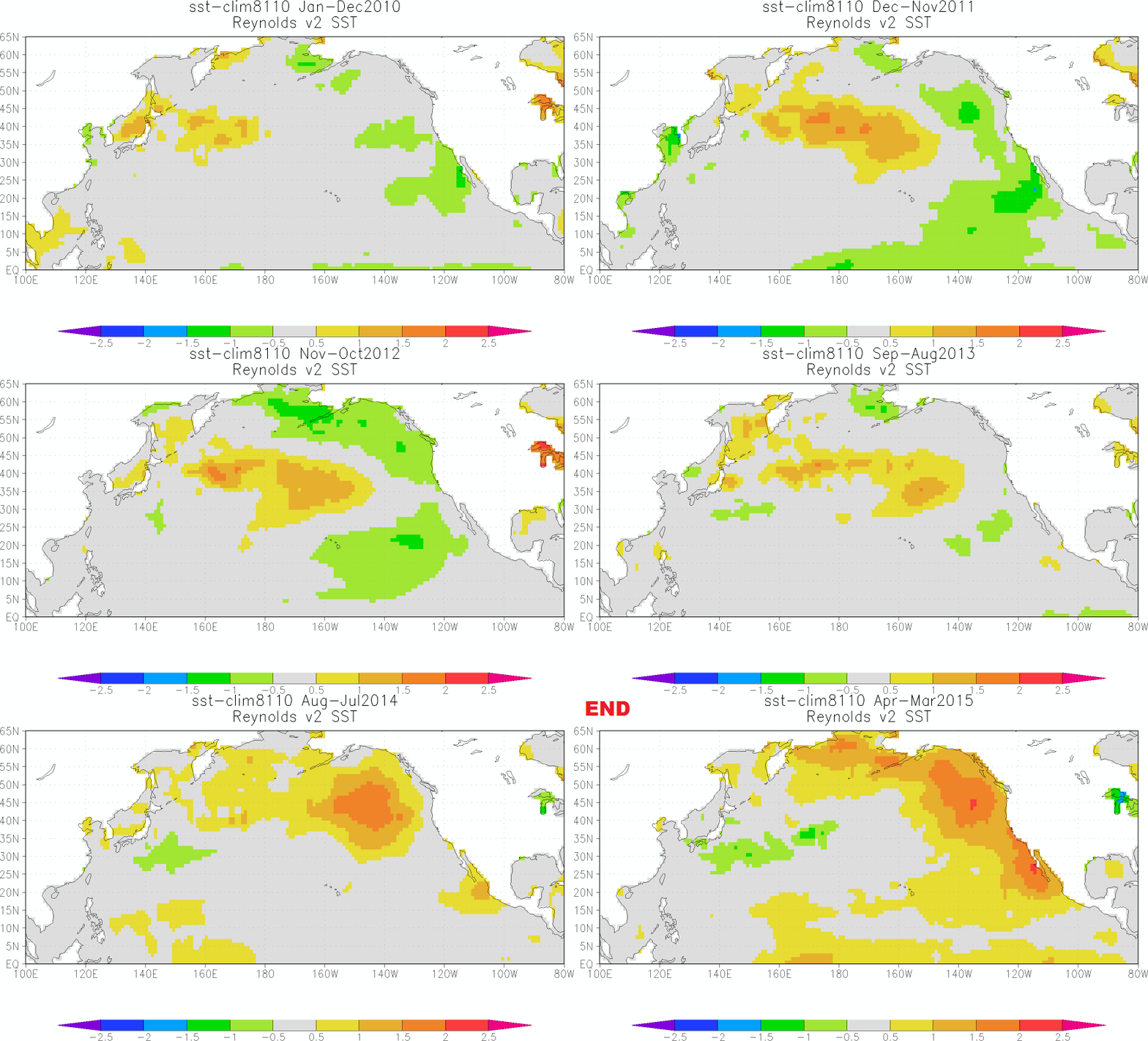
Also, see the following animation from the post here:
https://bobtisdale.wordpress.com/2015/04/21/north-pacific-update-the-blobs-strengthening-suggests-its-not-ready-to-depart/
It formed in the west and migrated east:
http://www.meer.org/ebook/npaccur2.gif
Given the current patterns isn’t the Blob just going to disappear without reinforcing warm water from the west?
Bob, I was just saying it moved from west to east and recently hasn’t moved much. No comment on intensity except that I wish we had data from the seventies.
Bob, I see the blob, but this time it is in 1955 to 2003 trends in sea level. Stumbled across this (and stole it from your post) while researching a value/degree C for the thermosteric component of sea level rise.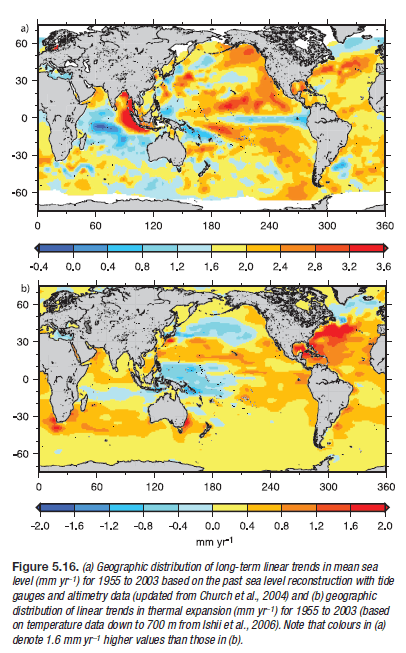
The first image showing the “blob” is old school based on tide gauges and “altimetry”. Don’t know how they did altimetry in 1955.
Been trying to articulate a suspicion that the blob is new to us because now we can see it, and we never could before…
Meanwhile, the Atlantic is dead quiet. How much longer will that hold?
Not too much longer, the water has warmed up some. The waves are coming across. The season is approaching the traditional peak (Sept 10) early season dust is probably settling out though there is still a lot of dust coming across, shear is not terribly noticeable. The season of long runners, the Cape Verde storms should start about now. Time will tell.
One of the effects of the Blob is increased water vapor over the Canadian shield and Hudson Bay. The reduced TSI has led to lingering ice in Hudson Bay and does not bode well for the east coast this winter.
Perhaps, not just the US East Coast. If a structure like this became semi-permanent for whatever reason, it could be a driver of another ice age. The jet stream would become nearly permanent with a NW flow over the eastern half of North America. This is exactly the format taken by continental glaciers.
The cooling of Hudson Bay could be key. If the ice doesn’t melt over the summer it would affect the nearby land areas which would also lead to later snow melts and eventually the formation of glaciers.
The higher planetary albedo would then lead to cooling over other areas of the planet.
I can’t help but notice that this persistent weather pattern has made life a little less pleasant for our friends on the West coast and the East Coast. It couldn’t happen to better group of… people. I hope D.C. gets so much snow this winter that the federal government has to close for the duration.
a little less pleasant for our friends on the West coast
=====================
Vancouver is the new San Diego. Somehow I don’t miss the 7×24 overcast drizzle.
I suspect The Blob is responsible for most the warmest evah claims over the past two years. Has anyone looked at where the global surface temperature would be right now without this warm area? Would it be tracking closer to the satellite data?
Richard M. The blob is responsible for the “most the warmest evah claims”. We discussed I in the post last year:
https://bobtisdale.wordpress.com/2014/12/04/did-enso-and-the-monster-kelvin-wave-contribute-to-the-record-high-global-surface-temperatures-in-2014/
Global sea surface temperature anomalies without the extratropical North Pacific:
The strengthening El Nino should be a major player too in 2015.
Why not remove the warm area covering -40/90 N, -180/180 E. Then there will be no warming at all.
http://data.giss.nasa.gov/cgi-bin/gistemp/nmaps.cgi?sat=4&sst=6&type=anoms&mean_gen=06&year1=2015&year2=2015&base1=1951&base2=1980&radius=1200&pol=rob
The North Atlantic region is in for a big chill. What goes around comes around.
Thanks Bob
How has the shape and extent of this anomaly changed over time? I see a SE movement based upon the 2014 graphic link you provided, but it is hard to tell without comparable overlays. What depth are we actually measuring too? Something similar to TCHP measurements?
ossqss, see the following animation using maps of 12-month averages:
https://bobtisdale.wordpress.com/2015/04/21/north-pacific-update-the-blobs-strengthening-suggests-its-not-ready-to-depart/
It’s few months old, but it’ll give you an idea of how it developed.
http://www.opc.ncep.noaa.gov/Loops/GRTOFS/sst/GRtofs_sst_Pac_03_Day_flash.shtml
Does it have anything to do with Arctic sea ice extent? Arctic Sea Ice Extent bottomed out in 2012. Could it be a reduction in cool water flowing out of the Arctic and into the Northern Pacific since 2012? Just a guess, I have no idea which way melt water flows between the Arctic and Pacific.
http://ocean.dmi.dk/arctic/plots/icecover/icecover_current.png
This map of ocean currents may reveal an answer:
http://www.physicalgeography.net/fundamentals/images/oceancurrents.gif
HAS ANYONE CONSIDERED PLATE TECTONIC FRICTION?? WHERE WOULD ONE FIND CURRENT SEISMIC ACTIVITY? IS THIS A PRELUDE TO THE BIG ONE WHERE THE ENTIRE WEST COAST FALLS INTO THE PACIFIC??? JUST SAYIN’.
cool but gross.
Answer: According to Bond et al (2015), a persistent ridge of high pressure in the mid-to-high latitudes of the eastern North Pacific prevented the sea surfaces there from cooling normally.
That of course begs the question:
“Why is the ridge of high pressure so persistent?”
While we are on the subject of questions….
Are there any measurable changes in currents over the norm for the season?
What do the ARGO data say for readings in the area of the blob over the past 5-10 years?
If there is a surface anomaly, do we see the anomaly at 200 m? 500 m? 2000 m?
Any noticeable changes in conductivity in the profiles?
How about drift magnitude and directions of sequential ARGO measurements in the area over the time period? (That would be an interesting series of maps, even if there were no changes at all.)
What volcanic sea mount explorations have been conducted in the past 5 years in the area?
In what has to be a very sparsely sampled domain, has there been ANY report of activity more than expected?
What are the error bars on the base line?
Just how good was the data in 1971? And
How variable was the base line in the decades of the 70’s, 80’s, and 90’s?
1. The blob causes a persistent ridge.
2. The ridge forces most of the weather systems to the North of the Blob.
3. With strong weather systems diverted around the blob, it… persists.
4. Go to 1.
Could this be an effect of The Blob??…
The U.S. Energy Information Administration (EIA) reported yesterday in their daily “Today in Energy” news release that U.S. West Coast wind power generation is significantly below normal so far this year:
http://www.eia.gov/todayinenergy/detail.cfm?id=22452
http://www.eia.gov/todayinenergy/images/2015.08.11/main.png
Not only that, the reduction in wind power output decreases the further north you get. The reduction in wind power is least in California, 2nd least in Oregon and the most in Washington State.
Wind power capacity factor for the entire west coast was less than 10% in January. For wind, that is exceptionally low.
Could it be that The Blob has altered wind patterns such that it’s decreasing wind farm energy production?
One might ask if the large scale wind farms have contributed to the creation of the blob over time also? I recall an MIT study (2009-10) on large scale wind farm impacts on regional climate. It was not a desirable impact. I do not have the links in this device unfortunately.
It would be interesting if a link were made between the existence of The Blob and all the wind farms that have been built in the Columbia River Gorge area. They obviously have taken away some of the airfow through the Gorge.
If that were true, then The Blob isn’t going away at all. There probably isn’t a link, but time will tell if one exists.
The Blob has altered wind pattern
=====================
Climate Science 101. Cause and effect. Which came first, the wind-farms or the Blob? Since the wind-farms were installed before the blob, they must be causing the blob.
Well, the windmills take kinetic energy from the air and reduce convection (since the wind moves more slowly).
Less convection would mean more NGAGW (Non-GHG Anthropomorphic global warming) which would attributed to CO2 to justify more windmills which would reduce convection, causing more NGAGW which would falsely be attributed to CO2 to justify more windmills… etc.
There isn’t a practical limit to the amount of warming Global Warmers can create trying to stop warming that is unrelated to CO2, by reducing CO2 emissions.
This graph clearly shows that the average monthly or yearly capacity factor is not 35% which EIA use for their levelized electricity calculations and comparisons for wind turbines vs conventional options like coal and nuclear . Using the 35% factor instead of 20- 25% lowers the cost per kwh and makes it look more competitive when in fact it may not be so.
I’m still trying to live down that infamous Friday night. I wish you hadn’t published my booking photo.
Thought I recognized you, Alan ;o)
.
.
Before the current Ice Age (i.e.permanent ice at the poles and not referring to the most recent past glaciation), I wonder if Blobs had a chance to get particularly large? It would seem to me that with better ocean circulation, the oceans would be warmer almost everywhere, but not really, really hot anywhere; no blobs. It sounds a little paradoxical to me, but would we only see great warm blobs when there is an Ice Age and then only during the interglacials?
I suppose somebody around here ought to know that answer.
Does this mean that we (Western Canada) are going to have another warm winter? Exelent!
In the top graph, it looks like SST in the Blob area averaged on the cold side from 1999 through the first half of 2012 due to three strong La Ninas, two of them double-dip ones. The Blob looks like it could be some sort of a bounce from this situation.