Rebuttal to Chen and Tung (2014) highlighted in “Cause for ‘The Pause’ #38 – Cause of global warming hiatus found deep in the Atlantic Ocean”
Numerous scientific papers have reported the hiatus in global surface warming will end with the next El Niño event. But according to a new paper by Chen and Tung published today online in ScienceMag (link to paper follows), that’s not going to happen because the multidecadal variations in ocean heat sequestration at depth in the Atlantic and Southern Oceans will suppress surface warming for a decade or two more. Additionally, unlike many other papers of its kind, Chen and Tung (2014) indicate a lessening in ocean heat sequestration to depth (the reverse of what we’re seeing now) was responsible for the accelerated warming during the latter part of the 20th Century.
Looking at Chen and Tung (2014) in a different light, they went looking for Trenberth’s missing heat, and, not surprisingly, they found it in the same ocean heat content reanalysis (ECMWF ORAS-4) used in Balmaseda et al. (2013), which Trenberth co-authored.
The paper is Chen and Tung (2014) Varying planetary heat sink led to global-warming slowdown and acceleration. The abstract reads (my boldface):
A vacillating global heat sink at intermediate ocean depths is associated with different climate regimes of surface warming under anthropogenic forcing: The latter part of the 20th century saw rapid global warming as more heat stayed near the surface. In the 21st century, surface warming slowed as more heat moved into deeper oceans. In situ and reanalyzed data are used to trace the pathways of ocean heat uptake. In addition to the shallow La Niña–like patterns in the Pacific that were the previous focus, we found that the slowdown is mainly caused by heat transported to deeper layers in the Atlantic and the Southern oceans, initiated by a recurrent salinity anomaly in the subpolar North Atlantic. Cooling periods associated with the latter deeper heat-sequestration mechanism historically lasted 20 to 35 years.
Basically, Chen and Tung (2014) are saying that the vast majority of the human-induced global warming signal can be found in the ocean temperature and salinity data (and reanalysis) for the oceans to depths of 1500 meters. (There’s nothing new about that.) They are also clarifying that naturally occurring variations (that last for multiple decades) in where that ocean heat is sequestered (shallow or deeper layers of the oceans) impacts the rate of global warming at the surface. (There’s nothing new there, either.) During the “latter part of the 20th century” there was “rapid global warming as more heat stayed near the surface” and “[i]n the 21st century, surface warming slowed as more heat moved into deeper oceans.” While this proposal is not new, Chen and Tung (2014) are arguing against El Niño and La Niña as the primary cause and saying the variations in sequestration are occurring in the Atlantic and Southern Oceans…the result, primarily, of Atlantic meridional overturning circulation, with which the Atlantic Multidecadal Oscillation (AMO) is associated. The last little tidbit of value is the time periods of similar past cooling periods, 20 to 35 years, and that’s important because the current hiatus has not lasted that long yet.
Unfortunately, the Southern Ocean is one of the key regions in Chen and Tung (2014). There is so little long-term subsurface temperature and salinity data that far south that any reanalysis of the Southern Ocean before the ARGO floats were deployed (around 2003) has to be viewed as fantasy.
DATA AND REANALYSIS
Chen and Tung (2014) relied on the JMA ocean heat content data (Ishii and Kimoto) along with the COBE sea surface temperature data and on the ORAS-4 Reanalysis from ECMWF. As you’ll recall, a reanalysis is the output of a computer model that uses data as one of its inputs, so it’s not data. We discussed the curious behavior of the ECMWF reanalysis in the post Trenberth Still Searching for Missing Heat. The ECMWF ORAS-4 is forced by volcanic aerosols and ENSO to give it features that do not exist in data. Also see Willis Eschenbach’s post Why Reanalysis Data Isn’t…
Would the results of Chen and Tung (2014) be different if they had used another reanalysis of subsurface temperatures and salinity?
CHEN AND TUNG COMMENT ON OTHER PROPOSED REASONS FOR HIATUS
Chen and Tung (2014) discussed a number of the proposed explanations for the slowdown in surface warming. To these, they stated (my boldface):
Response to solar cycle changes was found to be small (40, 41). The aerosol cooling should have a signature in subsurface ocean (42), and yet it is not seen, perhaps suggesting that the proposed radiative effects may be too small. The second involves ocean heat sequestration: The present work follows the original proposal of Meehl et al. (5, 24) regarding global deep-ocean heat sequestration. However, our observational result does not support their Pacific-centric view. The duration of the cooling periods in the CCSM4 model they used is typically 10 years, with one rare 15-year hiatus in 375 years and none over 15 years. The current hiatus already lasted over 15 years using their definition of hiatus as periods with zero trend. Comparing that model with observation, we found that model’s Atlantic has too little variability with too high frequency (fig.S7 versus Fig. 6). This artifact appears to be attributable to a new overflow parameterization scheme in CCSM4 in the Denmark Strait and Faroe Bank Channel (31).
CHEN AND TUNG CONCLUSIONS
They write:
The fact that the global-mean temperature, along with that of every major ocean basin, has not increased for the past 15 years, as they should in the presence of continuing radiative forcing, requires a planetary sink for the excess heat. Although the tropical Pacific is the source of large interannual fluctuations caused by the exchange of heat in its shallow tropical layer (3), the current slowdown is in addition associated with larger decadal changes in the deeper layers of the Atlantic and the Southern oceans. The next El Niño, when it occurs in a year or so, may temporarily interrupt the hiatus, but, because the planetary heat sinks in the Atlantic and the Southern Oceans remain intact, the hiatus should continue on a decadal time scale. When the internal variability that is responsible for the current hiatus switches sign, as it inevitably will, another episode of accelerated global warming should ensue.
So according to Chen and Tung (2014), an El Niño will only cause a temporary surge in global warming but not impact the multidecadal hiatus. But data contradict them. We know that strong El Niño events are a primary cause of global surface warming. Sunlight-produced warm waters released from below the surface of the western tropical Pacific during strong El Niño events (like ones in 1986/87/88, and 1997/98 and 2009/10) are then distributed to adjoining ocean basins in the wakes of those El Niños, and those El Niño residuals cause blatantly obvious upward steps in the sea surface temperatures of the South Atlantic, Indian and West Pacific Oceans. For more information on how strong El Niños cause those upward shifts, see the illustrated essay The Manmade Global Warming Challenge (42mb pdf).

However, in some respects, the sea surface temperature data for the North Atlantic do agree with Chen and Tung (2014). That is, the surface of the North Atlantic had been warming at a much higher rate than the rest of the global oceans during the satellite era (about 3 times faster)…until about 11 years ago. Since January 2003, the surface of the North Atlantic has been cooling, while the warming has slowed drastically for rest of the global ocean surfaces. (See the graph here.) So the North Atlantic has suppressed global warming for the past 11 years.

And, of course, the sea surfaces of the Southern Ocean show cooling for the entire satellite era, with a big step down in 2006-08.
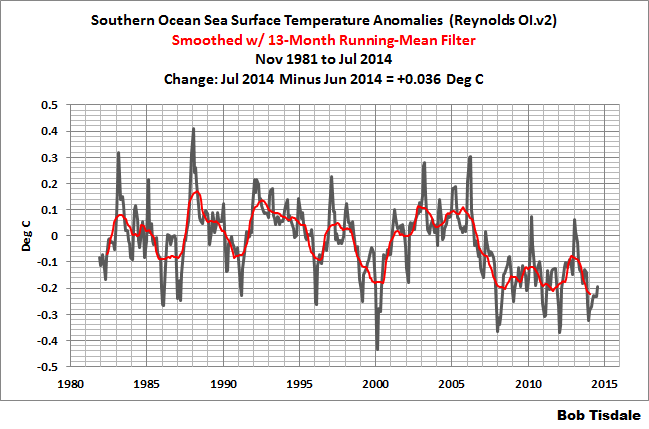
Last, according to Chen and Tung (2014), hiatus periods due to the sequestration of ocean heat to depth in the Atlantic and Southern Oceans can last 20 to 35 years. And they note the current hiatus period has already lasted 15 years. That indicates we’ve got another 5 to 20 years more to go with the current hiatus.
CLOSING
Over the past few years, we’ve seen more and more papers that admit natural variability contributed to the warming from the mid-1970s to the turn of the century and suppressed the warming in the 21st Century. When will the climate science community admit they’d tuned their models to a naturally occurring upswing in the warming of global surfaces from the mid-1970s to the turn of the Century, and as a result their projections of future global warming are way too high? (Answer: Probably not in my lifetime.)
Thanks, Anthony.
Cheers
“The fact that the global-mean temperature, along with that of every major ocean basin, has not increased for the past 15 years, as they should in the presence of continuing radiative forcing, requires a planetary sink for the excess heat.”
OR requires a re-evaluation of the radiative forcing…
We DONT have to “invent” a place where the “missing” heat goes… we SHOULD actually be questioning IF there’s actually excess heat in the first place!!!
Sounds like they have been spending some time reading the posts here at WUWT.
CHEN AND TUNG CONCLUSIONS
They write:
The fact that the global-mean temperature, along with that of every major ocean basin, has not increased for the past 15 years, as they should in the presence of continuing radiative forcing, requires a planetary sink for the excess heat. Although the tropical Pacific is the source of large interannual fluctuations caused by the exchange of heat in its shallow tropical layer (3), the current slowdown is in addition associated with larger decadal changes in the deeper layers of the Atlantic and the Southern oceans. The next El Niño, when it occurs in a year or so, may temporarily interrupt the hiatus, but, because the planetary heat sinks in the Atlantic and the Southern Oceans remain intact, the hiatus should continue on a decadal time scale. When the internal variability that is responsible for the current hiatus switches sign, as it inevitably will, another episode of accelerated global warming should ensue.
First of all it is the visible light and long UV light wavelengths that are the main contributor to heat accumulation in the oceans. I think they are referring to IR radiation when they say in the presence of continuing radiative forcing. If not then I stand corrected.
I also think this explanation can eek out more time to keep AGW theory hopes alive while all of the data continues to go against the theory as time moves on.
I suspect by the end of this decade much more will be known about solar/climate connections due to primary and secondary solar effects. If solar conditions remain quiet and the temperature trend is up or steady it can be dismissed but if the global temperature trend is down once again like it has done in the historical record it is going to make for a very strong case of a solar /climate connection. Especially in the face of rising co2 concentrations.
Bob I appreciate your work.
“we’ve hit a critical desalination point.” [from ‘The Day After Tomorrow’] #3 worst science fiction movie line according to MIT Technology Review. http://www.technologyreview.com/view/424251/the-five-worst-hard-science-fiction-movies-ever/
Correct, nothing new in there.
Natural variability in the N. Atlantic is well documented. The N. Atlantic SST (AMO) lags by number of years other natural events of similar or identical longer term trends. As I show
HERE.
Even the nearby CET is often out of step or in advance of the AMO.
Hmmmm seems to me that they have discovered some of the reasons behind the 60-year warming and cooling cycle.
It darn well better cause warming – it was down to 4 C last night up here. Leaves are changing color and geese are already flying south. Not a good sign. Gonna be a really cold winter.
The fact that the global-mean temperature, along with that of every major ocean basin, has not increased for the past 15 years, as they should in the presence of continuing radiative forcing, requires a planetary sink for the excess heat.
========
or the radiative theory is wrong. that water vapor provides a negative, not positive feedback. that as you add CO2, H2O is decreased by an equal mass, before any warming can take place.
Does their model include changes in global net radiative imbalance from 1985 to 2012 as seen by Allan et al, doi:10.1002/2014GL060962, that is, pointing to the outgoing long-wave radiation having increased over the past 60 years, in contradiction to the naïve AGW expectation, I wonder. And does it do cloud cover and cloud dynamics correctly?
settled skeptical science
“We know that strong El Niño events are a primary cause of global surface warming.”
err no we dont.
“And they note the current hiatus period has already lasted 15 years. That indicates we’ve got another 5 to 20 years more to go with the current hiatus.”
Here we go again, no pause, then pause needs to be 17 years (Santer) to be significant then as we approach it, now revised to 20 to 35 years. I am sure it will soom be 50 years.
“Numerous scientific papers have reported the hiatus in global surface warming will end with the next El Niño event.”
Could you cite some references for this please, Bob? Thanks.
We’re doomed in 5 to 20 years from now? The AGW doomsday cult won’t sign up many new members with prognostications this vague.
Even the Old Farmer’s Almanac is jumping on the “A very cold winter is coming” bandwagon.
http://hosted.ap.org/dynamic/stories/U/US_OLD_FARMERS_ALMANAC?SITE=AP&SECTION=HOME&TEMPLATE=DEFAULT&CTIME=2014-08-20-15-08-00
The AP writer says, “The almanac, which has about an 80 percent success rate in its forecasts, employs modern technology but still uses the “secret formula” that founder Robert Thomas devised in 1792. By combining the study of sunspots, prevailing weather patterns and basic meteorology, the almanac’s weather staff comes up with a long-range forecast. The temperature deviations are based on 30-year averages compiled by government forecasters.”
Hmmm… where recently have I seen that 30 year average before?????
Q: How will the public react to another brutal winter?
A: CAGW – RIP
Bob, I’ve been saying the same thing for more than a decade. The evidence is accumulating, their ship is sinking…..
First – Bob, I think it is reason 32, not 38.
But to the meat. yea, it does present a conundrum for the team. If the heat really is missing in the deep, then when it reappears will apparently not depend upon CO2. So the control knob does not work. Kind of a damned if you do and damned if you do not.
Bob I have a question. Is the Atlantic Meridional Over Turning Circulation (AMOC) the same as the Atlantic Multidecadal Oscillation? (AMO) Thanks
The AMO won’t go negative for probably another decade.
What happens to global temps then?
http://www.esrl.noaa.gov/psd/cgi-bin/gcos_wgsp/tsanalysis.pl?tstype1=91&tstype2=0&year1=&year2=&itypea=0&axistype=0&anom=0&plotstyle=0&climo1=&climo2=&y1=&y2=&y21=&y22=&length=&lag=&iall=0&iseas=1&mon1=0&mon2=11&Submit=Calculate+Results
Maybe missing heat is the energy used to melt the retreating land/continental ice burgs, perma frost, and sea ice. However, there is sea ice growth recently. q = mcΔT, where
q = heat energy
m = mass
c = specific heat
ΔT = change in temperature
Maybe someone has an idea of how many mega-grams of ice has melted in 120 years.
“The last little tidbit of value is the time periods of similar past cooling periods, 20 to 35 years, and that’s important because the current hiatus has not lasted that long yet.”
AND THEN
“The fact that the global-mean temperature, along with that of every major ocean basin, has not increased for the past 15 years, as they should in the presence of continuing radiative forcing, requires a planetary sink for the excess heat…………….because the planetary heat sinks in the Atlantic and the Southern Oceans remain intact, the hiatus should continue on a decadal time scale. When the internal variability that is responsible for the current hiatus switches sign, as it inevitably will, another episode of accelerated global warming should ensue.”
———————————————–
By a simple rationale, as the excess heat must be much higher at around 400ppm of CO2 then the required planetary sink must be of a much higher magnitude than in case of past similar cooling periods that seem to have lasted 20 to 35 years.
As they say the current co2 emissions and concentration in atmosphere is unprecedented……therefore a same uprecedented magnitude of a planetary sink is required to explain the current hiatus.
I think is fair to assume that if such explanation for the hiatus is considered feasible then why not feasible enough to explain in principle by the same means the LIA.
A planetary sink process causing a cooling period like LIA.
In such a light is feasible I think to consider also the possibility that another 5 to 20 years of continuing of the current hiatus is and must be the most minima expected with a probability of a much loger period of a hiatus or even cooling for that matter.
Maybe the next episode of any meaningful global warming acceleration may ensue far away in the future, perhaps thousands of years in the future….perhaps….perhaps not, but could be one of possibilities lookingn at by the angle offered…..
cheers
Jim S: Hmmmm seems to me that they have discovered some of the reasons behind the 60-year warming and cooling cycle.
I think that is the best response to the paper. They found a part of the mechanism in the oscillatory behavior of the thermohaline circulation. Everything requires confirmation by subsequent research, but that looks good. KK Tung explains at Climate Etc that the press release including “half of warming due to CO2” was based on another paper (he supplies a link at Climate Etc.)
By itself, this paper does not demonstrate that any of the warming since the end of the Little Ice Age is due to CO2. What is shows is that *if* increased CO2 is causing increased heat accumulation, it is not mere hand-waving to assert that the “missing” heat is being directed into the deeper ocean.
2010 El Nino did not end the pause….
Steven Mosher says:
August 21, 2014 at 12:36 pm
settled skeptical science
“We know that strong El Niño events are a primary cause of global surface warming.”
err no we dont.
####
I guess predicate logic is not your strong suite, or maybe it just a problem with reading comprehension.
It seems to me that when the slightly warmer water, down to 1500 m in depth, comes to contact with the even COLDER benthic waters that go down to 4000-5000 meters, conduction will tend to pull the heat even deeper, sequestering for even longer. And diluting the temperature gradient even more. As a Fourier’s Law transfer, it will be quite slow, but it will be down there 30 years or so to move the heat even deeper.
In an analogy, the 11 year solar SSN cycle is related to the meridional flow velocities from pole to equator. When the SSN solar cycles weaken, it is an indication the meridional flow velocity slowed. The AMOC and the AMO cycle lengths are also related to the meridional flow velocities, and by extension, the cycle time length changes. So it seems to me, based on first principles, the extra heat down below will (slowly) speed up the AMOC, not by much, but possibly measurable.