In the post Trenberth Still Searching for Missing Heat, we discussed the recent Balmaseda et al (2013) paper “Distinctive climate signals in reanalysis of global ocean heat content”, of which Kevin Trenberth was a coauthor.
Dr. Roy Spencer also has a recent post on that paper. I’ve cross posted Roy’s post following this introduction. Roy Spencer argues that it is possible for the oceans to warm to depth, while the surface temperatures remain flat, but… (No spoiler from me. You’ll have to read Roy’s post.)
Roy does note that arguments about continued ocean warming to depth “…depend upon global deep ocean temperature changes being measured to an accuracy of hundredths or even thousandths of a degree…”. That’s why all of the adjustments to the ocean heat content data are so critical to this discussion.

Figure 1
If we were to consider the “unadjusted” ocean heat content data (represented by the UKMO EN3 data in Figure 1) to be correct, then the ocean heat content for depths of 0-2000 meters flattened as soon as the ARGO floats had reasonably compete coverage of the global oceans in 2003-04. It’s only when the ocean heat content data is corrected, tweaked, adjusted, modified, whatever (represented by the NODC data in Figure 1), that the global ocean heat content continues to warm in relative agreement with climate models.
START OF ROY SPENCER’S POST
More on Trenberth’s Missing Heat
April 8th, 2013 by Roy W. Spencer, Ph. D.
While I don’t necessarily buy Trenberth’s latest evidence for a lack of recent surface warming, I feel I need to first explain why Trenberth is correct that it is possible for the deep ocean to warm while surface warming is seemingly by-passed in the process.
Then I will follow up with observations which run counter to his (and his co-authors’) claim that an increase in ocean surface wind-driven mixing has caused the recent lack of global warming.
Can Deep Ocean Warming Bypass the Surface?
It depends on what one means by “warming”. A temperature change is the net result of multiple processes adding and subtracting heat. Warming of the deep ocean originally caused by radiative forcing of the climate system cannot literally bypass the surface without some effect on temperature. But that effect might be to keep some cooling process from causing an even steeper dive in temperature.
It’s like adding a pint of warm water, and a gallon of cold water, to a sink full of room temperature water. Did adding the pint of warm water cause the temperature in the sink to rise?
To appreciate this, we first need to understand the basic processes which maintain the vertical temperature distribution in the global oceans. The following cartoon shows a North-South cross section of measured ocean temperatures in the Atlantic.

The average temperature distribution represents a balance between 3 major processes:
(1) surface heating by the sun (mitigated by surface evaporation and infrared radiative loss) which warms the relatively shallow ocean mixed layer;
(2) cold deepwater formation at high latitudes, which slowly sinks and fills up the oceans on time scales of centuries to millennia, and
(3) vertical mixing from wind-driven waves, the thermohaline circulation, and turbulence generated by flow over ocean bottom topography (the latter being partly driven by tidal forces).
The key thing to understand is that while processes (1) and (2) continuously act to INCREASE the temperature difference between the warm mixed layer and the cold deep ocean, the vertical mixing processes in (3) continuously act to DECREASE the temperature difference, that is, make the ocean more vertically uniform in temperature.
The average temperature distribution we see is the net result of these different, competing processes. And so, a change in ANY of these processes can cause surface warming or cooling, without any radiative forcing of the climate system whatsoever.
So, let’s look at a few ocean mixing scenarios in response to radiative forcing of the climate system (e.g. from increasing CO2, increasing sunlight, etc.), all theoretical:
Scenario 1) Warming with NO change in ocean mixing: It this case, surface warming is gradually mixed downward in the ocean, leading to warming trends that are a maximum at the ocean surface, but which decrease exponentially with depth.
Scenario 2) Warming with a SMALL increase in ocean mixing. This case will result in weaker surface warming, and slightly stronger warming of the deep ocean, both compared to Scenario 1. The warming still might decrease exponentially with depth.
Scenario 3) Warming with a LARGER increase in ocean mixing. This case could lead to an actual surface temperature decrease, but warming of the deep ocean, similar to what I believe Trenberth is claiming.
Yes, the surface waters “warmed” before the deep ocean in Scenario 3, but it was in the form of a weaker temperature drop than would have otherwise occurred.
Because of the immense heat capacity of the deep ocean, the magnitude of deep warming in Scenario 3 might only be thousandths of a degree. Whether we can measure such tiny levels of warming on the time scales of decades or longer is very questionable, and the new study co-authored by Trenberth is not entirely based upon observations, anyway.
I only bring this issue up because I think there are enough legitimate problems with global warming theory to not get distracted by arguing over issues which are reasonably well understood. It takes the removal of only one card to cause a house of cards to fall.
But it also points out how global warming or cooling can occur naturally, at least theoretically, from natural chaotic variations in the ocean circulation on long time scales. Maybe Trenberth believes the speedup in the ocean circulation is due to our driving SUVs and flipping on light switches. He has already stated that more frequent El Ninos are caused by anthropogenic global warming. (Except now they are less frequent — go figure).
In some sense, natural global warming and cooling events are made possible by the fact that we live within an exceedingly thin warm surface “skin” of a climate system in which most of the mass (the deep ocean) is exceedingly cold. Any variations in the heat exchange between those two temperature worlds (such as during El Nino with decreased mixing, or La Nina with increased mixing) can cause large changes in our thin-skinned world. It that sense, Trenberth is helping to point out a reason why climate can change naturally.
Have Ocean Winds Increased Recently?
Trenberth and co-authors claim that their modeling study suggests an increase in ocean surface winds since 2004 has led to greater mixing of heat down into the ocean, limiting surface warming.
Fortunately, we can examine this claim with satellite observations. We have daily global measurements of ocean surface roughness and foam generation, calibrated in terms of an equivalent 10 meter height wind speed, from AMSR-E:

I don’t know about you, but I don’t see an increase in surface winds since 2004 in the above plot. This plot, which is based upon wind retrievals that have been compared to (as I recall) close to 1 million buoy observations, really needs to be extended back in time with SSM/I and SSMIS data, which would take it back to mid-1987. That’s on my to-do list.
So far, I would say that the so-called missing heat problem is not yet solved. I have argued before that I don’t think it actually exists, since the “missing heat” argument assumes that feedbacks in the climate system are positive and that radiative energy is accumulating in the system faster than surface warming would seem to support.
For the reasons outlined above, Trenberth’s view of deep ocean storage of the missing heat is still theoretically possible since increased vertical ocean mixing doesn’t have to be wind-driven. But I remain unconvinced by arguments that depend upon global deep ocean temperature changes being measured to an accuracy of hundredths or even thousandths of a degree.
Finally, as I have mentioned before, even if increased rate of mixing of heat downward is to blame for a recent lack of surface warming, the total energy involved in the warming of the deep oceans is smaller than that expected for a “sensitive” climate system. Plots of changes in ocean heat content since the 1950′s might look dramatic with an accumulation of gazillions of Joules, but the energy involved is only 1 part in 1,000 of the average energy flows in and out of the climate system. To believe this tiny energy imbalance is entirely manmade, and has never happened before, requires too much faith for even me to muster.

END OF DR. SPENCER’S POST
Back to Roy’s statement, “But I remain unconvinced by arguments that depend upon global deep ocean temperature changes being measured to an accuracy of hundredths or even thousandths of a degree”:
First consider that the ARGO floats have had “complete” coverage of the global oceans since 2007. The Earth’s oceans and seas cover about 361 million square kilometers or 139 million square miles. There were 3566 ARGO floats in operation in March 2013. If the floats were spaced evenly, then each ARGO float is sampling the temperature at depth for a surface area of approximately 101,000 square kilometers or 39,000 square miles—or an area about the size of Iceland or the State of Kentucky.
Second, consider that the ARGO era is when the sampling is at its best, but before ARGO temperature sampling at depth was very poor. Refer to the following animation. Temperature sample maps at 1500 meters (6MB). There is little observational data at depths of 1500 meters prior to ARGO. In other words, we have little idea about the temperatures of the global oceans to depths of 2000 meters and their variability before ARGO.
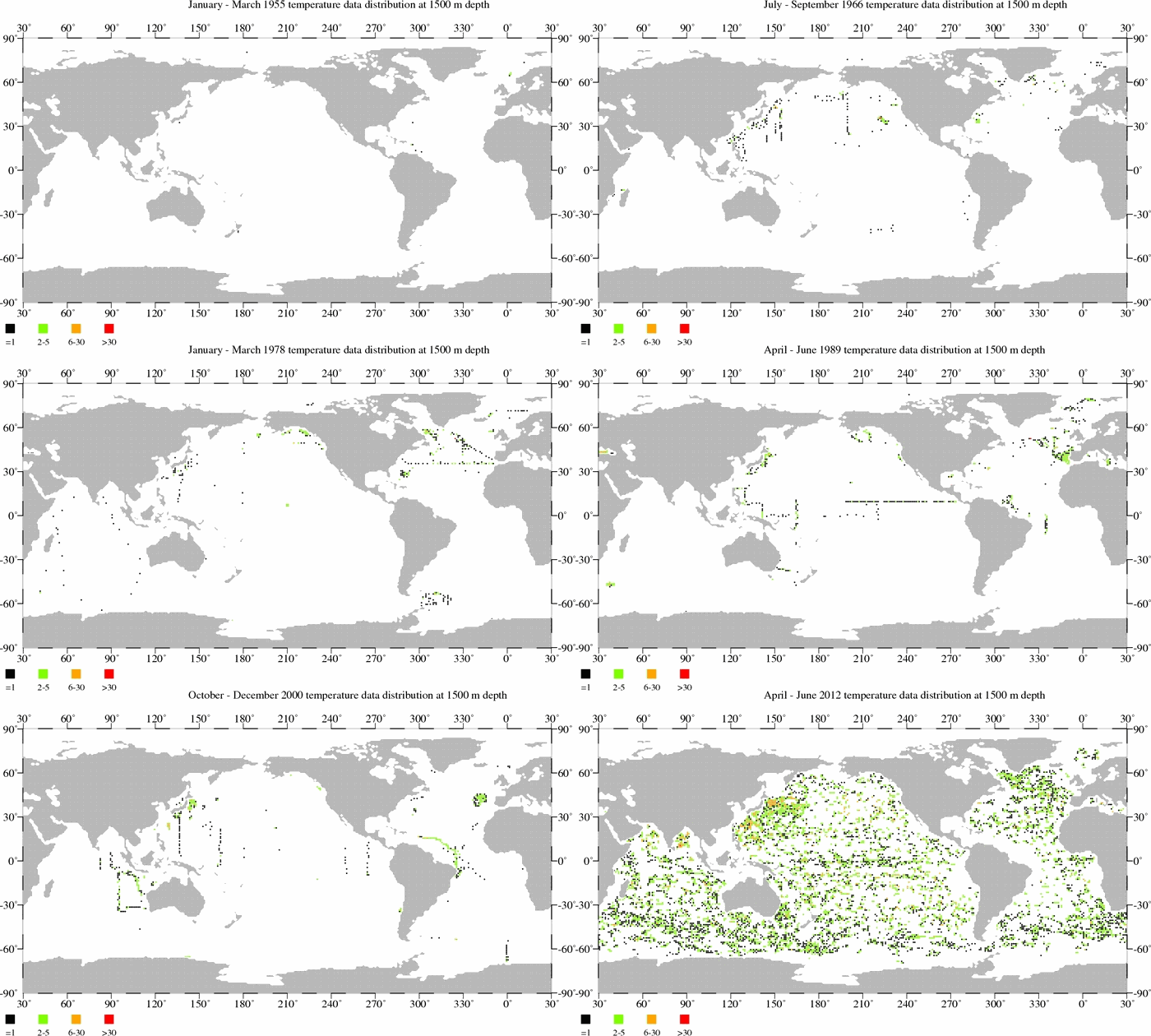
Third, on top of that, consider that ARGO floats have been found to be unreliable, hence the need to constantly readjust their observations.
Do we have any idea about the variability of the temperatures and ocean heat content of the global oceans to depth? Simple answer: No.
For more information on the problems with Ocean Heat Content data, refer to the post Is Ocean Heat Content Data All It’s Stacked Up to Be? and NODC’s Pentadal Ocean Heat Content (0 to 2000m) Creates Warming That Doesn’t Exist in the Annual Data – A Lot of Warming.
The best thing about the deep ocean is that its virtual total unexplored , so you can make great claims about ‘maybe ‘ in it and know its unlikely others can prove you wrong . Of course such a position has no real place in science where the normal procedure is to offer ‘proof ‘ to back up claims , but then this is climate ‘science’ and Trenberth’s is already on record expressing how he want to reverse the normal procedure for the null hypotheses. So the fact this ‘trick’ is to science what Charlie Manson is to family values is to be expected .
I have asked this question a number of times , but it is worth asking again , are their any actual standards within climate science? Then have show time and again they cannot even meet the academic standards expected of any science undergraduate when they write an essay , but are we really saying that BS mixed with guess work is ‘good enough ‘ for these professional ?
Frankly if I was one of their students that had my work marked down , I be tempted to point out to them their own basic failings in following the scientific approach.
Even if there is some increase in the heat content of the oceans it says nothing about whether warming due to man made CO2 is currently happening, or ever happened. All it tells you is that at some time in the past there was some warming from some cause.
Come on Kevin, over here now, make yourself comfortable. Everything’s going to be OK ……
http://www.independent.co.uk/migration_catalog/article5250293.ece/ALTERNATES/w460/dr-kildare.jpeg
I have often wondered if the very slow moving deep ocean currents are the Earth’s natural thermostat.
Sometime ago, someone knowledgable on WUWT commented that if the oceans gave up 0.1 degrees C of heat in one second (an obvious impossibility) then the atmosphere’s temperature would instantly rise to boiling point.
If Trenberth’s ‘missing heat’ is being transported away from the surface by these deep ocean currents, it would mean two things:
1. The Earth’s natural thermostat would ensure CAGW is a complete impossibility.
2. There would be a very tiny rise in the level of the oceans as they expanded due to the minute increase in temperature.
I have a suspicion Trenberth may be right about there being missing heat transported to the bowels of the oceans. The point is he has not followed the argument through, for if this is currect – as said earlier – these deep ocean currents must be a significant part of the world’s natural thermostat system.
Below is a Wikipedia comment on these deep ocean currents.
http://www.google.co.uk/url?sa=t&rct=j&q=deep%20ocean%20currents&source=web&cd=7&cad=rja&sqi=2&ved=0CE4QFjAG&url=http%3A%2F%2Fen.wikipedia.org%2Fwiki%2FThermohaline_circulation&ei=z9prUYvMK8vWPNvUgagK&usg=AFQjCNG-6rsl1n2fMr13jya8Bi0Xm4RgYQ
I can see no way of heating ‘deep ocean’ by bypassing the surface. It just is not possible and nothing I’ve read suggests otherwise. Yes, the surface can mix caused by long lived storms / depressions but not down below 700m. Roy is gradually losing it, sadly, what with measuring back radiation with a cheap IR temp metre (8ù to 14ù bandwidth) by pointing at cloud and open sky, pulezzz.
Stephen Richards says: “I can see no way of heating ‘deep ocean’ by bypassing the surface.”
I don’t believe Roy said or suggested it bypassed the surface. He wrote, “Warming of the deep ocean originally caused by radiative forcing of the climate system cannot literally bypass the surface without some effect on temperature.”
The assumption here is that longwave radiation from greenhouse gases does something other than evaporate a little more warm water.
Wikipedea states rising co2 is the cause of agw.not even calling a theory but citing it as a fact. Is it any wonder we are all so misinformed! Just read how these so called experts measure co2 in the atmosphere,they get measurements from the top of several mountains!
Forgive my ignorance but may I ask about heating from the bottom of the Ocean?
I know that volcanoes aren’t everywhere but they are down there. And they are very hot.
Is the effect of geological heat release smaller by orders of magnitude than the effects of sunlight (which is weaker but far more widespread)?
This is a genuine question, asked in ignorance.
A significant thermal gradient in the deep would change the significance of everything, including that diagram in this post.
Excellent post, thanks bob and Roy. The deep water measurements use salinity as a proxy for temperature don’t they?
The assumption here is that longwave radiation from greenhouse gases does something other than evaporate a little more warm water.
Bob, exactly. Good post.
If any extra heat generated by anthropomorphic GHG is transferred (by means unknown) to the ocean depths, then there can be no temperature rise at the surface from that heat. Since the positive feedback loop inherently depends on a surface temperature rise, to increase evaporation, then logically, there is no positive feedback.
Seems like a lot of faith is being placed on ocean sensors that measure the temps for each 39k square miles, need to do it to 0.001° and have problems so their readings need to be adjusted. And we have to come up with a process of ocean mixing to explain the missing temperature. Sounds to me like we are a bit short of data to explain much of anything.
When I read this, I thought about the old joke about the guy interviewing accountants. The first two answer his questions with detailed explanations, the third responds “what number do you want?”
What is there about Laws of Thermodynamics that warmists do get. Heat rises simple as that.
And when volcanoes heat the bottom, the heat rises.
It’s easier to fake things that aren’t easily measured, or manipulated. Corrected data is manipulated dat.
Here’s a link to a three-minute Bloomberg video on the Wave Glider, a wind- and wave-powered robot / programmable guided buoy that can gather data on the ocean. It has two parts, a float and a submersible. 200 are in operation. This could provide a network of data sensors for NOAA that would stay in fixed positions, which ARGO can’t do.
http://www.bloomberg.com/video/the-wave-glider-sv3-a-floating-computer-7~BC0zHQRvu86vt2Rrxk1A.html
Here’s a link to a google search for “wave glider”:
http://www.google.com/search?client=safari&rls=en&q=%22wave+glider%22&ie=UTF-8&oe=UTF-8
Perhaps a fourth process, the solar/geomagnetic coupling of lateral solar flare currents directly into the first several hundred metres of the oceans depth is quite significant? This could mean that the global temperature anomaly would be highly correlated with the ak index but would not resolve solar cycle minima because the oceans buffer this heat for long periods of time, about a decade. Global temperatures would then reflect Grand minima, maxima and regular periods of solar activity. The heating need not be due to surface heating but vertical mixing would regulate the buffer duration.
Why would anyone worry about hundredths of a degree of “warming”? That has zero effect.
“Warming of the deep ocean originally caused by radiative forcing of the climate system cannot literally bypass the surface without some effect on temperature”.
I discussed this issue in a previous post.
It is possible to heat bulk of the water without heating the surface, Although the effect is quite small the cumulative effect could be significant. If you snorkel under water you can see. What you see always looks blue. The fact that you can see demonstrates that significant radiative energy penetrates to a depth of several metres without significant absorption. The blue hue is because this is not true for the red end of the spectrum which is absorbed very close to the surface.
All wavelengths will eventually be absorbed and converted to heat. In the absence of particulates I believe the UV parts of the spectrum will be absorbed at depths of up to 100 metres but Roy may have a better figure for this.
Roy may still consider this to be the surface ( which would justify his statement) but I think it is possible that this radiative absorption at medium surface depths may be playing an important role in ocean cycles. The reason I believe this is two fold. Firstly, although the UV part of the spectrum is small (3% of TSI at the surface) it varies considerably with the sun’s activity (30% I think) so if you are looking for a source of the correlation of climate with sun spots this is a good candidate. Secondly the variation in UV has no balancing increase in infrared radiation and evaporation at the surface so can accumulate for decades until ocean currents bring the warm pools up to the surface.
It is worth pointing out that the anthropogenic climate change via increased downward infra red radiation from the upper atmosphere is a very poor candidate for bulk heating of the oceans since the wavelength of this radiation is around 14-18 micron. This wavelength will be absorbed within a millimetre of the sea’s surface. It is hard to see how increased energy absorption at this wavelength would not be immediately compensated for by increased losses through evaporation.
Finally. If my idea is correct, it is pointless to look for an increase in ocean heating now. All the warming would have taken place during the period of the active sun several decades ago. I would now expect to see a gradual cooling. Once they have stopped fiddling with the Argo results maybe this is what we will see.
How can surface heat warm the deep oceans without warming the layers of water in-between? Simple — quantum teleportation!
As you read this, the climate models are being updated to include quantum teleportation.
Earth’s oceans contain 310 million cubic miles of water at an average of 4C temperature. Human CO2 emissions are 28 giga-tons per year, at 125 lb/cu ft, converting, human emissions are less than 3 cubic miles. The specific heat of water is more than four times the specific heat of CO2. In a “normal” thermodynamic heat flow equation the (thermal mass) x (specific heat) would yield the relative heat heat transfer. It is IMPOSSIBLE for this tiny human caused ” 3 cu mile tail” to wag this huge natural “310,000,000 cu mile dog”. As for ocean warming, it DOES come from below, see “Earth’s Missing Geo-thermal Flux”, as a large portion of this heat flow is disguised in latent phase changes of the discharge vent gases.
We have been lied to by Lester diverted tax dollars to fake science grants. See “Lesterland” by Harvard Professor Lawrence Lessig, the just announced winner of the Houston Film Festival…trailer posted at:
This is obviously an excellent post and some thoughtful comment. I am intrigued by the statement that “ARGO floats have been found to be unreliable”. If anyone can offer any info on this unreliability I would be most obliged.
It maybe that you have to say that they are unreliable to justify ‘adjusting’ their data.
Until 1980, most people in the world believed that “water seeks its own level” in the oceans, and that oceans level around the world are uniform. In fact, there is an Indonesia bulge of 1 meter verses the west coast of South America at the equator. And, in the Atlantic, the Gulf of Mexico is 0.3 meters higher than the level at the west coast of Africa. Satellites launched after 1980, measuring the Ocean surface, revealed this fact.
After 1980, most people in the world still believe that ocean levels are uniform.
These bulges are created by the Sun heating the Equatorial waters producing the Trade Winds. The Trade Winds then create a wind driven current across the Pacific/Atlantic creating a void in the East. This surface current piles up waters in the West. When the bulge gets to a certain level, it causes a “surface/deep” current to flow both North/South, of the Equator, that eventually replaces the “void” of waters” to the East.
After much study, I have found that there is a disconnect between the Surface and the Deep Ocean currents. Until this disconnect is fixed, La Nina/ El Nino will not be understood. In addition, how the Sun drives the climate system is only partially understood. The movement of waters driven by the Trade Winds [forced by the Sun] is not part of the Climate Models.
How can “Science” say where the “heat” has gone, without understanding the Surface and Deep Ocean current relationship???
When I was younger man in navy technical school we had a poor instructor spend a week lecturing with little student comprehension. Following this wasted week of lectures was an inadequate exam with a 70% failure rate (I had a 52). The lead instructor decided to add 17points to normalize the grades. I ended up with a 69% and was assigned night study for a week. The leading chief called me in and asked what I had to say so…… I said (with little restraint in my voice) ” The training was poor and the exam was really confusing. I understand you have the authority to put me on stupid study any time you want but it’s your logic that’s screwed up.”
It seems to me these are the same type of arguments. We don’t know the right answer but we’ll say it’s rrriiiiggghhhhttttt here.
btw, I spent the next week on night study. It was the military, Doh!
cn
Here is a better comparison of what the theory really says should be happening.
Not a tiny 15 10^22 joules over 25 years (0.5 W/m2) but it is predicted to be increasing at a rate which is more than twice that which has been observed from Argo.
GISS Model ER
http://www.realclimate.org/images/ohc11.jpg
Trenberth’s CCSM4
http://s21.postimg.org/e4ozrdnyv/Trenberth_s_OHC_Climate_Model.png
That leaves a large amount of energy missing. More than half.
A number of questions arise, before the premise behind this conjecture can be taken seriously, such as:
1.
What is precise mechanism whereby heat (energy) is transported to the deep ocean? At what rate can heat be sequestered to depth? Will the heat resurface, if so by what mechanism and when will this occur?
2.
When did this mechanism first start? For example, has it been operative throughout the entire history of planet Earth and if so that begs the question as to why the deep ocean is only some 2 to 3degC after some 4 billion years of deep ocean warming. If it started more recently, what caused this mechanism to now kick in? Why was it not operative during say the late 1970s to late 1990s warming?
3.
What has caused the atmosphere to stop warming? Is it easier for the effects of backradiation (whatever they may be) to heat the atmosphere, or the deep ocean? Can it only do one or other, or both simultaneously?
4.
Has the atmosphere stopped warming precisely at the time when the oceans at depth began to warm? If so, are these two mechanisms related in some way, and if so, what is their relationship?
5.
If backradiation cannot directly heat the ocean because it only penetrates a few micrometers and the energy flux at this layer is upwards (such that energy absorbed in the first few microns cannot be conducted downwards), and ocean over-turning is a slow mechanicakl process operating at a speed slower than the rate of the absorption of DWLWIR (such that it cannot sequester the energy to depth before the energy absorbed in the first few micron layer drives evaporation) can the oceans only heat (in the sense that they are losing heat more slowly than would otherwise be the case), if the atmosphere above the oceans was warming?
I am of the view that this appears to be ‘fantasy’ conjecture. We do not have the data to test the conjecture, nor will we possess it for at least 50 or more years. We would need to extent the coverage of ARGO by probably 100 million fold, and have this data set for say a minimum of 50 years before trends could realistically be assessed, and even then there would be issues as to whether we can measure temperature to the required accuracy.
In summary, this smells of desperation and should really be dismissed for the fanciful b*llsh** it appears to be.
Should not the melted Arctic ice cause some form of cooling measurable by the Northern meters?