Guest post by Paul Homewood

http://www.guardian.co.uk/environment/2013/mar/27/climate-change-model-global-warming
The Mail on Sunday ran an article by David Rose a couple of weeks ago, pointing out just how woeful most climate models had been in predicting global temperatures in the last decade or so. Added to other media reports in recent months, the public at large, at least in the UK. are now gradually becoming aware that temperatures have flatlined for several years.
Desperate to counter this, the Guardian have reported on some work by Myles Allen, Professor of Geosystem Science at Oxford University. They report:-
Forecasts of global temperature rises over the past 15 years have proved remarkably accurate, new analysis of scientists’ modelling of climate change shows.
The debate around the accuracy of climate modelling and forecasting has been especially intense recently, due to suggestions that forecasts have exaggerated the warming observed so far – and therefore also the level warming that can be expected in the future. But the new research casts serious doubts on these claims, and should give a boost to confidence in scientific predictions of climate change.
The paper, published on Wednesday in the journal Nature Geoscience, explores the performance of a climate forecast based on data up to 1996 by comparing it with the actual temperatures observed since. The results show that scientists accurately predicted the warming experienced in the past decade, relative to the decade to 1996, to within a few hundredths of a degree.
The forecast, published in 1999 by Myles Allen and colleagues at Oxford University, was one of the first to combine complex computer simulations of the climate system with adjustments based on historical observations to produce both a most likely global mean warming and a range of uncertainty. It predicted that the decade ending in December 2012 would be a quarter of degree warmer than the decade ending in August 1996 – and this proved almost precisely correct.
The new research also found that, compared to the forecast, the early years of the new millennium were somewhat warmer than expected. More recently the temperature has matched the level forecasted very closely, but the relative slow-down in warming since the early years of the early 2000s has caused many commentators to assume that warming is now less severe than predicted. The paper shows this is not true.
These claims raise a number of issues, but let’s start by looking at the actual numbers. Plotted below are the annual HADCRUT4 anomalies, (based on y/e August, in line with Allen’s workings).

The decade averages, as indicated by the red lines, have increased from 0.196C to 0.467C, so on the face of it, Allen’s prediction was spot on. But we need to delve a little deeper.
1) Let’s start by making a general observation. The Guardian suggest that the results of this one model somehow vindicate climate modelling in general. This is clearly a nonsense, as we will see later, as is their claim that it “should give a boost to confidence in scientific predictions of climate change”
2) The article also talks about “the relative slow-down in warming since the early years of the early 2000s”. This is more nonsense – warming has not “slowed down”, it has stopped.
3) The first thing to notice about Allen’s prediction is just how low it was, compared with most other models. His forecast of 0.25C warming in 16 years equates to about 1.5C/century, well below other predictions. We’ll compare a couple later.
4) His starting point, the 10 years ending 1996 were, of course, affected by Pinatubo. The years 1992-94 were about 0.15C lower than the years before and after, so it is reasonable to assume the decadal average was about 0.04C lower as a result. In other words, about a sixth of Allen’s prediction of a 0.25C increase is no more than a rebound from Pinatubo.
5) As there was warming between 1986 and 1996, the temperatures at the end of that decade were already higher than the decadal mean. The average of 1995/96 was 0.07C higher than the decadal mean. In other words, part of Allen’s predicted increase between 1996 and 2012 had already occurred before 1996.
6) By the time the paper was written in 1999, Allen, of course, already knew that temperatures had climbed significantly since 1996, with the average of 1997 and 98 being 0.46C. Remember that his model predicted a figure of 0.45C for the decade to 2012, (0.196C + 0.250C).
I wonder why we were not told then that there would be no net warming for the next 13 years?
7) Although the model has, fortuitously, accurately predicted the temperature to 2012, this does not mean that it has been validated. The lack of warming for at least 10 years is a significant feature, and any model that fails to predict this cannot be said to be validated. It is ludicrous to posit that it “should give a boost to confidence in scientific predictions of climate change”.
8) As I mentioned, many other models forecast much more rapid rates of warming. The Met Office’s decadal forecast in 2007, for instance, which predicted global temperatures in 2012 would be 0.60C higher than 1996.

http://notalotofpeopleknowthat.wordpress.com/2013/02/06/met-office-decadal-forecast2007-version/
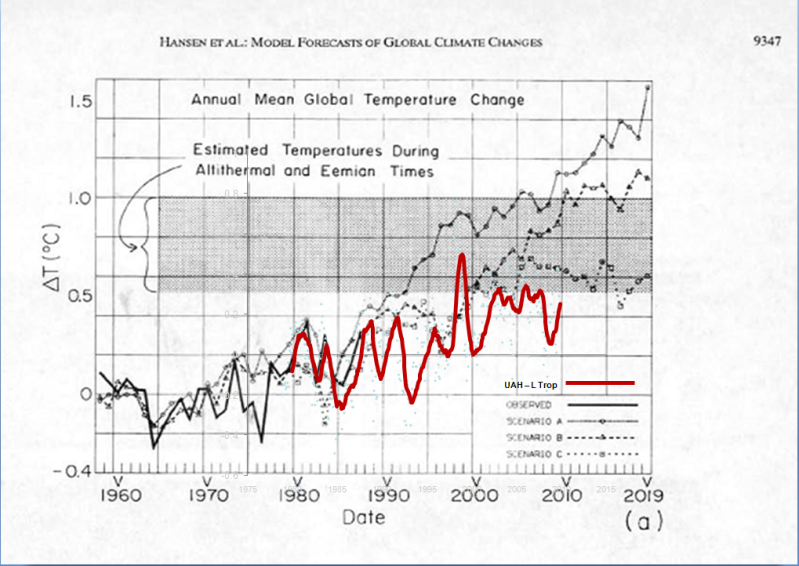
9) Or Hansen’s famous 1988 model, that predicted more than a degree of warming, even under Scenario B.

http://i90.photobucket.com/albums/k247/dhm1353/Climate%20Change/HansenvUAH.png
Conclusion
Contrary to the Guardian’s claims, Myles Allen’s work does not indicate vindicate climate modelling in general, nor does it inspire confidence in current predictions.
Furthermore, Allen’s work fails to explain why temperatures have flatlined in the last ten years, and why his original model did not predict it. More importantly, it has nothing to say about what this pause means for temperatures during the next decade.
But you would not expect to hear any of this from the Guardian.
There are people who live in the real world then there are the people in the above story.
(facepalm)
Anyone with a print copy of the Grauniad is probably burning it right now to keep warm.
I see the Guardian has not taken up another prediction Myles Allen was involved in-
“Myles Allen first hit the headlines when a research project that he was involved with issued a press release (26th Jan 2005) predicting that temperatures could rise by 11° C even if the amount of CO2 in the atmosphere is limited to only double the level before the Industrial Revolution.”
http://ccgi.newbery1.plus.com/blog/?p=81
Strange how the press release does not seem to be available on climateprediction.net!
The Guardian is to jounalism what Ghengis Khan was to diplomacy!
It seems global warming modeling is remarkably accurate at predicting past temperatures.
AGW promoters have very little sense of shame.
I’m going to make a prediction what the high temperature on my front porch will be today.
Tomorrow I’ll let you know what it will be today.
Even a blind pig finds an acorn sometimes.
Given the enormous number of ‘prediction’ darts thrown at the global warming board, it is hardly news that one has landed somewhere near the center.
It’s not the Guardian, which amazes me, but the source. I just can’t understand how a Professor at Oxford, can produce a report which frankly, worms its way around the observed facts, and produces results which intentionally obscure the truth.
And todays offering from the Guardian
http://www.guardian.co.uk/environment/2013/mar/31/alps-skiing-climate-change
Basically then, Myles Allen has modified climate models retrospectively to fit observations. A crude piece of PR supporting his climate change hypothesis.
I imagine Allen’s forecast was not two straight flat lines. It was a line going up as shown in Figure 3 in the 1999 paper.
http://140.208.31.101/bibliography/related_files/mallen0001.pdf
Its really the forecast from HadCM2 prepared for the IPCC 1992 supplement using IS92 scenarios (and which was amended from time to time up to about 1998 and hence the projections might start in 1997).
The temperature projections from this report are the lowest of any climate model forecasts made. The primary IS92A scenario only gets to 2.0C (from 1990 levels) by the year 2100 while the current forecasts are all in the 2.8C (from 1990 levels) range.
http://www.cics.uvic.ca/scenarios/img/is92_temps.jpg
You can get some kind of data for the IS92 runs of HadCM2 here. I believe Myles Allen says he used the GSA-identified scenario – the second group of forecasts on this page at the bottom. They are only available in long-term means and the grid system data is unusable so don’t bother downloading.
http://www.ipcc-data.org/is92/hadcm2_download.html
Mike Hulme also published about the projections here.
http://www.sciencedirect.com/science/article/pii/S0959378099000151
If I was a Climate Scientist or ex warmist mainstream news reporter, I would run now. When the depth and scale of this scam is realized (as is now happening) your own mainstream media will have absolutely no mercy on you. It will become the story of the decade LOL
Nobody other than left-leaning BBC luvvies read the Grauniad. It panders to the weird belief system of the chattering classes who live in leafy London and get their income from the hard work of taxpayers.
No need to follow the money, just the stink
Face in the trough Yeo
http://order-order.com/2013/02/15/tim-yeos-2-5-million-conflicts-of-interest/
http://www.dailymail.co.uk/news/article-2187948/Conservative-MP-chairs-climate-committee-earns-140k-green-energy-firms.html
http://www.telegraph.co.uk/news/politics/conservative/2529667/Tory-MP-Tim-Yeo-in-conflict-of-interest-row-over-car-tax-report.html
http://eotp.org/2012/09/19/2012-conservative-m-p-tim-yeo-conflict-of-interest/
And so on- ad infinitum
When is this freeloader going to get the boot- or preferably the Huhne?
Every day some clairvoyant somewhere predicts a plane crash.
Every now and then one of them gets lucky….
You’ve got “indicate vindicate” there in the conclusion.
[Thanks- sorted]
In other headlines: Tesco to Reshelve Pork with Other Poultry
“… what this pause means for temperatures during the next decade”.
What pause? Why do you believe the 15-year flat trend is a “pause”?
Earlier, you quite correctly say that warming has not “slowed down”, it has stopped. The entire warming episode lasted only 20 years, and then it was over. Eventually a new trend will commence, heading either upwards or downwards, but it won’t be a resumption of the 1980/90 trend.
We don’t describe the 1940-77 period as a “pause” between the two warming trends that occurred last century.
The Guardian reveal their true colours not by what they say, but rather by what they don’t.
If AGW really was as bad as they claim (“The Gravest Threat To Humanity, Ever”) then any weather or climate event that even remotelychallenges the theory of climate catastrophe would be great news for the future of us Earthlings, and woulld be greeted with optimistic headlines of “Has climate catastrophe been averted”? But never shall such words pass the Mods attention at the Guardian’s CiF, let alone the actual Editor.
Thus their agenda is revealed as pre-determind, with nothing allowed to challenge their pro-AGW prejudice, or the social policies that are ‘urgently required’ to ‘tackle climate change’. They even knowingly refute the obvious implications of the observed reality of no global warming for well over a decade – despite record CO2 emissions, as it rather embarrassingly flatly contradicts the entire AGW theory that their predjudice is predicated on.
They should be ashamed of themselves.
No matter, as temperatures continue in flat-out the wrong direction as per the climate models doom-laden predictions we can console ourselves with the knowledge they’re heading for perhaps the most humiliating climbdown in UK newspaper history.
Rather that “Global Warming Predictions Prove Accurate”, a better title would have been, “One Global Warming Prediction Accurate”.
Does anyone know where to find the original Allen 1999 paper and prediction?
The chart image in the Guardian article is a bit strange… It shows observations (yellow diamonds for annual data, red for 10 year means), and it compares these observations to the prediction (a dashed black line). However, it also shows a solid black line growing at an even higher rate, but says nothing about what this line is, or why it’s shown.
What do you expect? It is the “Guardian” second only to the BBC in spreading the AGW gospel.
Moonbat (Monbiot) is a regular columnist for this loss-making rag.
I was stunned when I first read the Guardian article … and then I realised Duncan Clark must obviously have been caught up in a ‘global warming time-warp’ that left him confused, and not realising that April Fools Day – April 1st, 2013 – is actually tomorrow.
Should I find it hilarious that their baseline temp is ‘pre-industrial’? I mean, I guess that makes sense if you’re trying to define human effect on the temperature but it still seems like garden of Eden bias.
I’ll never need more to know it’s true what they say about the Guardian though. Describing this one particular model as an “Analysis of climate change modelling for past 15 years” punches my sense of reality in the face the same way the President of Iran does when he says he might be the 12th Imam.
As a mere electronics technician , with no science training past the high school level, I would say 1.That if your theory does not match observable facts, you have an invalid theory and it is back to the drawing board.
2. If you have a model that seems to fit the observable facts, you need to confirm the model by feeding in different test data and see if your model still produces a similar result.
If it does, you may have a problem with your data handling procedures that will invalidate the model.
3. If 1 and 2 both happen to you as a scientist ,well ,we don’t shoot people for honest errors.
4.The biggest mistake you can make, is being unwilling to admit you made one.