Australia has recently experienced a hot summer leading to calls of “global warming did”, but its actually been cooler than the time when the first convicts arrived in Australia back in 1790

Guest post by Craig Kelly MP
It’s been a scorcher. With the mercury soaring to 42.3 C in Sydney last week and the city in meltdown, the papers screamed, “This is climate change. It is here. It is real.” Even the taxpayer funded Climate Commission could not hide their excitement declaring, “it was hotter than before” and that “climate change” was responsible for the “unprecedented” extreme heat Sydneysiders were experiencing.
And with the satellites unable to detect any global warming for the last 16 years, and the IPCC computer modelled predictions failing to come to fruition, Labor Government ministers were quick to exploit the situation to claim the “extreme heat” was evidence of why the Carbon Tax was needed to “do the right thing by our children”. Yet they failed to detail how, when, or by how much (even to the nearest 0.0001 °C) that the Carbon Tax would change the temperature.
But I wonder if any of these people actually knew that Sydney’s so-called ‘record hot day’ on Tuesday 8th Jan this year, that had them screaming “Global Warming”, was actually COOLER than the weather experienced by the convicts of the First Fleet in Sydney way back in the summer of 1790/91 ?

For while the mercury peaked at 42.3 C last Tuesday at Observatory Hill in Sydney – more than 222 years ago at 1.00pm on the 27th Dec 1790 (measured at a location just stones-throw from Observatory Hill) the mercury hit 108.5 F (42.5 C) before peaking at 109 F (42.8 C) at 2.20pm.
The extreme heat of Sydney’s summer of 1790/91 is detailed by Watkins Tench (1758 –1833) in his book ‘A Complete Account of the Settlement at Port Jackson’ published in 1793. (Available to download from the internet for free, here).
Watkins Tench was British marine officer whom accompanied 88 male and 20 female convicts on the First Fleet ship the Charlotte which arrived in Botany Bay 20th January 1788. Watkins then stayed in Sydney until December 1791 when we sailed home to Britain and later went on to fight in the Napoleonic Wars where after a naval battle he was taken prisoner by the French and imprisoned on a ship in Brest Harbor.
Of Sydney’s weather of 27th December 1790, when the mercury hit 42.8 C (109 F), half a degree Celsius higher than last Tuesday, Tench wrote; “it felt like the blast of a heated oven”. But the extreme heat wasn’t restricted to the 27th Dec 1790. The following day the temperature again surpassed the old 100 Fahrenheit mark, hitting 40.3C (104.5 F) at 12.30pm.
And later that same summer, in February 1791, the temperature in Sydney was recorded at 42.2 C (108 F). Tench commented;
“But even this heat [of 27th Dec 1790] was judged to be far exceeded in the latter end of the following February, when the north-west wind again set in, and blew with great violence for three days. At Sydney, it [the temperature] fell short by one degree of what I have just recorded [109F]: but at Rose Hill, [modern day Parramatta] it was allowed, by every person, to surpass all that they had before felt, either there, or in any other part of the world. Unluckily they had no thermometer to ascertain its precise height.”
Tench also speculated on the cause of the extreme heat of the summer of 1790/91, and he didn’t blame global warming, coal mining, or failure to pay homage to a pagan god. Tench deduced;
“Were I asked the cause of this intolerable heat, I should not hesitate to pronounce, that it was occasioned by the wind blowing over immense deserts, which, I doubt not, exist in a north-west direction from Port Jackson, and not from fires kindled by the natives.”
Now global warming devotees may be sceptical of Tench’s records. After all, scepticism is a healthy thing. They may even seek to deny Tench’s measurements and have them purged from our history, sent down a memory hole – as the global warming texts & prophesies deem it heresy for it to have been warmer in Sydney way back in summer of 1790/91 than it is in the ‘unprecedented’ extreme heat of Sydney’s ‘globally warmed’ summer of 2012/13.
However, Tench’s meteorological recordings were undertaken following strict scientific procedure using a “large thermometer” made by Ramsden, England’s leading scientific instrument maker of the day. Tench also left a message for those that might seek to question the accuracy of the records;
“This remark I feel necessary, as there were methods used by some persons in the colony, both for estimating the degree of heat, and for ascertaining the cause of its production, which I deem equally unfair and unphilosophical. The thermometer, whence my observations were constantly made, was hung in the open air, in a southern aspect, never reached by the rays of the sun, at the distance of several feet above the ground.”
It also worth noting that in 1790, Sydney (population 1,715) was still surrounded by mostly natural bushland, where modern day Observatory Hill in Sydney (population 4,627,000) is now surrounded by the concrete, steel and glass of a modern city, not to mention the tens of thousands of air-conditioners pumping out hot air into the surrounding streets, nor the 160,000 cars & trucks that cross the Sydney Harbor Bridge daily and pass within 100 meters of Observatory Hill.
Further, the contemporaneous notes of the day concur with the empirical measurements. Lieutenant-Governor David Collins (1756-1810), in his book ‘An Account of the English Colony in New South Wales’ published in 1798 also commented on the incredible effect of the extreme heat of 1790/91 summer on the local wildlife:
“Fresh water was indeed everywhere very scarce, most of the streams or runs about the cove being dried up. At Rose Hill [Parammatta], the heat on the tenth and eleventh of the month, on which days at Sydney the thermometer stood in the shade at 105°F [40.6°C], was so excessive (being much increased by the fires in the adjoining woods), that immense numbers of the large fox bat were seen hanging at the boughs of trees, and dropping into the water… during the excessive heat many dropped dead while on the wing… In several parts of the harbour the ground was covered with different sorts of small birds, some dead, and others gasping for water.”
Tench also recorded the effects of the extreme heat of Feb 1791;
“An immense flight of bats, driven before the wind, covered all the trees around the settlement, whence they every moment dropped dead, or in a dying state, unable longer to endure the burning state of the atmosphere. Nor did the perroquettes, [parrots] though tropical birds, bear it better; the ground was strewed with them in the same condition as the bats.”
And even Governor Arthur Philip noted the effects of the extreme heat of the summer of 1790/91;
“from the numbers [of dead bats] that fell into the brook at Rose Hill [Parramatta], the water was tainted for several days, and it was supposed that more than twenty thousand of them were seen within the space of one mile.”
Yet 222 years later, reports of the mass death of birds and bats are more like to come from those sliced & diced by industrial steel wind turbines, than the heat.
Finally, Watkins Tench concluded on ‘climate change’ in Sydney back in 1790’s;
“My other remarks on the climate [of Sydney] will be short; it is changeable beyond any other I ever heard of”
Fortunately for the convicts and settlers of the new colony, Governor Arthur Philip and later Governors didn’t believe they could change that with a new tax.
===============================================================
Addendum from Anthony: Readers may also find my investigation into the thermometer at Observatory hill interesting: Sydney’s historic weather station: 150 meters makes all the difference.
Note also the current placement of the BoM weather station at Observatory Hill is surrounded by heat sinks. Here are my photos from June 2010.


Click for a larger image
Note how the BoM thermometer shelter is completely surrounded by urban heat sinks and wind breaks.
A 1972 study by meteorologists Rosea Kemp and John Armstrong found that since 1918 Sydney’s average annual maximum temperature, as recorded at the new site, was 0.7 degrees warmer than the average at the old site. Winter averages were up 1.6 degrees.
The old thermometer shelter at the observatory is the pyramid shaped slatted object at the left side of this photo:

It was more exposed to the breezes of the bay than the current location.
UPDATE: Reader kalsel3294 notes support for drought and high temperatures from 1789-1796 in the peer reviewed literature:
A quick search found this research regarding the South Asian monsoon noting the great drought in India of 1790 to 1796, noting also how the reduction in rainfall in 1789 preceded by a year droughts in “Australia, Mexico, the Atlantic Islands and southern Africa” A High-Resolution Millennial Record of the South Asian Monsoon …
http://bprc.osu.edu/Icecore/LGT00-3.pdf
Weather is not climate
Phew!
The foundation that Cagw is built on, that temperatures are higher now than ever before, is very shaky.
It would be interesting to see if those conditions in 1790 correlate with any records available for the timing of the arrival of the monsoon season in the areas to our north.
Real cause of our bushfires down under:
http://www.quadrant.org.au/blogs/doomed-planet/2013/01/the-fires-the-greens-make-us-have
http://joannenova.com.au/2013/01/in-australia-if-you-try-to-clear-a-firebreak-on-your-land-you-could-go-to-gaol/
Leif Svalgaard says: January 14, 2013 at 7:02 am
Weather is not climate
“Weather differs from climate in that the latter includes the synthesis of weather conditions that have prevailed over a given area during a long time period—generally 30 years” – Britannica
30 years of weather is climate.
So weather is climate after all.
Anthony, do you have an estimate of of how much UHI adds to the current temperature?
2 degrees?
5 degrees?
Certainly in the UK cities are much warmer than the surrounding countryside.
A quick search found this research regarding the South Asian monsoon noting the great drought in India of 1790 to 1796, noting also how the reduction in rainfall in 1789 preceded by a year droughts in “Australia, Mexico, the Alantic Islands and southern Africa”
A High-Resolution Millennial Record of the South Asian Monsoon …
http://bprc.osu.edu/Icecore/LGT00-3.pdf
Heat sinks?
A sink consumes something. A source produces something. An air conditioner would act as a heat source for an outside thermometer. ie. by producing heat it makes the thermometer read higher than it otherwise would.
And also, climate is the statistical artifact of weather–that is, it’s weather that makes climate, and not the other way around.
From what Jo and others have discovered about CISRO over the years, I am surprised those 1790s-and-up records have not already been altered / purged.
Skeptical Science have put up a debunking of “warming has stopped for 16 years”, inspite of the UK MET Office admitting this is the case and adjusting their projections accordingly.
Looking forward to the counter point.
Leif, weather is not climate unless it’s hot, then it’s climate.
It’s not the skeptics who keep incorrectly equating weather and climate. It’s the people claiming this year’s and last year’s heatwaves are evidence of global warming who are guilty of this.
Beautiful. the AGW crowd does not remember history .The argument is that people in olden times
were: 1. inaccurate
2.ignorant
3. Not as “evolved”
Yet in my sailing days (not nearly as extensive as Willis’) I found that the “Lady Washington”
the Replica ship of Captain Gray’s expedition is faster under sail than power or even power and
sail .The Great “Tea Clippers could out run most steam ships of the day. The age of enlightenment was the real flowering of scientific curiosity .Instead of forward we seem to be going backwark into a rigid, near, inquisitional mindset that is not unlike the “Scientists” of the day that berated Galileo (who was niled because of “consensus” as much as dogma.)..
Leif Svalgaard says:
January 14, 2013 at 7:02 am
Weather is not climate
===========================
so which is it that we’re trying to control?
Who you gonna believe, a history book or a government spokesman. History can be sooooo inconvenient.
More Soylent Green~ Eh, they’re just taking a Leif out of the Skeptic’s playbook…
(sorry, have to get the puns in where I can!)
Leif Svalgaard says:
January 14, 2013 at 7:02 am
>>Weather is not climate<<
Not sure I see why you post that? – are you implying that the article is about weather conditions instead of climate? or that the article is trying to say that climate hasn't changed in some way?
I see it quite clearly as an article stating that past recorded temperatures were higher than those of the recent heatwave which suggests that the recent heatwave is indeed 'weather' and NOT climate (change)? The warmista like to use all and every possible 'record' as evidence of the AGW scam – when in reality, these may not be actual 'records' at all.
‘Now global warming devotees may be sceptical of Tench’s records. After all, scepticism is a healthy thing. They may even seek to deny Tench’s measurements and have them purged from our history, sent down a memory hole – as the global warming texts & prophesies deem it heresy for it to have been warmer in Sydney way back in summer of 1790/91 than it is in the ‘unprecedented’ extreme heat of Sydney’s ‘globally warmed’ summer of 2012/13.
######################
a skeptic would ask these questions.
1. was the thermometer properly calibrated.
2. since this was prior to the days of CRS can we trust it.
I find it amusing that people who question records prior to the invention of the CRS, so willingly accept them when they like the story.
@Mosher And I find it amusing that your BEST team unquestioningly uses pre CRS records without regard to exposure provenance.
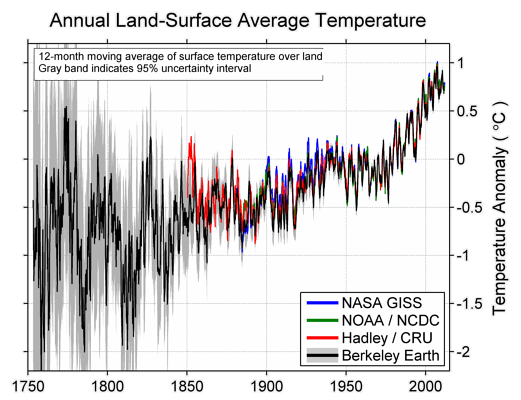
Note also the update, there’s some paleo support for the Tench event. No doubt the uncertainty is higher for that 1790 reading, as evidenced by the larger swings seen if data prior to the invention of the CRS/Stevenson Screen in 1890. One wonders though, why your BEST data uses such readings back to 1760 without questioning exposure at all. In this case, we have a description of exposure from Tench, whereas the majority of records that BEST uses have no such provenance. Tench’s description of exposure and shading would eliminate about 90-95% of the daytime bias, but would not eliminate any nighttime bias due to IR. But, we aren’t talking about a nighttime reading or an average. We are talking about a daytime high temperature. I have a higher confidence in the high than I would the low or the average, because the main bias (sunlight) has been removed.
I can’t speak to the calibration of the thermometer, but neither can you nor can BEST in all those pre-CRS readings they used. Note that other datasets plotted in comparison don’t use those numbers.
I brought up this subject to Muller when I visited him at his home, and he’s dismissed the issue with a wave of the hand, since he was going for a dog and pony show in front of Congress rather than real science. No wonder they still have no peer reviewed papers published.
What’s good for the Goose is good for the gander ‘eh Mosh? I look forward to BEST addressing the pre-CRS exposure issues instead of playing drive by sniper.
“It was more exposed to the breezes of the bay than the current location.”
That may be, but similar to Oregon’s new AGW winds that are causing upwelling, hypoxia and ocean dead zones those Australian bay breezes are different and are now contributing to global warming.
All of which is consistent with Climate Models.
See how easy it is to be purposefully mendacious? Or delusional?
That’s where we’ve arrived in the Climate War. There’s barely anything we laypeople can do but apply mockery and sarcasm to the AGW devotees.
These two current stories below in the Seattle and Portland newspapers have brought out the devotees and their pandemonium of deceit and delusion.
This in particular is laughable:
“City agencies are calculating the local effects of climate change and how to respond and adapt to protect people and infrastructure, The Seattle Times reported.”
Primarily because their idea of preparing for climate involves no more than raising taxes and keeping the bureaucrats busying pondering things.
In reality it’s all a do nothing plan while perpetually pretending to be preparing to do something yet to be defined. some yet to be defined time in the future when they are certain adapting must begin.
The comment battles are just rich.
http://www.oregonlive.com/environment/index.ssf/2013/01/global_warming_will_decrease_n.html
http://www.oregonlive.com/pacific-northwest-news/index.ssf/2013/01/seattle_officials_calculating.html#incart_river
Same here in Philly. I have two temperature records stored on my computer. One is monthly weather statistics starting in 1790 and ending in 1846 (from a book published in 1847), the second a continuous daily record of average high, average low, and precipitation data starting from 1874 up to the current day I got from the Franklin Institute.
Every time the news proclaims some record event I like to look it up in those records. For example, lately our high temps have been in the 50’s. Sounds warm for a winter? Probably even unprecedented? Well, there have been 348 times that tempeartures in January have been greater than 55F in the month of January (~4% of the time). And there have been 12 days at or above 70F since 1874. One of the earliest warm days was Jan 12, 1890 with a high of 72F and a low of 40F.
Can you imagine the proclimations of Thermageddon(tm) if Philly would hit 72F by then end of this month???? Yet it has happened a dozen times in the past 122 years
Why can’t these guys check a little of the historical archives once in awhile?
Steven Mosher:
At January 14, 2013 at 8:04 am you say
I suspect the thermometer was correctly calibrated because its specification and manufacturer are known. However, that is not the main point.
The report says there are several documented accounts of very large numbers of bats and parrots being killed by the high temperature. Similar effects on wild life are not reported for the recent heat wave, and this is strong supporting evidence that the 1790 heatwave was hotter. Unless, of course, you have evidence to the contrary?
Richard
vukcevic says:
January 14, 2013 at 7:32 am
So weather is climate after all.
More of your usual nonsense.
For those who believe recent Australian droughts and flooding rains are unprecedented, look at this 1868 Sydney newspaper clipping:
http://trove.nla.gov.au/ndp/del/printArticleJpg/60828173/3?print=y
Now we are producing a lot more heat than back then and in a temperature inversion it will hang around at low levels.