The December data from NOAA’s Space Weather Prediction Center is in, and it looks more and more like the peak of solar cycle 24 has been reached, and that we are now past it. Even with documented problems like “sunspot count inflation” the sunspot count for December is quite low:
![sunspot[1]](http://wattsupwiththat.files.wordpress.com/2013/01/sunspot1.gif)
Note the large difference between the prediction line in red, and the counts. There are other indications that our sun remains in a slump.
The 10.7cm solar radio flux seems to have peaked also.
![f10[1]](http://wattsupwiththat.files.wordpress.com/2013/01/f101.gif)
And, the Ap solar geomagnetic index has dropped to its observed second lowest value again (for recent years), which last happened in November 2011:
![Ap[1]](http://wattsupwiththat.files.wordpress.com/2013/01/ap1.gif)
Dr. David Hathaway updated his forecast recently. Here is the plot:
![ssn_predict_l[1]](http://wattsupwiththat.files.wordpress.com/2013/01/ssn_predict_l1.gif)
He thinks it will be the fall of 2013 though before the peak is reached
The current prediction for Sunspot Cycle 24 gives a smoothed sunspot number maximum of about 69 in the Fall of 2013. The smoothed sunspot number has already reached 67 (in February 2012)due to the strong peak in late 2011 so the official maximum will be at least this high and this late. We are currently over four years into Cycle 24. The current predicted and observed size makes this the smallest sunspot cycle since Cycle 14 which had a maximum of 64.2 in February of 1906.
The prediction method has been slightly revised. The previous method found a fit for both the amplitude and the starting time of the cycle along with a weighted estimate of the amplitude from precursor predictions (polar fields and geomagnetic activity near cycle minimum). Recent work [see Hathaway Solar Physics; 273, 221 (2011)] indicates that the equatorward drift of the sunspot latitudes as seen in the Butterfly Diagram follows a standard path for all cycles provided the dates are taken relative to a starting time determined by fitting the full cycle. Using data for the current sunspot cycle indicates a starting date of May of 2008. Fixing this date and then finding the cycle amplitude that best fits the sunspot number data yields the current (revised) prediction.
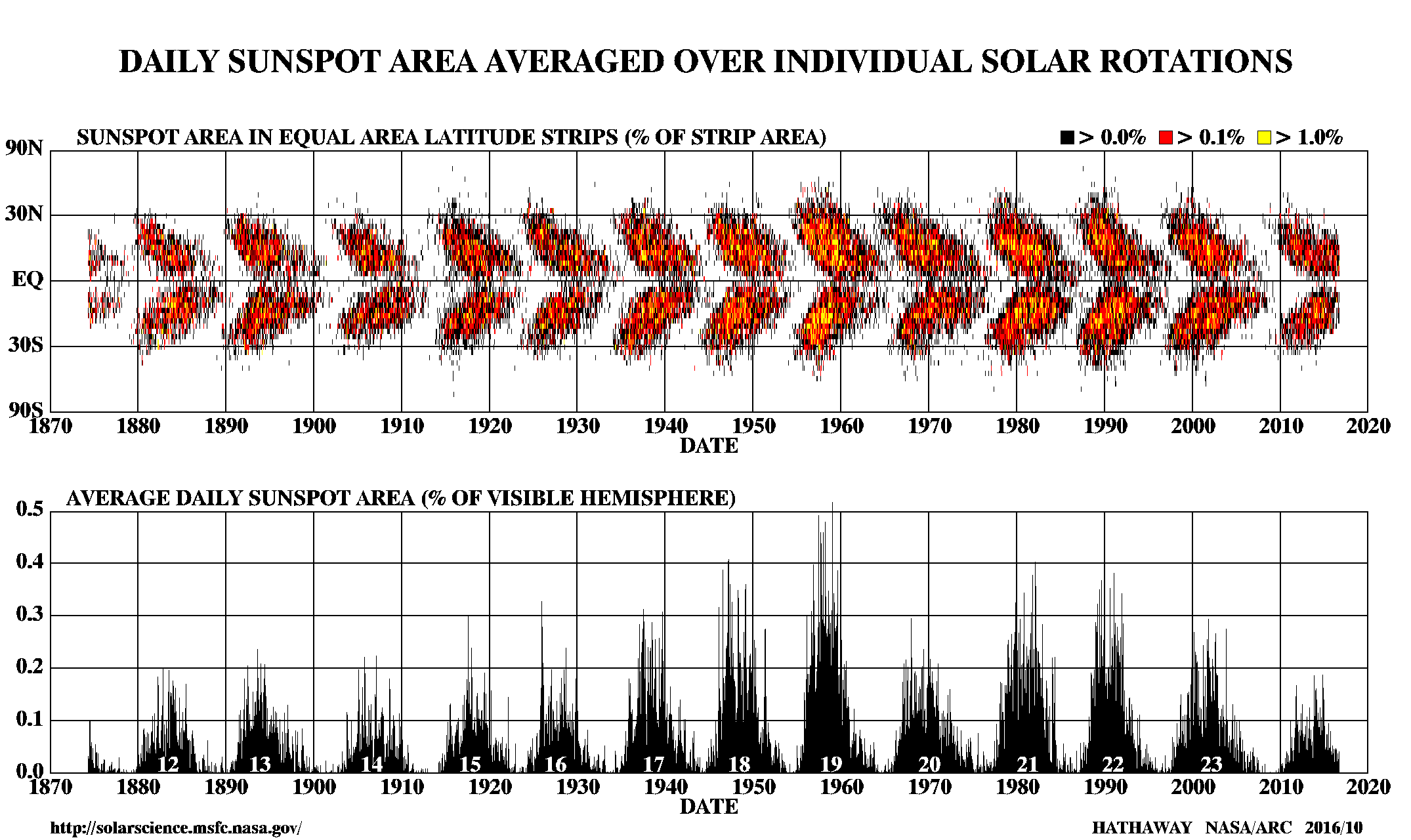
Perhaps, the sun right now seems to be having a spot resurgence:
![latest_512_4500[2]](http://wattsupwiththat.files.wordpress.com/2013/01/latest_512_45002.jpg?quality=83)
In other news, Dr. Svalgaard’s plot:
Solar Polar Fields – Mt. Wilson and Wilcox Combined -1966 to Present

…looks like it is getting ready to flip, suggesting the peak of Cycle 24 is imminent if not already past.
His predictions for cycle 24 are looking better and better.
Global cooling is going to suck alot.
Leif, if I may: You have been extremely conservative concerning papers which point to solar influences. Have you seen any papers, over the past few decades, which in your opinion, have a real chance of being accurate, re: solar climate change / cooling?
I think the sun is secretly enjoying defying prediction /sarcoff I am totally enjoying the SOHO and SDO observations though.
Relevtn NASA conference:
Nik says: January 8, 2013 at 11:10 pm
http://science.nasa.gov/science-news/science-at-nasa/2013/08jan_sunclimate/
A dilemma. On the one hand it seems that global cooling will have a rather deleterious effect on agriculture and the standard of living of the world in general and so should be dreaded.
On the other hand unless we somehow kill off this CAGW meme convincingly once and for all we are forever going to be at the mercy of political engineered pseudo-science.
I suspect we will be better off after a couple of decades off cooling if we can at least get science back onto a scientific basis.
So far David Archibald 100% spot on from 3 years ago prediction (SSN ave max 40). The other magicians at NASA etc ALWAYS fail and only change their mind when the event actually is occurring eg Hathaways etc….very convenient.
Plenty of time yet for Sol to play some more tricks on those who think they can predict the future.
Otter….
http://science.nasa.gov/science-news/science-at-nasa/2013/08jan_sunclimate/
January 2013 has stated with a bit of spurt:
http://www.vukcevic.talktalk.net/SSN.htm
but is it going to last?
temp says:
January 9, 2013 at 3:28 am
Global cooling is going to suck alot.
Certainly, in a number of ways. Not in all, though. Fighting nature brings people together and encourages advancement, like perhaps nuclear-heated greenhouse complexes with several growing seasons a year via temperature control, optimal elevated internal CO2 (far higher than even today), and other factors adding up to result in many times the yield per unit area of regular farms if needed. Lesser forms of greenhouse agriculture, though small relative to the total market, are already expanding today.
A bit more extreme example in different context:
“Thus the farmer in a typical American Midwestern farm who produces 100 bushels of corn per acre in a single season year [1970s figures] would look with astonishment on the space colony farmer who produces 4164 bushels of corn from a single acre in his 4-season year. While this factor of 40 is substantial, it is believed to be credible since a portion of it is derived from year-round growing.”
http://settlement.arc.nasa.gov/75SummerStudy/5appendC.html
The poorest nations least able to afford countermeasures are primarily near the tropics, which won’t cool much anyway, unlike higher latitudes, although impacts on food trade from elsewhere can occur.
The CAGW movement won’t be able to execute a switch to getting the cooling blamed on mankind this time, so they won’t be able to turn mankind against itself as much.
sun, i am disappoint
In the last solar cycle, sunspots were declining much by 2002-2003, but reduction of magnetic deflection of GCRs did not really get going until 2004, which illustrates how they can be partially out of sync. But, over the next several years, cosmic ray flux will much change.
On the short term, there is also an echo effect of El Ninos releasing some previous ocean heat back to the atmosphere. Yet, on the scale of later this decade and beyond, the effects of transitioning into a cold Grand Minimum will be an interesting time as judged from the past: http://s7.postimage.org/69qd0llcr/intermediate.gif
The old global cooling articles like the old National Geographic of http://tinyurl.com/cxo4d3l correctly pointed out some aspects like more storms in a cooling world (greater polar-tropics temperature difference driving convection). No wonder “extreme weather” is starting to be extra hyped now (along with cherry-picking a single month post-storm on arctic ice extent rather than how the recent annual averages in http://www.webcitation.org/6AKKakUIo are comparable to the mid-1990s, which were in turn comparable arctic temperatures to the late 1930s in http://earthobservatory.nasa.gov/Features/ArcticIce/Images/arctic_temp_trends_rt.gif ).
People have to realize the the sun is the main driver of the entire climate cycle on earth. Our solar system is always moving and when it comes into a region of more energy or less for the sun the cycles are much stronger or weaker. There is a cause and effect for everything and there is something we can not see yet that makes that happen. My feeling it is like the same thing when a hurricane is on open water and hits some warm water, it will intensify then when it move across colder water will weaken. Everything works the same in the universe, physics.
Just my feeling
P.S Anthony Watts, Thanks again for all your hard work on trying to keep the playing field even against the AGW’s. AWG’s have more power in media and government but they don’t have the true facts to back up claims.
If that spike a year ago was it, not good. Long way to go to get up to the red curve, and the red curve isn’t anything to brag about.
Fortunately we have excellent natural gas production to keep us warm, but unfortunately someone is intent on shutting down our coal fired electricity.
Solar irradiance from the SORCE Tim instrument is still in the + 0.4 W/m2 higher than average range (mean in this instrument is about 1,361.25 W/m2). This might be a little lower than a typical solar cycle peak but not that much, maybe 0.1 W/m2 or so.
http://lasp.colorado.edu/sorce/total_solar_irradiance_plots/images/tim_level3_tsi_6hour_3month_640x480.png
Don Yeomans of NASA’s Jet Propulsion Laboratory :
Watch out for Apophis: Asteroid named after an Egyptian demon set to pass by Earth today
http://earthsky.org/space/asteroid-apophis-due-to-pass-close-in-2029
During the previous cycle the magnetic “flip” was a year or so before the peak of the cycle, so there may be another year till the peak of this cycle. The double peak looks more and more likely.
The previous magnetic “flips” have taken 9.5 to 11 years. The magnetic cycle shown above looks to be 13 years (or more?) long. Will the next minimum be around 2022?
I have followed solar activity for over 20 years and find the current cycle fascinating. I am convinced that before this cycle is over the question of the influence of the sun on the climate will be answered or at the very least much clearer. It is likely that by then quite a few people will have mud on the face. But it is also likely that most people will claim they always believed the impact was larger than publicly stated. You cannot win such arguments. If, as expected, the next cycle is even weaker, the cacophony about global warming will quickly become almost comical. And it is only 10 years away: Not that long to wait really.
I’m quite happy letting the peak be defined as the pole flip instead of anything from the sunspot number (too variable) or 10.7 flux (too flat at peak). The magnetic flux is near its peak rate of change at the flip, so it provides the “cleanest” date for the peak.
As for the current crop of spots – recent cycles seem to have “naked-eye” (read: unmagnified and filtered) sunspots. These aren’t worth looking for.
If we’re entering a repeat of the Maunder Minimum, this may be the biggest crop of spots we’ll see for 70 or 80 years!
I have been keeping an eye on the sunspot numbers since 2007 when the expected minimum between cyles 23 and 24 failed to materialize on time. It finally showed in 2009, 13 years after the previous minimum. See the long-term graphics at http://sidc.oma.be/sunspot-index-graphics/sidc_graphics.php
The only recurring theme is that forecasts of sunspot numbers have consistently been inaccurate – beyond the known statistical variances.
Great work Leif!
Any update on the Livingston and Penn effect?
Yes, December was low, but it’s rising again. We will have multiple peaks and a long plateau with the center on ~2014/15. Very slow and weak cycle. The next minimum not before 2021. Then it depends if it speeds up again or remain slow or even get slower. Then it’s a grand minimum (Eddy?).
I’d love to see an overlay of all of Dr. Hathaway’s predictions on the actual data.
Otter
Try David Stockwell’s research
http://vixra.org/pdf/1108.0004v1.pdf
AP Index minima for the last 6 years all occured in December.
Is this coincidence or did the solar magnetic field in recent years have a directional pattern with a distinct minimum in direction of the earth’s December position ?