PART1 – (part 2 comes later today is NOW ONLINE HERE)
I’ve been noting with some humor the anticipation of a new Arctic sea ice extent minimum in the Alarmosphere. Yesterday, the frustration that there hasn’t been any major announcement yet bubbled to the surface in the form of a Michael Mann tweet, who was upset that NSIDC is making him wait:

Today though, looking at the NSIDC extent graph, he seems happy, declaring it “official”:

NSIDC made an announcement a few minutes ago, just as I started writing this post (and for that reason I’m publishing this post in two parts, see below):
Arctic sea ice appears to have broken the 2007 record daily extent and is now the lowest in the satellite era. With two to three more weeks left in the melt season, sea ice continues to track below 2007 daily extents.
Arctic sea ice extent fell to 4.10 million square kilometers (1.58 million square miles) on August 26, 2012. This was 70,000 square kilometers (27,000 square miles) below the September 18, 2007 daily extent of 4.17 million square kilometers (1.61 million square miles).
Here’s the plot, annotation mine:

Predictably, Seth Borenstein is already practicing for the big story he’ll be writing any minute now, and, the money quote he uses is just as predictable:
Data center scientist Ted Scambos says the melt can be blamed mostly on global warming from man-made emissions of greenhouse gases.
Neither Borenstein nor NSIDC’s current announcement mentions the massive Arctic storm that broke up huge amounts of sea ice, making this new record low possible. NSIDC said on August 14th:
As of August 13, ice extent was already among the four lowest summer minimum extents in the satellite record, with about five weeks still remaining in the melt season. Sea ice extent dropped rapidly between August 4 and August 8. While this drop coincided with an intense storm over the central Arctic Ocean, it is unclear if the storm prompted the rapid ice loss.
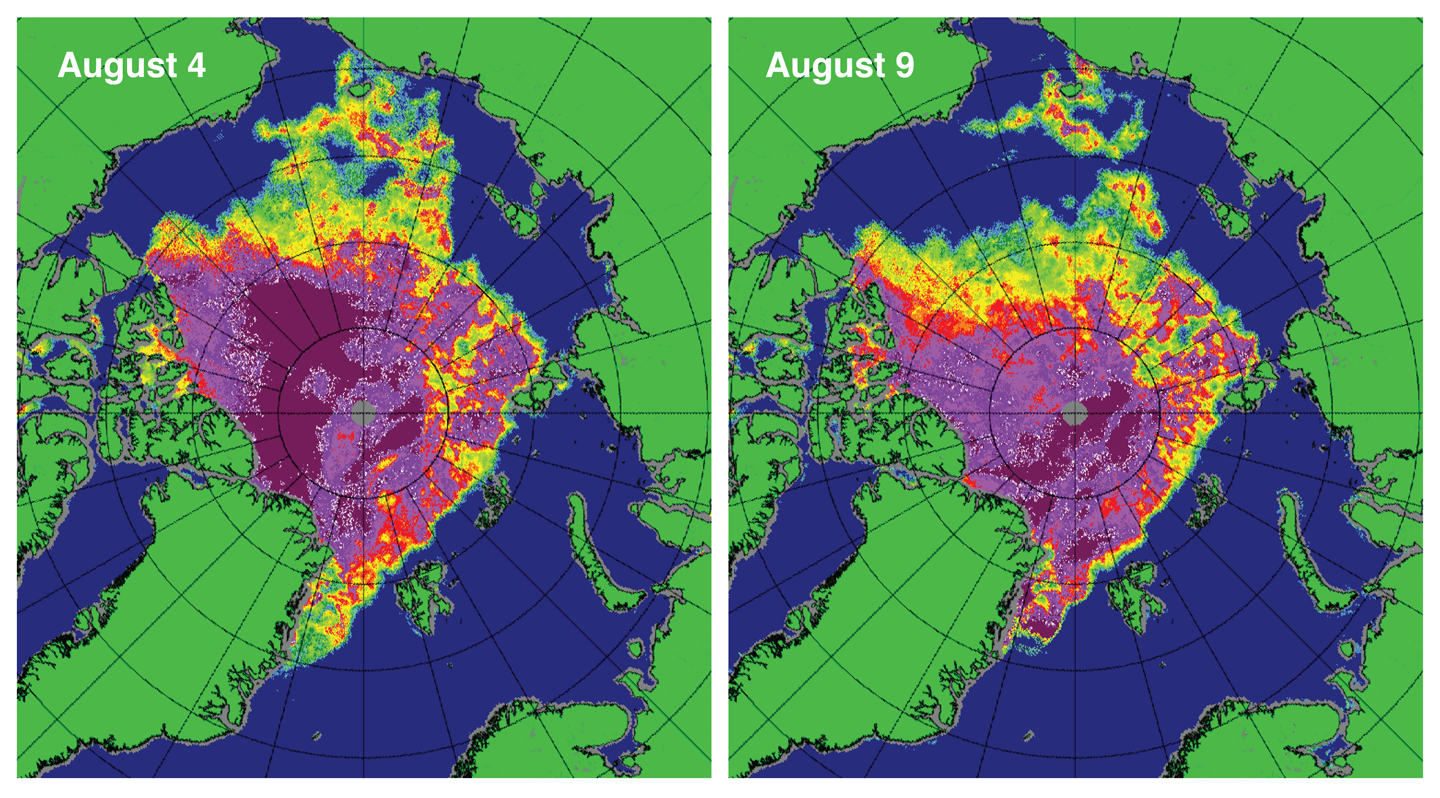
Unclear? Hmmph. Further down they dub it: “The Great Arctic Cyclone of 2012” and provide this before and after image:

Figure 4. These maps of sea ice concentration from the Special Sensor Microwave Imager/Sounder (SSMIS) passive microwave sensor highlight the very rapid loss of ice in the western Arctic (northwest of Alaska) during the strong Arctic storm. Magenta and purple colors indicate ice concentration near 100%; yellow, green, and pale blue indicate 60% to 20% ice concentration.
Credit: National Snow and Ice Data Center courtesy IUP Bremen
Calling the reason “unclear” seems more than a bit disingenuous to me, especially when you don’t mention it again.
It should be noted that in the ARCUS sea ice forecast submitted on August 5th, both NSIDC and WUWT forecasts agreed at 4.5 million sqkm. Clearly NSIDC didn’t expect this storm nor its effects, because if they had, their forecast would have been much lower.
In part two of this post, later today, I’ll share some other interesting things I’ve found that suggests NSIDC and the media aren’t telling you the full story right now.
Well, it is too late now for much more ablation of the ice pack. The melt ponds in the view of the drifting cameras are already starting to freeze over. Surface melt has already stopped so only the underside of the ice pack is melting at this point. The sun angle is too low for any solar melting of the surface. Now it’s just up to the wind and the waves.
An open Arctic Ocean means more moisture availability for the Polar Easterlies!!!
Watch for more “Ocean-Effect” snow to add to Greenland’s snow/ice depth, wiping out the “loss” from the brief early August “melt” so eagerly pounced upon by the AGW crowd!
How about this for a headline: “Arctic Sea Ice recovering since 2012”.
Just noticed the “Death Spiral” myself! Anthony, you said:
Well, of course, the “massive Arctic storm” will be blamed on CAGW, just like the drought, heavy snowfalls etc.
I guess I can blame my dead front lawn on CAGW, but I doubt they will pay to have it resodded!
There is good correlation between the storm and the rapid loss of ice loss in the region, so it’s quite plausible that the storm played some role. But we don’t exactly what role it played and how much of an effect it had. The ice was already quite thin in that region and probably poised to melt out anyway. The storm may have given it a jump start, but much of the ice there would’ve probably melted out without the storm.
One thing one can definitely not say is that without the storm we wouldn’t have set a new record low. We were already tracking below 2007 levels before the storm.
Walt Meier
REPLY: Thanks Walt, but I don’t think your statement of “One thing one can definitely not say is that without the storm we wouldn’t have set a new record low. We were already tracking below 2007 levels before the storm.” can be certain, because as you and many other people noted in the past, Arctic sea ice is at the mercy of the weather in the final days, without that Arctic storm, who’s to say the weather would not have turned more favorable? Can you tell me what the weather will be in the Arctic from now to the equinox and if it will be favorable/non favorable to sea ice extent? – Anthony
Break up the whole ice cap right before it starts refreezing and you ultimately get a solid coverage even bigger than last winter?
http://www.guardian.co.uk/environment/2012/aug/23/arctic-sea-ice-record-low?intcmp=122
I wrote to Vidal pointing out that he hadn’t mentioned that “record” meant “record since satellite monitoring started 30 years ago”.
No response, no edit of the programme.
I then emailed him with various other riders that have been published here and elsewhere indicating how meaningless this “record” is.
No response, no edit of the programme.
This from the paper that likes to claim that
“Comment is free but facts are sacred”.
A line judge needs to whistle this play dead vis-a-vis ‘beating the 2007 low’ and disregarding the part that “The Great Arctic Cyclone of 2012″ played in the ice extent decline …
.
Whenever MSM keep strangely mum about something, you bet there is a full story they aren’t telling….
What? Record? Did you say “record”? Nothing is a record until we decide it is!
Was it over when the Germans bombed Pearl Harbor? Hell no!
Otter: [to Boon] Germans?
Boon: Forget it, he’s rolling.
And it ain’t over now. ‘Cause when the goin’ gets tough… [thinks hard of something to say]… The tough get goin’! Who’s with me? Let’s go…!!!
The weird thing is that in 2007 the last minimum the UK had a dreadful summer, this year we have also had an Awful summer (April and June have set new records for rainfall).
In both years the Jetstream was driven south on both occasions, which is an interesting coincidence.
Since we have entered a subdued period for UV output from the Sun the jetstream also appears to form more Omega patterns than I have ever seen before, which here in the UK also given us the very cold months of January 2010 and December 2010 (the second coldest December on record and the coldest for 100 years).
Less ice seems to give the UK very cold winters, they started in Feb 2008 and apart from last winter (which was like winter 2006-2007) have been the coldest in my lifetime, I wonder if the pattern is about to reload 😮
There’s just been a risible news interview about this topic on the BBC, with Prof Peter Wadhams. He unequivocally laid the blame for the low sea ice extent squarely on CAGW due to CO2 emissions.
He spent the whole piece dispensing alarmist nonsense and disinformation, with a shit-eating grin plastered across his face. His apparent solution was to spray clouds with water vapour.
}:o(
A possible reason?
http://notrickszone.com/2012/08/27/arctic-ice-loss-temperature-or-soot/
Honestly, who cares? Melt the whole cap. Shipping will become a lot easier. People dreamed for hundreds of years of a passage over the top. They may get that dream eventually. It’ll matter as much as it does that we no longer have a 5 mile thick glacier over the area that is now New York city, thanks to the melting since the last Ice Age.
Climate change is dominated by natural oscillations of sun and the Earth’s core. One provides the energy, the other the variability in the absorption and release of the energy. Understanding of the natural oscillations is key not only the climate but other natural events. Here I demonstrate one more of the Sun-Earth relationships.
http://www.vukcevic.talktalk.net/Sun-Earth.htm
With all this record melting, why hasn’t New York City been deluged? Why are the Netherlands still above water?
Replying to Anthony: I agree. We can’t say that we would’ve set a new record even without the storm. But we also can’t say the the storm led to the record – we might’ve set the record regardless of the storm.
A key point is that while the weather helps determine where the final numbers end up, the long-term trend determines whether we’ll be high, average, or low. And a decreasing trend pushes the odds in favor of new records, as we’ve seen. And one reason for this is that the long-term changes makes the ice more vulnerable to a storm like the one that came through in early August. The ice is thinner, more broken up, and more vulnerable to any impacts (waves, ocean mixing, warm air transport) from such storms.
Though a record always gets a lot of attention, which is understandable, more relevant is the long-term trend of over 12%/decade, the fact that we’ve set a new record low 4 times in the last 11 years, and the last 6 years are the lowest in the 34-year record.
Walt Meier
REPLY: Thanks Walt, have you ever considered we may be at/near the bottom of a natural cycle? How can you rule that out without data much beyond 30 years? There’s historical anecdotal evidence of very low Arctic sea ice in the past where you have no data. – Anthony
“REPLY: Thanks Walt, but I don’t think your statement of “One thing one can definitely not say is that without the storm we wouldn’t have set a new record low. We were already tracking below 2007 levels before the storm.” can be certain, because as you and many other people noted in the past, Arctic sea ice is at the mercy of the weather in the final days, without that Arctic storm, who’s to say the weather would not have turned more favorable?”
Was there ever a clearer example of anti-empiricism. Was there ever a clearer example of distaste for present and relevant fact? It is as if the arctic storm had not occurred. This so-called science is totally “a priori” and reveals that the so-called scientists have no empirical instincts whatsoever.
Mann’s tweet is an excellent example of someone who was once eaten alive by confirmation bias and now is an outright activist. All he cares about is the moment that he gets to trumpet the announcement of his victory in record low sea ice extent.
Think of all that energy that can now be released from the Atlantic where there is no longer ice cover.
Expect the North Atlantic to cool quite a bit, this is a negative feedback in the system. I don’t know when Enough energy will be released to start the significant cooling but it will happen.
I’d like to add my thanks to Walt Meier for his openness and honesty, he’s the only one I trust in that place.
DaveE.
To Walt Meier: Just before the big storm, sea ice was tracking exactly on the 2007 record (not below). And you cannot definitely say what would or what would not have happened without the storm (faulty logic).
I don’t know whether this link will work outside the UK. The Met Office provide weather forcasts and background information for the BBC. In this video John Hammond (no, not the Dylan-Springsteen CBS one) from the Met Office even uses the phase ‘global warming’, but does not mention any weather events such as artic cyclones.
“Arctic sea ice melt set to break record”
http://www.bbc.co.uk/weather/features/19362809
We need more windmills and solar panels, the earth is doomed due to man and his destructive nature. Sod houses and bicycles for everyone but the people in China and India. 🙂
Notice that the axis of the graph begins at 2, not zero.
Anthony I think you are missing a key point, it doesn’t matter too much what the weather does anymore. Whether you have persistent unusually high pressure over the Beaufort coupled with low pressure over Eurasia such as in 2007, or this summer that didn’t have as favorable weather as in 2007, but had an early August storm, the ice cover continues to be anomalously low in summer. The ice is thinner than it was 20-50 years ago, so that it melts out more easily in summer.
REPLY: It doesn’t matter what the weather does anymore? Really? I’m sorry but I just can’t accept a statement like that given some of your previous posts on the subject here. And, tell me please, why don’t you report in your public announcements your “much greater accuracy than daily products based on singlesource satellite data.” product, MASIE, that shows extent at 4.7 million sqkm on August 26th?
Why hold back a “new and improved” system? – Anthony
I see Peter Gleick has popped up commenting on Mann’s tweet, maybe Mann could use him as a character witness in his upcoming trial?