Guest post by David Archibald

We return to Dr Svalgaard’s plot of four solar parameters, updated daily at: http://www.leif.org/research/TSI-SORCE-2008-now.png
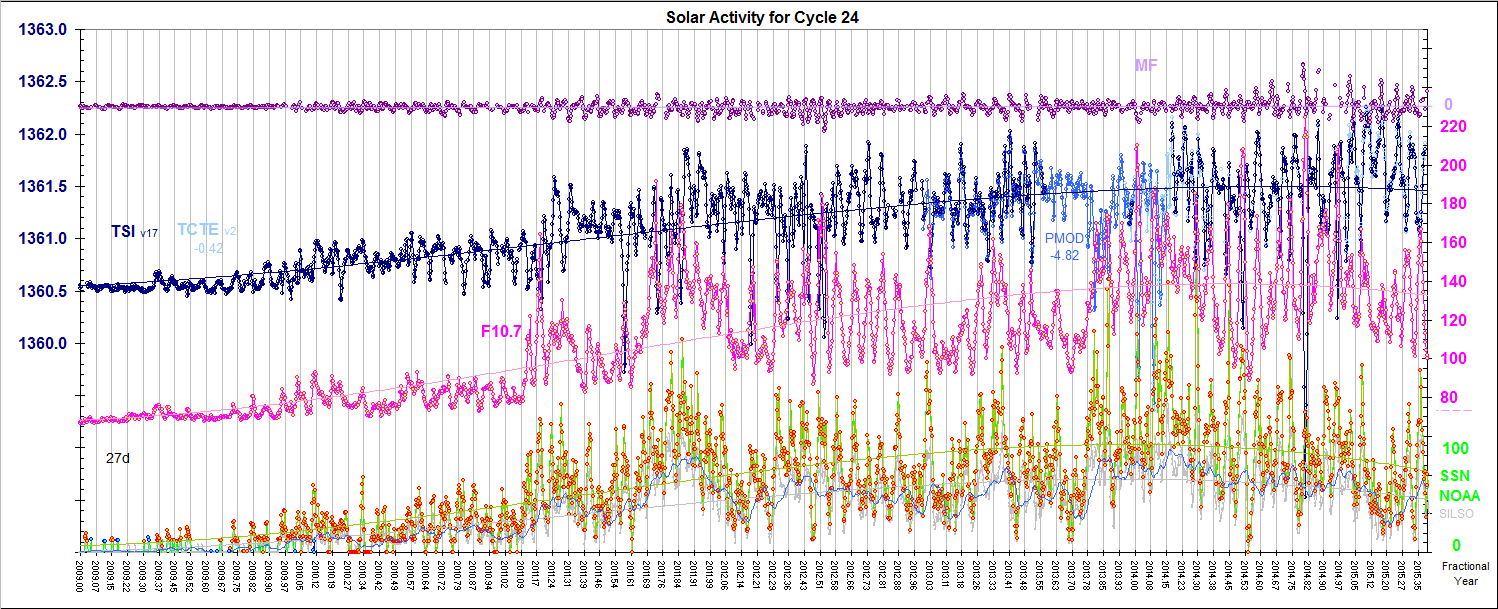
There are a couple of things to note. Firstly, the solar Mean Field, which is the top line, went into the Solar Cycle 23/24 transition being neat and regular like a heartbeat, and has come out choppy and arrhythmic. Secondly, the F10.7 ramp up continues to be very flat indeed. The line of best fit of the F10.7 flux, currently at 82, equates to a sunspot number of 24. In terms of sunspot number, the rate of ramp up over the last year is 11 per annum. At two years into the cycle, this will be the maximum rate of increase we will get.
One of the accepted solar cycle prediction methodologies is a curve fitting exercise two years after the month of solar minimum, which was December 2008. Inspired by the fact that NOAA et al called 2010 the hottest year ever when it was only half over, we have decided to go early and curve fit now. The green corona brightness tells us that solar maximum will be in 2015. Combined with that constraint, the graphic below is the result:

F10.7 flux at solar maximum will be 105, equating to a sunspot number of 50. It will be the weakest solar cycle since Solar Cycle 6, the second half of the Dalton Minimum (1810 to 1823). Solar Cycle 5 had a maximum amplitude of 49.2 and Solar Cycle 6 of 48.7.
The evidence for a Dalton Minimum repeat continues to build. As a 210 year de Vries cycle event, it has come along right on schedule.
Nice discussion. Keep in mind how crappy our data is for the early solar cycles, Svaalgard will tell you how great his data is on historical sunspots out of one side of his mouth, and admit that cosmogenic radiation and magnetic data is actually crap out of the other ( the latter is correct), thus we are truly entering a first in the solar cycle – a grand minimum that we can study and will have actual knowledge about. Bring on the Little Ice Age (hope fully, if the minimum is low enough)!
Hi Anthony,
According to a model developed by de Jager, Archibald’s forecast seems to be reasonable:
http://journalofcosmology.com/ClimateChange111.html
“The magnitude of the sunspot maximum occurring at the end of a chaotic transition depends on the type of episode that develops after (De Jager and Duhau, 2009). After the 2009 transition an M-type instead of an R-type episode is expected to occur. Therefore the amplitude of the Gleissberg cycle will be nearly three times the one previously assumed. Therefore we expect that sunspot maximum #24 will even be weaker than the earlier prediction, with Rmax = 55. “
I’m sorry, David. This can’t possibly be right.
I mean, news.com.au is predicting a solar storm “… to hit with the force of 100 million hydrogen bombs”!
http://www.news.com.au/technology/sun-storm-to-hit-with-force-of-100-bombs/story-e6frfro0-1225909999465
I’m debating with some warmers here in Manila, on the role of the Sun and its impact on the Earth’s climate, they are totally clueless. I showed Willie Soon’s graphs, David Archibald’s powerpoint in his blog, zero reply from them.
Q? You mention a 210 year de Vries Cycle, Does this connect in some or any way to the 200 year Suess Cycle or am I barking up the wrong tree, or just barking full stop?
Exactly right David…and the De Vries cycle is code for “the force that must not be mentioned”.
So far this cycle is right on track…a weak grand minimum. The change in activity that we have now is interesting, the early part of this year saw many large groups with some wait time in between. Now we have more constant activity but the overall strength of the groups is right down. The magnetic activity has been strong but dominated by single alpha spots like we saw on Big Bear recently.
I doubt whether the published sunspot numbers earlier than the middle of the 19th century are as accurate as you are implying. I think the earlier numbers are unlikely to more accurate than +/- 10 . I would also prefer not to be so dogmatic as to say that that the present rate of increase will be the maximum we will get. I think the best comparisons we can make are with the minima of 1901 and 1913 and suggest a possible doubling of the rate of increase to a maximum of between 60 and 100 (mean annual). I certainly would not attempt to predict more accurately than that.
My question to this information would be, what is the best investment for the cool to come, coal, oil or gas, perhaps uranium? Maybe EM Smith could help put me right.
This’ll put a spanner in the works of the warmenists !
Amazing post, its interesting to see what’s next
Im curious too about comparing different solar cycles you can watch here:
http://www.solen.info/solar/cyclcomp.html
I would be very interested if this is truly a cycle and not debris hitting the sun causing sunspots by punching through the corona.
Scientists have forgotten that our Solar system travels through space.
The last Dalton Minimum caused a 2 degree drop. The solar activity previous to that was almost as high as it has been over the last few years. So we could expect to see something like the same. Interestingly the long term Swedish temperature trend show temps in the late 18th century just before the Dalton min, similar to today. Looks like temps will be going down to 19th century levels.
Mr. Archibald, I assess the thrust of your post as, “aio, quantitas magna frumentorum est”.
Of course the farther we are along in a cycle the easier it is to pick the rest of it.
My position is, “adversus solem ne loquitor”.
John
“Firstly, the solar Mean Field, which is the top line, went into the Solar Cycle 23/24 transition being neat and regular like a heartbeat, and has come out choppy and arrhythmic.”
1. Correct, but to see if this is special, indicative of something, you need to compare it with previous MF solar cycle transistions.
2. There appears to be a pattern starting around 2010 April. It has the same period (about a month) as that prior to the minimum.
My own prediction for cycle 24 just over 18 months ago was for an Rmax of 50-55 in late 2015.
greetings from coffs harbour.
Nice work.
could you dig up the Grenwich sunspot records and graph them up.
This was the record that convinced me.
Three solar threads in a week! Must be Christmas. They should have used a flash on that big bear ‘Sauron’ photo. Anyway………
Geoff Sharp says:
August 27, 2010 at 3:52 am
Exactly right David…and the De Vries cycle is code for “the force that must not be mentioned.”
Please put me out of my misery by either sending a case of good french wine or explaining this.
Besides which you are all wrong because there is no coupling with the sun because the TSI variance is only .1 of W/m2.
The CME of 1859 has been described in Stuart Clarke’s book “The Sun Kings”.
It might also be useful to consider that the 1859 CME occurred during a Dalton minimum, so David’s prediction that we are headed for another cooler period is consistent.
Joe Lalonde says:{August 27, 2010 at 4:42 am}
“I would be very interested if this is truly a cycle and not debris hitting the sun causing sunspots by punching through the corona.”
You’re joking just to tick off Dr. S, right?
Nonoy Oplas (3:21): Good luck with trying to debate with Warmists!
Belief in AGW is a branch of religion, not of science. It has taken me a couple of years to realise this; I have debated long and hard with a bunch of hard-line believers at the Deltoid site: http://scienceblogs.com/deltoid/2010/03/the_empirical_evidence_for_man.php
Like Jehova’s Witnesses, no amount of evidence will shake their belief.
But we mustn’t despair! The general public are increasingly sceptical, and if we have two NH cold winters in the next three years, Warmism will sink under a tide of laughter. I believe you don’t get winters at Manila, so maybe you should challenge your Warmists to show how the seas are rising.
This research from Boulder folks admits that there is more to the sun than TSI.
http://www.nsf.gov/news/news_summ.jsp?cntn_id=117580&org=NSF&from=news
Henry@Louis Hissink
Sorry could not find CME in the glossary.
What does it mean?
It was asked what is the best investment. How about corn or wheat futures?
From what I have seen over the last few years Russia and China have been hedging their bets, acquiring land for food production closer to the equator. Neither have taken to the silly act of distilling food for fuel.
Of course, one the other hand, at least we are not de-commissioning nuclear power plants like Germany is. I would think, if we where to truly be hedging our bets, we would be currently working hard for smaller to medium size newer nuclear power plants, more regional in size. With of course full on re-processing of our “waste heat”. The regional smaller plants would be ideal as the “waste heat” could be used for hydroponics and other industrial uses.
eck, but what do I know, just a silly EE.
Mr. Watts – thank you for your blog!
“Sorry could not find CME in the glossary.”
Coronal Mass Ejection