Radiative Physics Simplified II
A guest post by Jeff Id
Radiative physics of CO2 is a contentious issue at WUWT’s crowd but to someone like myself, this is not where the argument against AGW exists. I’m going to take a crack at making the issue so simple, that I can actually convince someone in blogland. This post is in reply to Tom Vonk’s recent post at WUWT which concluded that the radiative warming effect of CO2, doesn’t exist. We already know that I won’t succeed with everyone but when skeptics of extremist warming get this wrong, it undermines the credibility of their otherwise good arguments.
My statement is – CO2 does create a warming effect in the lower atmosphere.
Before that makes you scream at the monitor, I’ve not said anything about the magnitude or danger or even measurability of the effect. I only assert that the effect is real, is provable, it’s basic physics and it does exist.
From Tom Vonk’s recent post, we have this image:
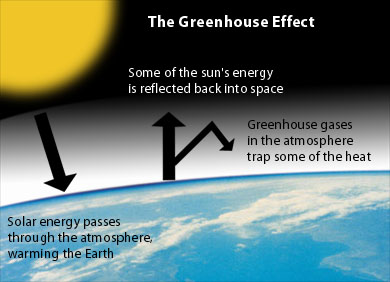 Figure 1
Short wavelength light energy from the sun comes in, is absorbed, and is re-emitted at far longer wavelengths. Basic physics as determined by Planck, a very long time ago. No argument here right!
Figure 2 below has several absorption curves. On the vertical axis, 100 is high absorption. The gas curves are verified from dozens of other links and the Planck curves are verified by my calcs here. There shouldn’t be any disagreement here either – I hope.
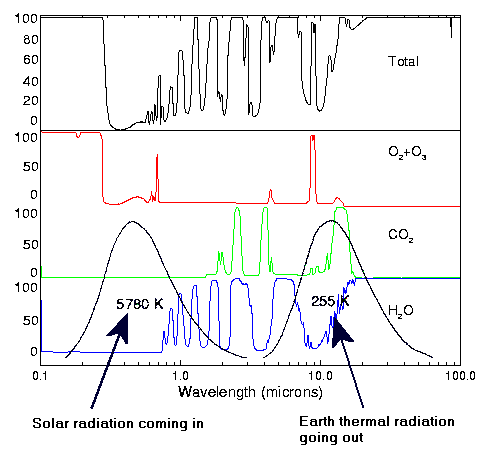 Figure 2 – Absorption curves of various molecules in the atmosphere and Planck curve overlay.
What is nice about this plot though is that the unknown author has overlaid the Planck spectrums of both incoming and outgoing radiation on top of the absorption curves. You can see by looking at the graph (or the sun) that most of the incoming curve passes through the atmosphere with little impediment. The outgoing curve however is blocked – mostly by moisture in the air – with a little tiny sliver of CO2 (green curve) effective at absorption at about 15 micrometers wavelength (the black arrow tip on the right side is at about 15um wavelength). From this figure we can see that CO2 has almost no absorption for incoming radiation (left curve), yet absorbs some outgoing radiation (right curve). No disagreement with that either – I hope. Tom Vonk’s recent post agrees with what I’ve written here.
Energy in from the Sun equals energy out from the Earth’s perspective — at least over extended time periods and without considering the relatively small amount of energy projecting from the earth’s core. If you add CO2 to our air, this simple fact of equilibrium over extended time periods does not change.
So what causes the atmospheric warming?
Air temperature is a measure of the energy stored as kinetic velocity in the atoms and molecules of the atmosphere. It’s the movement of the air! Nothing fancy, just a lot of little tiny electrically charged balls bouncing off each other and against the various forces which hold them together.
Air temperature is an expression of the kinetic energy stored in the air. Wiki has a couple of good videos at this link.
“Warming” is an increase in that kinetic energy.
So, to prove that CO2 causes warming for those who are unconvinced so far, I attempted a thought experiment yesterday morning on Tom Vonk’s thread. Unfortunately, it didn’t gain much attention. DeWitt Payne came up with a better example anyway which he left at tAV in the comments. I’ve modified it for this post.
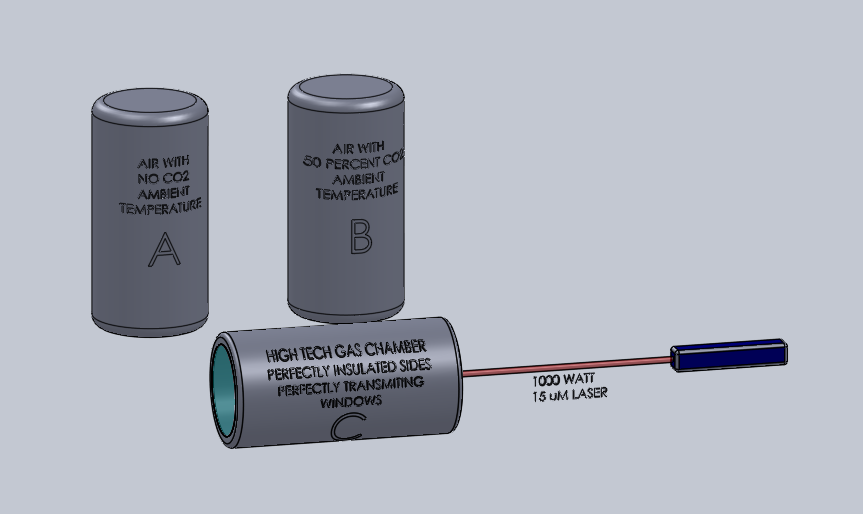 Figure 3- Experimental setup. A – gas can of air with all CO2 removed at ambient temp and standard pressure. B – gas can of air diluted by 50 percent CO2, also at ambient temp and standard pressure. C ultra insulated laser chamber with perfectly transparent end window and a tiny input window on the back to allow light in from the laser. Heat exit’s the single large window and cannot exit the sides of the chamber.
Figure 4 is a depiction of what happens when C contains a vacuum.
 Figure 4 – Laser passes straight through the chamber unimpeded and a full 1000 Watt beam exits our perfect window.
The example in Figure 5 is filling tank C with air from tank A air (zero CO2) at the equilibrium state.
 Figure 5 – Equilibrium of hypothetical system filled with zero CO2 air from canister A.
Minor absorption of the main beam causes infrared absorption and re-emission from the gas reducing the main beam from the laser. This small amount of energy is re-emitted from the gas through the end window and scattered over a full 180 degree hemisphere.
What happens when we instantly replace the no-CO2 air in chamber C with the 50% CO2 air mixture in B?
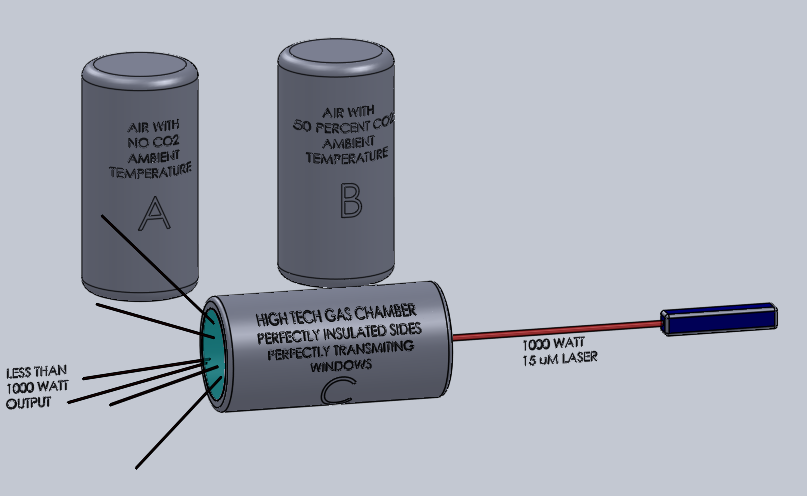 Figure 6 – Air in C is replaced instantly with gas from reservoir B
From the perspective of 15 micrometer wavelength infrared laser, the CO2 filled air is black stuff. The laser cannot penetrate it. At the moment the gas is switched, the laser beam stops penetrating and the 1000 watts (or energy per time) is added to the gas. At the moment of the switch, the gas still emits the same random energy as is shown in Figure 5 based on its ambient temperature, but the gas is now absorbing 1000 watts of laser light.
Since the beam cannot pass through, the CO2 gains vibrational energy which is then turned into translational energy and is passed back and forth between the other air molecules building greater and greater translational and vibrational velocities. —- It heats up.
As it heats, emissions from the window increase in energy according to Planck’s blackbody equation. Eventually the system reaches a new equilibrium temperature where the output from our window is exactly equal to the input from our laser – 1000 watts. Equilibrium! – (Figure 7)
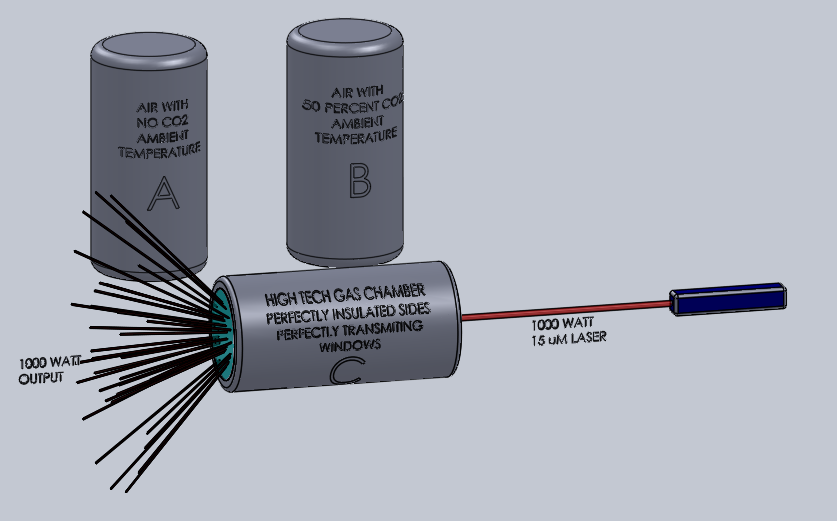 Figure 7 – Equilibrium reached when gas inside chamber C heats up to a temperature sufficient to balance incoming light energy..
The delay time between the instant the air in C is switched from A type air to B air to the time when C warms to equilibrium temperature is sometimes stated as a trapping of energy in the atmosphere.
“CO2 traps part of the infrared radiation between ground and the upper part of the atmosphere”
So from a few simple concepts, two gasses at the same temp, one transparent the other black (at infrared wavelengths), we’ve demonstrated that different absorption gasses heat differently when exposed to an energy source.
How does that apply to AGW?
The difference between this result and Tom Vonk’s recent post, is that he confuses equilibrium with zero energy flow. In his examples and equations, he has a net energy flow through the system of zero, which is fine. Where he goes wrong is equating that assumption to AGW.
What we have on Earth, is a source of 15micrometer radiation (the ground) projecting energy upward through the atmosphere, exiting through a perfect window (space) – sound familiar? Incoming solar energy passes through the atmosphere so we can ignore it when considering the most basic concepts of CO2 based warming (this post), but it is also an energy flow. In our planet, the upwelling light at IR wavelengths is a unidirectional net IR energy flow (figure 2 – outgoing radiation), like the laser in the example here.
Of course adding CO2 to our atmosphere causes some of the outgoing energy to be absorbed rather than transmitted uninterrupted to space (as shown in the example), this absorption is converted into vibrational and translational modes (heating). Yes, Tom is right, these conversions go in both directions. The energy moves in and out of CO2 and other molecules, but as shown in cavity C above, the gas takes finite measurable time to warm up and reach equilibrium with space (the window), creating a warming effect in the atmosphere.
None of the statements in this post violate any of Tom’s equations; the difference between this post and his, is only in the assumption of energy flow from the Sun to Earth and from Earth back to space. His post confused equilibrium with zero flow and his conclusions were based on the assumed zero energy flow. The math and physics were fine, but his conclusion that insulating an energy flow doesn’t cause warming is non-physical and absolutely incorrect.
Oddly enough, if you’ve ever seen an infrared CO2 laser cut steel, you have seen the same effect on an extreme scale.
————-
So finally, as a formal skeptic of AGW extremism, NONE of this should create any alarm. Sure CO2 can cause warming (a little) but warmer air holds more moisture, which changes clouds, which will cause feedbacks to the temperature. If the feedback is low or negative (as Roy Spencer recently demonstrated), none of the IPCC predictions come true, and none of the certainly exaggerated damage occurs. The CO2 then, can be considered nothing but plant food, and we can keep our tax money and take our good sweet time building the currently non-existent cleaner energy sources the enviro’s will demand anyway. If feedback is high and positive as the models predict, then the temperature measurements have some catching up to do.
Even a slight change in the amount of measured warming would send the IPCC back to the drawing board, which is what makes true and high quality results from Anthony’s surfacestations project so critically important.
This is where the AGW discussion is unsettled.
====================================
My thanks to Jeff for offering this guest post – Anthony
A much better post than that of Tom Vonk.
1. It would be crazy (just endlessly stupid) to deny greenhouse effect as such.
2. The direct effect of CO2 is easy to calculate. It gives less than 1 degree C per doubling of CO2 concentration.
3. The central question is the feedback. Is it positive or negative and how large is it. If it is negative (it must be negative!), we are fine. However, according to IPCC it is positive and uncertain. The uncertainty may result in some warming between 2 degree C and infinity (sic!).
A clear dissertation which appears to be eminently rational. If others with more math than I posess (which wouldn’t take much!) agree with this, I can go along with it.
If my high school math and science teachers had been as clear and succinct as many of those who post essays on WUWT, I may have stayed at school a bit longer. In the early 1950s in New Zealand, with full employment and a booming post-war economy,(as one of our better-known poets put it) ‘many high school teachers couldn’t get a job in the Post Office’. This had a serious negative effect on the education attainment of my generation (less than 3% of school leavers went on to higher education) which we are paying for now in terms of too many of us believing for too long the alarmist nonsense cranked out by the Greens, the closet Marxists and the extreme Left. A good education is a wonderful insurance against spin-doctors and snake-oil salesmen!
Nice clear piece Jeff, thanks. I have to agree CO2 has a warming or insulating effect, but the effect is small and limited, also the water vapor/cloud system appears to be a huge negative feedback.
Well done, Jeff.
Thank you jeff.
Like you I believe in moving the discussion FORWARD. There are a couple places where the skeptical “movement” is retarded, err held back. Understanding and accepting the way the greenhouse effects works is one of those areas. The continual refusal to accept the basic physics, makes Skeptics look like the defenders of mann. Otherwise smart people, steadfastly refusing to accept a well proven physics. A well proven physics that works. The refusal on skeptics part to accept this physics is bewildering.
1. The design of working devices depends on this physics.
2. This physics is correct, But it has LITTLE BEARING on the alarmist claims.
3. Denying this physics, Weakens your position when you try to discuss the REAL UNCERTAINITIES.
4. When you deny the obvious and well proven physics, people will not take you seriously when you make valid objections to more questionable aspects of AGW.
5. When you accept this physics, you confuse the hell out of AGW folks, because THEY THINK you are anti-science.
6. When you accept this physics you have a better chance of being heard on the REAL issues.
And just for good measure we will throw in some appeal to authority:
Spenser, lindzen, Monkton,Christy,Willis,Anthony.. All accept the basic physics.
That is why they are not so easily dismissed. The real issue is Feedbacks, sensitivities, damages, and solutions.
No argument here. I live in NE Oregon. I lurvs me some greenhouse gas.
All physicists do not include LIFE in their equations and CO2 reactions are intimately related to life on earth. Life needs, in special we, warm blooded animals, an excess of energy to keep negentropy, life itself. This is why exists the UHI effect. Just calculate how much glucose, we the 7 billion inhabitants of the earth, need: We got the energy transforming championship.
Ask yourself how much, how many kilos of those nasty fat growing carbohidrates diets we consume or even how many kilos of jeans, t-shirts and underwear made from that polymer of glucose called cottom we use.
Then WE SHOULD BE REFUNDED , of course in CASH, not in carbon credits.
We should revisit:
http://wattsupwiththat.com/2008/06/24/rip-george-carlin-whoosh/
Nice post. Just a somewhat urgent off-topic comment.
In The Guardian, John Cook thinks that “A new iPhone climate change sceptics’ app [Our Climate] inadvertently reveals the strategies of disinformation and denial they employ”:
http://www.guardian.co.uk/environment/blog/2010/aug/06/iphone-climate-denial-app
Do you agree with him? Please create an account at the Guardian and freely express your opinion.
Other questions, to which the answer almost certainly exists, but I have no idea where to look:
The absorption spectrum of CO2 shown indicates some maximum absorption (attenuation of the 15 micrometer radiation). How does this change as the concentration of CO2 increases?
I think this is vitally important to answer. At some concentration the gas will become completely opaque to 15 micrometer radiation. Adding more will make no difference.
Are we already at that point? What is that point?
Can some back-of-the-envelope numbers using Beer’s Law and molar absorptivities/extinction coefficients be provided in this analysis? If not, where can I find something like that? That is where part of my skepticism lies, as anyone who’s run IR in organic chemistry can tell you that it doesn’t take a long pathlength before the CO2 absorption at 2350 wavenumbers (cm-1, around 4.25 microns) becomes saturated. Another fun thing I just realized is that CO2’s other main absorption band maxes out right around 666 cm-1…interesting.
Anyway, the main point of my comment is that I want someone to direct me to where I can get molar absorptivities for CO2 and hopefully water too. If no one has run the actual numbers with respect to saturation, I can start working on that (lots of numerical integrations, I know).
-Scott
On behalf of the Peanut Gallery, thank you for an example that was easy to understand.
One of the problems in this debate is that scientists sometimes forget that most of the people in the world are not science oriented, (the Peanut Gallery). The ability to communicate positively with these people is very important yet often forgotten. The AGW crowd, specifically Al Gore, has been winning this part of the war for years. Unless that changes, nothing else can change. This post is a very good start.
OK. That’s a good thought experiment and I have no issues with the conclusions. However, you missed out the other half of the experiment.
Tak two cans, one with dry air, the other with 50% CO2, heat them to the same temperature well above the ambient. Now see how long each of the cans take to reach, say, half way to the ambient. The CO2 can will emit IR more than the dry air, and therefore cool the can quickest.
How does this apply to AGW? CO2 heating in the day is balanced(?) by CO2 cooling at night.
On another topic, why do the global heat flow diagrams only ever depict the situation in the daytime and not at night?
Ed
Spencer also did a nice explanation on this at his site. It makes perfect sense that any barrier impeding the free flow of energy from a source will insulate that source and cause a higher temperature than a system without such insulation. Just as a cloud cover in winter holds warmth overnight, and a clear winter night becomes much colder. But our roiling convective atmosphere, heating during day, cooling overnight, facilitates the transfer of kinetic energy from CO2 to water vapor and then to relinquish that energy to space when water condenses. We live in a giant evaporative cooler.
I just traveled internationally a few days ago. I like to monitor parameters of flight on the seatback display. At the surface, temperature here was +63F. At 8000 ft it was near zero, and at 20,000 ft it was -50F. Yes, energy is being retained, but hardly what I would call a “hot spot”.
Another opportunity to promote my description from a while ago in case some find it easier to follow:
http://climaterealists.com/index.php?id=1562&linkbox=true&position=4
“Greenhouse Confusion Resolved”
An excellent illustration of the error in Mr. Vonks conclusion. Thank you.
Actually I think we need both posts for a full explanation.
Tom Vonk’s post explains the physics fairly well for a system in local EQUILIBRIUM without any external input. (It could use a bit of rewrite) This post takes the base laid by tom’s post to the next step, a NON-EQUILIBRIUM situation. If you can understand what Tom was saying about the special case of a system at equilibrium, especially how photons get translated into velocity (heat) then the next step, adding energy in the form of photons that is then translated into heat becomes easier to understand. Also the transport of that energy to space and the time lag become understandable.
And yes I realize Tom was not trying to prove what he actually did prove (physics of a system at equilibrium), the physics and explanation were still OK.
Between Jeff, Tom, and Willis, the situation is getting clearer and clearer. I’m sitting here watching the thunderheads building over the Sacramento Mountains (NM), as they do nearly every day during the summer, pumping heat from the desert into the stratosphere. I’m looking forward to a rain shower this afternoon, which will bring the temperature down here from the mid-80’s (F) to the mid-60’s. The earth’s thermostat works just fine here. When it gets hotter, the rain is heavier and lasts longer.
See? Before I got to the diagram with the 1000-watt output reestablished at a different equilibrium, I was ready to throw rocks at you… 🙂
Yes, while reading through the comments here sometimes I wince at both “sides”. However, like many arguments, the real question usually turns out to be the definition of the words rather than the underlying reality (ie, we use the phrase “greenhouse” even though it’s not the same as a greenhouse).
Enneagram points out another obvious issue: the presence of life on this planet alters simple physical processes in a major way. You HAVE to account for:
1) the current influence of life on atmospheric and oceanic processes, and
2) the fact that life WILL change to adapt to conditions, and by doing so will change the conditions.
Are there any purely physical theories to account for 21% O2 in an atmosphere, that do not rely on the presence of life?
Can someone post from Co2science Please? They have excellent papers on this subject.
“From the perspective of 15 micrometer wavelength infrared laser, the CO2 filled air is black stuff.”
I believe this is incorrect. Chemical bounds within CO2 absorb the energy of specific photons, and at equilibrium emit them at the same rate, though not necessarily in the same direction, as they are whizzing around, smacking into each other. It’s not black stuff, it’s “white” stuff, like a cloud. Does a 15 micrometer detector pointed at the earth from space see a black ball?
Anthony, it is not clear from what you write whether this is a real experiment or a thought experiment (describing what you expect to happen).
If it is a real experiment, there are other possible explanations for what is said to happen. For example, I could say that the infra-red beam at 15 micron is effectively ‘scattered’ by the CO2 (via absorption and re-emittance) and impinges on the sides of the insulated chamber. It thus warms the insides of the chamber which in turn warm the gas by conduction and convection (which is how the atmosphere gets heated anyway?) Any radiation you detect with a ‘blackbody’ spectrum characteristic of the chamber temperature is probably coming from the warmed material of the chamber itself, and not necessarily from the gas. How do you eliminate that possibility? I think you need to repeat the experiment with the whole chamber made of what you call “perfectly transparent” window material. The radiation will not then heat the chamber itself, but simply pass through it.
By the way, isn’t the emissivity of the gas so low that it would be hard to detect its emissions anyway? Surely it’s coming from the interior walls of the chamber?
I guess you also must add to the equilibrium issue how more seeohtwo affects growth if temp also goes up a bit. Is that a feedback loop comparable to temp issue, smaller or bigger?
Seems to me that the ‘dummies’ posit that seeohtwo PLUS the solar output affect temperatures is arguable from this. Key spectral freqs for solar warm up??
As a moderate skeptic, what’s your thoughts about how radically or weakly seeohtwo warms the earth??
Jeff;
You are absolutely right, denying that CO2 contributes to the earth’s temperature weakens our position. Excellent post.
I somehow think or remember that each CO2 molecule can absorb no more than a finite quantity of the electromagnetic (em) radiation at 15 mm. With finite absorption, the temperature will never reach the 1000 watts of input energy as the excess laser em radiation will pass through the canister.