By Steven Goddard,

http://ocean.dmi.dk/arctic/meant80n.uk.php
Summer is rapidly winding down in the Arctic, and (based on DMI graphs) the region north of 80N appears set to finish the summer as the coldest on record. So far, there have only been a small handful of days which made it up to normal temperatures. The Arctic is one of many places described by climate scientists as “the fastest warming place on earth.”
Ice melt during July was the slowest in the JAXA record.

NCEP is forecasting below freezing temperatures for the next two weeks across much of the Arctic.

http://wxmaps.org/pix/temp2.html
Solar energy received in the Arctic is in rapid decline, as the sun drops towards the horizon.

http://earthobservatory.nasa.gov/Features/EnergyBalance/page3.php
As we forecast two weeks ago, PIPS average ice thickness has bottomed out between 2006 and 2009.

Ice thickness has increased by 25% since 2008, indicating that PIOMAS claims of record low volume are probably incorrect. PIOMAS models are often used as a “data” source by global warming activists as evidence that the Arctic is in a “death spiral.”

Below are the PIOMAS forecasts for the rest of summer. PIOMAS is expecting a big melt in August, because they believe that the ice is very thin.

Next week we will start visual comparisons of actual extent vs. PIOMAS forecasts.
Ice extent is tracking below 2006 and above 2009, just as the PIPS thickness data has indicated all summer. Evidence so far points towards PIPS being a very reliable data source.

http://ocean.dmi.dk/arctic/icecover.uk.php
The modified NSIDC image below shows how 2010 has diverged from 2007. Green areas have more ice than 2007, and red shows the opposite.

The modified NSIDC image below shows ice loss over the last week in red. As predicted in last week’s Sea Ice News #15, there has been substantial loss in the East Siberian and Chukchi Seas. Based on NCEP weather forecasts, this will continue for at least one more week.

The next modified NSIDC image below shows the differences between current Arctic ice and September, 2006. Areas in green indicate how far the ice will have to melt back to exceed the 2006 minimum. Areas in red show where ice loss has already exceeded the 2006 minimum.

Our PIPS based forecast of 5.5 million km² continues to be right on track.
Meanwhile down south, Antarctic ice continues near record highs.

http://nsidc.org/data/seaice_index/images/daily_images/S_stddev_timeseries.png
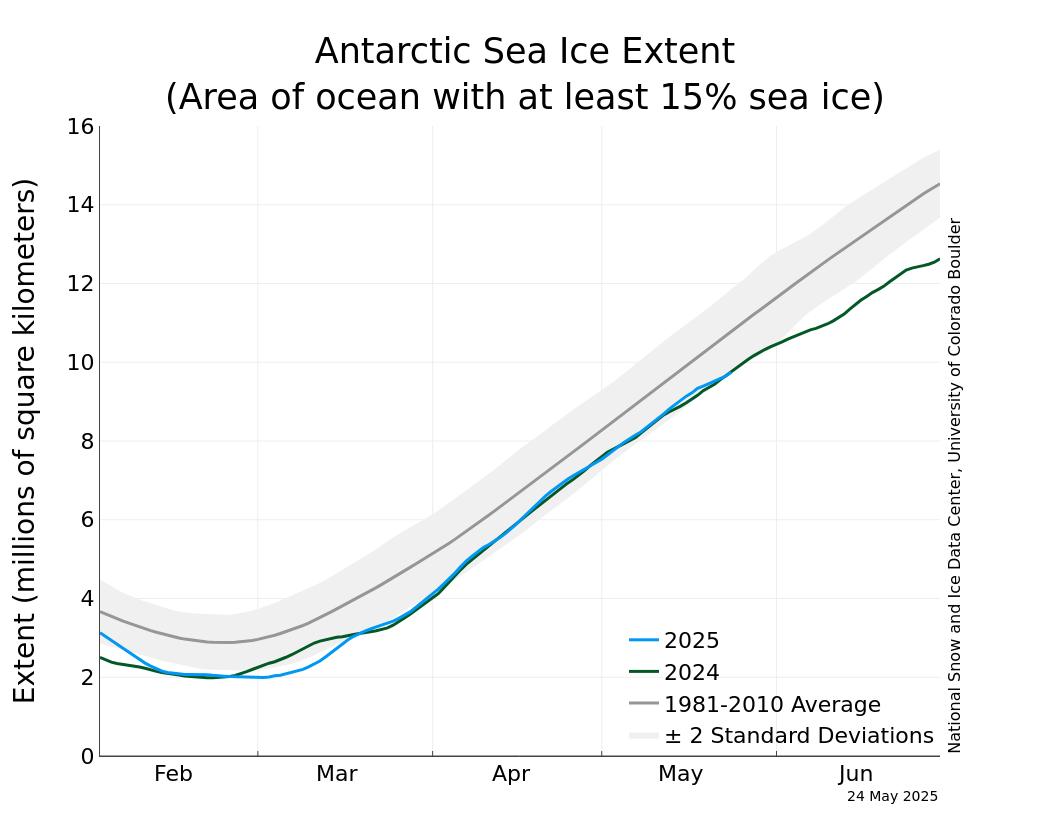
There has been much press this year about a “record polar melt” in the works. This information is incorrect, but it is seems extremely unlikely that the scientists behind those reports will make much of an effort to set the record straight.
The Arctic Oscillation is forecast to turn negative again, hinting at cooler weather in the Northern Hemisphere starting in about a week.

Much of Russia, Siberia and the former Soviet Republics are already seeing well below normal temperatures, but this is (of course) not being reported by the press.

http://www.esrl.noaa.gov/psd/map/ANIM/sfctmpmer_01a.fnl.30.gif
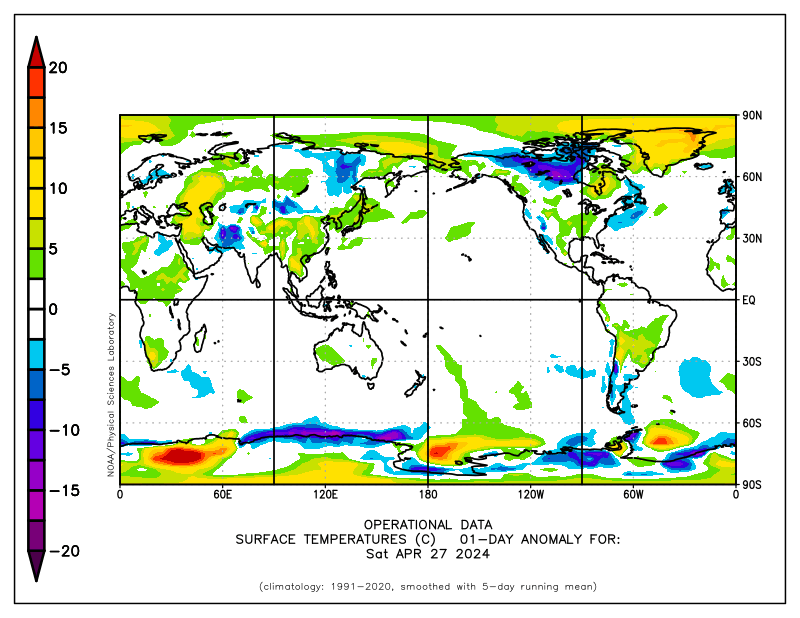
Arctic amplification should work both ways, and appears to be doing so!!!
Strong La Nina plus negative AO. What happens weather-wise over North America?
Some frost in Canada expected, but permafrost in Siberia is now burning.
http://ice-map.appspot.com/?map=Arc&sat=ter&lvl=8&lat=65&lon=155&yir=2010&day=211
Over to you Mr R Gates….
I hope you’re right, I could use some cooler weather down here in Oklahoma! Not looking forward to this winter though.
Once again, nice post, and thanks for data synopsis. Will anyone call the folks from GISS on their inter-/extrapolated from limited data, projected hottest “ever” 2010 Arctic ‘high’ anomaly I wonder?
All stations in the Norwegian arctic were above normal (1961-1990) in July, though:
Jan Mayen 70.9333N 8.6667W 6.2 °C (+2.0)
Bjørnøya 74.5167N 19.0167E 5.5 °C (+1.1)
Hopen 76.5097N 25.0133E 3.6 °C (+1.7)
Sveagruva 77.8833N 16.7167E 6.1 °C (+0.3)
Svalbard lufthavn 78.2500N 15.4667E 6.6 °C (+0.7)
Ny-Ålesund 78.9167N 11.9333E 5.7 °C (+0.8)
It’s currently possible to circumnavigate all of Svalbard without meeting ice, which is unusual.
Seeing well below normal temperatures?? ….Like you said…..
“….Much of western and central Russia is suffering through a severe drought, thought to be the worst since 1972, in what has been the hottest summer since record-keeping began 130 years ago. This year’s harvest was already in trouble, and the fires have finished off vast fields of golden wheat and other crops.
Temperatures have topped 95 degrees (35 Celsius) for much of the past three weeks, with an all-time high of close to 100 degrees (38 Celsius) recorded in Moscow last week….”
http://news.yahoo.com/s/ap/20100801/ap_on_re_eu/eu_russia_fires
Yup.
Record cold = weather
Record hot = climate
Hi Steven. Thanks for you weekly sea ice update. It is great to have all the relevant info, so I can check the arguments against the facts.
The developing story of GISS vs DMI is especially fascinating.
Is Bastardi making you guys do his homework for him? 🙂
Just found this site thanks to Joe…great stuff. Keep up the good work.
A very interesting month lies ahead!
Summer winds down at the same rate everywhere! 🙂 But your point is well made. The Seattle area has been very cool, too. Apparently all the heat is in Russia – that part of Russia that is not Siberia.
When does enough weather become climate?
I read on another blog that PIPS was outdated and PIOMAS was state of the art. WUWT?
Bruce
I can’t wait to see the GISS hot red spot over the North Pole in their July map- accompanied by Hansen’s explanation about how they have the best Arctic coverage as justification for this being the hottest year since humans inhabited the planet.
Some people are desperate to imagine themselves as world saviours. Facts and reality no longer matter.
Stephen Pruett
PIOMAS gives the answer which warmists want to hear, so they make up justifications for that idea.
Steinar
Good time for Lewis Pugh to take off in his kayak towards the North Pole.
Whether PIPS is technically more accurate than PIOMAS is kind of irrelevant in the significance of this summer’s ice extent. PIPS’ “relative” values have been a much better predictive tool than PIOMAS. If you were using both tools to predict the ice extent the past month, PIOMAS would say we should be light years below 2007 right now, while PIPS says we should be slightly ahead of 2009…neither is true, but we are nearly neck and neck with 2009 right now on extent (and significantly higher than 2007) which makes using PIPS a lot MORE accurate for the purposes these posts have been made for.
It will be interesting to see if 2010 finishes ahead of 2009 and see each group’s volume values in September.
Perma frost does not burn, Tundra does Ask any one who’s fought wildland fire in Alaska-I have…
We may just hear less and less of him as the weeks go by. However, should the Arctic go into a massive death spiral then you will hear no end of comment. I do miss him really. :o(
stevengoddard says:
August 1, 2010 at 1:49 pm
Steinar
Good time for Lewis Pugh to take off in his kayak towards the North Pole.
_______________________________________
And have a meaningful encounter with a polar bear…. No thank you! http://www.explorersweb.com/oceans/news.php?id=19544
It has been extremely hot right around Moscow since the beginning of June but this hotspot has been surrounded by areas which are cooler than normal.
This is the hi-res Modis temperature map for July 29th (lots of missing pixels but you should be able to see it).
http://neo.sci.gsfc.nasa.gov/RenderData?si=1508381&cs=rgb&format=JPEG
This is the week of July 20th to July 27th.
http://neo.sci.gsfc.nasa.gov/RenderData?si=1508290&cs=rgb&format=JPEG
Steinar,
When I see these lists of temperature anomalies I go looking for the Stevenson Screens. We know where the one at Svalbard Luft is located, right next to the large, paved, parking area. Jan Mayen isn’t located much better. It’s right next to the meteorological building, which is next to the airstrip.
http://www.jan-mayen.no/met-stn/Bilder/mettenOgBeerenberg_panorama.jpg
Should I search for the others?
I find myself curious how GISS can validate 1200km given the obvious difference between DMI and GISS. I mean, I understand the rationale that the patterns look real, but that seems like a line of reasoning used when you are guessing, doesn’t it? Still, it’ll be interesting to see how this all plays out.
Bill Illis says:
August 1, 2010 at 2:26 pm
It has been extremely hot right around Moscow since the beginning of June but this hotspot has been surrounded by areas which are cooler than normal.
This is the hi-res Modis temperature map for July 29th (lots of missing pixels but you should be able to see it).
http://neo.sci.gsfc.nasa.gov/RenderData?si=1508381&cs=rgb&format=JPEG
This is the week of July 20th to July 27th.
http://neo.sci.gsfc.nasa.gov/RenderData?si=1508290&cs=rgb&format=JPEG
__________________________________________
So where did the super cold in South America go??? http://wattsupwiththat.com/2010/07/30/frozen-tropics-as-la-nina-takes-hold/
Meanwhile, 2010 is the second lowest sea ice extent and area on record, second only to the summer of 2007:
http://www.ijis.iarc.uaf.edu/seaice/extent/AMSRE_Sea_Ice_Extent_L.png
http://www.ijis.iarc.uaf.edu/seaice/extent/AMSRE_Sea_Ice_Area.png
Notice all that melting ice south of 80° N which doesn’t care what DMI’s model of air temperature north of 80° N says:
ftp://ftp-projects.zmaw.de/seaice/NEAR_REAL_TIME/Arc_latest_large.png
or the open water north of 80° N, for that matter.
Here’s the Arctic sea ice on 9/13/2009, the day of the summer minimum last year:
http://iup.physik.uni-bremen.de:8084/amsredata/asi_daygrid_swath/l1a/n6250/2009/sep/asi180-n6250-20090913_visual.png
Notice all that open water north of 80° N, and how easy it is for sea ice south of 80° N to melt in the next month and a half.
Sometime in mid September, we’ll see what the 2010 summer minimum is.
Until then, I’ll be enjoying the beach each weekend …