By Steve Goddard
The Arctic is proud to have been listed as one of many “fastest warming places on earth.”
The GISS 250km Arctic image below shows temperature trends from 1880-2009. Areas in black represent regions with no data.

In most fields of science, data is considered an essential element of historical analysis. But climate science gets a pass, because it involves “saving the planet.” Antarctic coverage is equally as impressive. The image below looks right through the earth to the Arctic hole.

Temperatures in the high Arctic have been running well below normal and have started their annual decline. There are only about 30 days left of possible melt above 80N.

http://ocean.dmi.dk/arctic/meant80n.uk.php
This can be seen in North Pole webcams which show the ice frozen solid.

http://psc.apl.washington.edu/northpole/webphotos/noaa2.jpg

As forecast in last week’s sea ice news, ice loss accelerated during the past week over the East Siberian Sea due to above normal temperatures.

http://ocean.dmi.dk/arctic/icecover.uk.php
The modified NSIDC map below shows (in red) regions of the Arctic that have lost ice over the past week.

The modified NSIDC map below shows (in red) ice loss since early April.

The modified NSIDC map below shows (in red) ice loss since July 1. The Beaufort Sea has actually gained ice (green.) Looks like a Northwest Passage traverse is quite possible (by helicopter.)

Ice loss from July 1 through July 23 has been the slowest on record in the JAXA database. Ice loss during July has been about one half that of 2007.

The graph below shows the difference between 2010 and 2007 melt. 2010 started the month half a million km² behind 2007, and is now half a million km² ahead of 2007.

The modified NSIDC image below shows the difference between 2007 ice and 2010 ice. Green indicates more ice in 2010, red indicates less.

“Climate expert” Joe Romm reported in May
Arctic sea ice shrinks faster than 2007, NSIDC director Serreze says, “I think it’s quite possible” we could “break another record this year.” Watts and Goddard seem in denial
Average ice thickness continues to follow a track below 2006 and above 2009, hinting that my prediction of a 5.5 million km² minimum continues to be correct.

During July, ice movement has been quite different from 2007 – which had strong winds compressing the ice towards the pole. By contrast, July 2010 has seen winds generally pushing away from the pole. Thus the ice edge on the Pacific side is further from the pole. No rocket science there, and a pretty strong indication that the alleged 2007 record summer melt was primarily due to wind.
Cryosphere Today showed two days ago that Arctic Basin ice is nearly identical to 20 years ago, but unfortunately their web site is down and I can’t generate any images.
NCEP forecasts warm temperatures in the East Siberian, Chukchi and Beaufort Seas for the next week, so I expect that melt will continue around the edges of the Arctic Basin.
Meanwhile, Antarctic ice continues well above normal. Antarctica is also the fastest warming place on the planet.
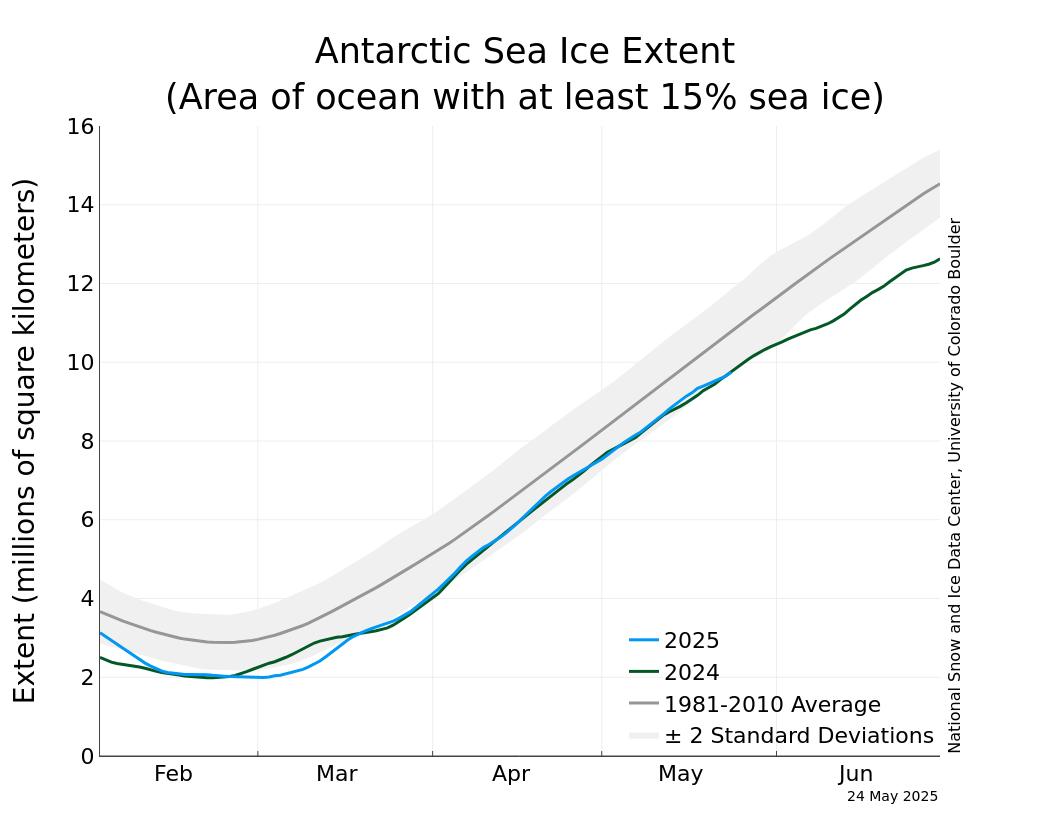

Conclusion: There is no polar meltdown at either pole.
Next week we start comparing PIOMASS forecasts vs. reality. PIOMASS claims that Arctic ice is the thinnest on record.

============================================
Don’t forget to bookmark WUWT’s new Sea Ice Page
Sponsored IT training links:
Subscribe for 350-030 training and get up to date 70-649 materials with 100% success guarantee plus get free demos for 220-701 exam.
Steve
Thanks for the update and commentary.
Looks like a Northwest Passage traverse is quite possible (by helicopter.)
And by that chap in kayak (carrying it).
Conclusion: There is no polar meltdown at either pole.
There is. It’s just hidden. Trenberth is on the job looking for it.
It does not mean anything (yet), but Nansen (Arctic ROOS) shows the ice extend the same in 2008, 2009 and 2010. So everybody can still hope (my simpleminded prognosis from November 2009 was 5 Million sq-km because “minimum ice has never increased 3 years in a row”).
Pity the Northwest Passage looks like it may remain shut this year. I really enjoy the exploits of the fellows who force their way through, (even if their politics is a bore.)
There is a Norwegian with a really neat trimaran who is waiting up at the top of Norway, and hoping to do a complete circuit, including both the Northwest and Northeast Passage. Looks a bit like he may have to call it off until next year.
However those trimarans can really fly. And sometimes these narrow strips of open water appear right along the arctic shorelines. Maybe the wind will blow the ice in towards the poles, and the fellow will get tempted…..
I myself would rather sail in warmer waters, (if I could afford it,) but it sure if fun to sit at my computer and watch these crazy dudes dash across the stretches of open waters, and dodge the shifting ice. (Also I don’t suppose they have to worry about modern-day pirates, that far north.)
“Arctic sea ice shrinks faster than 2007, NSIDC director Serreze says, “I think it’s quite possible” we could “break another record this year.”
Watts and Goddard seem in denial”
In denial of what, Dir. Serreze ? That the world is going under?
Please take a realism test. Look around you. The world is a better place than ever.
And you are denying it.
The logical conclusion is that it is You who are in denial.
“Looks like a Northwest Passage traverse is quite possible (by helicopter.)”
LOL!! Thanks, Steve, well done!
Thanks for the polar weather update Steve…you go a great job looking at Arctic weather.
Now, as far as your final conclusion:
” There is no polar meltdown at either pole.”
__________
I take it you’re talking about the weather here and not the climate. Of course, climate can only be seen over the longer term, and it is more than obvious that the Arctic sea ice has been in a long term state of decline for many years. We’ve not seen a positive Arctic sea ice extent anomaly since 2004.
In terms of the rest of the summer, look for all that ice that has spread out over the past few weeks (hence the real reason for the extent to have slowed) to begin to melt rapidly. The waters are warm and that low concentration ice is already showing signs of melting fast. I’ll keep with my 4.5 million sq. km. forecast for now…but then again, we’re talking about the weather, not the climate.
This can be seen in North Pole webcams which show the ice frozen solid.
Think a mini-sub can fit in the frozen pond?
Thanks Steve,
Assuming the information (following links) are accurate, there appear to be research stations within many of the black out areas you listed. If they’re still active, isn’t their data included in global temp etc.?
Arctic Research Stations
http://maps.grida.no/go/graphic/major-research-stations-in-the-arctic
ANTARCTICA RESEARCH STATIONS
http://www.antarcticconnection.com/antarctic/stations/index.shtml
South Pole
http://www.antarcticconnection.com/antarctic/stations/southpole.shtml
When I look at http://ocean.dmi.dk/arctic/icecover.uk.php , are there “reliable” (non-model generated) data concerning the range of the cycle over the latest inter-glacial period?
(Say 10,000 years so that we don’t use the Younger Dryas to “inflate” the values.)
I would imagine that this decade’s spread is quite small when compared to millennial results….
Steve, I’m a bit surprised at your comment on the NWP. From the AMSR-E and MODIS imagery, the NWP has significantly less sea ice than it did in any of the 2007-2009 years when it opened. During 2007-2009, it didn’t open until the end of August.
Also, it should be noted that the ice edge is moving past the 4+ year old ice that was advected into the Beaufort and Chukchi seas this winter.
Forecast from the Canadian weather service calls for high pressure over the Canada Basin with low pressure over Eurasia. This will foster more offshore wind from Siberia, so ice loss in the E. Siberian Sea will likely continue to accelerate during the next week.
Finally, there has been persistence of low ice concentrations from AMSR-E in the interior of the icepack, confirmed in MODIS data as open water areas. I suggest linking to the AMSR-E and MODIS imagery more often in your postings since they give a higher resolution on the state of the ice pack than the SSM/I data does.
I think some fool will try the NW passage and will get stuck.
hey sTv,
That first NSIDC graph. Is that dated 07/26/2010? Or maybe 07/28/2010? Good going, mate! Can you tell me how my investments will be doing next month? Dying to know.
I’m so happy to see that really good science, done by really good scientists, published on really good blogs, avoiding that silly “peer-review” process with all its political innuendo, is what’s keeping the denial machine alive. Good on yer, mate!
It’s also nice to see Dr. Christy, so highly respected, publish in E&E, rather than, say, in Nature or Science. Right bloody on, dude!
We’ll show those alarmists a thing or two about blog science! Shoot, anybody can blog! But can anybody blog science like you guys can? Heck, no! It would take a monumental amount of hypocrisy to be able to pull that off, and quite frankly, Lindzen, Christy, Spencer and you, sTv, just about cornered the market on that one.
Speaking of free market, why hasn’t anybody grasped how well Greece is doing these days? They’re much better off than Argentina is, what with the loans to pay off interest on other loans and such.
Let’s go free market!! Woot!!!
-sTv
Hey, is north pole ice as salty as seawater?
Cryosphere Today showed two days ago that Arctic Basin ice is nearly identical to 20 years ago, but unfortunately their web site is down and I can’t generate any images.
I’m assuming by 2 days ago that you mean July 23rd?
According to CT on that date this year the ice area was 5.1075397Mm^2 whereas on the same date in 1990 it was 6.1955042Mm^2, that isn’t nearly identical!
Any chance of fixing the Y-Axis label on the JAXA Jul 1-23 Ice Melt chart so it doesn’t inadvertently indicate trillions of square kilometers? No big deal. We all know what is meant. But still…
“Average ice thickness continues to follow a track below 2006 and above 2009, hinting that my prediction of a 5.5 million km² minimum continues to be correct.” !!!!!
This can be seen in North Pole webcams which show the ice frozen solid.
Doesn’t look frozen solid to me, in fact the crack through the site which has been there since late May has started to really open up as well.
http://www.arctic.noaa.gov/npole/2010/images/noaa2-2010-0725-130427.jpg
Amino, I thought Trenberth was looking for heat, but in all the wrong places…
Now, I suspect, we are seeing the beginning of the blog wars – the climate science community has clued in and they are beginning to battle back with the mediums and in the manner with which the skeptics have been for some time. I suspect Mr. Watts will not like this, may even feel aggrieved and assaulted (as do his friends on other blogsites such as Climate Skeptic), and his claims will be investigated (as Phil is doing above). In the end, I suspect Mr. Watts may find himself rather Breitbarted.
REPLY:Blog wars have been going on since 2004 when the RC -vs- CA first started.
Also FYI Steve Goddard wrote this post, and that is who “Phil.” is responding to. See you again on September 30th. – Anthony
Steve,
by comparing with the curves from last years, have you noticed a significant change in their progression? I think it is not due to sun high…
sVt A.K.A. “Ex” Republican on another blog
The “WOOT” gives you away
“In most fields of science, data is considered an essential element of historical analysis. But climate science gets a pass, because it involves “saving the planet.”
Filling in data using statistical fabrication – or whatever technique – that wasn’t actually observed is FRAUD. Nasa GISS is guilty of FRAUD and needs to be held accountable.
They are also guilty of a second fraud, not reporting that they’ve used DATA FABRICATION on the actual images produced. The images need to say “CONTAINS FABRICATED DATA, DOES NOT REFLECT REALITY”. Truth in labeling laws must apply to scientific graphs and images.
ALL papers based upon Nasa’s fraudulent and fabricated data are NULL AND VOID! They need to be found and marked as needing to be redone and corrected to reflect the actual observed data rather than made up fraudulent data.
Now if I recall there is a paper by one of the infamous climategate antiheroes that claims that it is ok to fabricate data using statistics. At the moment I’ve not been able to find it (if someone knows which one I’m talking about please post a link to it below – thx). This paper needs to be rescinded as NULL AND VOID and BAD SCIENCE. ALL papers that reference it also need to be rescinded and redone or just tossed into the garbage paper pile where most ideas in science end up.
Clearly a creeping acceptance of fabrication of data by the alleged scientists involved in the alleged scientific field of climate science has played a major role in the corruption of some of the key people involved and a corruption of their work. They might not even know it since it’s a creeping lowering of the standards of what is accepted as valid climate science over a period of a number of decades.
Fraud in science must be stopped when it’s detected. Fabrication of data is unacceptable. Use of statistical games to fabricate data is unacceptable. Scientists need to be held to the highest possible standards to insure the integrity of the scientific work. Extreme claims (and all claims of doomsday are extreme) require extraordinary evidence, not substandard evidence with non-observed fabricated data pretending to be real data. The people that scientists who’s work influence the public deserve better.
Zilla,
Skeptics? Who’s a skeptic?