By Steve Goddard
This summer we have had confirmation that Arctic ice behaviour has everything to do with wind. During June, winds were circulating clockwise in an inwards spiral, which caused ice extent to diminish and ice concentration to remain high. Around July 1, the patterns reversed and we have seen counterclockwise winds pushing ice away from the pole. As a result, ice area/extent has scarcely changed and instead we see a gradual decline in average ice thickness. The video below shows June/July ice movement and thickness.
The graph below shows changes in ice thickness during summer over the last five years. Based on past behaviour, we can expect the average ice thickness to flatten sometime in the next two weeks. It should bottom out somewhere between 2006 and 2009. NSIDC has warned me that PIPS is not an accurate measure of ice thickness, though I would have to say it has done remarkably well as a predictor of this summer’s behavior. As you can see below, 2010 is following a track similar to 2006.

As you can see below, we have reached the midpoint of the melt season in the high Arctic, and temperatures have been slightly below normal there for most of the last 55 days. There are only about 40 days left above freezing in the high Arctic.

http://ocean.dmi.dk/arctic/meant80n.uk.php
NCEP is forecasting below normal temperatures in most of the Arctic for the next two weeks.
The sea ice graphs have nearly flatlined since the beginning of the month. DMI’s graph is particularly interesting, since it only measures higher concentration ice, which is less likely to melt through.

http://ocean.dmi.dk/arctic/icecover.uk.php
Below is a closeup image showing that 2010 extent is now running close to 2006.

The concentration and extent appears quite similar to 20 years ago.

It has been cloudy in the Arctic and you can clearly see the counterclockwise circulation in the satellite IR image below. Clouds are white, ice is red.

The webcams continue to show a little ice on the surface of the meltponds, indicating ongoing below freezing temperatures at the North Pole.

http://psc.apl.washington.edu/northpole/webphotos/noaa2.jpg

We are at peak melt season, and there just isn’t much happening in the Arctic. The Arctic Oscillation has turned slightly positive in July, which tends to keep cold air contained in the Arctic and out of lower latitudes.

http://www.cpc.noaa.gov/products/precip/CWlink/daily_ao_index/ao.sprd2.gif

The modified NSIDC map below shows ice loss (red) and ice gain (green) over the last week. There has been slightly more loss than gain.

The modified NSIDC image below shows ice loss since early April.

The modified NSIDC image below shows the difference between 2010 (green) and 2007 (red.) There is clearly more ice now than in 2007, and this is also shown in the NSIDC extent graph.


http://nsidc.org/data/seaice_index/images/daily_images/N_timeseries.png
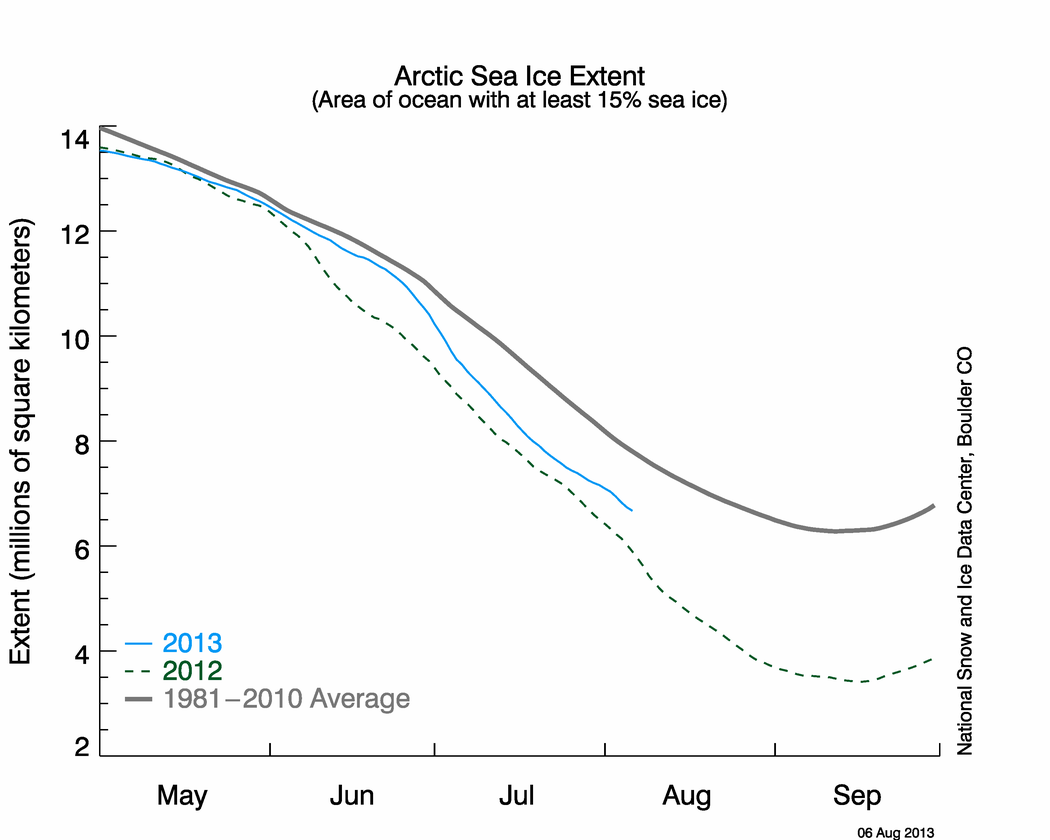
Ice has flatlined in the North, while it goes through the roof in the south.

http://nsidc.org/data/seaice_index/images/daily_images/S_timeseries.png
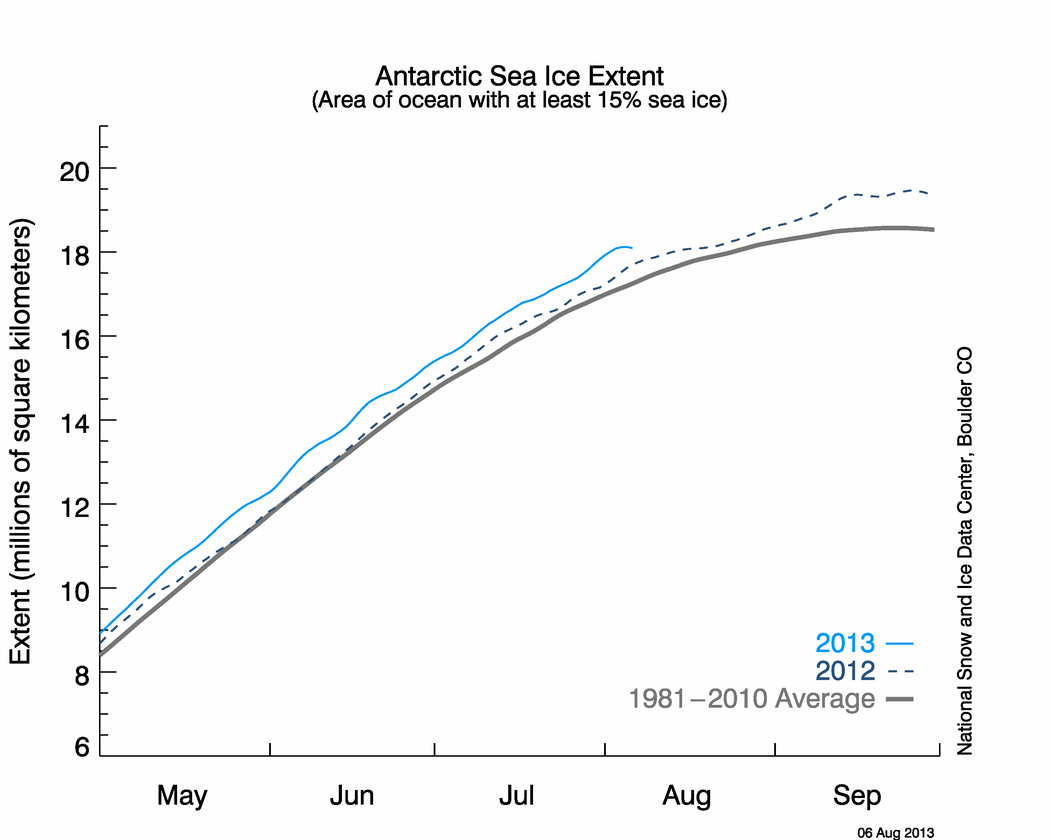
In other words, the widely claimed polar meltdown continues to be nothing more than bad fiction.
But Steve, this is weather, not climate! 🙂
Meanwhile, USCGC Healy continues to ensure it’s ‘rotten’ in the vicinity of Barrow.
http://www.sailwx.info/shiptrack/shipposition.phtml?call=NEPP
but Steve, arctic and antarctic ice extents are just local events, and not indicators of global climate…
….no wait, it was the Medieval Warm Period and Little Ice Age that were only local
and we know that because one tree ring data is not local weather, but global weather, and ice cores are not local, ice cores are global
I have to go now, my trees are wandering all over the yard and threatening to go to Disney without me………
“Arctic ice behaviour has everything to do with wind”
Everything?
The NERSC plots at arctic-roos are not flat, they show a marked increase in Artic sea ice extent, probably related with the 15% concentration threshold and how wind changes that.
I love watching the play by play on this. BUT … I have to wait until late Augusts or September before I go off bloviating about how real science trumps political activism.
Of course .. I’ll get the usual …. 3 years of data doesn’t make a trend!! .. LOL .. oh yeah it does .. it makes a three year trend. … a trend that .. btw .. has bucked the lack of wisdom held in the poltical activists.
And what of Pips 2.0 ?? Pips shows a huge area, thinning RAPIDLY North of Russia’s Northmost Land & up to 87 degrees North.
… ironically, in the 2007 Mega-Melt, this area held firm all year. It is Crucial because this is where the Gulf Stream delivers warm Water — in 2007, the 40 degree (F) water was separated by this ridge of Ice. We may get an Ocean Current Shutdown – – EVEN if the Ice total is not as low as 2007, because of the PLACES that melt off.
Current Pips: http://www7320.nrlssc.navy.mil/pips2/ithi.html
2007 Pips at Ice Minimum: http://www7320.nrlssc.navy.mil/pips2/archive/retrievepic.html?filetype=Thickness&year=2007&month=9&day=24
And then R. Gates’ favorite Topaz, likely the Most detailed: http://topaz.nersc.no/topazVisual/matlab_static_image.php?action=NA_ARC_NWA_Function&file_prefix=ARC&match_date=20100708&depth=0005&variable_name=hice
– – they all show what may well be the European Diesel Craze (“Cash for Clunkers” in Germany is actualy: trading Gasoline for Diesel), eating away at the Ice, apparently by dropping Soot on it & turning it BLACK (or polka-dotted, actually).
I know this is an unpopular view with the Politically Motivated.
AGW is indeed REAL – – it’s just that most of the Bad effects are not from Capitalism, but the Global Warming Lobby trying to increase their $100 Billion a year Tax subsidy – – by making things worse.
& Don’t forget Wayne Davidson’s theory that a quick Switch from El Nino to La Nina made 2007 so bad.
But is it Switching ? ?
>> The Ice drift in the Arctic, so recently almost nothing, is now Counter-clockwise and Strengthening.
As the Areas with the Least ice are toweards Novaya Zemlya & Svalbard – where melting has already reached 2007’s Minimum & GONE PAST, this would throw Ice into that hole, rather than the usual disposal down the East Shore of Greenland.
Pips 2.0 : use link above to Current Page & switch to Displacement (in upper right) OR substitute “Displacement” for “Thickness” for dated link.
… 2007 Drift seemed to be usually Strong but sometimes switched Direction ( ! ).
New update means new estimate.
Sea ice extent (mean, 15% cutoff definition per JAXA/NSIDC) = 4.2E+6 km^2 (standard deviation = 0.45E+6 km^2).
Previous estimate was 3.9E+6 km^2 (standard deviation = 0.51E+6 km^2).
When I arrive in Sargents, CO. in Sept. I hope the Arctic ice is on your forecast and there is still a little snow along the continental divide this year which has been missing for about 3-4 years. This is based on my observation for about 20 years or so. I would feel much better about the climate if these minor things happened.
N-Icely done update Steve. Very thorough, and it seems you’ve carefully chosen your data to support your final conclusion:
“In other words, the widely claimed polar meltdown continues to be nothing more than bad fiction.”
I hope everyone bookmarks this quote of yours, or cuts and pastes it somewhere with the data of 7-11-2010. It should be forever connected with you, as it seems to be your deeply held belief.
Meanwhile, as Steve has given us a nice update on the Arctic WEATHER, (which reminds me very much of “it’s snowing in Florida, so this is proof there’s no global warming.”of more interest is the long term climate trend in Arctic sea ice. Everyone is well familiar with the longer term charts of Arctic Sea ice, and those who are honest (and not just skeptical) know what has been happening in the Arctic over the past few decades, and especially these past 3 or 4 years. 2010 is showing no recovery from the deep plunge of 2007, and the little wiggles in the trend lines (like the March-April) bump up are nothing more than weather noise riding on top of the longer term decline in Arctic Sea ice. This graph says it all about Arctic Sea ice:
http://arctic.atmos.uiuc.edu/cryosphere/IMAGES/seaice.anomaly.arctic.png
But if you want the Arctic weather, Steve does a great job. And speaking of weather, as I said in the last of Steve’s updates, look for big spike down later in July and into August in Arctic Sea ice, with particularily strong melt coming from the Atlantic side of the Arctic Basin.
I was wondering if you attended this symposium “Steve Goddard” :
http://www.igs2010.org/programme.html
Or are you still just a bystander, not at all knowledgeable of the basic research being done.
Looks like the ice melt is FLAT LINING!!!!!!!!!
Ok I only believe what I read in the MSM…..
the world is on fire!
Tim
R. Gates
Global sea ice is right at the 30 year mean. That clearly is not consistent with a “polar meltdown.”
Steve,
Thank your for your work and for the information you present.
I notice that you did not mention Point Barrow in this posting. 🙂
Here is one of the plenary lectures by Professor David Barber:
http://video.hint.no/mmt201v10/osc/?vid=55
any comments?
As Steve points out above, Antarctic Sea Ice continues to trend well above average and NSIDC’s Antarctic Sea Ice Extent chart shows the rate of increase has accelerated significantly in the last week;
http://nsidc.org/data/seaice_index/images/daily_images/S_stddev_timeseries.png
here is a good visualization/map of the current Antarctic Sea Ice Extent Anomaly; http://nsidc.org/data/seaice_index/images/daily_images/S_bm_extent_hires.png
The Antarctic Sea Ice Area Anomaly, is currently a positive 1.461 Million sq km;
http://arctic.atmos.uiuc.edu/cryosphere/IMAGES/seaice.anomaly.antarctic.png
and at close to parity with the Arctic Sea Ice Area Anomaly, currently a negative 1.500 Million sq km;
http://arctic.atmos.uiuc.edu/cryosphere/IMAGES/seaice.anomaly.arctic.png
reinforcing that Antarctic and Arctic Sea Ice appear to be interrelated;
http://www.robertb.darkhorizons.org/seaice.anomaly.Ant_arctic.jpg
one might say, two sides of the same coin. Global Sea Ice Area is thus currently alarmingly average;
http://arctic.atmos.uiuc.edu/cryosphere/IMAGES/global.daily.ice.area.withtrend.jpg
and offers no indication of the rapid global warming that’s been claimed by the Warmists…
R. Gates you seem to always leave out the effects of wind patterns. You said ” it seems you’ve carefully chosen your data to support your final conclusion:” That was the CRU.
R. Gates says:
July 11, 2010 at 11:33 am
Yeah OK but look at the graph again and tell us what has happened since 2007?
There seems to be an upward trend, therefore the sea ice is recovering, no need to panic………. Arctic basin ice free? = Not in your or my life time mate.
http://arctic.atmos.uiuc.edu/cryosphere/IMAGES/recent365.anom.region.1.html
Now I’m wondering if there’s no sensor problem again here (I mean in the last few days). The symmetry of the two signals (arctic/antarctic) seems to suggest it and moreover the JAXA index has no such “plateau” (see the widget to the right). Is there any way to verify this?
R. Gates says:
July 11, 2010 at 11:33 am
N-Icely done update Steve. Very thorough, and it seems you’ve carefully chosen your data to support your final conclusion:
“In other words, the widely claimed polar meltdown continues to be nothing more than bad fiction.”
I hope everyone bookmarks this quote of yours, or cuts and pastes it somewhere with the data of 7-11-2010. It should be forever connected with you, as it seems to be your deeply held belief.
Yes and I have bookmarked yours;
“look for big spike down later in July and into August in Arctic Sea ice, with particularily strong melt coming from the Atlantic side of the Arctic Basin.”
Just the facts says:
Nice response and graph.
The lack of any serious ice melting in the North and the large increase in the South is just a travesty. Did Al baby head to the south pole recently? just in case…scarc off…
Guess what, since the beginning of time, we have had ice melt and recovery, some less, some more. Its good that Steve continues to counter the ‘alarmist’ view, but really, ebb and flow each year.
Charles Wilson says:
July 11, 2010 at 11:06 am
“[…]- – they all show what may well be the European Diesel Craze (“Cash for Clunkers” in Germany is actualy: trading Gasoline for Diesel), eating away at the Ice, apparently by dropping Soot on it & turning it BLACK (or polka-dotted, actually).
I know this is an unpopular view with the Politically Motivated.[…]”
No, the cash for clunkers programme in Germany paid 2500 Euro if you give up your old car and buy a new one, no matter which.
We have always driven lots of Diesels because Diesel was taxed lower here; but in recent years the prize difference at the pump dropped and sometimes became zero so Diesel loses some of its attraction.
Germany has introduced strict soot controls and Diesel cars need to have a particle filter; old ones need to be retrofitted to be allowed into some cities.
All people i know that participated in the cash for clunkers programme bought a gasoline car.
Our new favourite is LPG; it’s tax excempt because it produces less CO2 per mile. But the installation costs 2500 Euro so it’s only economical when your mileage is high enough, otherwise you never make a gain.
Your information about Germany is wrong. Wherever you got it.
Thanks Steven for another good report. ArcticROOS bear out your statements about what’s happening in the Arctic, and it looks like the recovery continues.
http://arctic-roos.org/observations/satellite-data/sea-ice/ice-area-and-extent-in-arctic
Strange how all the global warming we’ve had over the last 15y (NOT) has had so little impact on total global sea ice levels. With the sun still in the doldrums, I think it likely that the recovery seen in 2008/9 is set to continue.
I would say Goddard’s conclusions again match my own through my watching of pretty much all the same data with the exception of PIPS as I do not follow those data.
Continuing cloudy weather at the pole is likely to retard solar melting even in the presence of (despite the presence of?) soot/ash contaminated ice. Air temperatures are below normal so no unusual melting from that either. Winds seem so far to be behaving themselves and aren’t blowing large amounts of the floating arctic ice cap out into the Atlantic. In two weeks temperatures begin to fall in the Arctic and sun angle is no longer going to be a significant contributor to melt at high latitude.
I notice there is no “Northwest Passage” chatter this year, nor is there likely to be barring some really unexpected weather event.
It doesn’t look like we have had breakup at Point Barrow yet either.
Nothing surprising in this report and everything looks on track. I would say the only difference between what I expect and what Steve Goddard expects is I expect the ice to be closer to 2006 than he does.