By Steve Goddard

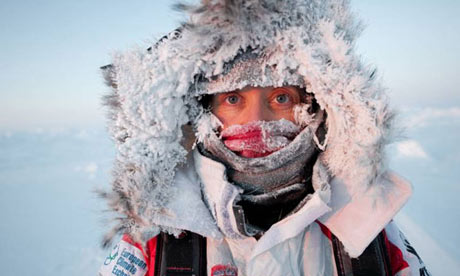
Guardian photo : Ann Daniels Enjoying The Warming Arctic
Yesterday, WUWT reported on a University of Melbourne study claiming that melting ice is behind the warming of the Arctic.
“Findings published in Nature today reveal the rapid melting of sea ice has dramatically increased the levels of warming in the region in the last two decades. The sea ice acts like a shiny lid on the Arctic Ocean. When it is heated, it reflects most of the incoming sunlight back into space. When the sea ice melts, more heat is absorbed by the water. The warmer water then heats the atmosphere above it.”
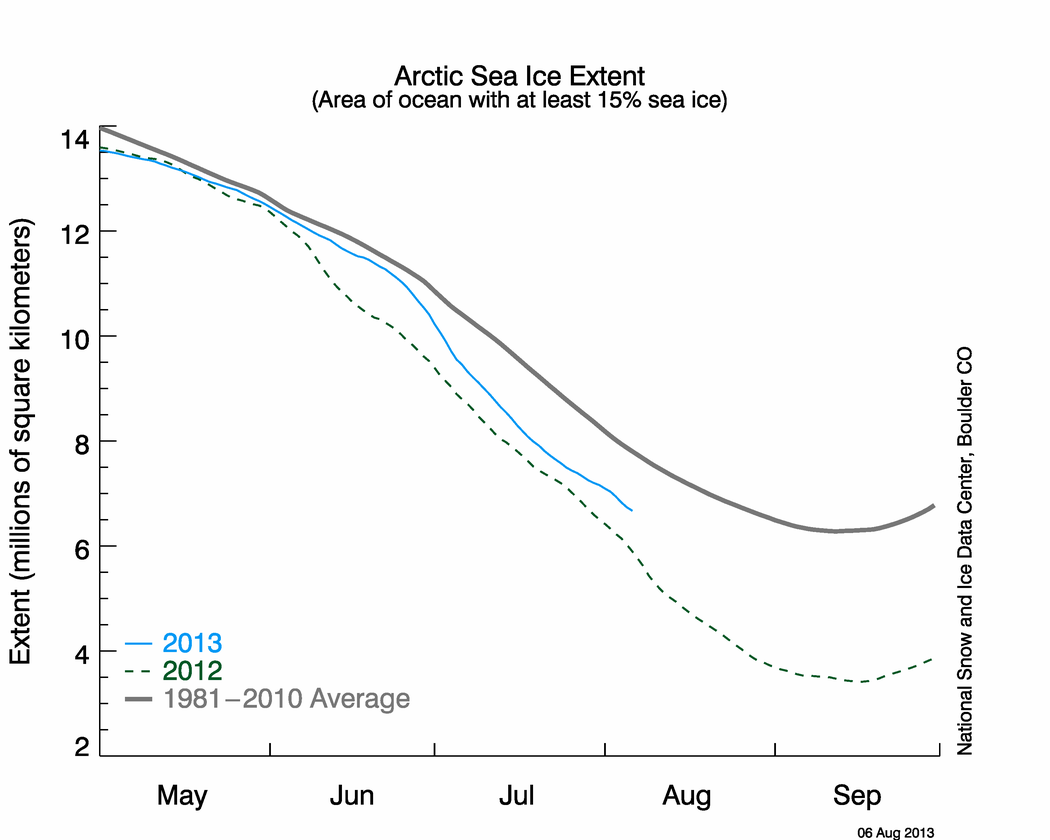
If this were true, we would expect to see that months with the most ice loss would also show the most warming. In fact, we see the exact opposite. As you can see in the graph below, most Arctic warming from 1979-present has occurred in the winter and spring, with very little warming during the summer.

By contrast, ice extent trends over that same time interval show that ice loss has occurred mainly during the summer. It appears that the relationship between warming and ice loss is inconsistent with the claims in the University of Melbourne study. Temperatures have increased the least during times of year when ice loss was the greatest.

April is the month which has warmed the most, a full seven months after September – the month of peak ice loss. There is very little variation in ice extent year over year during April – except for this year which is running well above any other recent years.

http://ocean.dmi.dk/arctic/icecover.uk.php
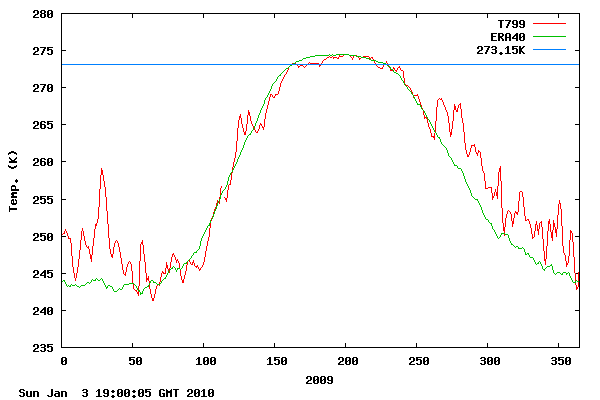
A couple of other familiar graphs showing the same issues can be seen below. Note in the DMI graph below that Arctic temperatures have not warmed at all during the summer in the central Arctic.

In the Cryosphere Today graph below, you can see that most ice loss has been during the summer, when there has been little or no temperature gain.


The scatter plot below shows Arctic temperature trends vs. the absolute value of ice extent trends, for all 12 months. Note that there is no meaningful correlation between temperature trends and ice loss. In fact, the months with the most increase in temperature seem to be the ones with little ice loss.

The article claims
” Strong winter warming is consistent with the atmospheric response to reduced sea ice cover.”
But this is inconsistent with the fact that there has been very little reduction in winter ice cover. The temperature of water under the winter sea ice is fixed by thermodynamics at -2C down to a depth of tens of metres, and does not vary from one year to the next. Furthermore, the rate of heat transfer through 2-5 meter thick 99+% concentration ice, is very low. NSIDC is currently showing ice extent right at the 1979-2000 mean, and above the 1979-2009 mean – yet temperatures in the Arctic have been well above the mean all through the spring. How is the heat escaping through all the thick, high concentration ice?

http://ocean.dmi.dk/arctic/meant80n.uk.php
The article also claims :
“reduced summer sea ice cover allows for greater warming of the upper ocean….The excess heat stored in the upper ocean is subsequently released to the atmosphere during winter.”
There is a major problem with that theory. The summer minimum occurs at the autumnal equinox when the Arctic is receiving almost no SW radiation, and that which is being received is well below the critical angle of water. By September, the shortage of insulating ice cover is actually causing a net loss of heat from the ocean. NSIDC explains it like this:
“In the past five years, the Arctic has shown a pattern of strong low-level atmospheric warming over the Arctic Ocean in autumn because of heat loss from the ocean back to the atmosphere. …. As larger expanses of open water are left at the end of each melt season, the ocean will continue to hand off heat to the atmosphere.”

In other words, loss of summer ice should produce atmospheric warming in the autumn, but not in the winter and spring when ice is cover is normal or near normal.
Two years ago, WUWT published this article after review by Walt Meier at NSIDC, Roger Pielke Sr. at CU, and Ben Herman at the University of Arizona. It explains why changes in ice cover probably are causing a net cooling effect. None of the reviewers had any substantive disagreements with the conclusions.
Conclusion: The University of Melbourne study claims are not supported by the available data. The authors seem to have jumped right into statistical analysis without proposing a physical mechanism that works. Heat flows across differences in temperatures, yet the winter water temperature under the ice is fixed at -2C. Thus elevated winter air temperatures should actually cause a reduction in heat flow out of the ocean. Whatever is driving increases in winter Arctic temperatures is not heat coming out of the Arctic Ocean, which is covered with insulating ice.
A more logical conclusion would be that the decline in ice thickness is associated with warmer winter temperatures.
If scientific reasoning were limited to the logical processes of arithmetic, we should not get very far in our understanding of the physical world. One might as well attempt to grasp the game of poker entirely by the use of the mathematics of probability.
– Vannevar Bush
I just don’t understand how any credible scientist can really believe that the earth’s climate system is so unstable.
Arctic ocean currents are key to North Atlantic temperature changes. It is an interesting fact (whether coincidence or causal correlation) the Geomagnetic field in the Arctic area has the same historical trend as the NA temperature.
http://www.vukcevic.talktalk.net/LFC16.htm
http://www.vukcevic.talktalk.net/LFC8.htm
“In other words, loss of summer ice should produce atmospheric warming in the autumn, but not in the winter and spring when ice is cover is normal or near normal.”
I shall assume the highlighted “is” is extra, rather than the “c” and the “is” before “normal” are mistakes.
Otherwise, another great job by WUWT’s new regular non-guest poster! (Hope you’re getting paid good for this gig.)
Nice post Steve. Thank you.
“[…] Whatever is driving increases in winter Arctic temperatures is not heat coming out of the Arctic Ocean, which is covered with insulating ice. […]”
Gosh! I thought it was obvious. All the thermometers spend the winter in Palm Beach. ;o)
Funny, how often even amateurs can debunk todays “scientific claims”.
Influx of warmer Atlantic water caused by AMO is sufficient enough for explanation. Positive feedback by ice loss is obviously not strong enough, since once the AMO switches to cold, the ice extent inevitably increases again.
http://blog.sme.sk/blog/560/195013/arcticamo.jpg
So the ice extent recovering is going to cause a net warming?
It’s worse than we thought.
/sarc off
Climatology definition: Effect is the driving factor behind the cause. This paper is keeping with the approved “Climatology practices” developed for the IPCC review process!
I should mention a couple more things.
1. Open water in the autumn is a negative feedback, because it causes the ocean to cool by radiation and diffusion to the air – which can’t happen when it is covered with ice.
2. When the open water freezes in the autumn, it exothermically releases ocean heat to the atmosphere, causing warming of the air and loss of heat from the ocean. Once again, this is a negative feedback because it reduces the heat content of the ocean.
If a smidgeon of CO2 can cause CAGW why not ice? LOL
I think Nasa’s SDO is going to shed more light on the subject than hacks needing to publish something, anything.
I am old fashioned. Before the CO2 epidemic, warming caused melting and not melting caused warming.
Nice post Steve, except I think your logic is flawed. Low summer ice means more warming of the water, and that heat is not released until later in the season. We don’t see maximum ice extent until March, (almost spring, and past March 21st this year as we all know). At some point in the fall and early winter, that excess heat that was absorbed during the summer would begin to release, raising temps in the fall and early winter. I honestly think the Melbourne study makes perfect sense, though your analysis is thorough, it is not looking at when the maximum sea ice extent actually occurs.
BTW, it looks like some day in the next week or so, arctic sea ice extent will be falling below the 2009 extent for the same date, and based on my projections, will likely stay below 2009’s level until we hit the summer minimum extent in September. That ice that you said was “10 feet thick” off of Barrow Alaska is only about 4 feet thick, and I think will indeed be melted away come August. Lots of open ocean N. of Alaska this summer, and on the other side of Arctic, the talk of Svalbard is “where’s the ice?”.
Note, the reason why the amplified warming occurs in autumn is because the heat the ocean gained in summer is released back to the atmosphere when the ice reforms. If the ocean was keeping all that heat it gained, the oceans under the sea ice would be warming substantially. There is some evidence that some of the heat is retained in the ocean, but most of it is released back out to the overlying atmosphere.
The reason you don’t see the warming in summer from the melting of ice is because the energy from the sun is used to melt the remaining sea ice and increase the sensible heat content of the upper ocean, limiting changes in surface and lower tropospheric temperature. The heat goes into the ocean and the ice, not out of. Thus, the premise of this blog is incorrect.
Increasing solar activity will show up strongest in monthly trends from the equinoxes, when aurora and solar storms are strongest. Increasing ice loss at the Autumn equinox would be expected, especially after a nightless summer. The Vernal Equinox warming will not be able to have such an impact on relative ice loss trends, simply due to so much more ice being there at that time of year.
Steve, if you look at this winters (DJF) 925 temperature anomalies and compare those with DJF sea ice concentration anomalies you will note the largest temperature anomalies are directly over the regions of the lowest ice concentrations. This is most likely a result of thinner/lower ice concentration ice than from advection of warm air into the region. You can get a figure of the DJF 925 temperature anomalies from NCEP and the sea ice concentration anomalies from NSIDC and see for yourself.
The issue remains a hot issue: thanks Steve. In the early part of last century the Arctic warmed suddenly since winter 1918/19. The warming was and remained highly pronounced during the winter season until 1940
http://www.arctic-heats-up.com/img/c1-p1_s.jpg , and in the Atlantic sector http://www.arctic-warming.com/hottopics/20080422/clip_image002.jpg , a clear indication that not sun ray/reflection was the cause but the ocean in general, and the West Spitsbergen Current in particular. The early Arctic warming was recently discussed here WUWT/04 Nov. 2009, http://wattsupwiththat.com/2009/11/04/arctic-warming-goes-with-the-floe and with figures available at http://www.arctic-warming.com/_FIN_Feb2010_WEB_CC_Arctic1919.pdf .
Trends can be useful, I would break it down and see which Autumn`s were warmer, and what I could correlate that to.
R. Gates,
The sun is high in the sky from mid-April to mid-August. During most of that time sea ice has not been reduced significantly. The losses have been primarily mid-August to mid-October, when the sun is getting low.
Have you seen today’s NSIDC graph?
http://nsidc.org/data/seaice_index/images/daily_images/N_timeseries.png
Ice doesn’t warm as it melts and warmer water in contact with the ice gives up heat and cools to melt the ice. That is why you have a relatively constant temperature in summer that does not change from year to year. In winter, the rate of heat loss to space is controlled by the thermal conductivity of ice and it’s changing thickness. The thinner the ice, the higher the skin surface temperature, thus a higher rate of heat lost to space. CO2 has no measurable effect on OLR in the Arctic (http://www.kidswincom.net/CO2OLR.pdf).
Well, as the ice melts it is PREVENTING the ocean from warming, not CAUSING the ocean to warm. The calories which WOULD cause warming of the ocean are used up in melting the ice. The only time the ocean warms is when there is no ice present. SOME of the arctic ocean does warm in this way during summer because most of the ice cover has been lost, and the available calories can go towards warming the surface water. For parts of the arctic which never become ice-free, the ocean doesn’t warm at all.
What you are missing; however, is that if melting ice caused a positive feedback (i.e. more warming than would otherwise be expected) then it would be an automatic tipping point, and there should be no arctic ice whatsoever.
I don´t see someone discussing the heavy fog in Arctic sea summer.
Does it have any effect on albedo?
If this is the quality of Nature’s papers and the quality of the peer review process they use, then I think publishing in Nature would put any researchers reputation at great risk? If I produced work like this I would not have any clients and despite my professional stamp my work would be ignored.
Steve, why not do some analysis of the winter ice motion for this year?
Look at the buoy data, or the ice motion data produced by various institutes. what you will find is that the Transpolar Drift Stream was much reduced, but ice flow out of Fram Strait was not below normal. Also, the Beaufort Gyre was much enhanced, leading to advection of old ice into the Beaufort and Chukchi Seas.
Sea ice that forms or drifts into the Beaufort Gyre may circulate around the Arctic for several years, accumulating snow and thickening each winter before exiting out of Fram Strait. Thus, a stronger Beaufort Gyre as observed during a negative AO phase should help to replenish the ice cover which may slow summer ice loss in this region. While this has been true in the past, more recent years have seen removal of ice transiting the Beaufort Gyre (i.e. the ice is more prone to melting out in the Beaufort Gyre in summer). In the late 1990s, ice began to melt in the southernmost stretch of the Gyre before completing the circulation. In summer of 2007, sea ice retreat was especially pronounced in the region encompassing the Beaufort, Chukchi, East Siberian, Laptev, and Kara Seas. 2007 saw the most positive Beaufort Sea High (BSH) from 1979-2008. A strong BSH in summer leads to positive air temperature anomalies over much of the western Arctic Ocean, favoring ice melt. While there is no obvious trend in the BSH for any seasons, the BSH has been positive for four of the past five years in summer. A positive BSH in summer favors a decrease in ice concentrations in the Beaufort and Chukchi seas through advection of ice away from the Alaskan coast and through advection of warm air into the region [e.g. Rigor and Wallace, 2004].
Ogi et al. [2004] suggest a linkage between winter and summer AO indicies, such that a negative AO in winter tends to be followed by a negative AO in summer. So…a stronger BHS again this summer would not be good news for that old and thicker ice advected into the Beaufort this winter.
Also, look at the buoy data. It shows very slow ice growth rates this winter.
BTW…the ice loss is most significant at the end of summer which makes sense since the heat is being input during the entire summer, accumulating to foster ice melt throughout the summer. You should look at the MODIS imagery from today and yesterday, and you will see that areas where NSIDC is still showing ice (i.e. Novaya Semlia) there really isn’t much ice at all there and it will be gone shortly (http://rapidfire.sci.gsfc.nasa.gov/subsets/?mosaic=Arctic)
Great debunk! Thanks!
From an Icecap publication I copied this quote:
“Goldberg said in 1977, there was a great climate shift in the Pacific Ocean, the temperature in Alaska increased by 3 degree C in one year. In 2008, it decreased 3 degrees back to normal which means the warm water is not going to the Arctic Ocean any more. “So when you hear the ice in Arctic Ocean is disappearing, it was because of this warm current flowing to the Arctic. Now it has stopped. So the ice is building up again. Very few seems to have understood this. They think it is the global warming that has melted the ice, but in fact, it is the warm current that melted the ice,” Goldberg said”.
http://www.iccap.us (third column, second article)
H.R.
Some mountain towns in Colorado leave their main water pipes above ground, because snow is a better insulator than dirt.
vukcevic says:
April 30, 2010 at 11:30 am
And what about these geomagnetic field changes caused by changes in the “solar wind”, forbush decreases,etc.?