By Joseph D’Aleo, CCM ICECAP.US
El Nino is still hanging on but likely not for very long. Warmer than normal water can still be seen along the equator in the tropical Pacific. It is even warmer in the sub-tropical North Atlantic because of the suppressed winter jet stream and subtropical high which meant lighter than normal winds and less clouds.

Signs of the demise of the El Nino are numerous. It is likely given the flip of the PDO which favors shorter El Ninos and stronger, more frequent and lengthy La Ninas that a moderate to strong La Nina is next in the cards this year and next.

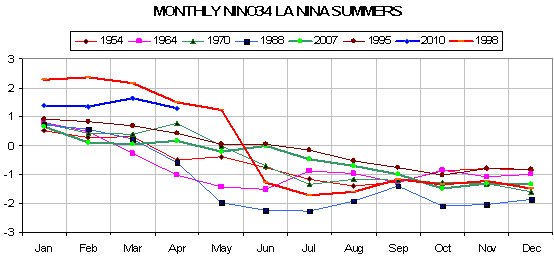
Notice in the temperature anomaly plot for NINO region 34 (region shown on the CDC map below)

How we are somewhere between 1998’s super El Nino and a cluster of more moderate ones and how they declined quickly by the summer on the graph that follows (enlarged here). Values are given in STD of NINO 34 SSTA.

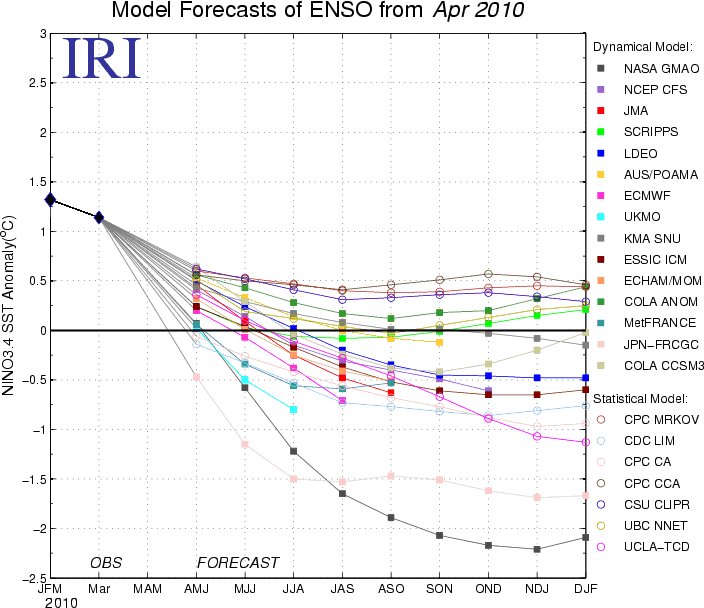
ENSO models, both dynamical (coupled air and ocean models) and statistical suggest a rapid cooling with all models dropping below threshold El Nino levels by summer (JJA – June-July-August) and perhaps half reaching La Nina values by summer or fall.

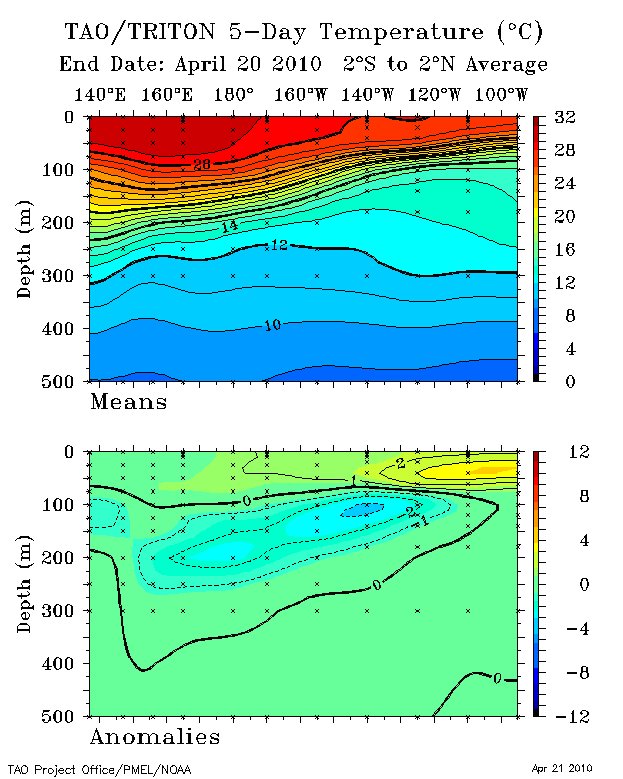
In the depth cross section across the entire tropical Pacific that is built from the TAO-Triton buoy data, we can see the warm water in the eastern top water which was 5C above normal has diminished as the water mixes with cooler surface water and the thermocline is lifted. Notice the developing strong cold pool not unlike that in 1998 at 100 meters across most of the Pacific. Notice the amazing cool down of NINO34 in 1998 from May to June in the multiyear graph above.

The El Nino followed two years of La Nina with below normal temperatures in NINO34 and in much of the Pacific leading to below normal ocean heat content in the tropical eastern half of the Pacific. A strong La Nina in 2007/08 was followed by a summer rebound then another dip in January.
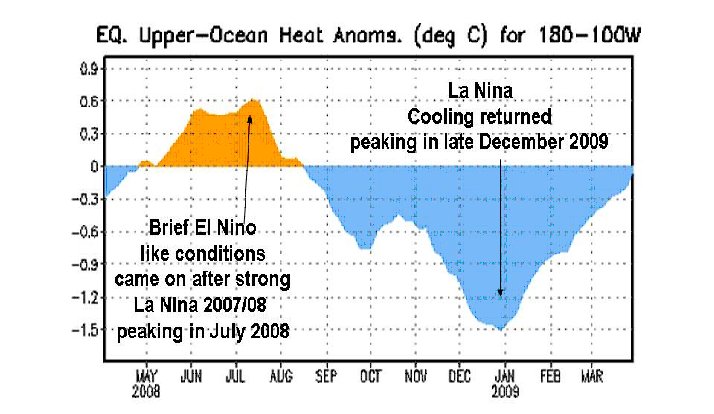

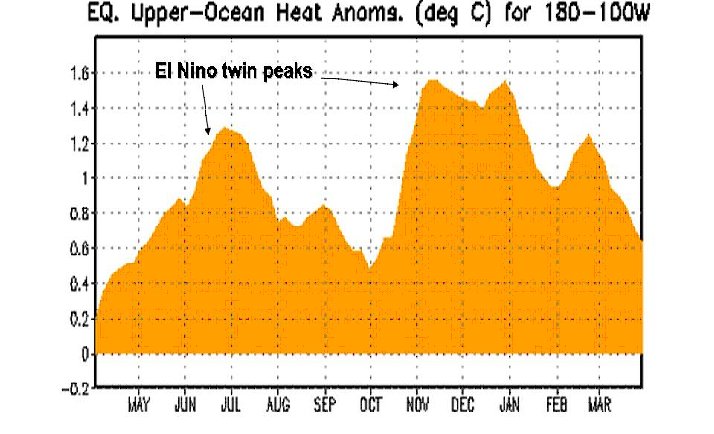
We can see in the heat content the last year, a peak last summer a fall decline and then a multi peak winter warming fed by westerly wind bursts this past winter, notice the decline as we started April.

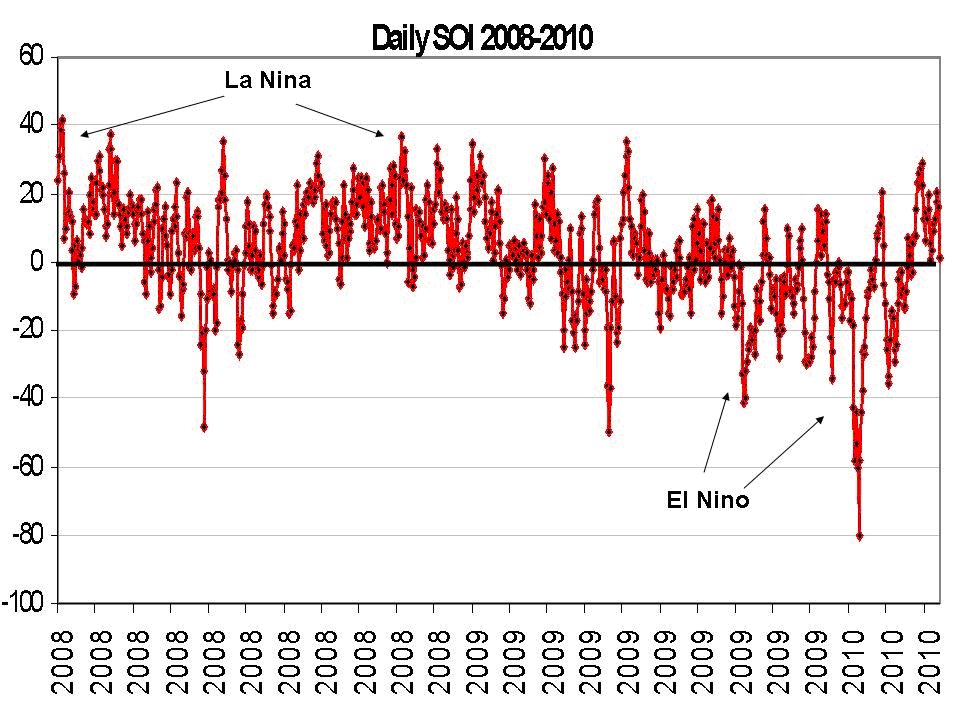
The Southern Oscillation Index which was in positive La Nina territory in 2007/08 and 2008/09 dropped into negative El Nino territory reaching an incredible 8 STS in early 2010. It has rebounded to positive and usually leads the change of ENSO state by a few months given credence to a return of La Nina.

See much more on the possible implications for the summer and following winter (with recognition of the possible influence of the solar and volcano wildcards) here.
This El Nino was a peculiar kid, this year, as during the SH summer it was absent along the SA west coasts; it was only a nino limited to 3-4 regions and not to 1-2. Only late in summer and beginning autumm it appeared in 1-2 zone.
Was it because of jetstream changes due in turn to geomagnetical changes due in turn to any other exterior cause?
I’m curious to see if temp anomalies will drop with the combo of the recent volcano and the death of El Nino.
Speaking of updates hasn’t it been a week since the weekly ice extent update started or did I miss something?
Good to know about El Niño, I’m curious to know what number they will pop out for the April anomaly.
Quiet Sun, SSN=0 for 11 days in a row, low speed “solar “wind”” and if we read:
INFLUENCE OF SOLAR WIND ON THE GLOBAL ELECTRIC
CIRCUIT, AND INFERRED EFFECTS ON CLOUD MICROPHYSICS,
TEMPERATURE, AND DYNAMICS IN THE TROPOSPHERE
BRIAN A. TINSLEY
Discussion and Conclusions
Of the three inputs into the global electric circuit that are modulated by the solar wind, two of them do not involve cosmic rays or other particles that are energetic enough to penetrate to cloud levels and directly affect clouds. But all three inputs cause Jz variations that extend all the way down to the surface. So we have concluded that in all three cases it is most likely that Jz variations are causing changes in cloud microphysics that then produce correlated changes in weather and climate.
http://www.utdallas.edu/physics/pdf/Tin_rev.pdf
Sonicfrog (08:16:01) : Hope more “ingredients” in that “Combo” to reach a whopper level ☺
Enneagram (08:04:58) :
“Was it because of jetstream changes due in turn to geomagnetical changes due in turn to any other exterior cause?”
No doubt it was the usual suspects: rich white guys…
Whhich, if anything, will be the consequences on solar activity (against the consensus of course of post normal holy inquisition) by the current Jupiter/Uranus conjuntion and Saturn/Uranus opposition this interesting year?
Looking good for a hottest on record 2010.
REPLY: And that would make you happy?
The current El Niño has been a bit of a strange animal, almost like a car sputtering along on only 3 cylinders, and not seeming to have had much effect in mitigating the savage NH winter, which here in the UK was the coldest for over 30 years!
Perhaps the weak solar cycle 24 had something to do with this, along with the weakened NH polar vortex and a more southerly jet stream. I suspect that this more southerly jet stream will continue, unless the sun really kicks back into gear, so we could be in for another cool summer.
The thought of a late La Niña fills me with dread for the coming winter and I’ll be laying in a large supple of logs over the next few month, just in case.
Yeah .. I”m curious to see how all this is going to play out.
To boot, the sun has gone all funky on us again. I’m not sure I know how to read these things, but A index is at 1, flux back at 75, and SN back to 0 going on 11 days in a row now.
Someone needs to email John Christy and tell him to double check some stuff. Since all the stories of flawed data, et al., I’m having a hard time believing the numbers I’m seeing.
OT, but I’m surprised that nobody is commenting about the recent solar (in)activity. After a few months with a good deal of sunspots, when the rare day was the spotless day, we are now into an 11-days run without any sunspots, or 17-days run, if you don’t count sunspecks (SSN<15). It looks like if the wake-up of SC24 will be slower than it was looking. I don't know how normal this is given the previous much higher activity.
That old El Nino he ain’t what he used to be, ain’t what he used to be.
That old El Nino he ain’t what he used to be . . .
I just happened to listen to this link off of CNN. Sting’s wife mentions that the world (might) end up not being able to sustain life. If this is not a perfect example of hysterical think, then I don’t know what is. Here is the link
http://www.cnn.com/video/#/video/bestoftv/2010/04/25/nr.sting.trudie.earthday.cnn
I can clearly see the hotspot next to Iceland that caused the heat/melting and volcano recently.
The proof is clear.
The link: http://www.spc.noaa.gov/climo/online/monthly/newm.html
Headline at Drudge Report: “Number of tornadoes, hail, and wind reports at decade low… ”
On linked page, at top is a table with 3 year statistics (completed ones 2007-2009), so the “decade low” must come from the Severe Weather graphs below it that run to 2000.
Anyone here see that low?
Not only was the Southern Oscillation Index “an incredible 8 STS in early 2010,” but the Arctic Oscillation was also in “unprecedented” territory at the start of the year.
My hunch is that these larger-than-usual swings are due to the quiet sun.
Please do not ask me to explain how the heck the sun does it. I haven’t yet seen any explanation of the step-by-step mechanics. However, if only our records went back as far as the last time the sun was quiet, perhaps we would see that the Southern Oscillation Index and Arctic Oscillation behaved in the same manner back then.
I’m betting my nickel on dramatic cooling over the next year, as the El Nino has shot its wad, and the PDO is cooling. Also the AMO, though still warm, is past its peak. Lastly, though recent volcanoes haven’t shot their ash and SO2 very high up, any ash whatsoever is more than we had during the amazingly (“unprecedented”) ash-free period that followed Pinatubo.
The wild card is the quiet sun. How will the slight decrease in energy translate out? If less energy means weaker trade winds, then the El Nino may come back in a sluggish manner (as it’s supply of heat is somewhat drained.) That will create one of those counterintuitive situations where less energy means more heat, in the short term. However usually a period of “recharging” is necessary before an El Nino can again “discharge” heat.
In any case, there is a lot we will be seeing for the first time with our modern satellites. There were no satellites when the PDO and AMO last went through these stages. It’s a pity politics has everyone so worked up, because it would be nice to just admit how little we know, and to just sit back and observe, and learn.
I doubt we’ll be able to be so relaxed, however.
Deanster (08:52:23 Don’t you remember it? Only the Watts Effect could release the braking of the Sun by those pesky planets!
fred houpt (09:01:17) :
I just happened to listen to this link off of CNN. Sting’s wife mentions that the world (might) end up not being able to sustain life. If this is not a perfect example of hysterical think, then I don’t know what is. Here is the link
(…)
Not that hysterical, as it’s a given that will happen someday. But the actual amount of time until that happens will be quite a bit longer than she expects…. Barring certain severe solar events, asteroid impacts, and similar things, of course.
I will bet-colder than normal summer- late, with Nina by Sept….
April has been no great shakes as far as warm weather here in NE
Oregon? Also for the Aussies among us? how was your summer?…
I’d like a non- hothouse tomato summer but I do not know….
phlogiston (08:45:07) :
Looking good for a hottest on record 2010.
REPLY: And that would make you happy?
Dont know about you lot, but we could sure do with it here in Ireland, after the winters and summers we’ve had lately!
I’m not an English major, but shouldn’t the last sentence (“…which meant lighter than normal winds and less clouds”) be “less cloud cover” or “fewer clouds” instead? I thought the rule of thumb was anyting you can count (like clouds) used the word “fewer” and anything you would measure (like cloud cover) used the word “less”.
Graph states that La Nina peaked in late December 2009 – Probably should say late December 2008
phlogiston (08:45:07) :
“Looking good for a hottest on record 2010.”
I’m willing to bet that this will be the hottest ever 2010… The coldest too…
fred houpt (09:01:17) :
Sting. And his Mrs. And Geldof. And Bono.
We are not worthy.
I too am interested in what is going on with the sun. After a pretty decent period where it at least seemed like activity was beginning to ramp up, we get 11 days of absolute nothing again.
My gut feeling is that this, coupled with a transition from El Nino to La Nina may indeed bode a harsh winter again, but I am not a meteorologist, nor do I play one on TV 🙂
As for this year being on track for “warmest ever!” that is fine. Certainly isn’t holding true down here on the surface where I actually live, and I know that is also the case for many others as well.
For those of you that have not figured it out yet, climate is pretty darn cyclical, and it is about time for cooling again, so break out your parkas on your way to East Anglia!